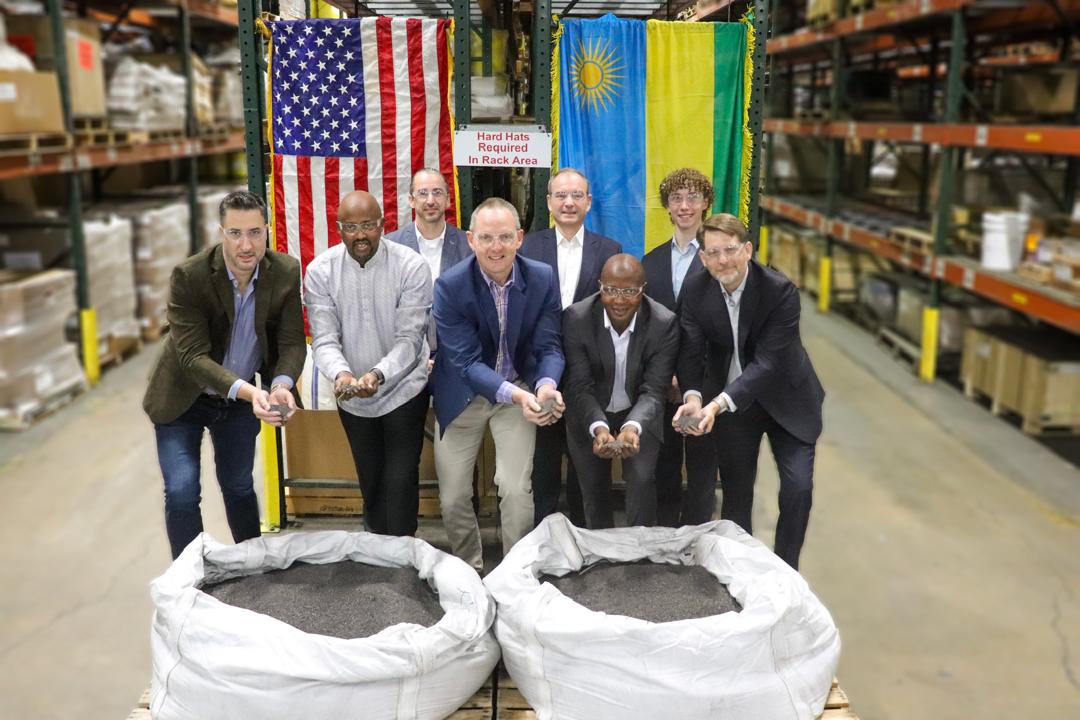
Helberg made the remarks while responding to a post by Trinity Metals on X featuring an interview with its Chairman Shawn McCormick, who discussed the company’s growing role in supplying tungsten to the United States and its allies.
“The U.S. Government is working with companies like Trinity Metals to help build supply chains free from non-market distortions,” Helberg wrote on August 26.
“Take tungsten. It powers the conductive films for modern semiconductors. Diversified, secure sourcing of inputs like this isn’t optional — it’s foundational to Pax Silica’s objectives to build secure, resilient, and innovation-driven supply chains for AI infrastructure and advanced manufacturing.”
The remarks place Trinity Metals within the broader U.S. strategy to diversify sources of critical minerals as Washington seeks to reduce vulnerabilities associated with concentrated global supply chains.
Trinity Metals operates three mines in Rwanda, including the Nyakabingo tungsten mine, and has become an increasingly important supplier to the U.S. market.
In an interview with National Security News, McCormick said the company currently accounts for about 20% of tungsten concentrate consumed in the United States.
“We currently represent about 20 percent of all tungsten concentrate consumed in America,” he said, noting that the United States currently produces no tungsten.
Trinity Metals began shipping tungsten concentrate from Rwanda to the United States in 2025 under an agreement involving Global Tungsten & Powders (GTP) and commodities trader Traxys.
More than 320 tonnes of high-grade tungsten concentrate have since been shipped from Rwanda to GTP’s processing facilities in Towanda, Pennsylvania, where the material is refined for use in industrial and defence applications.
McCormick said Trinity Metals deliberately sought to redirect some of its production toward the United States and its allies after examining where the company’s minerals were being sold.
“I wanted to personally make sure that the flow of the product was going to the US and its allies,” he noted.
He said Trinity Metals is currently the only tungsten producer in Africa sending its product to the United States.
Tungsten is considered strategically important because of its use in manufacturing, aerospace, electronics and defence systems. McCormick cited applications ranging from industrial drilling equipment to missile systems and other military technologies.
He also pointed to the concentration of global tungsten production in countries including China, Russia and North Korea as a reason for developing alternative sources.
“Over 90% of the tungsten produced in the world today comes from three countries, China, Russia, and North Korea, not great friends of the US and the West,” McCormick said.
China alone accounts for more than 80% of global tungsten supply, according to Trinity Metals.
The company has sought to position Rwanda as an alternative source by emphasising traceability and standards across its operations.
McCormick said Trinity Metals does not purchase minerals from outside its mine gates and uses Better Mining for monitoring and verification. He said the system provides continuous oversight of the company’s mining and processing activities.
“We are fully conflict-free and fully child labour free in our production,” he said.
Trinity Metals was formed in 2022 through the merger of Nyakabingo Tungsten Mine, Rutongo Tin Mine and Musha Tin and Tantalum Mine. The company employs more than 6,500 people, the overwhelming majority of them Rwandans.
The company has also received U.S. government support. In 2024, it secured $3.865 million in technical assistance funding from the U.S. International Development Finance Corporation (DFC), becoming the first operating mine in Africa to receive such funding.
McCormick said the DFC involvement helped signal that Trinity Metals operates according to international standards.
“What the DFC involvement gave us was the flag. You plant the flag on the company,” he said, referring to the U.S. government’s involvement.
Beyond tungsten, Trinity Metals is seeking to expand its role in U.S.-aligned critical mineral supply chains.
The company has signed an agreement with U.S. tin manufacturer Nathan Trotter, which is developing a new tin processing facility with support from the U.S. Department of Defence.
McCormick revealed that Trinity Metals intends to supply the U.S. market once the facility becomes operational and commercial terms are agreed.
The company is also exploring lithium after identifying a high-grade spodumene deposit at its Musha concession in Rwanda.
For Washington, the growing relationship with Trinity Metals fits into the objectives of Pax Silica, a U.S.-led initiative focused on building secure and resilient supply chains for artificial intelligence infrastructure and advanced manufacturing.

Leave a Reply