
The initiative, supported by The Rockefeller Foundation and implemented with partners including Vanguard Economics and the World Food Programme (WFP), seeks to replace refined maize flour with fortified whole-grain alternatives in school meals.
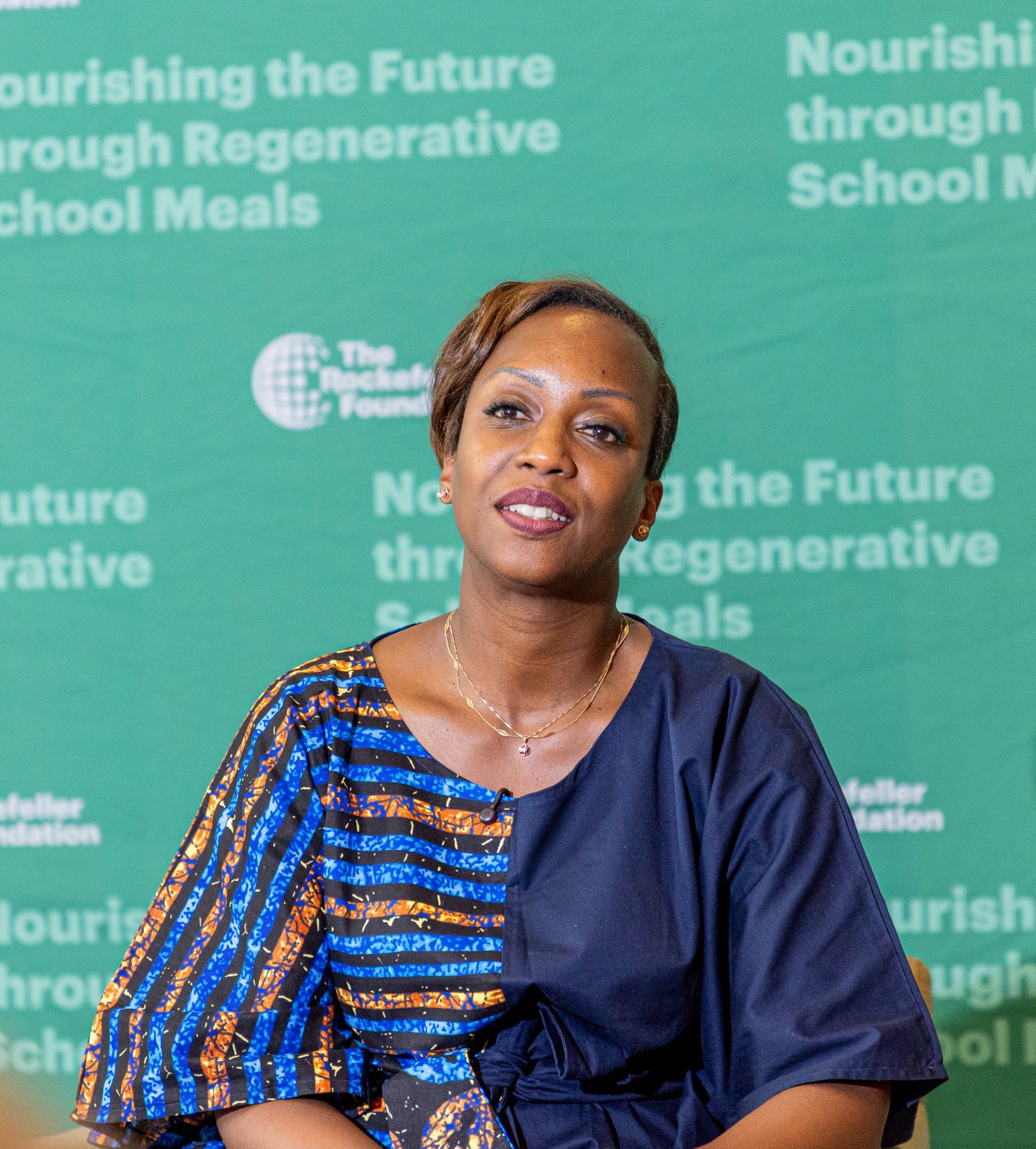
Diane Dusabeyezu, Consultant and Programme Manager at Vanguard Economics, said the initiative is being implemented as part of broader efforts to strengthen regenerative school meals and improve nutrition among children.
Speaking to IGIHE during the Africa Food Systems Forum (AFSF) in Kigali, Dusabeyezu explained that the approach goes beyond simply changing what is placed on children’s plates.
“It’s an entire value chain actor in the initiative program with whom we are engaging in running this project in Rwanda,” she said.
The initiative works with farmers, millers, premix companies, government institutions and other stakeholders to ensure the product can be produced, supplied and accepted at scale.
From farmers to schoolchildren
Dusabeyezu noted that Vanguard Economics has supported food processors through training on fortified whole grain production, access to quality inputs and premix, as well as efforts to ensure millers have the necessary certification to supply school feeding programmes.
Farmers are also being trained and supported with access to appropriate inputs and assistance in developing business cases to help them secure financing.
“We have been providing training to farmers. We have been supporting them in getting the right inputs. We have also been supporting them in writing a business case to get the financial support they need,” she said.
The initiative also involves engagement with Rwanda’s Ministry of Agriculture and Animal Resources and Ministry of Education, as well as private-sector companies and development partners.
Dusabeyezu stressed that such collaboration is important because introducing a new food product requires awareness and acceptance among the different actors who will ultimately be involved in its production and consumption.
The Rockefeller Foundation describes this broader approach as “regenerative school meals”, which connects local farmers with public school procurement systems to improve children’s nutrition while strengthening local economies and food systems.
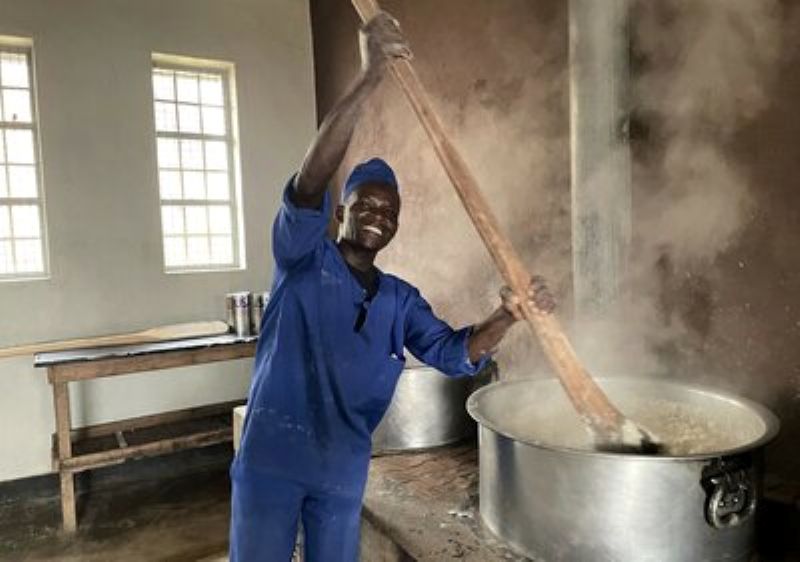
The broader approach was also showcased through Solid Africa, a Rockefeller Foundation grantee working to improve nutrition through school meals and stronger local food systems. During a field visit in Kigali, participants visited Solid Africa’s model, which includes a kitchen garden, nutrition education and a centralised kitchen supplying meals to schoolchildren.
Why whole grain?
Unlike refined maize flour, fortified whole grain flour uses the entire grain, including the bran and germ, which contain important nutrients.
The Rockefeller Foundation says fortified whole grain foods can provide substantially more nutrition than refined alternatives, while the Rwanda pilot found that the product could be produced at the same cost as refined maize flour.
Rwanda’s school feeding guidelines also identify fortified maize flour or whole grain meal as an important source of micronutrients in school meals.
The initiative was initially piloted in 18 schools in Rwanda. According to WFP, more than 13,500 children were reached during the initial phase, with 73% of children demonstrating awareness of the nutritional benefits of fortified whole grains and 97% preferring the whole grain product to its refined equivalent.
The programme subsequently expanded, with the Rockefeller Foundation reporting that nearly 74,000 students in 81 schools had been reached in Rwanda by January 2023.
Testing before scaling
Dusabeyezu recalled that the project spent time developing and testing the product before expanding its reach.
“We did consumer research because you need to do a testing of the product. You need to take it to the household. They test, then you improve the quality, the texture, the colour,” she said.
The initiative also worked with early childhood development centres and conducted pilots to establish whether children would accept the product.
She pointed to the experience as evidence that programmes seeking to achieve lasting impact should involve government, private-sector players and food processors from the beginning.
“When the pilot is successful, it’s easy to scale up,” she said.
The initiative is being expanded through a phased approach, with the long-term ambition of reaching more than 3 million schoolchildren across Rwanda.
Rwanda’s experience has already attracted interest beyond the initial pilot. A 2024 initiative involving the National Industrial Research and Development Agency (NIRDA) and Vanguard Economics sought to increase the capacity of local maize millers to produce fortified whole grain maize flour, including through technical assessments, plant upgrades and training.
Government ownership key to sustainability
For Dusabeyezu, one of the most important lessons from the project is the importance of government ownership.
She argued that initiatives are more likely to become sustainable when they are integrated into existing government policies and programmes rather than operating as separate projects.
“The key, very important point is really the government ownership,” she said.
The fortified whole grain initiative is being implemented within Rwanda’s existing school feeding system, rather than creating a separate programme.
Rwanda formally launched its National School Feeding Programme in October 2021, while its school feeding policy provides for nutritious meals for children in pre-primary, primary and secondary schools.
Dusabeyezu said Rwanda’s adoption of universal school feeding provides an experience that other African countries could study and potentially adapt to their own circumstances.
Measuring acceptance and future nutrition impact
At its current stage, the initiative is primarily tracking product acceptance, certification of millers and the quality of premix used in production.
Baseline and endline surveys are being conducted among schoolchildren to assess acceptance of the fortified whole grain product.
Dusabeyezu indicated that the longer-term objective is to track the nutritional impact on children as the initiative expands.
The broader approach is consistent with the Rockefeller Foundation’s school meals strategy, which seeks to use school feeding not only to address child nutrition but also to strengthen local food systems and create markets for farmers.
A model for other African countries
Dusabeyezu said the Africa Food Systems Forum provides an opportunity for countries to share experiences and identify approaches that can be adapted to different national contexts.
She pointed to Rwanda’s universal school feeding system, local sourcing and the involvement of farmers and food processors as some of the experiences that other countries could examine.
“The delegates that will attend the forum will learn from what is already being implemented in Rwanda,” she said, adding that they could take lessons from the country’s experience and consider how to replicate them in their own contexts.
The 20th Africa Food Systems Forum is being held in Kigali through September 4, 2026, bringing together more than 5,000 delegates from over 50 countries to discuss investment, nutrition, food security, climate resilience, youth, technology and intra-African trade.
The Rwanda initiative forms part of a broader effort by The Rockefeller Foundation to strengthen school meal programmes globally. In 2025, the Foundation committed $100 million over five years to support efforts to provide more nutritious school meals to 100 million children worldwide, with a focus on locally and regeneratively grown food.
For Rwanda, the fortified whole grain initiative represents an attempt to make school meals serve a broader purpose: improving children’s diets while creating demand for locally produced food, strengthening value chains and demonstrating how public food programmes can support wider food-system transformation.
Leave a Reply