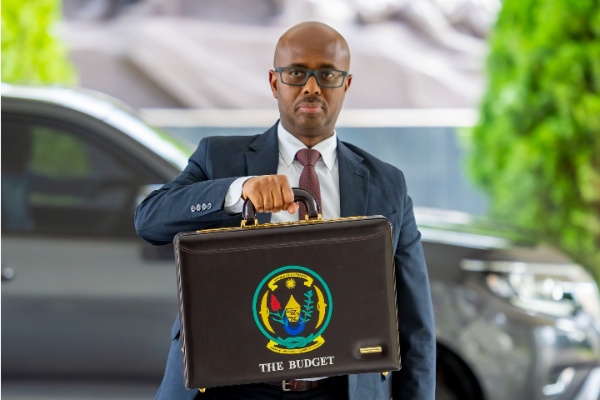
The framework, presented by the Minister of Finance and Economic Planning, Yusuf Murangwa, outlines the country’s spending and revenue priorities over the 2026/27 to 2028/29 period.
It also reflects a significant increase of Rwf 844.2 billion compared to the revised 2025/26 budget, signaling expanded government investment in key sectors.
Murangwa said Rwanda’s economy continues to show resilience despite global uncertainties.
“Rwanda’s growth momentum remains strong, despite a challenging environment caused by war in the Middle East, climate change effects, geopolitical tensions, trade wars, among other factors,” he said, adding that the government remains committed to maintaining macroeconomic stability and promoting inclusive growth through investment in strategic sectors.
According to the framework, the Rwf 7.8 trillion budget will be financed mainly through domestic revenue, which is projected at Rwf 5,273.8 billion. This includes Rwf 4,429.1 billion in tax revenue, Rwf 582.4 billion in other revenues, Rwf 138.8 billion in domestic financing, and Rwf 123.6 billion from financial assets. External financing will also contribute, with grants estimated at Rwf 548.3 billion and loans at Rwf 1,974.1 billion.
On the spending side, the government plans to allocate Rwf 4,779.1 billion to recurrent expenditure, including salaries and operational costs, while Rwf 3,017.2 billion will go toward capital investments.
The increased capital investment is expected to support major projects such as the construction of the New Kigali International Airport in Bugesera, the expansion of RwandAir, and continued subsidies for fertilizers to strengthen agricultural productivity and cushion external shocks.
The Budget Framework Paper also comes on the back of strong economic performance in 2025, when Rwanda recorded 9.4 percent growth, surpassing the earlier projection of 7 percent. Growth was driven by industry at 11 percent, services at 9 percent, and agriculture at 7 percent, reflecting broad-based expansion across key sectors.
Minister Murangwa noted that the government will continue prioritizing investments that enhance resilience and inclusive development, particularly in energy, agriculture, manufacturing, healthcare, education, and social protection.
The framework aligns with Rwanda’s long-term development vision under Vision 2050 and the National Strategy for Transformation (NST2), which emphasizes economic transformation, social development, and improved governance.
The full national budget for the 2026/27 fiscal year is expected to be tabled before Parliament in June 2026, where detailed sector allocations will be further debated and approved.
Leave a Reply