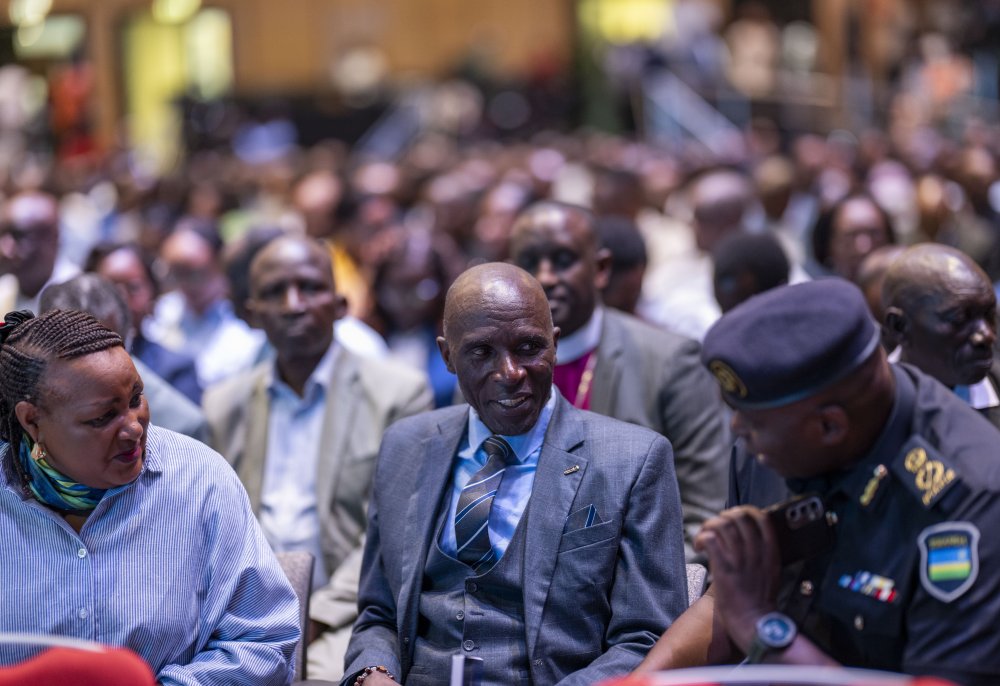
He made the revelations on June 27, 2026, during a symposium on the history of the Genocide against the Tutsi and the Liberation Struggle held at Intare Arena. The event was attended by President Paul Kagame, First Lady Jeannette Kagame, members of Unity Club, and other senior officials.
In his testimony, Bora described how he joined the FDLR and detailed the group’s alleged planning and operations aimed at destabilizing Rwanda and targeting Tutsi communities.
He stated that children raised in forest-based FDLR camps, including those born there, are currently being sent for military training in Kananga.
“They move as Congolese. There is someone called Calendo Padiri; his military connection is Rwarakabije, who provided him with trainees. After completing training, he became confident and went to Kinshasa. He is now in charge of retired soldiers in Kinshasa,” he said.
Bora further testified that some officers within the Congolese army (FARDC) were formerly affiliated with the FDLR, including Brig. Gen. Mugabo Hassan.
“While we were still in the camps, he was a fighter. Even in the camps that had not yet been dismantled, former FAR elements sent people to train combatants. Mugabo’s thinking was no different from that of the former FAR or ours. Today, he is in Kinshasa,” he added.
He also mentioned Chief Bigembe Turikunkiko, saying he was originally a hunter in Gatoyi who later received training and rose to become a political figure.
Bora further revealed that the FDLR’s influence extends beyond armed structures to political representation. He said members of parliament at both provincial and national levels in areas once under FDLR influence were effectively aligned with the group.
He said elections in such areas were controlled, with voters reportedly being shown preferred candidates in advance. He named several deputies, including Serubuga, Safari Nganizi, and Safari Nyagatare, whom he said represented FDLR-aligned interests in Masisi and other regions.
On relations between the FDLR and Burundian actors, Bora said that after the defeat of the former FAR, they fled with Rwanda’s national radio equipment through Gitarama and into Zaire. He said the equipment was later taken to Burundi, where it is now associated with REMA radio under CNDD-FDD control.
He further argued that the CNDD-FDD shares ideological similarities with the FDLR, tracing connections back to its formation in Lubumbashi with the involvement of Col. Renzaho and former FAR networks.
Regarding ongoing conflict in eastern DRC, Bora said that during fighting in Goma between FARDC and the AFC/M23 coalition, MONUSCO was responsible for technical intelligence, the FDLR handled ground intelligence, and FARDC supplied military equipment.
He also revealed that, under international pressure, President Félix Tshisekedi integrated FDLR elements with Wazalendo forces, making it difficult to distinguish between the groups as they now operate alongside FARDC.
According to him, the FDLR continues to receive weapons from certain military actors and has established control over large agricultural areas in parts of the DRC.
“We used the population. They had two days of community work per week to farm for us, and they would also farm for themselves in allocated areas. We charged $80 per hectare, and when the crops matured, they would give us 40 kilograms,” he said.
He added that in Nyakagina, land was reportedly sold extensively, with even local authorities purchasing plots.
Bora concluded that dismantling the FDLR would require more than military force from the FARDC, arguing that the group is deeply embedded within local structures. He also warned that its ideology remains focused on expanding influence across Rwanda, Burundi, Kenya, Uganda, and Somalia with the aim of targeting Tutsi populations.
Leave a Reply