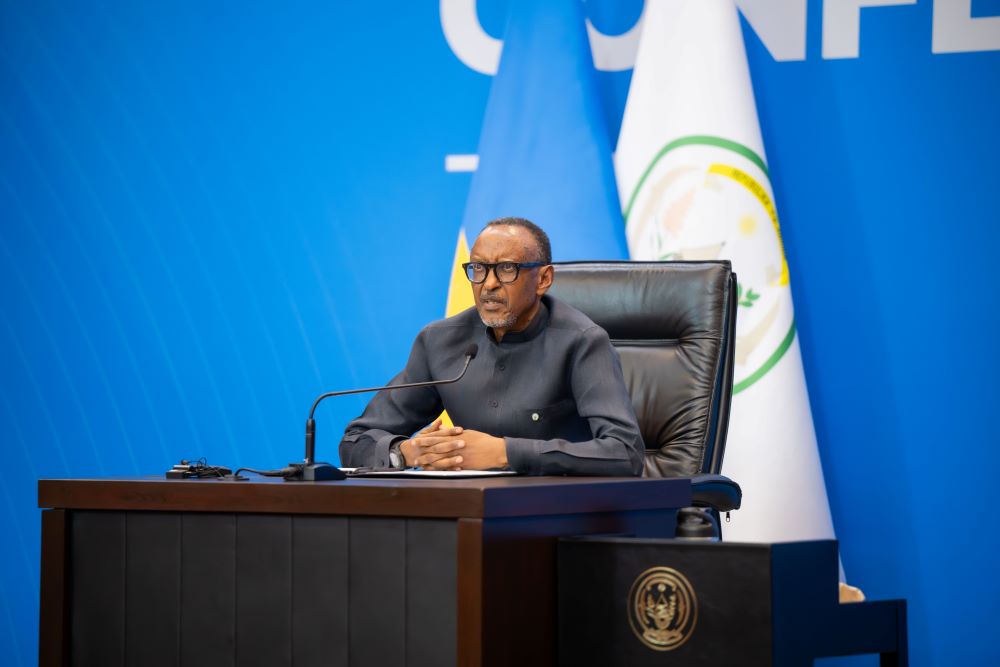
Kagame made the remarks during a press conference on August 24, 2026, in response to a journalist’s question about the fate of factories that had been shut down and their employees as authorities intensified a nationwide campaign against alcoholic beverages that fail to meet required standards.
He said the debate should begin with evidence of the harm caused by the products rather than claims or perceptions surrounding the crackdown.
“On the issue of substandard alcoholic drinks, we should not base our conclusions only on what people say. People can say all kinds of things depending on their perceptions or what they want others to believe,” Kagame said.
“We should also look at what is happening in reality and at the evidence before us.”
Rwanda has stepped up enforcement against illicit and substandard alcoholic beverages in recent weeks.
In Kigali alone, authorities have closed over 30 factories and businesses found to be operating outside required standards, while thousands of litres of ethanol and large quantities of alcoholic beverages have been seized.
The crackdown has also resulted in the arrest of public officials suspected of facilitating the production or distribution of non-compliant drinks.
But Kagame said the government’s starting point should remain the impact of the products on people’s health.
“There are substandard drinks that have caused deaths. That is where we should begin our discussion,” he said.
“The question is simple: Do these drinks kill people? Have they killed people? If the answer is yes, then that is where we should start.”
Kagame said the scale of the deaths should not be underestimated, arguing that the problem goes beyond isolated cases.
“People are dying, and in significant numbers,” he said. “If you follow the news, you will know that it is not simply a matter of two people dying today and another person dying tomorrow.”
“People die in groups of 20, 30, 50, and sometimes as many as 100 in a single day. When you add up the number of people who die over a year, you begin to understand the scale of the problem.”
The President rejected arguments that the crackdown should be weighed primarily against the factories and jobs involved in the alcoholic beverage industry.
“Before we talk about factories and the workers employed in them, we must first address the health and lives of these people,” he said.
“Do we want workers who will ultimately be killed by the products made in those factories?”
Instead, he said, the objective should be to have businesses that operate safely and workers who can return home without being exposed to products that harm consumers.
Kagame also pointed to the fact that not all harmful alcoholic beverages consumed in Rwanda are necessarily produced domestically.
“The harmful drinks that are killing people are not necessarily all manufactured here or originating here. Some come from outside the country. They are brought in without meeting quality standards, and they end up killing people,” he said.
He added that the effects of unsafe products can vary, with some causing immediate harm while others may contribute to health problems that emerge much later.
“Some kill people the same day or within the same week. Others may cause harm that becomes apparent after a year. They can slowly damage a person’s health until the person eventually dies,” Kagame said.
The President also questioned how protecting businesses could be used to justify practices that expose consumers to potentially fatal products.
“I do not understand how anyone could support such practices while arguing that they are thinking about factories and the people working in them, while ignoring those who are being killed day after day, as we see and as we know,” he said.
He said the government’s responsibility extends beyond individual producers to the institutions charged with regulating businesses and enforcing quality standards.
“But beyond the individual who produces something that kills people, we must also ask how the country is governed. Can a country simply watch its people die? What kind of society would that be?” Kagame said.
“That is why there are institutions and officials responsible for quality standards and enforcement. They are there to ensure that activities and products do not harm people, but instead contribute to improving people’s lives.”
His comments come amid ongoing crackdown that has also targeted alleged regulatory failures, with Rwanda Investigation Bureau (RIB) presenting 18 public servants on August 13, including Rwanda Food and Drugs Authority (Rwanda FDA) Director General Prof. Emile Bienvenu and 10 employees, alongside officials from the Rwanda Standards Board and local government.
RIB said 104 people had been arrested since July 20, with 97 case files submitted to prosecutors.
Investigations include alleged improper licensing and certification, while five local officials are accused of helping factory operators evade inspections.
More than 150 factories have since been closed, with Kigali authorities seizing over 470,000 litres of ethanol and nearly four million bottles of substandard alcoholic beverages.
Health authorities say more than 500 people have been treated, over 50 have died and more than 100 have reportedly suffered vision loss.
Kagame said such allegations should be investigated and those responsible given an opportunity to explain themselves.
“Those involved will have an opportunity to explain themselves when they are investigated and held accountable. They will have to provide the answers,” he said.
He also acknowledged that the conduct of enforcement agencies should itself be subject to scrutiny where necessary.
“If there are concerns about how these processes are carried out, how people are arrested or how they are investigated, those concerns can also be examined. If there is a problem, it may need to be addressed,” he said.
However, he cautioned against allowing such concerns to overshadow the wider public health problem.
“If some institutions are not doing their work as they should, they must be held accountable and corrected. But that should not distract us from confronting the bigger problem that is harming and killing people.”
Kagame further linked the alcohol crackdown to a broader responsibility to confront substances that pose risks to public health, saying Rwanda had also been discussing the growing use and promotion of other harmful substances.
“A country cannot simply watch its people die and say that no one should ask questions. Someone must ask why people are dying,” he said.
He maintained that consumers have a right to access products they need, but businesses and individuals must comply with the law and ensure that what they produce or bring into the country does not put lives at risk.
“As a leader of this country, I have to look at what is best for the country and its people and work with them so that they understand what serves their interests and what does not,” Kagame said.
“Those who want to break the law simply because they want to do things their own way and put their personal interests first will have to face the authorities responsible for enforcing the law.”
Leave a Reply