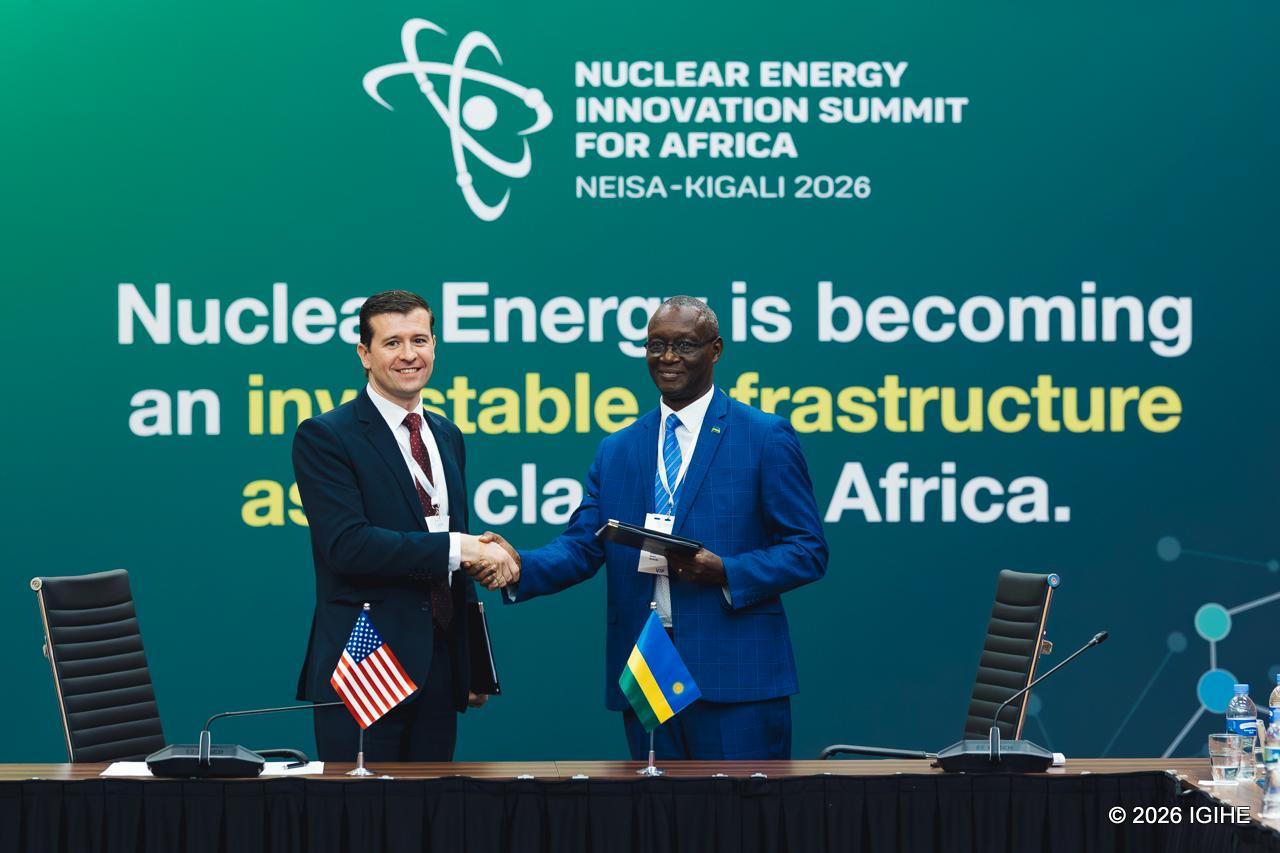
The agreement was signed on Tuesday, May 19, 2026, during the Nuclear Energy Innovation Summit for Africa (NEISA) in Kigali. It reflects Rwanda’s ambition to become a regional pioneer in advanced nuclear energy and supports its long-term strategy to strengthen reliable, low-carbon baseload power generation.
The deal was signed by Rafael Marin, Director of Holtec Europe, and Dr. Fidele Ndahayo, CEO of RAEB. It also coincided with a broader U.S.–Rwanda civil nuclear cooperation memorandum of understanding signed by officials from both governments.
The signing ceremony was attended by senior representatives, including Renee Sonderman, Acting Principal Deputy Assistant Secretary in the U.S. State Department’s Bureau of Arms Control and Nonproliferation, and Dr. Usta Kayitesi, Rwanda’s Minister of State for Foreign Affairs and International Cooperation.
According to Holtec, the agreement sets out a framework for technical cooperation, including site assessments, data collection, and feasibility studies for deploying SMR-300 units in Rwanda. The potential deployment could reach up to approximately 5 GW of capacity, aimed at supporting long-term economic growth and energy security through carbon-free baseload electricity.
“Through this agreement, Holtec and RAEB will work together to deploy SMR-300 units in Rwanda… supporting the country’s strategy to deploy reliable baseload power without carbon emissions,” said Rafael Marin, adding that the project could position Rwanda as a pioneer of SMR deployment in Africa.
Rwanda’s Atomic Energy Board said the agreement builds on earlier cooperation between the two governments and represents a shift toward practical implementation of nuclear energy planning. Dr. Fidele Ndahayo, the Board CEO, noted that Rwanda aims to have its first SMR operational by the early 2030s, following ongoing technical assessments and infrastructure development work.
“This development agreement is about creating a cooperation framework to work with Holtec’s technical team, assess possible sites in Rwanda, and gather data to determine whether SMR-300 can be deployed when the technology matures,” Ndahayo said.
He added that Rwanda remains open to emerging technologies and views the partnership as part of a structured process to gather data, evaluate potential sites, and prepare for future deployment decisions.
U.S. officials welcomed the agreement as part of broader cooperation on civil nuclear energy. Jacob Helberg, U.S. Under Secretary of State for Economic Affairs, said the partnership supports safe, secure, and reliable nuclear energy development while reinforcing American leadership in advanced nuclear technologies.
Holtec’s SMR-300 is a pressurised water reactor design described as a “walk-away safe” system with passive safety features and a compact footprint. The company says the design is intended to operate with minimal operator intervention and can adapt to both water and air cooling systems, making it suitable for a range of deployment environments.
Holtec President Dr. Richard M. Springman said the company’s integrated approach, including reactor technology, engineering, procurement, construction partnerships, fuel management, and decommissioning services, will support Rwanda’s broader nuclear program development.
President Paul Kagame, speaking at the same summit, reiterated that Rwanda remains on track to introduce nuclear energy in the early 2030s as part of its national energy strategy. He emphasised that small modular reactors are central to Rwanda’s long-term plans to address energy demand, industrial growth, and economic transformation.
At the summit, President Kagame received a report on the International Atomic Energy Agency’s (IAEA) Phase I Integrated Nuclear Infrastructure Review from Rafael Mariano Grossi, Director General of the IAEA. The review marked a key milestone in Rwanda’s nuclear energy roadmap and advances the country’s nuclear ambitions to the next stage following an assessment process conducted with international experts.
“We intend to have nuclear energy operational by the early 2030s. This assessment confirms that we are on track,” Kagame said.
Rwanda’s energy roadmap aims to significantly expand electricity generation capacity, including plans to reach up to 1.5 GW of nuclear power by 2050. Officials say nuclear energy is expected to complement renewable sources by providing stable and continuous baseload power needed for industrialisation and technological development.
The Kigali summit brought together African leaders, regulators, and international partners to discuss investment and cooperation in nuclear energy, highlighting growing interest in SMR technology across the continent.
Leave a Reply