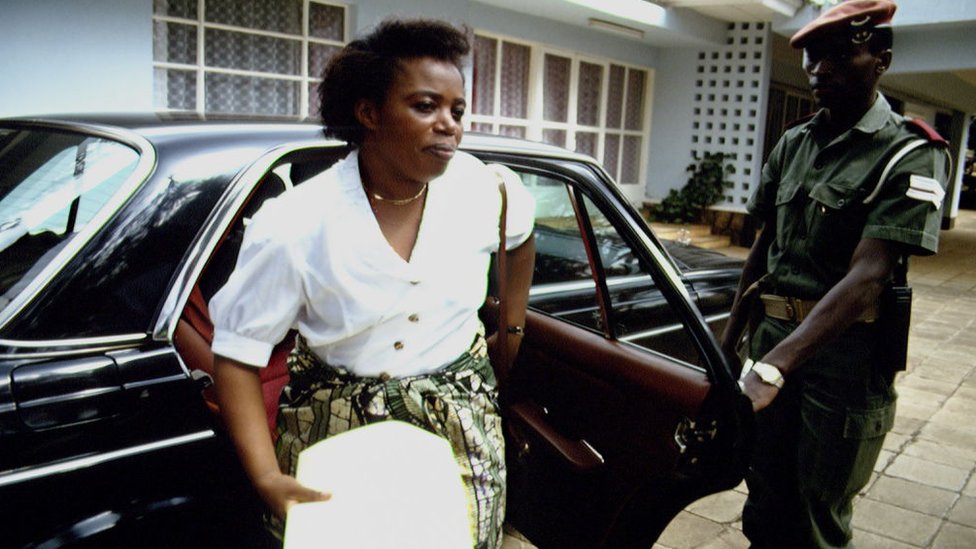
Uwilingiyimana, who was serving as Prime Minister at the time, was among several politicians targeted in the early hours of the genocide as extremist forces moved to eliminate opponents and moderate voices.
In September 2004, a protected witness told the International Criminal Tribunal for Rwanda (ICTR) in Arusha that a list of politicians to be killed had been prepared by individuals close to the Habyarimana family and senior figures within the former regime. Those named included Uwilingiyimana, Landouald Ndasingwa, Frédéric Nzamurambaho and others.
According to the witness, the list was prepared by Habyarimana’s wife, Agathe Kanziga, their daughter Jeanne, Protais Zigiranyirazo, and Major Protais Mpiranya.
The witness said Mpiranya was later instructed to send members of the presidential guard to carry out the killings.
A classified report by the United States Central Intelligence Agency (CIA) indicates that Uwilingiyimana attempted to seek refuge at the residence of the Deputy Chief of Mission at the US Embassy in Rwanda, but was forced to flee after hearing gunfire near her home.
On the morning of April 7, 1994, US Ambassador to Rwanda David Paul Rawson said Uwilingiyimana tried to reach the headquarters of the United Nations Development Programme (UNDP) for safety. However, presidential guards intercepted her and killed her.
Weeks later, on April 27, 1994, Matthieu Ngirumpatse, then Secretary-General of the National Revolutionary Movement for Development (NRMD) ruling party, and Justin Mugenzi, who served as Minister of Trade, addressed journalists during a press conference where Ngirumpatse spoke about the circumstances surrounding Uwilingiyimana’s death.
Ngirumpatse claimed that former government forces had accused Uwilingiyimana of planning to overthrow President Habyarimana shortly before his death.
“Two days earlier, the Prime Minister had summoned some senior military officers and told them about her plan to overthrow the President,” he said.
However, Uwilingiyimana’s supporters and survivors of the genocide have rejected such accusations, describing them as part of the propaganda used by extremist officials to justify the killing of political opponents.
The daughters of Dr. Emmanuel Akingeneye, Habyarimana’s personal physician, later told Belgian investigators that when they took their father’s body to the mortuary at Kanombe Hospital, the hospital’s Director General, Dr. Laurent Baransaritse, ordered that Uwilingiyimana’s body be placed in a separate room.
They also told investigators that they heard Jean-Luc Habyarimana, the former president’s son, saying he wanted to shoot Uwilingiyimana’s body. However, based on the information available to them, they said he did not carry out the threat.
Uwilingiyimana became Rwanda’s Prime Minister on July 18, 1993, after previously serving as Minister of Education. She joined the government as a member of the opposition MDR party, which was critical of Habyarimana’s administration.
During her time as Education Minister, she challenged the ethnic-based quota system that had limited access to education for many qualified Tutsi students. The reform angered hardliners within MRND.
Leave a Reply