For exporters, the pledge offers a chance to sell more to a country of 1.4 billion people that imported US$2.58 trillion worth of goods in 2025. It was the world’s second-largest import market for the 17th consecutive year.
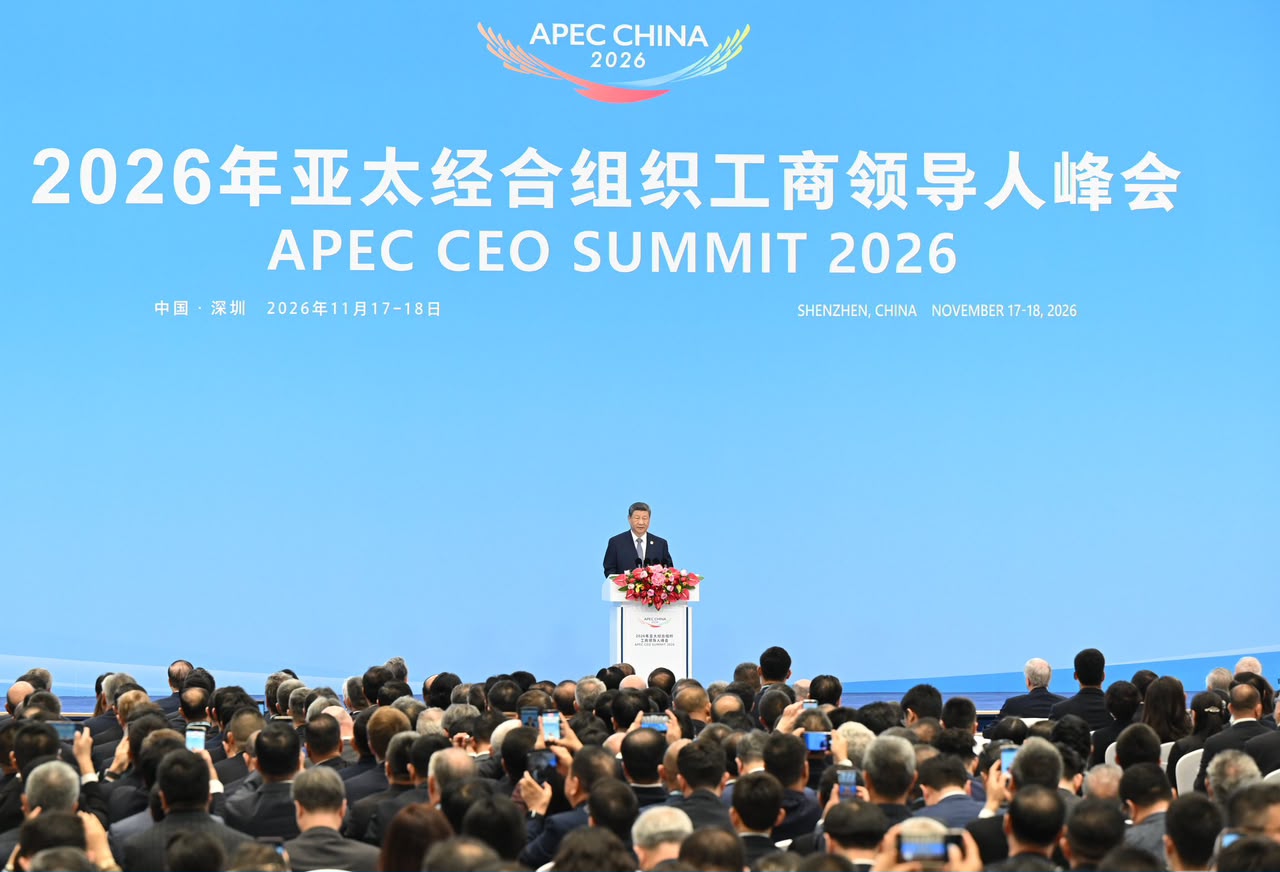
Xi made the pledge in Shenzhen, where he addressed business executives and political leaders at the 2026 Asia-Pacific Economic Cooperation (APEC) CEO Summit.
The two-day gathering at the Qianhai International Convention Center drew more than 2,000 delegates from all 21 APEC economies and 13 others, including representatives of 115 Fortune Global 500 companies.
Russian President Vladimir Putin and Malaysian Prime Minister Anwar Ibrahim also addressed the gathering.
“China will provide global business communities with a supersized open market,” Xi said.
Eight days earlier, in Shanghai, 16 exhibitors had been showing prospective buyers what they could supply in China International Import Expo.
The six-day expo recorded 470,000 visits, with participants from 162 countries, regions and international organisations.
Xi pointed to the Shanghai fair as an example of how China intends to bring more foreign goods into the country.
“China will also continue to host the Export to China series and other events to open efficient channels to help quality products from across the world enter the Chinese market,” he said.
Xi described businesses testing robots on farms and factory floors, putting driverless vehicles on the road and using drones to make deliveries.
“China’s 15th Five-Year Plan, which began this year, would give overseas companies opportunities to participate as traditional industries modernise and new ones emerge.
“Innovation-driven growth and green transition are the key words in observing China’s economy,” he said.
Electric cars offer a measure of how quickly a new technology can find Chinese customers. More than 13 million were sold in China in 2025, close to 55% of all new cars sold in the country.
Chinese factories also produced 773,000 industrial robots in 2025, up 28% in a year. Across the economy, output grew 4.6% in the first nine months of 2026.
Shenzhen offered delegates a local history of China’s opening to the world.
Designated the country’s first special economic zone in 1980, the city bordering Hong Kong had 18.25 million residents by the end of 2025. Its economy grew 5.5% that year to US$557.32 billion (about Rwf823.2 trillion), and its port handled roughly 330 million tonnes of cargo.
Xi wants trading centres like Shenzhen to work more closely together.
“China will not only cut tariffs and expand market access, but also go a step further. We will carry out reform in challenging areas such as rules, regulation and standards in order to allow full manufacturing access with an accommodating business climate,” Xi said.
US President Donald Trump was due to arrive from Manila later on November 18 for the separate APEC leaders’ meeting.
He, Xi and Putin were scheduled to meet on November 19. Ahead of those talks, Xi had made his case against protectionism. Putin used the same business gathering to describe how sanctions had changed where Russia sells its goods and how it gets paid.
The forum they addressed began in Canberra in 1989, when ministers from 12 economies met to strengthen trade and economic cooperation around the Pacific.
Measured across APEC’s present 21 members, combined annual output rose from US$11.6 trillion (about Rwf17,133 trillion) in 1989 to US$71.7 trillion (about Rwf105,901 trillion) in 2025, in nominal terms. Those economies are home to nearly three billion people and generate about 61% of global output.
For Putin, the shift towards Asia is visible in Russia’s own trade figures. In 2014, he said, the Asia-Pacific accounted for just over 25% of Russia’s foreign trade. Moscow set itself a target of 40%. By the time he spoke in Shenzhen, he put the share at 53%.
The change in currencies was sharper still. “Back in 2021, the share of the dollar and the euro in our exports was 85%. Now it has dropped down to 9%,” Putin said.
He argued that the sanctions imposed after Russia’s full-scale invasion of Ukraine had also hurt the European countries that turned away from Russian energy.
“The EU is now losing its industrial capacity and it’s losing in the competition,” he said. “This is a heavy burden for the European business and the European citizens, whose quality of life is rapidly decreasing.”
Putin said Russia had responded by finding new customers, expanding domestic production and investing in routes to the Pacific.
Malaysia’s Anwar brought a different question to the executives in Shenzhen. When a smaller economy gains access to a major market, do its people also gain the skills, technology and capital to produce more valuable goods of their own?
“The entire multilateral framework must change. We have passed the colonial imperialistic era. We have entered into a new era with more confidence and assertiveness,” Anwar said.
Yet in 2024, China alone bought 21.8% of the goods they exported, compared with 17% for the European Union and 7.9% for the United States. For these exporters, access to a single market shapes the prospects for more than a fifth of their overseas sales.
Anwar linked that imbalance to a longer history. “From the most remote areas, Africa to Asia to Latin America, we need that recognition because these countries have suffered immeasurably, periods, decades of colonialism and oppression,” he said.
Leave a Reply