Twenty-three soldiers were killed and 26 others injured on Monday in an assault by Boko Haram militants on the Barka Tolorom island military base in the region.
Late Wednesday, Chadian President Mahamat Idriss Deby Itno signed a decree declaring the mourning.
“During this period, flags are flown at half-mast and all festive activities are prohibited. Only religious music and prayers are permitted in the media and places of worship,” the decree stated.
The mourning declaration came just hours after local media reported another deadly Boko Haram attack on soldiers in Lake Chad on Wednesday. There was no official announcement regarding the number of casualties.
The Lake Chad region, bordering Nigeria, Niger and Cameroon, has long faced attacks by Boko Haram and its splinter faction, the Islamic State West Africa Province.
Chadian President Mahamat Idriss Deby Itno signed a decree declaring the mourning on Wednesday.
Epstein’s cellmate stated that he discovered the note in a book after the financier’s failed suicide attempt, several weeks before his eventual death in August 2019.
“They investigated me for month — Found NOTHING!!!” the note reads. “It is a treat to be able to choose one’s time to say goodbye.”
“Watcha want me to do — Bust out cryin!! No fun — NOT WORTH IT!!” it continues.
The handwritten letter, undated and unsigned, has not yet been authenticated and was not included in the millions of pages of Epstein-related documents released earlier this year by the U.S. Justice Department.
U.S. District Judge Kenneth Karas ordered the note’s release following a request by The New York Times, which reported its existence last week and argued that there was no basis for keeping the document sealed.
Epstein pleaded guilty in 2008 to a state charge of soliciting a minor for prostitution. He was arrested again in July 2019 on federal sex trafficking charges and was found dead in his jail cell the following month.
Although federal authorities ruled his death a suicide, questions about the official account have persisted for years.
A document that was included in the U.S. Department of Justice release of the Jeffrey Epstein files, photographed Tuesday, Feb. 10, 2026, shows a photo of Epstein on a inmate report from the Federal Bureau of Prisons . (AP Photo/Jon Elswick)
This legislation represents a shift in how France manages its public collections, which have long been protected by the legal principle of inalienability. Under that doctrine, any object entered into a state museum becomes the permanent property of the French Republic, previously requiring a specific, separate act of Parliament for every individual return. This new framework creates a permanent administrative mechanism to bypass that requirement for certain categories of contested heritage.
The law specifically targets items acquired through looting, theft, or sales conducted under coercion, a term often applied to transactions made during colonial occupations or under the shadow of military force. While the bill covers a broad 157-year timeframe, it maintains several restrictions that prevent an automatic or total emptying of museum shelves.
Military equipment and specific archaeological finds remain exempt from the streamlined process, and the French state retains final authority over the interpretation of an object’s history via a specialised scientific committee. Furthermore, the law applies only to state-owned museums and does not mandate returns from private collections or galleries.
The legislative move follows years of mounting diplomatic pressure from former colonies, primarily across Africa and Asia. Sub-Saharan nations such as Benin, Senegal, and Mali have been at the forefront of these demands, following the high-profile 2021 return of the Abomey Treasures to Benin.
In the Maghreb, Algeria continues a complex dispute with France regarding archives and artefacts taken during the 132-year colonial period ending in 1962. Similarly, Southeast Asian nations, including Vietnam, Cambodia, and Laos, have identified thousands of artefacts, ranging from religious statuary to royal regalia, held in major French institutions. Indigenous groups in Oceania, specifically in New Caledonia and French Polynesia, have also sought the return of ancestral remains and sacred ritual objects under similar ethical claims.
The version passed on Wednesday was a compromise text drafted by a joint committee of deputies and senators, intended to resolve previous disagreements over the level of parliamentary oversight versus executive power. Critics of the bill have pointed out that while it simplifies the legal path for restitution, it does not guarantee the return of items.
The process remains contingent on a claimant nation initiating a formal request and a French-led committee verifying the illicit nature of the original acquisition. The draft law now moves to the Senate for a final review, and if approved, it will proceed to the President for official promulgation into law.
Former culture minister Rachida Dati at a ceremony marking the official restitution to Côte d’Ivoire of the sacred drum “Djidji Ayôkwé,” also known as the “talking drum,” at the Musée du Quai Branly in Paris, on February 20, 2026. The Ayôkwé djidji, nicknamed the “talking drum.”
In its first-quarter earnings report published on Wednesday, Germany’s flag carrier Lufthansa said it had hedged around 80 percent of its jet fuel requirements. Despite these measures, it expects fuel-related costs in 2026 to increase by 1.7 billion euros (2 billion U.S. dollars), nearly 24 percent higher than previously forecast, mainly driven by surging energy prices and disrupted global aviation markets.
The group said it plans to offset the additional burden through higher ticket revenues, network optimization and further cost-cutting measures in the coming quarters.
“The ongoing crisis in the Middle East, combined with rising fuel costs and operational constraints, poses enormous challenges for the global economy, the aviation industry and our company,” Lufthansa CEO Carsten Spohr said.
According to the International Air Transport Association (IATA), jet fuel prices surged 106.6 percent year-on-year in March amid escalating geopolitical tensions. In Europe, prices have climbed to their highest since 2022.
IATA Director General Willie Walsh said that while the industry remains in better shape than during the 2020 pandemic lockdowns, the current fuel crisis has emerged as the most acute shock to global aviation since COVID-19.
According to a study released by Allianz Trade last week, Europe produces only half of the kerosene required by its domestic market, leaving the region’s aviation sector dependent on imports for the remainder of its jet fuel needs.
Several European airlines have already introduced measures to cope with rising fuel costs and concerns over potential supply disruptions.
Air France-KLM said it plans to impose a surcharge of up to 50 euros (58.73 dollars) on long-haul flights, while EasyJet and Ryanair warned that fares could rise further if fuel markets remain tight. Lufthansa said it has already implemented ticket price increases.
Analysts at Allianz Trade painted an equally bleak picture, estimating that international airfares have already risen by between 5 percent and 15 percent.
Lufthansa is also evaluating stopover options for its long-haul routes to Asia and Africa as a contingency measure against potential refueling failures at destination airports. Highlighting the gravity of the supply crisis, Spohr remarked, “We can only fly if we have fuel.”
A Lufthansa aircraft (Rear) and an EasyJet aircraft are seen after arriving at the newly-opened Berlin Brandenburg Airport in Schoenefeld, Germany, on Oct. 31, 2020. (Thomas Trutschel/photothek/Handout via Xinhua)
A potential deal would involve Iran committing to a moratorium on nuclear enrichment and the United States agreeing to lift sanctions, with both sides lifting restrictions on transit through the Strait of Hormuz, it said.
The duration of the moratorium on uranium enrichment remains under negotiation, with an estimated period of 12-15 years, said the report, adding that Iran initially proposed a five-year suspension while the United States demanded 20.
The White House is reportedly close to a deal with Iran on how to end the war
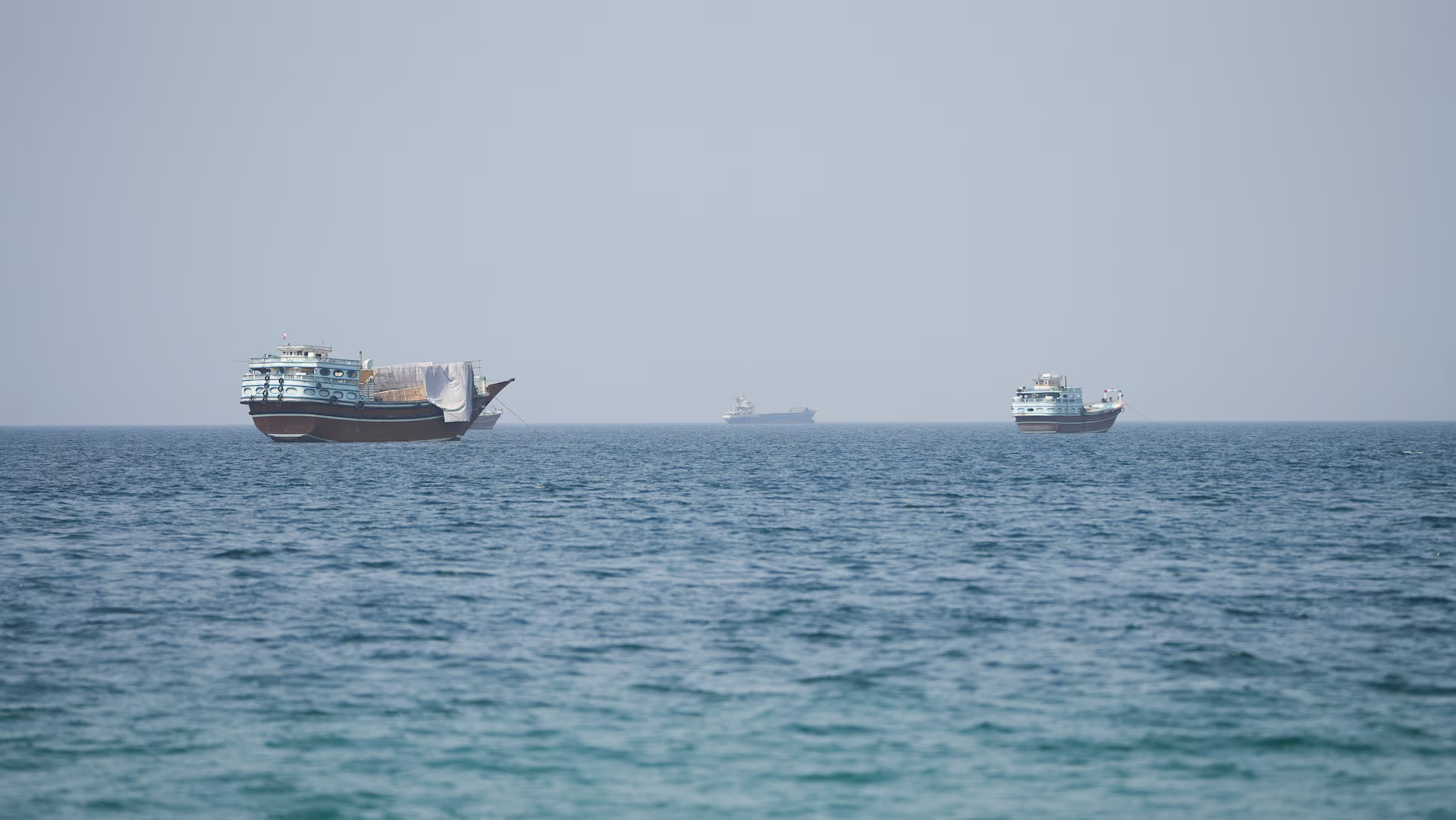
The vessel, named San Antonio, was attacked during its passage through the strategic waterway, according to French daily Le Figaro.
Crew members injured in the incident were evacuated and are currently receiving medical treatment, while the vessel sustained damage, the report said.
Iran’s Islamic Revolution Guard Corps Navy on Tuesday reiterated its warning to all vessels seeking to transit the Strait of Hormuz to solely take the corridor previously announced by the country.
French shipping company CMA CGM confirmed on Wednesday that one of its vessels was targeted in an attack on Tuesday while transiting through the Strait of Hormuz
Speaking at a press conference, Gomes said the three patients requiring urgent medical care are in stable condition, with no new cases reported among the remaining passengers and crew.
The evacuation will be carried out by specialized air ambulances, with one aircraft already in Cape Verde and another expected to assist. “The transfer will take place as soon as all safety conditions are in place,” she said, without specifying a timetable.
Gomes stressed that the risk to Cape Verde remains low, as no passengers have disembarked and there has been no contact with the country’s territory.
A sanitary corridor involving maritime and airport authorities has been established to ensure the safe evacuation of patients, medical staff, and the public.
The vessel may be cleared to resume its voyage once the evacuation is completed and sanitary conditions are verified, Gomes said, noting that the outbreak had been reported by international health bodies before the ship entered Cape Verdean waters.
Cape Verde’s National Director of Health Angela Gomes (C), briefs the press on arrangements for the medical evacuation of patients from the cruise ship MV Hondius during a press conference in Praia, Cape Verde, on May 5, 2026. Cape Verde will airlift three patients in the coming hours from the cruise ship MV Hondius, which remains anchored off the Port of Praia, National Director of Health Angela Gomes said Tuesday, following a deadly hantavirus outbreak on board. (Photo by Elton Monteiro/Xinhua)
The agency received reports of a hantavirus outbreak on the Hundius on May 2. Seven individuals of the 147 passengers and crew have been reported ill and three have died. The situation remains fluid, WHO’s chief of Epidemic and Pandemic Preparedness and Prevention Maria Van Kerkhove told reporters in Geneva.
“One patient is in intensive care in South Africa, although we understand that this patient is improving,” she said, adding that two other patients, still on board the ship, are being prepared for medical evacuation to the Netherlands for treatment.
Van Kerkhove stressed that the situation is being closely monitored. As a precaution, passengers have been asked to remain in their cabins while disinfection and other public health measures are carried out.
“The plan is, and our highest priority is, to medically evacuate these two individuals” to make sure that they receive the required care, and there are no other symptomatic patients on board, she said.
The ship is set to continue on to the Canary Islands, Spain, and the WHO is working with the Spanish authorities “to do a full epidemiologic investigation, full disinfection of the ship,” she added.
Hantaviruses are carried by rodents and can cause severe disease in humans. Thousands of infections are estimated to occur each year. People usually get infected through contact with infected rodents or their urine, their droppings, or their saliva.
As to the suspected origins of the virus, Van Kerkhove said that the initial patients — a husband and wife — boarded the ship in Argentina.
“With the timing of the incubation period of hantavirus, which can be anywhere from one to six weeks, our assumption is that they were infected off the ship,” she said.
“We do believe that there may be some human-to-human transmission that’s happening among the really close contacts,” such as the husband and wife and others who have shared cabins, she noted.
According to the WHO, human-to-human transmission of infection hantavirus between people is uncommon, but limited spread has been reported among close contacts in previous outbreaks of the Andes virus, which is part of the hantavirus group.
There are no specific treatments for hantavirus other than supportive care. “Typically, people will develop respiratory symptoms, so respiratory support is really important,” Van Kerkhove said.
This file photo shows Maria van Kerkhove (R), who was technical lead for the WHO’s Health Emergencies Program, speaking during a daily briefing in Geneva, Switzerland, on March 5, 2020.
The joint sitting of Romania’s bicameral parliament started at 11 a.m., with 431 of its 464 members present for the vote. Romania’s 464-seat parliament requires at least 233 votes to pass a no-confidence motion. A total of 288 lawmakers cast their votes, with three invalid ballots, leaving 285 valid votes.
Under the constitution, the Bolojan government will become an interim administration from the moment the vote passes, limited to handling routine administrative affairs. It will not be allowed to issue emergency ordinances or propose new legislation. The interim government’s term may not exceed 45 days.
The parties now enter negotiations to form a new government. Failure to do so could trigger a snap election.
The Social Democratic Party (PSD), the primary initiator of the motion, is willing to quickly find a solution “to have a government quickly,” and “all options are open,” said PSD President Sorin Grindeanu after the government was dismissed.
Catalin Predoiu, first vice president of the National Liberal Party (PNL), told local media Digi24 that this situation should not have happened, and negotiations between parties should continue.
Dominic Fritz, president of the ruling coalition member Save Romania Union (USR), said on social media that USR will “neither let the PSD and the Alliance for the Union of Romanians (AUR) drag Romania back to the past, nor enter into negotiations with the PSD to form a new government.”
Bolojan of the PNL took office in June 2025. However, its austerity policies and proposed sale of strategic state assets drew strong opposition from the PSD, the largest party in the original governing coalition.
In April, the PSD withdrew its political support and pulled all its ministers from the government, seeking Bolojan’s resignation but was rebuffed. The party then, together with major opposition parties and independents, submitted a no-confidence motion in late April.
Romania’s Prime Minister Ilie Bolojan speaks during a no-confidence vote against his government at Parliament Palace in Bucharest, Romania, May 5, 2026. Romania’s bicameral parliament passed a no-confidence motion against Prime Minister Ilie Bolojan’s government on Tuesday, with 281 votes in favor and 4 against, bringing down the government, according to the parliament’s live broadcast of the vote.
The move comes as the country continues to face a worsening security crisis nearly two weeks after an alliance of jihadist fighters and separatist rebels launched nationwide assaults. During the attacks, Defence Minister Sadio Camara was killed in an apparent suicide truck bombing targeting his residence near Bamako.
A decree read on state television on Monday confirmed Goïta’s new role as defence minister. He will be supported by army chief of staff Gen Oumar Diarra, who has been named minister delegate.
Goïta’s decision to hold both the presidency and the defence portfolio is widely seen as an effort to tighten his control amid growing pressure on his leadership.
The unrest began on 25 April when residents across Mali woke to gunfire and explosions as the separatist Azawad Liberation Front and the al-Qaeda-linked JNIM group launched coordinated attacks. Since then, the insurgents have reportedly imposed partial blockades on Bamako and other major cities.
The offensive, which also forced Malian and allied Russian forces to withdraw from the northern city of Kidal, has raised questions about the strength of Goïta’s military government, which came to power following a coup in August 2020.
Authorities say several soldiers have been arrested for alleged links to the attacks, with investigations suggesting involvement of both former and serving military personnel in planning and execution.
Mali has also coordinated with Niger and Burkina Faso to carry out air strikes against the insurgents. The three military-led countries, which form the Alliance of Sahel States, have expelled French troops and turned to Russian support in their fight against armed groups. However, insecurity persists, with large areas still outside government control.
Mali’s military leader Gen Assimi Goïta has taken over as defence minister after the officer who previously held the post was killed in a wave of surprise attacks.