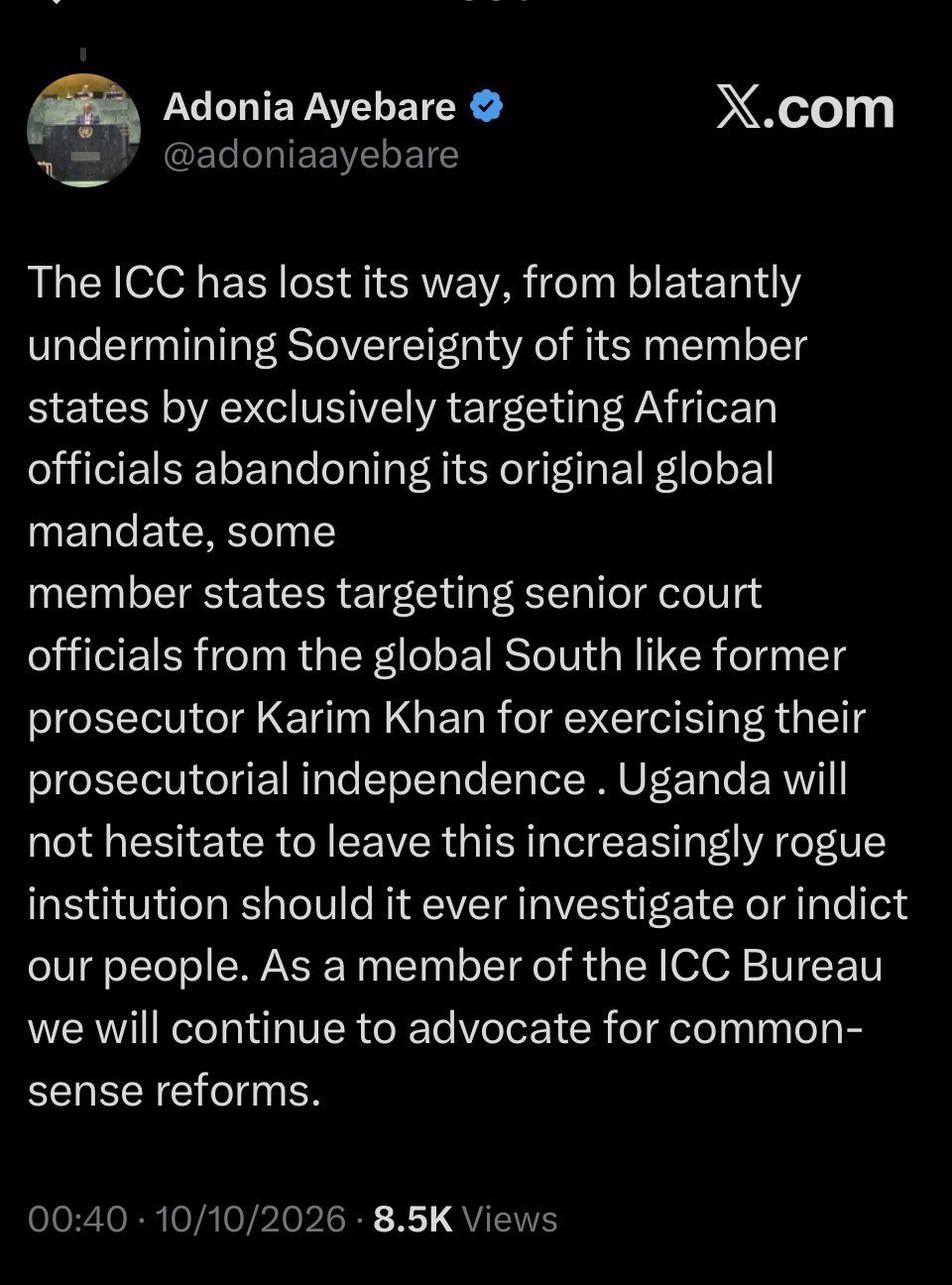
Foreign Affairs Minister Adonia Ayebare warned that Uganda would not hesitate to leave the court if it investigated or indicted Ugandan citizens, accusing the ICC of undermining national sovereignty and unfairly targeting African officials.
“Uganda will not hesitate to leave this increasingly rogue institution should it ever investigate or indict our people,” Ayebare said in a statement posted on X on October 10.
He also criticised what he described as the court’s disproportionate focus on African officials, arguing that it had departed from its original international mandate.
“The ICC has lost its way, from blatantly undermining sovereignty of its member states by exclusively targeting African officials, abandoning its original global mandate,” Ayebare said.
The minister added that Uganda would continue advocating reforms as a member of the ICC’s governing body, the Assembly of States Parties’ Bureau.
His remarks came after the United States announced new sanctions against the Hague-based court, renewing international debate over its authority to investigate and prosecute individuals accused of serious international crimes.
Justice and Constitutional Affairs Minister Norbert Mao publicly challenged Ayebare’s remarks, calling for further discussion before Uganda adopts a position on withdrawing from the court.
Mao also questioned the timing of the statement, arguing that publicly denouncing an international institution to which Uganda voluntarily belongs could undermine the country’s diplomatic interests.
He linked the controversy to Uganda’s support for former foreign minister Olara Otunnu’s campaign for United Nations secretary-general, noting that Otunnu’s candidacy relies on a commitment to international law and multilateral institutions.
“But above all, the timing of this statement kills Ambassador @Olara_Otunnu’s campaign for UN SG,” Mao wrote.
Mao added that Uganda should not promote a candidate whose public position on international law could be complicated by the government’s criticism of an institution it has joined voluntarily. He also acknowledged that Uganda has had reservations about the ICC.
He recalled that, at one point, he believed the court’s arrest warrants against leaders of the Lord’s Resistance Army (LRA) could undermine peace negotiations.
On the other hand Ayebare rejected Mao’s suggestion that his position was influenced by United States Secretary of State Marco Rubio, insisting that his views on the ICC were longstanding.
“With due respect Ladit, there is no relationship between the campaign for Dr Olara Otunnu for SG, and you know the facts, and my views on ICC which have been consistent for years,” Ayebare replied on X.
He maintained that the court had primarily targeted African situations, citing Sudan and Kenya, and referred to criticism surrounding former ICC prosecutor Karim Khan.
The two ministers subsequently moved to soften aspects of their exchange. Mao withdrew his remark accusing Ayebare of echoing Rubio’s position, while maintaining that the issue should be discussed on its principles.
The disagreement has placed Uganda’s position on international justice under renewed scrutiny as governments debate the court’s authority and the implications of political pressure against it.
The dispute comes amid renewed tensions between Washington and the ICC following US sanctions announced by the Trump administration.
The United States has argued that the court should not exercise jurisdiction over American citizens and officials because Washington is not a party to the Rome Statute, the treaty that established the tribunal.
The ICC, however, maintains that it has a mandate to prosecute individuals for genocide, crimes against humanity, war crimes and the crime of aggression under the conditions established by its founding treaty.
In response to the US measures, the court described the sanctions as “an assault on the rule of law and on the very foundations of the international legal order,”
The ICC urged its member states to support its continued operations, warning that the dispute extends beyond the institution itself to the broader international legal system.
Uganda remains a state party to the Rome Statute. Its government has not, in the statements cited above, announced a formal withdrawal process.
Under Article 127 of the Rome Statute, a state party seeking to withdraw must notify the United Nations secretary-general in writing. Withdrawal generally takes effect one year after the notification is received, and it does not automatically remove obligations arising while the country was a party to the treaty.
Uganda’s warning therefore signals a possible political dispute over its future relationship with the court rather than confirmation that withdrawal is already under way.
The government’s next steps will determine whether the threat develops into a formal move or remains part of the wider debate over the ICC’s authority, national sovereignty and international accountability.
Leave a Reply