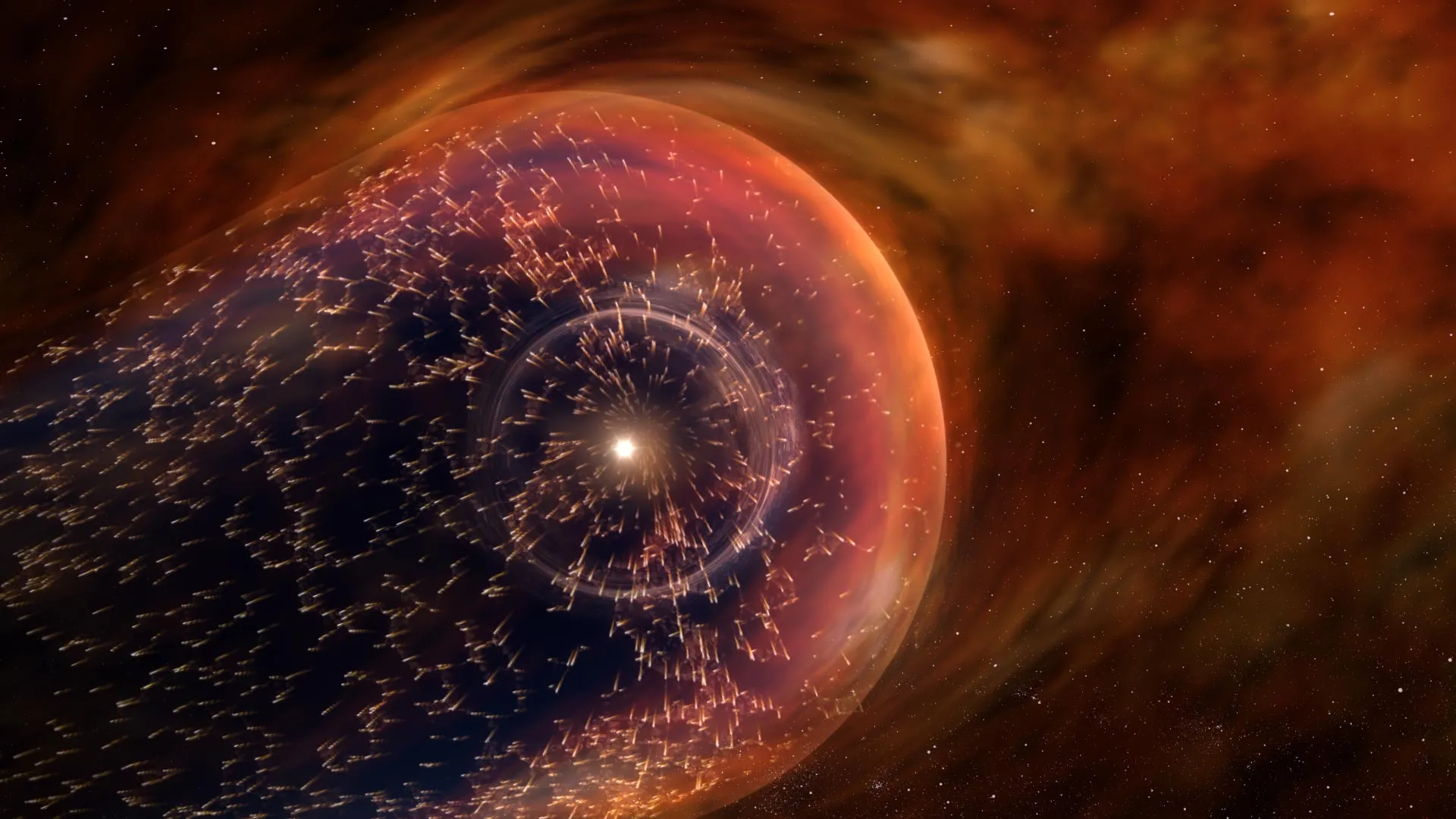
The protective bubble, known as the heliosphere, is created by the solar wind released by the Sun. It helps shield Earth and other planets from some particles and radiation coming from interstellar space.
Scientists from NASA’s SHIELD science center used computer simulations to study how the heliosphere may have changed as the solar system travelled through the Milky Way.
Their findings suggest that the Sun may have passed through extremely cold and dense clouds of gas and dust several times.
The pressure from these clouds could have compressed the heliosphere, potentially shrinking it to a size smaller than Earth’s orbit.
Researchers identified possible encounters around 2 to 3 million years ago, 6 to 7 million years ago and 13 to 14 million years ago.
During these periods, Earth may have been more exposed to material from interstellar space. Scientists have found evidence of interstellar particles in places including deep-sea sediments, Antarctic samples and lunar material.
The researchers believe changes in the heliosphere could have influenced Earth’s atmosphere and climate by allowing more interstellar material to reach the planet.
A second NASA-funded study examined Earth about three billion years ago, when the young Sun produced only around 70% of the energy it produces today.
Despite receiving less sunlight, geological evidence shows that liquid water existed on Earth.
Scientists suggest that powerful eruptions from the young Sun may have helped keep the planet warm.
Energetic particles from these eruptions could have triggered chemical reactions in the atmosphere, producing greenhouse gases such as nitrous oxide.
These gases may have trapped enough heat to keep Earth warm enough for liquid water to remain on its surface.
Together, the studies suggest that Earth’s climate and ability to support life may have been influenced by both the Sun’s activity and the solar system’s changing environment as it moved through the Milky Way.
The findings provide new insights into Earth’s ancient climate and may help scientists understand whether similar conditions could support life on planets around other stars.
Leave a Reply