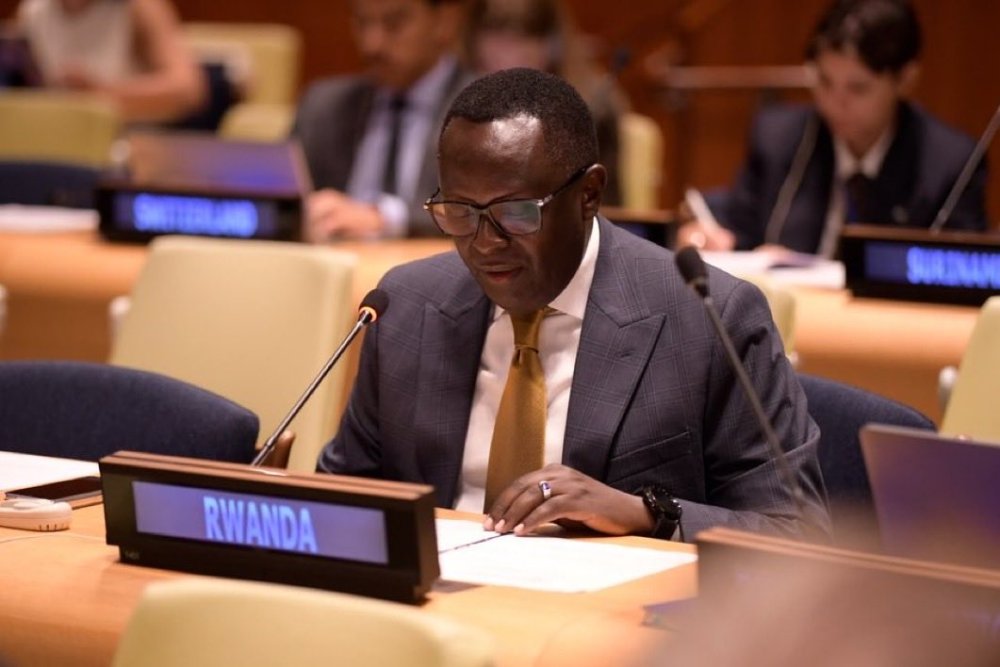
Amb. Ngoga made the remarks on September 29, 2026, during a UN Security Council briefing on the activities of the UN Organization Stabilization Mission in the Democratic Republic of the Congo (MONUSCO).
He said Rwanda remains committed to the Washington Accords and the ongoing Doha process, but stressed that agreements would only have an impact if their commitments are implemented and verified.
“Rwanda has taken steps to lift its defensive measures and has reported those steps through the Washington mechanisms. We have also proposed a tripartite verification mechanism comprising Rwanda, the DRC and the United States as a mediator.
“This points to one central proposition. Claims should be verified, commitments should be measured, and all parties should be held to the same standard,” Amb. Ngoga said.
Rwanda cites continued FDLR activity and FARDC collaboration
Amb. Ngoga said the FDLR remains operational in Rutshuru, Masisi, Nyiragongo and Walikale, citing the UN Secretary-General’s report.
He further said that information available to Rwanda indicated continued operational collaboration involving the FARDC, FDLR, Wazalendo and other allied forces throughout 2026.
He cited several incidents as examples. According to the information presented by Rwanda, FARDC helicopters and military trucks transported ammunition and supplies to locations where some of the material was subsequently distributed to FDLR and other armed-group commanders.
Amb. Ngoga referred to alleged deliveries in February and March, including 13 tonnes of small-calibre ammunition transported to Pinga and Kibua, 12 tonnes of ammunition and food rations taken to Ntoto, and a later delivery involving 693 rifles, six tonnes of ammunition and cash incentives.
He said the alleged pattern continued through April, June and July and cited August 15 as the most recent example presented to the Council.
“The significance is not any single incident. It is the continuity of the pattern from January to August, during the very period in which the neutralization of the FDLR was supposed to be advancing,” he said.
Rwanda, Amb. Ngoga added, had shared the information through the Joint Oversight Committee and Joint Security Coordination Mechanism.
The ambassador also criticised what he described as a separate arrangement being advanced between the DRC Government and the FDLR, arguing that it should not replace commitments already made under the Washington process.
He said the two sides had already identified and mapped FDLR positions, including its political and military command structures, through the Joint Security Coordination Mechanism.
Amb. Ngoga also said the DRC Government had concluded protocols with FDLR leaders and affiliated armed groups on several occasions, most recently on August 29, 2026.
“The obligation is clear: the FDLR must be neutralized, and that neutralization must be effective, complete and verifiable,” he said.
He described the continued presence of the FDLR and what he called its collaboration and support from the DRC Government as “a direct and existential security threat to Rwanda.”
Rwanda raises concerns over Rwandophone communities
Amb. Ngoga also used the Security Council platform to raise Rwanda’s concerns over violence against Banyamulenge and other Congolese Rwandophone communities.
He cited information in the public domain indicating that more than 650 villages had been destroyed or burned in the South Kivu Highlands since 2017, while more than 700,000 cattle had been looted and at least 147 schools and 57 health facilities destroyed.
He said more than 80% of the Banyamulenge and other Rwandophone population had been forced into exile through successive waves of violence.
Amb. Ngoga also referred to restrictions around Minembwe and what he described as a prolonged blockade affecting civilians.
He questioned the reported reinstatement of Major General Sylvain Ekenge as FARDC spokesperson, saying his return following a suspension over remarks targeting Kinyarwanda-speaking Congolese raised questions about accountability for ethnic incitement.
The Rwandan envoy also challenged the description of some armed groups fighting alongside the FARDC as “self-defence groups”. He said UN reporting had attributed 143 human rights abuses to Wazalendo groups and documented children associated with Wazalendo-affiliated armed groups.
He argued that armed groups should be assessed using consistent, evidence-based criteria, including Twirwaneho in the context of Minembwe.
Concluding his remarks, Amb. Ngoga said the Washington and Doha processes presented an opportunity to change the course of the conflict but stressed that implementation remained essential.
“Agreements alone will not bring peace. Implementation will,” he said.
He added that Rwanda was implementing its commitments and was ready for its actions to be verified, while calling for the same standard to be applied to all parties.
Leave a Reply