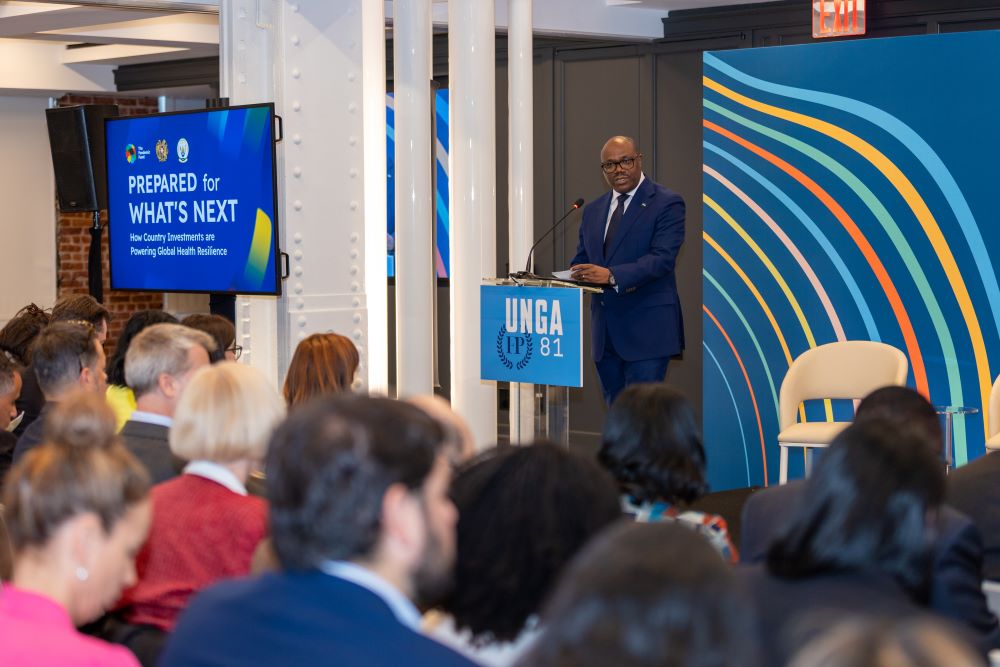
Dr. Nsengiyumva made the remarks in New York on September 23, 2026, during a high-level side event titled “What’s Next: How Country Investments are Powering Global Health Resilience,” held ahead of the United Nations High-Level Meeting on Pandemic Prevention, Preparedness and Response.
He said the world faces increasing health risks as climate change, pressure on land and growing movement of people and animals increase opportunities for pathogens to cross the species barrier.
At the same time, development assistance for health is declining, while the global attention that followed the COVID-19 pandemic has eased.
“Put simply, we are being asked to build more preparedness with less financing,” Dr. Nsengiyumva said, describing this as a challenge that requires a collective response.
For Rwanda, he said, pandemic preparedness has been shaped by experience with COVID-19, mpox, the country’s first Marburg outbreak and the continuing regional threat of Ebola.
Dr. Nsengiyumva pointed to Rwanda’s response to the Marburg outbreak in 2024 as an example of how investments in routine health systems can support emergency response.
During the outbreak, community health workers screened more than 9.5 million people in a country of about 14 million, helping bring the outbreak under control within three months. The outbreak was the third-largest Marburg outbreak recorded, with a case fatality rate of 22.7%, among the lowest ever recorded for this disease.
He said the response was possible because Rwanda already had community health workers, surveillance networks, laboratories and hospitals that could be mobilised when the new threat emerged.
“Preparedness, in our experience, is not a specialised capability held in reserve for emergencies. It is the everyday strength of a health system,” Dr. Nsengiyumva said.
Rwanda is also using its partnership with the Pandemic Fund to strengthen its One Health systems and establish a National Veterinary Reference Laboratory, which is expected to improve the country’s ability to detect zoonotic diseases and reduce reliance on testing abroad.
Dr. Nsengiyumva said countries need predictable domestic resources to sustain preparedness between outbreaks, while international partners should provide financing that allows governments to plan and maintain these systems.
He urged countries to translate international commitments into concrete investments, including dedicated preparedness funding in national budgets.
“The next threat may emerge anywhere,” he said. “What we can determine in advance is whether the systems it encounters are ready.”
He added that Rwanda will continue investing in preparedness domestically while working with neighbouring countries, regional institutions and global partners to strengthen health security across the region.

Leave a Reply