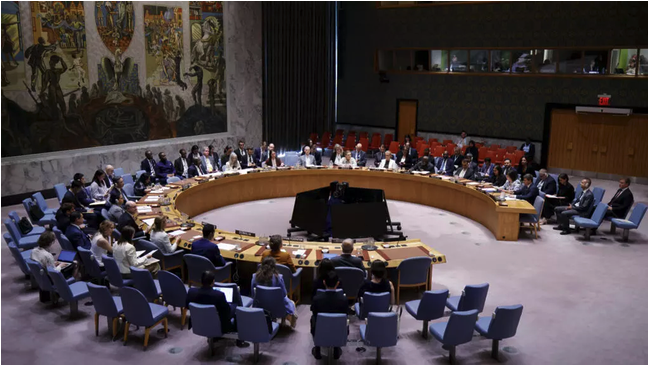
The closed-door vote marked the first formal test of support for the candidates within the 15-member Security Council, which is responsible for recommending a nominee to the UN General Assembly for appointment.
“The first round of straw poll has taken place,” Zenon Mukongo Ngay, the Permanent Representative of the Democratic Republic of the Congo to the United Nations and president of the Security Council for July, told reporters after the vote.
He said the candidates would be informed of the results through the permanent representatives of the member states that nominated them, while the President of the UN General Assembly would also be notified that the poll had been conducted.
As is customary, the results of the informal ballot were not made public.
Straw polls are confidential, non-binding ballots used by the Security Council to gauge the level of support for candidates. The process typically involves several rounds of voting until a candidate secures the backing of at least nine of the council’s 15 members without a veto from any of the five permanent members: the United States, the United Kingdom, China, France and Russia.
Under Article 97 of the UN Charter, the Secretary-General is appointed by the General Assembly upon the recommendation of the Security Council.
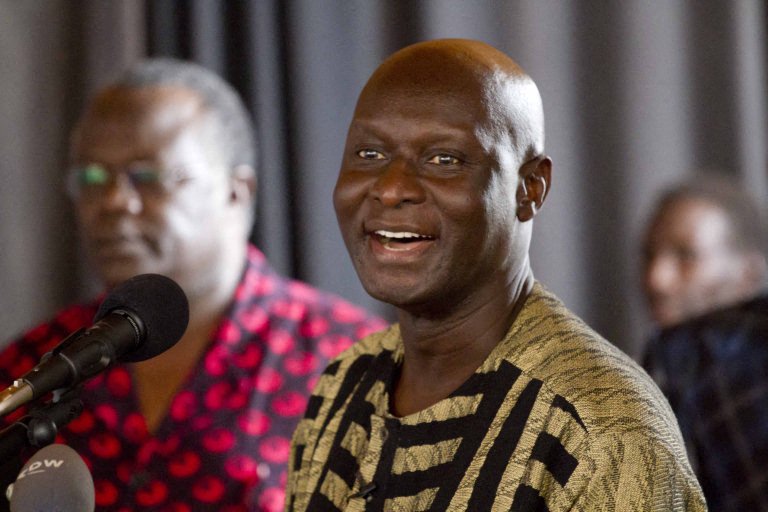
Otunnu, 75, was formally nominated by the Ugandan government earlier this month, becoming the seventh candidate in the race.
A veteran diplomat with more than four decades of international experience, Otunnu served as the UN Under-Secretary-General and Special Representative for Children and Armed Conflict from 1997 to 2005 under former Secretary-General Kofi Annan.
He also represented Uganda at the United Nations from 1980 to 1985 and served as President of the UN Security Council in December 1981. During that period, he helped break a deadlock over the selection of a UN Secretary-General by introducing the straw-balloting procedure that ultimately produced Javier Pérez de Cuéllar as a consensus candidate.
Before joining the UN leadership, Otunnu briefly served as Uganda’s Minister of Foreign Affairs and later led the opposition Uganda People’s Congress (UPC), contesting the country’s 2011 presidential election.
His candidacy places East Africa in contention for one of the world’s most influential diplomatic positions.
The other candidates are former Chilean President Michelle Bachelet, former Ecuadorian Foreign Minister and former President of the UN General Assembly Maria Fernanda Espinosa, International Atomic Energy Agency Director General Rafael Mariano Grossi of Argentina, UN Conference on Trade and Development Secretary-General Rebeca Grynspan of Costa Rica, Guyana’s Permanent Representative to the United Nations Carolyn Rodrigues-Birkett, and former Senegalese President Macky Sall.
The seven contenders recently presented their visions for the future of the United Nations during a televised dialogue ahead of the Security Council’s voting process.
Once the Security Council reaches consensus on a candidate, it will forward its recommendation to the UN General Assembly for formal appointment. The successful candidate will begin a five-year term on January 1, 2027, succeeding Guterres, who is completing his second term as Secretary-General.
Leave a Reply