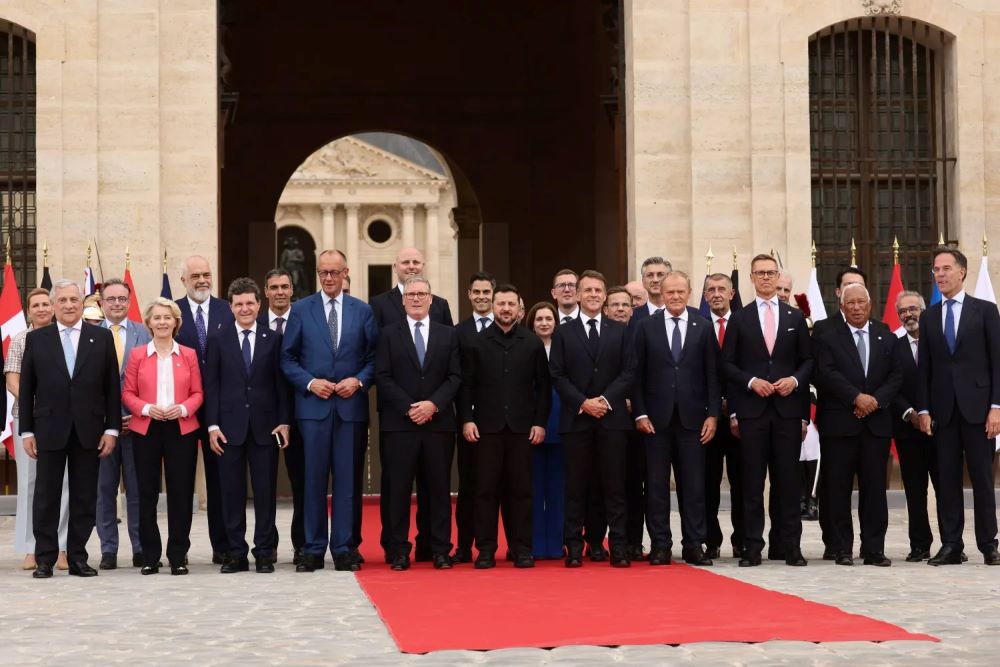
Announced on Monday at a Paris summit hosted by French President Emmanuel Macron, the landmark alliance, which includes defence heavyweights Britain, France, Germany, Italy, and Spain, aims to build an integrated, sovereign missile defence architecture to deter escalating Russian aerial threats.
A new role for Ukraine and the “Freyja” initiative
Significantly, this agreement marks a paradigm shift in how the West interacts with Kyiv. Rather than treating Ukraine as a passive recipient of military aid, the coalition positions Ukraine as a founding co-developer. The alliance’s immediate flagship initiative is the Freyja project, designed to break Europe’s reliance on prohibitively expensive U.S. Patriot interceptors, which cost upwards of $4 million per shot.
Instead, the coalition will focus on manufacturing a low-cost, mass-producible European alternative. By leveraging Ukraine’s active combat experience and cutting-edge domestic defence firms, such as Fire Point, which recently prototyped a $700,000 interceptor, the coalition plans to fuse Western aerospace engineering with Ukrainian wartime innovation.
The reality check: No cash, no timeline
Yet, behind the grand rhetoric of the joint declaration lies a stark industrial reality: the initiative currently exists only on paper. The charter commits member states merely to “exploring appropriate opportunities for funding,” leaving the project without a designated budget, a lead nation, or a centralised administrative secretariat.
Developing, testing, and integrating a brand-new anti-ballistic missile system from scratch is an incredibly complex engineering feat. Defence analysts warn that delivering an operational Freyja system will take several years, meaning it will offer zero protection for Ukraine’s vulnerable power grid during the immediate, impending winter bombardment campaign.
Furthermore, the coalition must navigate deep-seated European rivalries. While Macron used the Paris summit to urge European states to abandon “go-it-alone” national procurement, getting European capitals to collaborate remains notoriously difficult, a reality recently highlighted by the near-collapse of joint Franco-German defence programs.
Predictably, the initiative drew immediate fire from the Kremlin. Moscow spokesman Dmitry Peskov swiftly dismissed the alliance, branding it a “coalition of the deluded” and warning that such steps would only further destabilise the region.
Ultimately, the Paris declaration is a major political victory for Ukraine’s long-term integration into European defence infrastructure. However, until member nations back their signatures with hard currency, the Freyja project remains a promising blueprint rather than an active shield. For now, Europe’s skies will continue to rely on dwindling legacy stockpiles while this new coalition attempts to turn political promises into physical defences.
Leave a Reply