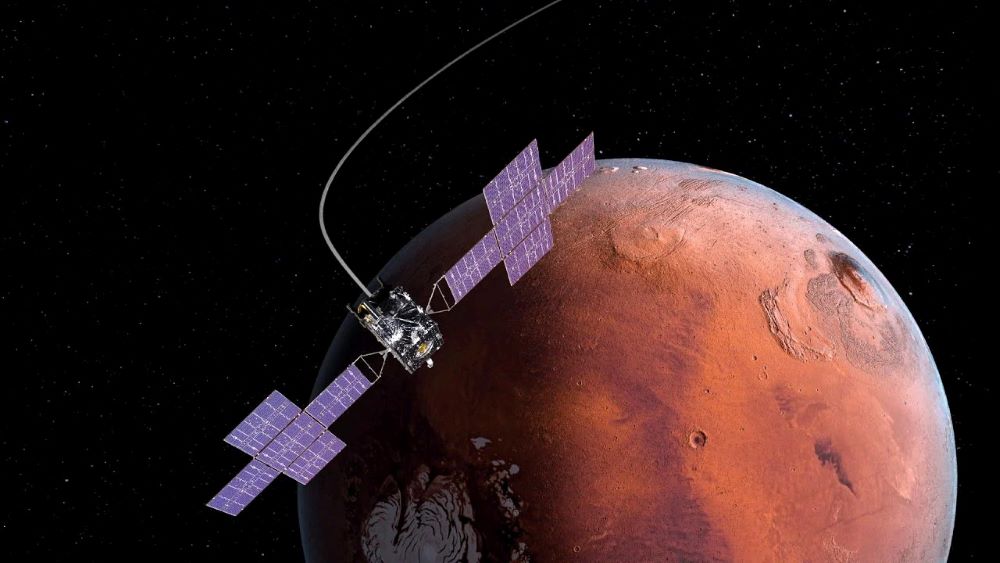
On May 15, the spacecraft will pass about 4,500 kilometers above the surface of Mars while traveling at nearly 20,000 kilometers per hour.
Scientists say the flyby will allow Mars’ gravity to pull the spacecraft forward, increasing its speed and changing its direction without using much fuel.
The spacecraft was launched in October 2023 and is expected to reach the asteroid in 2029. NASA says using a planet’s gravity in this way, known as a “gravity assist,” helps save fuel and makes long space missions more efficient.
During the flyby, Psyche will also collect images and scientific data from Mars. Engineers will use the opportunity to test the spacecraft’s cameras and other instruments before it reaches the asteroid.
NASA said the spacecraft has already started sending back early images showing Mars as a tiny point of light in space.
Scientists are especially interested in how Mars will appear during the flyby. Since Psyche is approaching from the dark side of the planet, it will first see Mars as a thin crescent rather than a fully bright planet.
Researchers also hope the spacecraft may detect faint dust around Mars, possibly caused by small impacts on the planet’s moons, Phobos and Deimos.
The spacecraft carries several scientific instruments, including tools that can study magnetic fields, radiation, and particles in space.
“Ultimately, though, the only reason for this flyby is to get a little help from Mars to speed us up and tilt our trajectory in the direction of the asteroid Psyche,” said Lindy Elkins-Tanton, the mission’s principal investigator.
NASA and European space missions already orbiting Mars will also help monitor the flyby.
Leave a Reply