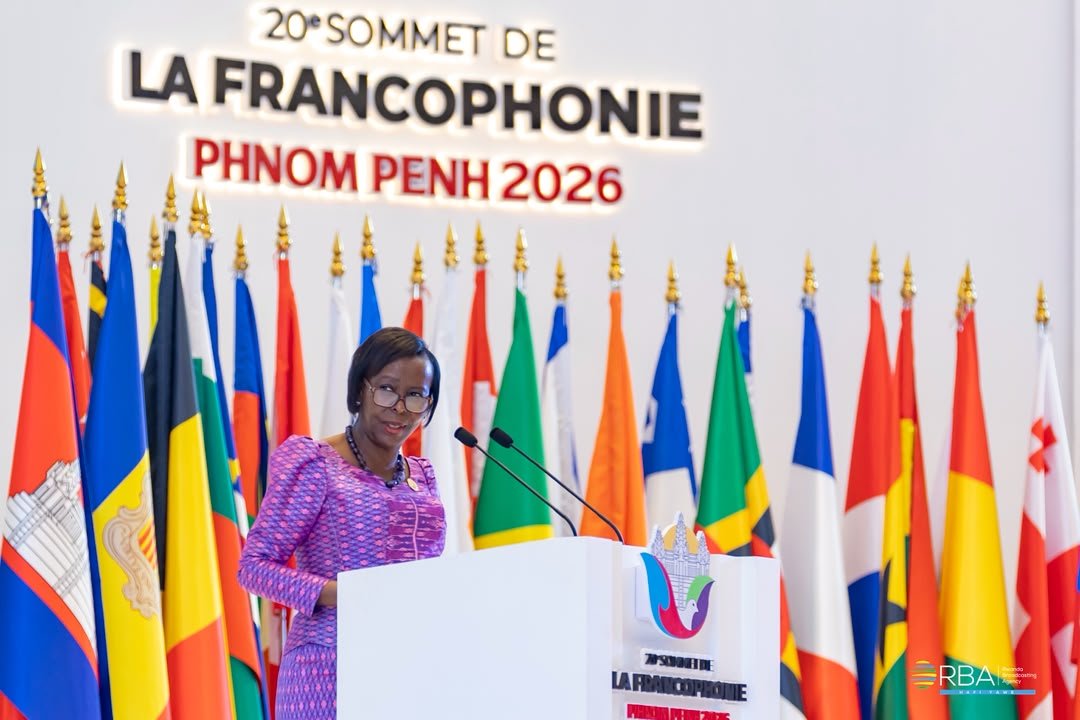
Kinshasa announced on November 14, 2026, that it had withdrawn Juliana Amato Lumumba’s candidacy, two days before heads of state and government are expected to select the organisation’s next leader for the 2027–2030 term at the 20th Francophonie Summit in Phnom Penh, Cambodia.
The decision followed reports that French President Emmanuel Macron had written to President Paul Kagame seeking Mushikiwabo’s withdrawal in favour of Cioloș. Similar overtures were reportedly made to the DRC and Mauritania.
Rwanda has rejected the suggestion that another country can dictate its choice of candidate, insisting that the selection must follow rules agreed upon by OIF member states.
“Rwanda is not a country that takes orders from another country, no matter how wealthy that country may be. No country has the right to tell another country that has nominated a candidate to withdraw that candidate,” Foreign Affairs Minister Olivier Nduhungirehe told Rwanda Broadcasting Agency (RBA).
He added: “Those days when one country thought it could make decisions for everyone in the Francophonie are over.”
Macron’s reported intervention and DRC’s change of position
In a report published on November 13, Jeune Afrique revealed that Macron had written to Kagame proposing Mushikiwabo’s withdrawal, reportedly assuring him that the DRC and Mauritania would also withdraw their candidates in favour of Cioloș.
The proposed arrangement was presented as a way of securing consensus around a “compromise” candidate.
A day later, Kinshasa announced Lumumba’s withdrawal and endorsed the Romanian contender, marking a significant development in the reported diplomatic initiative.
In its statement issued in Phnom Penh during the 48th session of the Francophonie Ministerial Conference, the Congolese government said the decision was intended to encourage a joint candidacy and build consensus among member states.
It emphasised that the withdrawal did not reflect doubts about Lumumba’s credentials, competence or commitment, while calling on other candidates and their supporting countries to demonstrate similar openness to compromise.
Rwanda, however, has maintained Mushikiwabo’s candidacy.
Rwanda insists on election rules
At the centre of the disagreement is the procedure for selecting the next Secretary-General.
The OIF’s Unified Rules of Procedure, adopted in 2022, provide for consensus as the first approach. If member states fail to reach agreement, the selection proceeds to a vote, with a simple majority of states present and voting determining the winner.
Each member state has one vote, regardless of its population or economic size.
The provision could work in Mushikiwabo’s favour should the process proceed to voting. Africa accounts for 27 of the OIF’s 53 full members entitled to vote, giving the continent a narrow majority and considerable influence over the outcome.
Although African countries are not guaranteed to vote as a single bloc, their combined numbers make them central to the outcome. Mushikiwabo could therefore have a stronger electoral position if consensus fails and member states resort to a vote.
The contest has consequently become about more than the individual candidates. It also raises questions about whether the organisation’s leadership should emerge through procedures agreed upon by its members or diplomatic arrangements negotiated outside the formal process.
Three candidates remain in the race
Four candidates initially entered the contest: Mushikiwabo of Rwanda, Lumumba of the DRC, Coumba Bâ of Mauritania and Cioloș of Romania.
Following Lumumba’s withdrawal, three candidates remain.
Mushikiwabo, who has led the organisation since 2018, is banking on her experience at the helm, reforms undertaken during her first two terms and initiatives targeting youth, entrepreneurship, education and cooperation.
Cioloș, a former Romanian Prime Minister and European Commissioner for Agriculture, is advocating stronger economic partnerships, international cooperation, training and development.
However, questions have emerged about his familiarity with Africa, which accounts for a substantial share of the Francophone world’s population and membership.
During his hearing at OIF headquarters in Paris on June 30, 2026, Cioloș acknowledged having limited direct experience of the continent and pledged to visit African member states if elected.
Coumba Bâ, a former Mauritanian minister and special adviser to the OIF, has presented a platform centred on education, youth and cooperation among French-speaking countries.
Africa’s influence at stake
The leadership contest comes as African countries seek to strengthen their influence in an organisation where they constitute the majority of members.
The DRC’s decision to abandon its candidate in favour of a European contender has renewed questions about the ability of African countries to build common positions on the Francophonie’s leadership.
The developments also unfold against the backdrop of strained diplomatic and security relations between Kinshasa and Kigali, particularly over the situation in eastern DRC.
The 20th Francophonie Summit is taking place on November 15 and 16 under the theme, “Investing Again in Peace for Shared Prosperity and Lasting Stability.”
The next Secretary-General is expected to be selected on November 16 during a closed-door meeting of heads of state and government.
If consensus fails, the subsequent vote could put Africa’s numerical advantage to the test, with potentially significant implications for Mushikiwabo’s bid for a third term and the organisation’s future leadership.
Leave a Reply