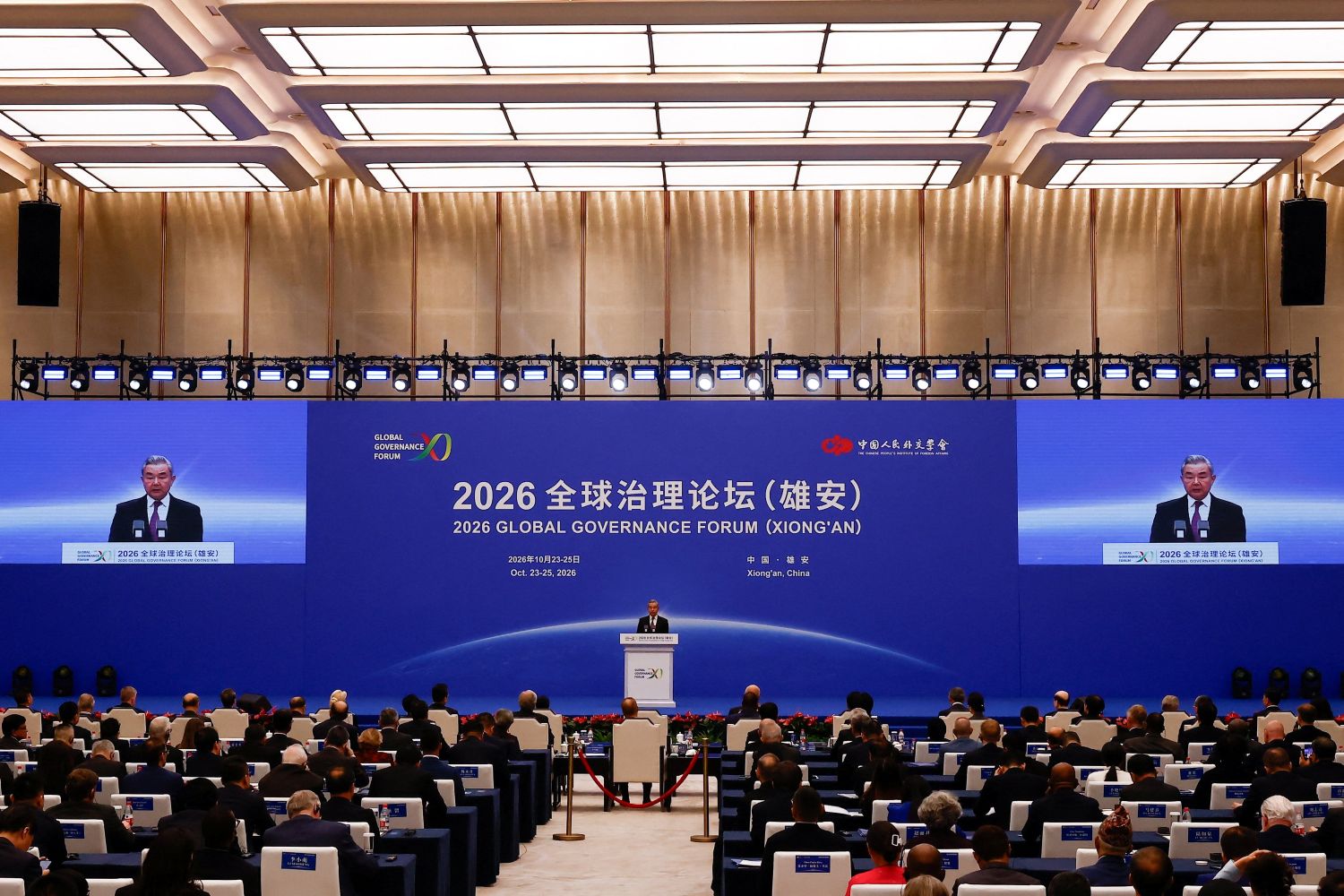
Wang was speaking on Friday, October 23, at the opening of the 2026 Global Governance Forum in Xiong’an New Area, in China’s Hebei Province.
His remarks renewed attention to Africa’s exclusion from permanent membership of the UN’s principal body responsible for international peace and security.
“The reform of the U.N. Security Council should move in the right direction, namely increasing the representation of developing countries, making it a priority to meet Africa’s aspiration through special arrangements, and involving more small and medium-sized countries in global decision-making,” Wang said.
The Security Council has 15 members. China, France, Russia, the United Kingdom and the United States hold permanent seats, while the remaining 10 members are elected for two-year terms. Africa holds three elected seats but has no permanent member.
This distinction carries considerable weight. Substantive decisions require at least nine supporting votes and no veto from a permanent member.
Any of the five permanent members can therefore block a resolution, even when all other members support it.
Africa’s common position demands at least two permanent seats, with the same privileges as existing permanent members, including veto rights if retained, and five elected seats in total.
The continent’s geographical size and economic importance strengthen its argument for permanent representation.
Africa covers approximately 30.3 million square kilometres, accounting for about 20% of the world’s land area, making it the second-largest continent.
It also holds approximately 30% of the world’s mineral reserves, according to the United Nations Environment Programme.
Its resources give the continent a significant place in global production and development.
These assets reinforce the case that Africa should help shape decisions affecting its future and international stability.
However, permanent membership is a question of political agreement and fair representation, rather than an entitlement determined by territory or mineral wealth.
Wang argued that the growing influence of developing countries should be reflected in international institutions.
“In keeping with this shift, the Global South must enjoy greater representation and say in international affairs. This will not only correct a historical injustice, but also provide a wealth of ideas for improving global governance,” he said.
China presents its support as part of its commitment to a fairer international order. From a diplomatic perspective, defending Africa’s demands can also strengthen Beijing’s relationships across the continent and reinforce its position as an advocate for developing countries.
His remarks did not identify which African countries should receive permanent seats or explicitly address extending veto rights. Reform remains dependent on wider agreement.
Changing Council membership requires a UN Charter amendment approved by two-thirds of General Assembly members and ratified by two-thirds of UN members, including all five permanent Council members.
At the opening, Wang also read a message from President Xi Jinping, who warned that deficits in peace, development, security and governance were growing.
Xi said his Global Governance Initiative sought to build a more just and equitable system through consultation, shared contributions and cooperation.
President Xi’s message further outlines the great significance of reforming and improving the global governance system, sets the direction for the GGI’s implementation, and states China’s commitment and readiness to work with all countries for a more just and equitable world.
Wang Yi outlined eight initiatives China plans to undertake to advance global governance reforms. China will host the APEC Economic Leaders’ Meeting in November, focusing on openness, innovation and cooperation, while continuing to support reforms aimed at making the United Nations more efficient and effective. Beijing will also strengthen the Group of Friends of Global Governance, organising activities around nine priority areas and encouraging more countries to participate.
China will also push for the full implementation of the BBNJ Agreement on marine biodiversity beyond national jurisdiction and support Xiamen’s bid to host its Secretariat. On human rights governance, Beijing will advocate greater recognition of the right to development and organise a workshop on economic, social and cultural rights to support capacity-building in developing countries. China will also issue a position paper proposing stronger and more inclusive rules for outer space governance.
On emerging technologies and research, China will publish a progress report on its AI Capacity-Building Action Plan for Good and for All, reviewing achievements from the past two years and promoting deeper international cooperation on artificial intelligence. It will also establish a Global Governance Research Center to conduct research, publish a Global Governance Index and annual reports, and provide intellectual support for reforms to the global governance system.
The three-day forum, hosted by the Chinese People’s Institute of Foreign Affairs, seeks practical approaches to reform.
Nearly 180 international guests from more than 90 countries and approximately 180 Chinese delegates had confirmed attendance.
The choice of Xiong’an gave those discussions a domestic setting. Established in April 2017, roughly 100 kilometres southwest of Beijing, the area was designed to accommodate functions not essential to Beijing’s role as the capital.
China is using the location to showcase its approach to long-term planning, innovation and green development.
Xiong’an has added 5,345 buildings and attracted more than 4,000 enterprises relocated from Beijing. Four universities and two hospitals are under full-scale construction.
Leave a Reply