
It started with a phone call that kept repeating itself.
Employers looking for technical talent regularly asked Niyonshuti Yves, who works as Assistant Lecturer at Rwanda Polytechnic – Tumba College, to recommend students who could do the job. He usually could. Many of the people he recommended have since become senior professionals in their organisations.
But the process had a weakness: it depended on who knew whom. Yves began to ask whether technology could give employers the same insight without needing a personal introduction.
The answer became Mpuza, an AI-powered talent and recruitment platform conceived in 2017 and now live. Its ambition is bigger than a job board: to become a trust-based professional platform, focused on employment, where the work people deliver becomes verified proof of what they can do.
The plan is to pilot in Rwanda, expand across Africa and compete worldwide, so that the next generation of employment technology is built by Africans for the global market.
Beyond the CV
Yves is an alumnus of the University of Rwanda’s African Centre of Excellence in Data Science (UR-ACEDS), where he enrolled in a master’s degree in Data Science with a specialization in Data Mining.
CVs remain central to hiring, he says, but they rarely tell the whole story. Candidates present their experience in different ways, and employers spend long hours deciding who really fits a vacancy as well as receiving a lot of candidate that is very difficult to evaluate each and everyone.
What Mpuza does
For job seekers, Mpuza offers:
- Semantic job search, which understands descriptions written in natural language instead of relying only on exact keywords, combining contextual matching with keyword signals.

- Personalised recommendations based on a user’s profile and on the jobs they explore, save or apply for.
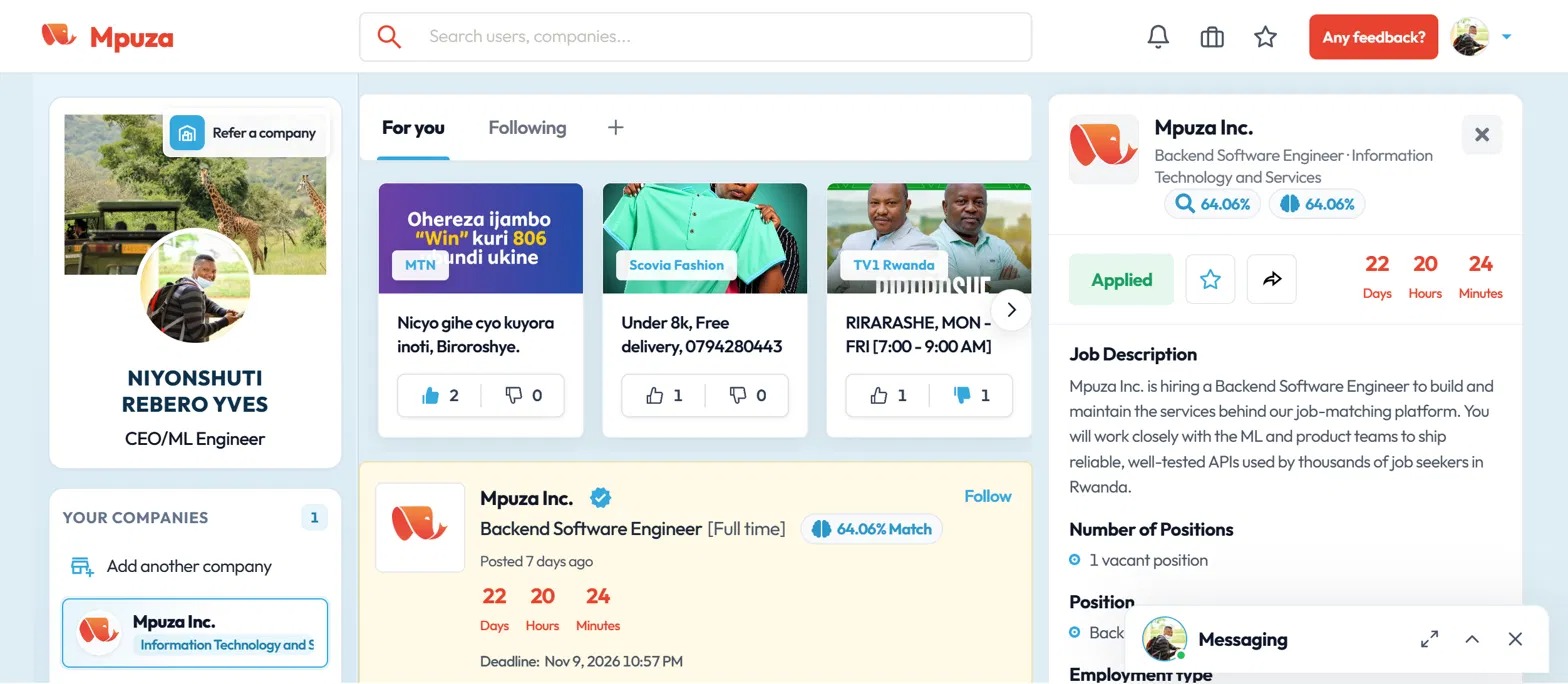
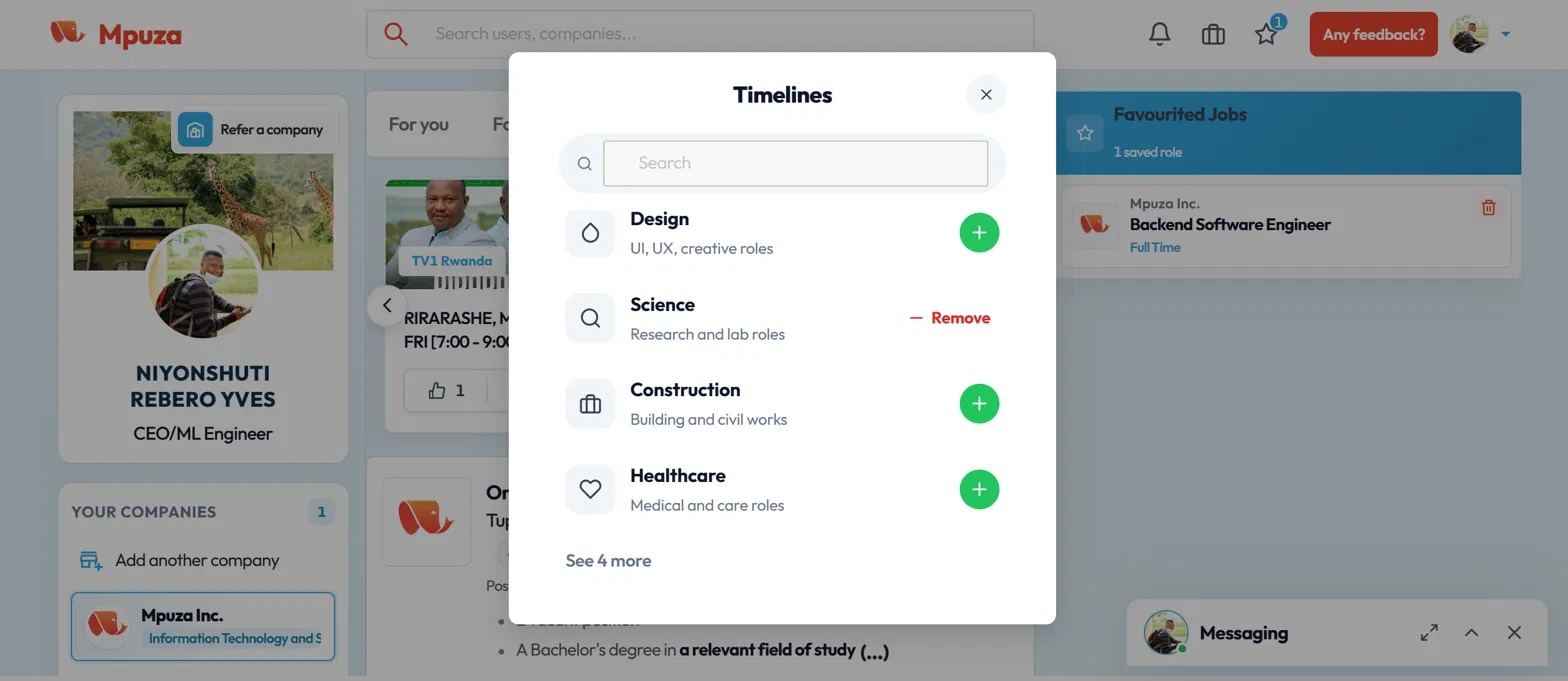
- Custom job categories to follow personalized opportunities across different professional domain.
- Profile connections, such as GitHub, so recruiters can see technical projects and contributions beyond what a CV shows.
For employers, Mpuza offers:
- Tools to publish vacancies, manage applications and run recruitment workflows.
- AI assistance to draft job descriptions and to rank or shortlist applicants against a vacancy’s requirements.

- Project-management tools to create projects, organise teams, assign tasks and track work.
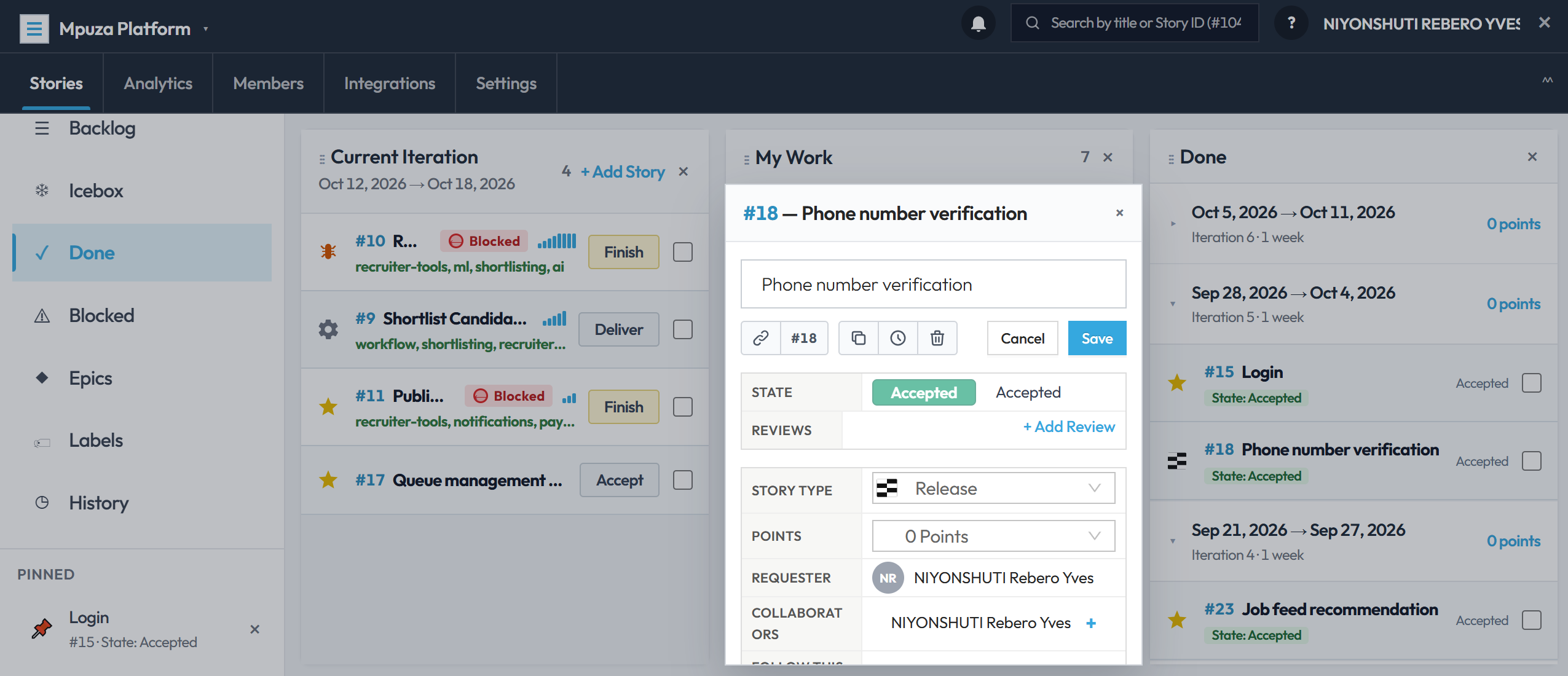
The AI is designed to support recruiters, not replace them. Employers remain responsible for reviewing candidates and making final hiring decisions.
The platform’s wider direction is to link verified work and completed deliverables to professional skills profiles, building a more evidence-based picture of what people can do. That could especially help professionals whose abilities are not fully captured by their formal qualifications.
More than a talent platform: a trust platform for employment
Yves describes Mpuza’s bigger picture as a trust platform for employment: a place where people are known for the work they have verifiably delivered, not only for what they say about themselves.
Most platforms help people look for work or describe their careers. Mpuza’s project-management tools are meant to do something different. They are the engine that turns everyday work into evidence. Here is the idea, step by step:
- An organisation creates a project, forms a team and assigns tasks.
- Team members complete and deliver their work on the platform.
- Project owners or managers review and confirm the deliverables.
- Confirmed work is added to the person’s profile as verified skills and experience.
- Recruiters see evidence, not just claims, and can hire with greater confidence.
This verified-work direction is being built step by step and is not yet a finished feature set. It would also need to protect privacy and let professionals decide what they share with recruiters, a principle Mpuza will have to prove in practice.
Local infrastructure behind the technology
Mpuza’s development has been supported by the UR-ACEDS and its Data Driven Incubation Hub. Through the Hub, Yves has had access to high-performance computing, servers for running AI model inference and GPU resources for training models.
For Dr. Jennifer Batamuliza, Head of the Data Driven Incubation Hub, the aim is to help innovators build real capability, not simply use existing tools.
“We have provided access to high-performance computing, servers for running AI model inference and GPU resources for training models. These resources allow the team to experiment with AI technologies and develop practical engineering expertise rather than depending exclusively on existing commercial AI APIs,” said Dr. Jennifer Batamuliza, Head of the Data Driven Incubation Hub, UR-ACEDS
“Young engineers should have opportunities to understand how AI systems are developed, trained, evaluated and deployed,” she added. She also noted that startups need continued technical guidance, business mentorship and a deeper understanding of customers as they prepare to scale.
A vision for education and industry
An UR-ACEDS representative said the centre wants Rwanda to produce engineers and innovators who build advanced technologies rather than only consuming solutions from elsewhere.
“Mpuza illustrates the potential of translating data science expertise into practical innovation,” said Prof. Charles RURANGA, Director of African Center of Excellence in Data Science(ACEDS)
The centre sees a future in which responsibly governed and anonymised workforce data could help researchers and TVET students study labour-market trends, spot emerging skills requirements and understand where education and employer expectations diverge. Such evidence could inform curriculum development, practical AI projects and workforce planning in line with Rwanda’s NST2 agenda.
This remains an ambition, not an achievement. Any research would depend on suitable data, strong privacy safeguards, institutional approval and the participation of employers and educational institutions.
Looking further ahead, Yves is also interested in how organisations may combine human workers with AI agents. That is part of his long-term vision for the future of work and is not a feature currently available on Mpuza.
Inspired by a national vision for AI
Yves says his ambition is shaped by Rwanda’s leadership in artificial intelligence. In July 2026, President Paul Kagame was named co-chair of the AI for Good Global Commission, a UN-backed initiative set up through the International Telecommunication Union (ITU) and co-chaired with Salesforce chair and CEO Marc Benioff. The Commission focuses on building trust in AI, widening access to it and making sure developing countries are not left behind
For Yves, that leadership is a source of motivation. He hopes Mpuza can help grow a dynamic community of African builders who follow that lead and contribute to its success, raising the flag of Rwanda and of Africa together. He is also grateful for the continued support given to young entrepreneurs to keep creating and innovating while serving the world.
Why digital exports matter: from a Rwandan pilot to a global product
Yves also sees Mpuza as an economic idea. If Rwanda can build software that customers abroad pay for, it can earn foreign currency without shipping a single container.
Early days, honest goals
At the time of writing, Mpuza records 13 users, 3 companies and 96 job postings. Yves is clear that these are early numbers, a snapshot of activity and not proof of large-scale adoption.
The next stage is practical: grow the user base, build stronger relationships with employers, improve the recruitment experience and establish a sustainable business model. The longer-term test will be building trust and showing that AI-assisted recruitment is used responsibly, with people accountable for every hiring decision.
For Yves, the goal is not simply to build an AI product, but to build trusted technology that connects people with opportunities, and to show what Rwanda’s own technology talent can create.
If Mpuza earns that trust, it could become one of many African-built products that serve customers worldwide, adding to Rwanda’s digital economy and proving that Africa is a builder of technology, not only a consumer of it.
Visit mpuza.com to learn more.
Leave a Reply