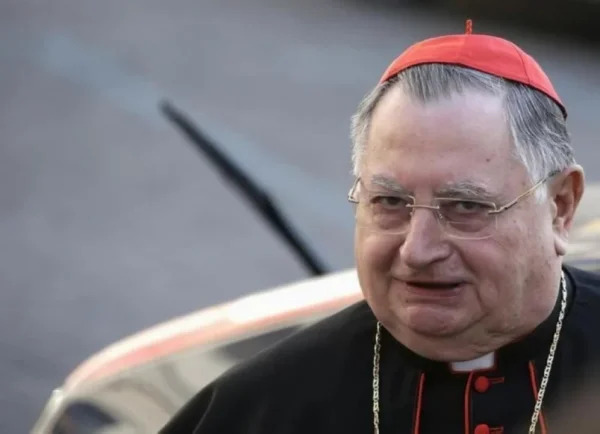
Giuseppe Bertello, who served as the Pope’s envoy to Rwanda from 1991 to 1995, wrote to André Louis, then Secretary General of the Christian Democratic International (IDC) in Belgium, asking the organization to cooperate with the MRND and help it promote what he described as genuine democracy.
In his February 17, 1992 letter, Bertello argued that the MRND was undergoing change and that its younger members deserved support to prepare them for public service.
“As a priest from a family with many members involved in the Christian Democratic International, I would be pleased to see the IDC cooperate with the new MRND in helping it establish genuine democracy and distance itself from the outdated mentality and practices of the former single-party system,” he wrote.
“Otherwise, it risks losing all credibility, which would be deeply regrettable because there are young leaders within the party who deserve support so they can use their talents in the service of the nation. They would benefit from such support.”
Bertello’s appeal came during a defining period in Rwanda’s history. In 1991, President Juvénal Habyarimana accepted the introduction of multiparty politics after growing domestic and international pressure. The move ended the MRND’s status as the country’s only legal political party.
However, the political transition unfolded alongside a war that had begun in October 1990, when the Rwanda Patriotic Army (RPA) launched an armed struggle against Habyarimana’s government. At the same time, peace negotiations were taking place in Arusha, Tanzania, eventually leading to the signing of the Arusha Peace Accords on August 4, 1993.
As new parties emerged, Rwanda’s political landscape became increasingly complex. The MDR, originally founded by Grégoire Kayibanda in 1959, was revived, while parties including the CDR, PL and PSD were also established.
The period was marked by intense political competition, but also by the persistence of ethnic divisions that had shaped Rwanda’s politics for decades.
The MRND and CDR, in particular, promoted political positions that were associated with ethnic and regional identity, while extremist elements within the political establishment intensified anti-Tutsi propaganda as the war continued.
During the same period, many young people were recruited into the military to support Habyarimana’s government in its fight against the RPA. The political environment became increasingly polarized, with discrimination and exclusion influencing state institutions and public life.
An IDC document published on February 2, 1992, examining the situation in Rwanda, discussed a statement issued by the Catholic Bishops’ Conference on December 1, 1991, which criticized the government’s handling of the political crisis.
The document argued that the bishops’ criticism was misplaced and pointed to another statement that it said reflected support for the government’s reform process.
“It is only natural that the major reforms being undertaken by the government should receive the support of both the Catholic and Protestant churches. Few expected this to happen,” it stated.
The IDC, which had maintained close ties with Habyarimana’s government, believed that peace could only be achieved if those who had launched the war were defeated. It also expected the MRND to maintain a dominant position in future elections, projecting that the party could win at least 70 percent of parliamentary seats, while opposition parties would secure between 20 and 30 percent.
Bertello’s tenure in Rwanda ended in 1995, after the genocide against the Tutsi in which more than one million people were killed and the collapse of the political order that had existed during his diplomatic mission.
His 1992 letter remains a reflection of how some international actors viewed Rwanda’s political transformation in the years before the genocide and the challenges of interpreting the country’s rapidly changing political landscape at the time.
Leave a Reply