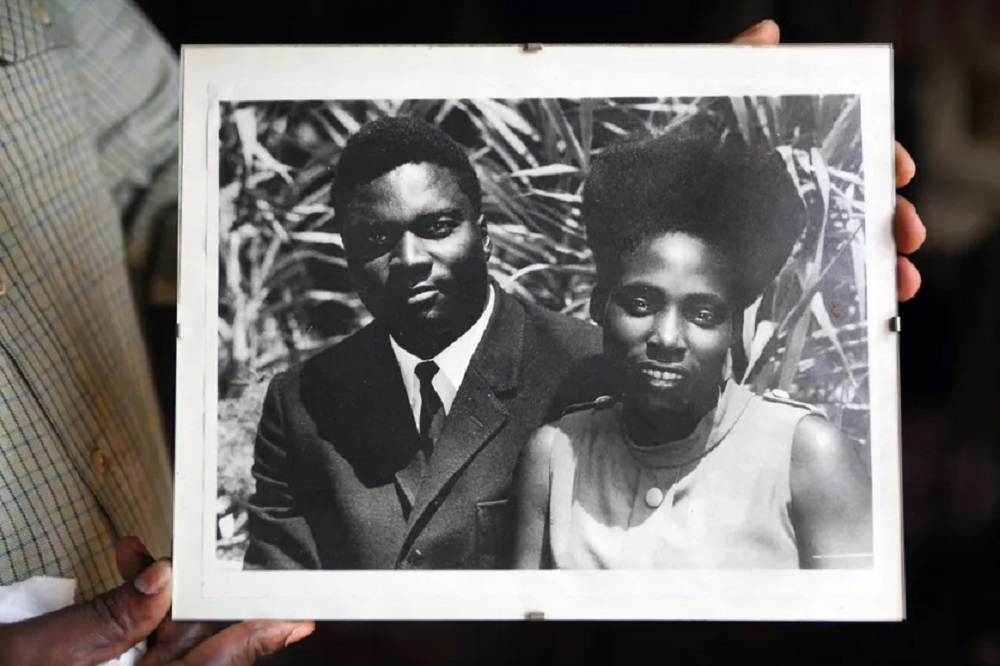
On April 9, 1994, three days after the start of the Genocide against the Tutsi, Grégoire de Saint Quentin, a technical advisor to the commander of the Para-Commando battalion, Maj. Aloys Ntabakuze, visited Kanziga’s residence in Kanombe. He reportedly informed her that French President François Mitterrand had requested that she and her family be evacuated to France immediately.
Kanziga, whose husband had been killed on April 6, 1994, when the presidential aircraft was shot down near Kigali, was instructed to prepare for immediate departure. She and her entourage were given little time to gather their belongings, with each person allowed only one bag and approximately 30 minutes to get ready.
At around 3 p.m. that day, French soldiers escorted Kanziga and 11 members of her family and friends to Kigali International Airport.
Among those with Kanziga were her three children, her younger sister Catherine Mukamusoni and her four children, as well as her son-in-law Alphonse Ntirivamunda. They were transported on a C-130 military transport aircraft.
The aircraft also carried Kanziga’s cousin, Twahirwa Séraphin, who had insisted on being evacuated, claiming he was seriously ill. It also carried two other families.
Reports indicate that Twahirwa had made prior financial arrangements to leave the country, including the conversion of Rwandan francs and the deposit of approximately 1 million USD into an account at Belgolaise Bank.
All of them departed Kigali at 7 p.m., heading to Bangui in the Central African Republic.
Agathe Kanziga chose to flee, leaving the country in the hands of Col. Théoneste Bagosora and her brother, Protais Zigiranyirazo. Members of the “Akazu” reportedly agreed to her departure, believing she would return soon once the country was “restored to peace.”
They also asked her to continue using her name in politics and her network of friends to help those who remained obtain military, political, and diplomatic support.
It is reported that French forces refused to transport President Habyarimana’s body, instead ordering that it remain in the mortuary of the military hospital in Kanombe.
In Bangui, Kanziga met a Polish nun named Editha, who ran her orphanage called Sainte Agathe, located in Masaka.
In deep sorrow, the nun told Kanziga that the Tutsi children in the orphanage had been killed on 7 April 1994, and asked her: “How could you allow such things to happen? The soldiers at least should not have done this.”
Kanziga told the nun not to blame the soldiers, saying they acted out of anger. She then asked her to remain silent and not speak further on the matter.
In the Central African Republic, Agathe Kanziga’s family was later flown out by an Air France aircraft. Upon arrival, she was welcomed with a bouquet sent by Mitterrand and a $35,000 financial support to help her start a new life.
She was also received by her two children, Jean-Pierre and Bernard, who were studying in France, as well as Marie Rose and Jean Claude, who were studying in Canada.
The family first stayed at the Forest Hill Hotel in Paris before moving into an apartment that Habyarimana had recently purchased in the city.
Kanziga’s reception in France was controversial, and every French official questioned about it reacted angrily to journalists.
Michel Roussin, then French Minister for Cooperation, once responded: “We had relations with a president who was elected legally; we evacuated his family because they requested assistance. It is not normal to blame France for acting this way. Other countries abandon leaders they had good relations with. What we did could have placed them in danger of death.”
Kanziga fled to France, believing she would return within days, expecting a swift military resolution. However, the Rwandan Patriotic Army (RPA) continued its advance, and the interim government eventually fled Kigali, relocating to Gitarama before crossing into what was then Zaire (now the Democratic Republic of Congo) following its defeat.
Leave a Reply