Rwanda, South Africa, Argentina and Thailand are reportedly the leading candidates for new races on the Formula 1 calendar, although no country has yet been officially confirmed.
“Negotiations are progressing very well in Africa. We are having other discussions in South America. We have discussions in the Far East,” said Domenicali during a media briefing with assembled international motorsport journalists, including representatives from PlanetF1 early this month.
“One thing that I can tell you is that we have more requests in China and Japan, but for the moment, we want to stay with one race in China because we need to consolidate the market before thinking about having other options there.”
Rwanda has been working to bring Formula 1 to the country as part of a broader strategy to establish itself as a major destination for global sports. President Paul Kagame formally announced the country’s bid to host a Grand Prix in December 2024 during the FIA General Assembly in Kigali.
Formula 1 has not held a race in Africa since the South African Grand Prix in 1993.
Rwanda, South Africa, Nigeria and Morocco have all expressed interest in bringing the championship back to the continent.
President Kagame has since visited Formula 1 facilities in Azerbaijan and Qatar, including the Baku City Circuit and Lusail International Circuit.
The proposed Formula 1 circuit in Rwanda is expected to be built in Bugesera District, near the new airport currently under construction.
In July, Sports Minister Nelly Mukazayire said Rwanda remained committed to hosting a Formula 1 race.
Formula 1 is the world’s premier single-seater motor racing championship, known for its high speeds, advanced technology and global following.
The championship is contested through a series of races known as Grands Prix, held on purpose-built circuits or temporary street circuits.
Drivers and teams earn points based on their results in each Grand Prix, with the driver and team accumulating the most points over the season crowned world champions.
Rwanda has been working to bring Formula 1 to the country as part of a broader strategy to establish itself as a major destination for global sports.
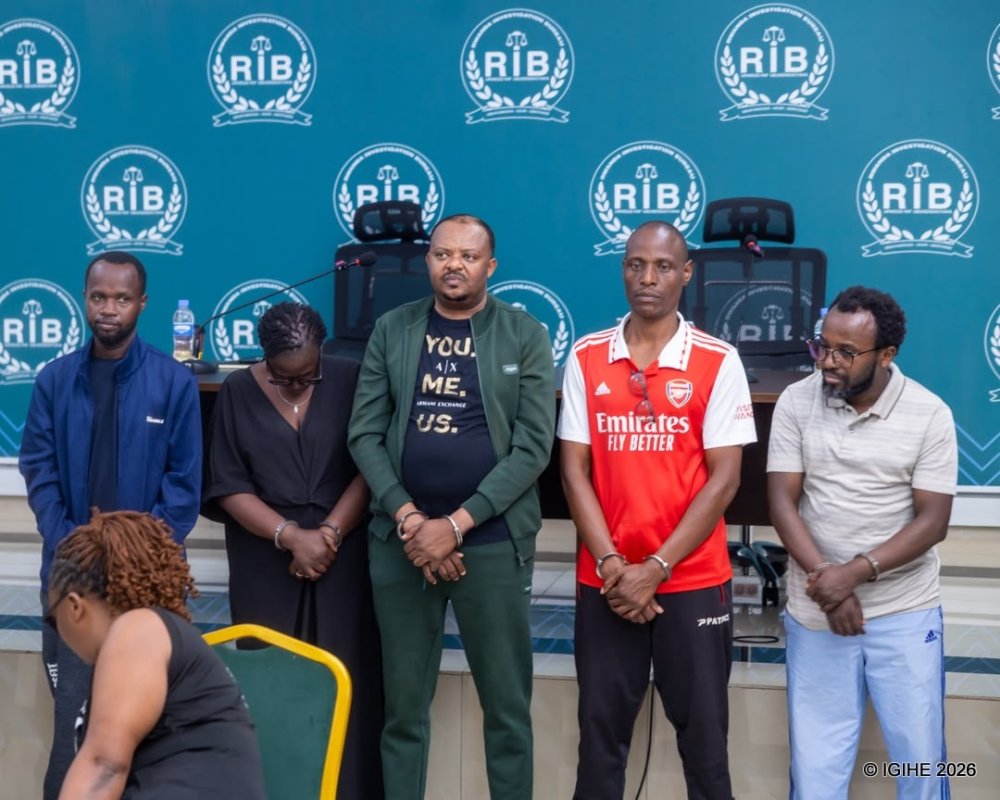
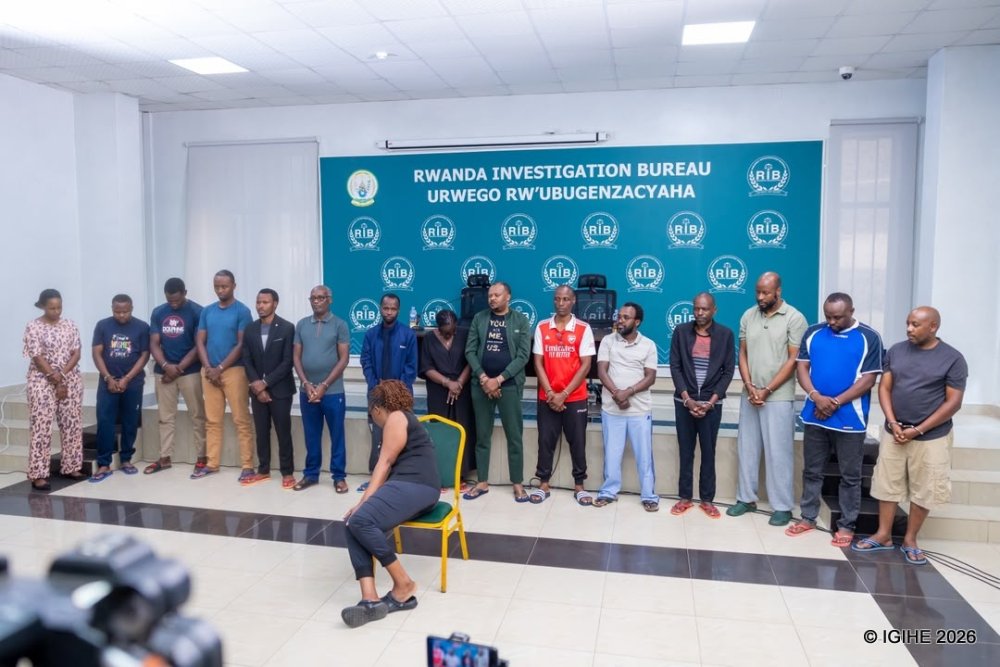
Ntihanabayo Samuel, also known as Kazungu, and 15 other suspects arrested in Kigali were presented by RIB on August 8, 2026. Ntihanabayo was arrested alongside two other employees of Ingufu Gin, including the factory’s quality control officer and production manager.
Oluwatosin Ayayi, the operations manager of Kerry Taste and Nutrition Rwanda, was also among those presented after being arrested in Kigali.
Other suspects presented by RIB included individuals linked to Ebeneza Hub, Sakaza Fruit, Entreprise Urwibutso, African Buffalo, Piphany Company and Lotas Medical Group.
Since August 2, the Rwanda Food and Drugs Authority (Rwanda FDA) has closed 148 factories producing alcoholic beverages that failed to meet required quality standards and suspended the production of the beverages manufactured by the affected facilities.
The decision followed inspections that found that some of the factories were using improperly processed ethanol in their alcoholic beverages, posing serious health risks to consumers.
The Government of Rwanda says 50 people have died from consuming substandard alcohol since January 2026, while another 100 people have lost their sight. An estimated 11,000 people across the country have also become addicted to the beverages.
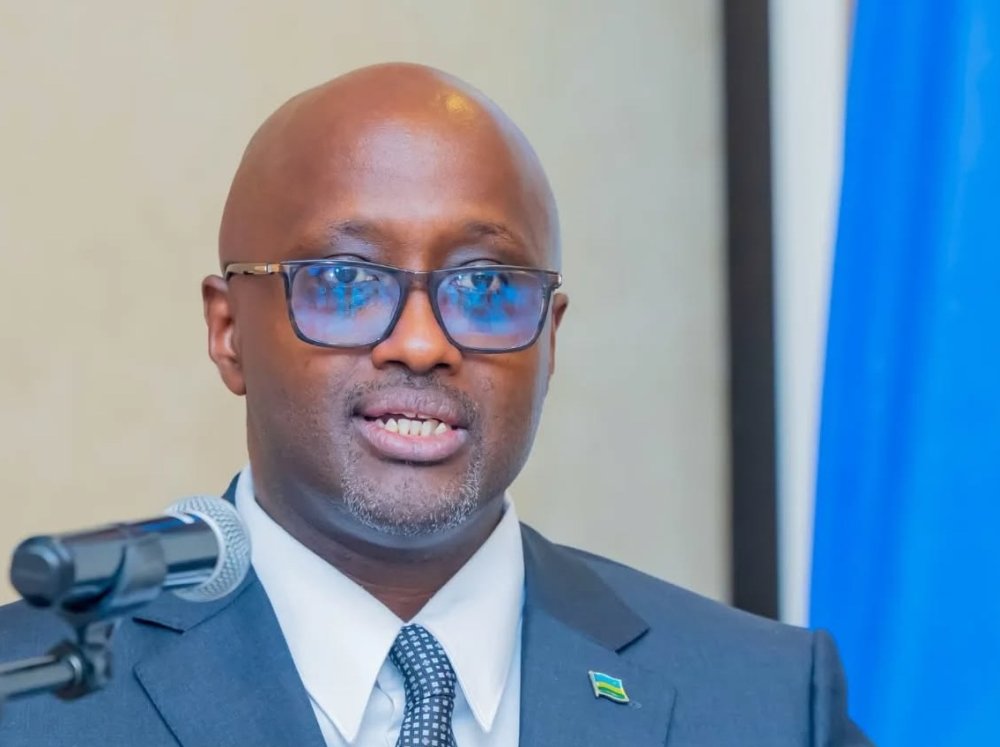
RIB spokesperson Dr. Murangira B. Thierry said those under investigation include government officials responsible for inspections and issuing permits, factory owners, employees of the closed factories, local government officials and people involved in illegal alcohol production.
“They all have one thing in common. They are connected through the chemical substance ethanol. They are facing four charges: giving a person something that can endanger their life, forging or using forged documents, embezzlement and insubordination,” Dr. Murangira said.
He explained that some factory owners and employees involved in producing substandard alcoholic beverages had been using expired materials and unauthorized measurements in pursuit of profit, without considering the consequences for consumers.
“So far, 80 people have been arrested across the country, 16 of whom we have presented here were arrested in Kigali. Investigations are still ongoing. In reality, nothing can be exchanged for human life because everything being done is in the interest of the public,” Dr. Murangira said.
RIB said inspections conducted in collaboration with relevant authorities found that some factories were operating without registration, while others were producing beverages without the required quality certifications.
Authorities also found factories operating in unhygienic conditions, producing alcohol in unauthorized locations and obstructing inspections by officials.
RIB said investigations into the production and distribution of substandard alcoholic beverages are continuing as authorities work to identify all individuals involved and protect the public from products that could endanger their health.
RIB presents some of those arrested over production of substandard alcohol.Ntihanabose Samuel, also known as Kazungu, is among individuals in RIB custody.
Speaking on The New Times’ Context programme, Nduhungirehe said the agreement does not need to be renegotiated or supplemented with new arrangements, but requires political will from the parties and the mediator to implement its provisions.
“The agreement itself is comprehensive enough. What we need to do is to implement it. We don’t need to renegotiate it because we agree with its content,” he said.
The minister said the Washington Accords built on the Concept of Operations (CONOPS) agreed between Rwanda and the DRC for the neutralisation of the FDLR and the lifting of Rwanda’s defensive measures.
“The Washington Agreement was actually taking the concept of operations that we had agreed on already in Rwanda for the neutralization of the FDLR, genocidal force, and the lifting of Rwanda’s defensive measures,” Amb. Nduhungirehe said.
He rejected a recent protocol announced between the DRC government and the FDLR under which the armed group said it was prepared to disarm and undergo demobilisation and reintegration.
Amb. Nduhungirehe said the FDLR is not a party to the Washington agreement but rather one of the issues the agreement requires to be addressed.
“The FDLR should be neutralized as per the Washington Accords. They are the subject of the Washington Accords. They are not a party to sign protocols,” he said.
He also accused the FDLR of working with the Congolese army and dismissed the recent exchange of communications between the group and the DRC government as a delaying tactic.
“We’ve seen communication between the FDLR writing to the DRC government and the DRC government responding to the letter by the FDLR leaders. It’s just comedy,” he said.
“What we believe is that this is delaying tactics that cannot fool anyone. And it’s not the first time.”
Amb. Nduhungirehe cited previous instances in which the DRC announced plans to neutralise the FDLR but, according to him, failed to follow through.
He recalled that in March 2024, then-DRC Foreign Minister Christophe Lutundula announced that Kinshasa would present a plan to neutralise the FDLR. Four days later, Amb. Nduhungirehe said Lutundula questioned whether authorities knew where the FDLR fighters were.
The minister also referred to March 2026, when DRC military authorities announced plans to begin operations against the FDLR.
“Then two days later, on 31st of March, they sent helicopters to Walikale full of rifles, close to 700 rifles, to the bases of the FDLR. Ammunition, money, mortars, and other weapons to the same FDLR,” he alleged.
Amb. Nduhungirehe said the lack of progress under the Washington agreement is primarily a question of political will.
“The process itself and the agreement are fine. And they are actually excellent when we read the document. But the problem we have is the political will to implement that agreement,” he said.
He said Rwanda had also raised concerns about the role of the United States as mediator, accusing it of becoming increasingly biased in the process.
Amb. Nduhungirehe maintained that Rwanda does not need another agreement to resolve the FDLR issue, but rather tangible implementation of the commitments already made.
Minister Olivier Nduhungirehe has discussed the implementation of the Washington peace agreement and the need to address the FDLR issue.
Jambo ASBL, which was founded in Belgium in 2008, is largely composed of descendants of individuals who participated in the 1994 Genocide against the Tutsi.
The organisation has for years said it advocates for Rwandan refugees and seeks ways for them to return to Rwanda in accordance with international law. The Rwandan government, however, maintains that it has never prevented Rwandans who wish to return from doing so. Rwanda receives civilians returning to the country as well as former members of armed groups operating in eastern DRC, including former FDLR combatants.
Those who surrender are provided with support intended to help them reintegrate into civilian life and live peacefully alongside the communities where they settle.
The latest disagreement follows the DRC government’s announcement of an agreement with the FDLR on the disarmament and demobilisation of the group’s fighters.
Rwanda has rejected the agreement, describing it as a diversion from the security threat posed by the FDLR and questioning the ongoing collaboration between Kinshasa and the terrorist group.
Rwanda has also reminded the DRC that its agreement with the FDLR is not provided for in the peace agreements signed by Rwanda and the DRC in Washington in June and December 2025, with the support of the United States.
On August 6, Jambo ASBL welcomed the agreement between the DRC and FDLR, describing it as an “important political step” in the implementation of the Washington peace agreements.
The organisation said lasting peace in the region cannot be achieved without resolving the issue of Rwandan refugees.
It argued that Rwandans who fled after the 1994 Genocide against the Tutsi should be given the opportunity to return voluntarily, safely and with dignity.
Jambo’s position bears similarities to recent statements by Cure Ngoma, the political spokesperson of the FDLR, who explained some of the provisions of the agreement between the group and the DRC government.
The FDLR has repeatedly presented the issue of Rwandan refugees as one of the reasons behind its continued activities, arguing that a political solution to the refugee question should come before the group’s complete dismantling.
Security analysts in the Great Lakes region have, however, argued that the FDLR has used the refugee issue as a means of justifying its continued existence, while Rwanda maintains that the armed group must be dismantled.
As the FDLR faced the prospect of being dismantled, it did everything possible to hold Rwandans who wanted to return home hostage, forcibly recruiting some of them, particularly young people and boys, into its ranks.
Following the AFC/M23 coalition’s capture of large parts of North Kivu, including Goma, many Rwandans who had been held by the FDLR were released and assisted in returning to Rwanda.
Jambo ASBL criticised the AFC/M23’s actions in helping the Rwandans return, a position that has drawn scrutiny because the releases reduced one of the arguments that had been used to justify the continued presence of the FDLR.
The organisation called on the United Nations High Commissioner for Refugees (UNHCR) and the UN peacekeeping mission in the DRC, MONUSCO, to protect the Rwandans against what it described as forced repatriation.
The description, however, ignores the fact that UNHCR and MONUSCO were involved in facilitating the return of some of the Rwandans, where their involvement demonstrates that the returns were not carried out in violation of international law.
The FDLR, which has operated in eastern DRC for decades, has carried out attacks against Rwanda and been accused of serious abuses in the DRC. The group’s history and leadership are also closely associated with individuals linked to the 1994 Genocide against the Tutsi.
The group continues to promote genocide ideology in the region and considers its presence a security threat rather than a refugee issue.
The government has therefore rejected attempts to frame the FDLR primarily through the refugee question.
While Jambo ASBL and the FDLR place the question of Rwandan refugees at the centre of their positions, Rwanda insists that the armed group’s military presence, ideology and activities make it fundamentally a security issue.
Jambo ASBL has echoed FDLR position, reinforcing perceived ties between the two sides
Eighteen-year-old Daniel Muhoza emerged as the hero, scoring a spectacular overhead kick in the 97th minute to hand the Rwandan giants their second regional title, adding to the trophy they won in 1998 against Zanzibar’s Mlandege. The victory also capped a flawless campaign in which Rayon Sports won every match and claimed the tournament’s $30,000 top prize.
Roared on by a capacity home crowd, Rayon Sports made a bright start and broke the deadlock in the 29th minute. Herman Junior Kameni reacted quickest inside the six-yard box to divert the ball past Gor Mahia goalkeeper Bryne Omondi and give the hosts a deserved lead.
Gor Mahia came back stronger after the break and equalised in the 53rd minute through Musa Sharif Sirengo, setting up a tense finish as both sides searched for a winner.
Neither team could find the breakthrough in the remainder of normal time, sending the final into extra time.
Seven minutes into the additional period, in the 97th minute, Muhoza produced a stunning overhead kick that beat Omondi and proved to be the match-winning goal, sparking wild celebrations among the home supporters.
Rayon Sports were reduced to 10 men after a late red card in extra time but held firm to secure a famous victory on home soil.
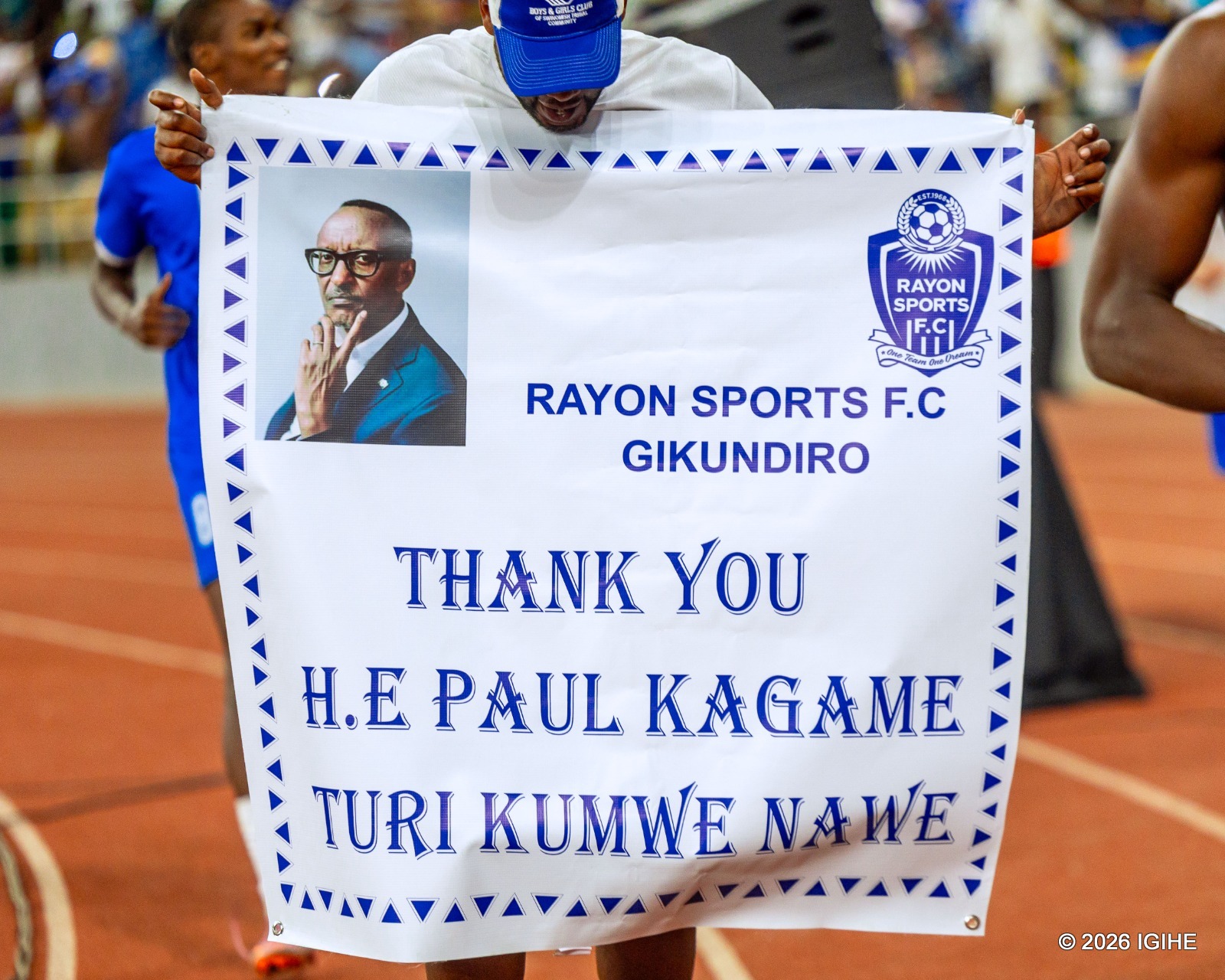
Prime Minister Justin Nsengiyumva presented the CECAFA Kagame Cup trophy to Rayon Sports after the final whistle as the club celebrated its first regional title in 28 years.
The triumph marks only the second CECAFA Kagame Cup title in Rayon Sports’ history and completes a remarkable tournament in which the club won every match and conceded just two goals.
Rayon Sports goalkeeper Junior Dande was named Goalkeeper of the Tournament after an outstanding campaign, while Emmanuel Nshimiyimana received the Most Valuable Player award for his influential performances throughout the competition.
For Gor Mahia, the defeat extends their wait for another regional title. The Kenyan side last lifted the trophy in 1985 and have now lost successive CECAFA Kagame Cup finals after also finishing runners-up in 2015. Despite the defeat, they received $20,000 in prize money as runners-up.
In the third-place playoff, Sudan’s Al Hilal defeated South Sudan’s Jamus SC 2-1 to claim the bronze medal and the tournament’s $10,000 third-place prize.
Rayon Sports ended a 28-year wait for the CECAFA Kagame Cup title after defeating Kenya’s Gor Mahia 2-1.Prime Minister Justin Nsengiyumva presented the CECAFA Kagame Cup trophy to Rayon Sports after the final whistle as the club celebrated its first regional title in 28 years. The victory also capped a flawless campaign in which Rayon Sports won every match and claimed the tournament’s $30,000 top prize.
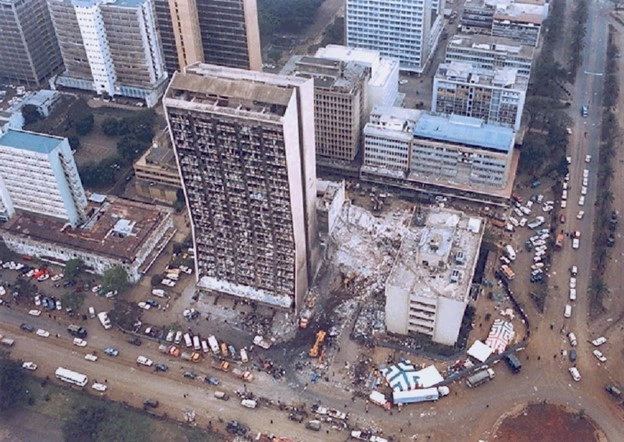
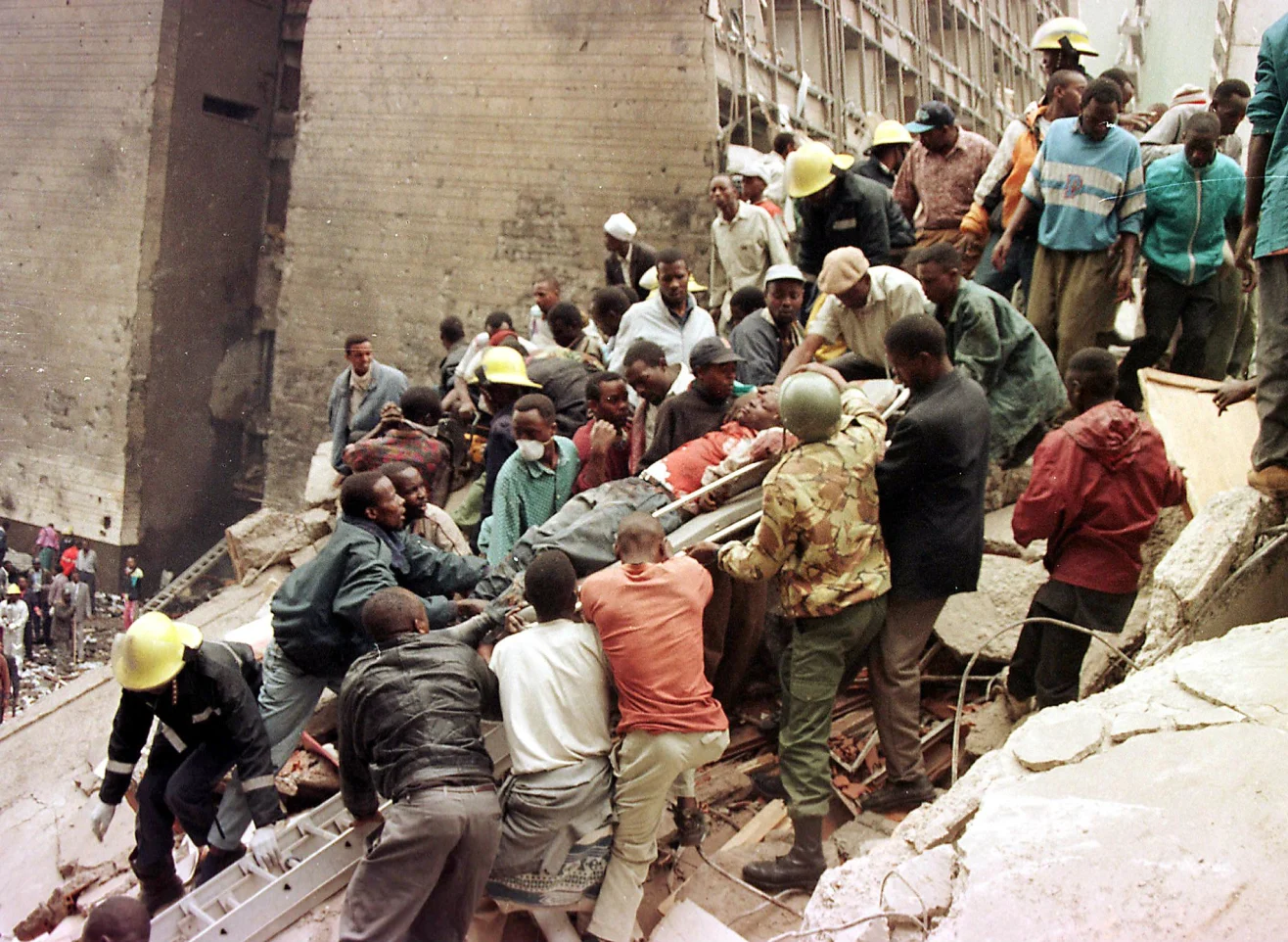
By the time the dust settled, 224 people were dead, including 12 Americans, and more than 4,500 were wounded. Nairobi accounted for the vast majority of the casualties: 213 killed and roughly 4,000 injured, most of them Kenyan office workers, students and bus commuters who had nothing to do with American diplomacy. Dar es Salaam recorded 11 dead and 85 injured.
What has aged worse than the rubble is how avoidable much of it was. Government investigators, and the ambassador who ran the Nairobi mission that day, later laid out in painstaking detail how a warning that reached Washington months earlier went unheeded, and how the embassy itself sat exposed on one of the city’s busiest corners, with no buffer between the public street and the chancery walls.
Nairobi accounted for the vast majority of the casualties: 213 killed and roughly 4,000 injured, most of them Kenyan office workers, students and bus commuters.
Al-Qaeda’s justification for the attacks was laid out months earlier. Osama bin Laden had grown increasingly hostile toward Washington over the US military presence in Saudi Arabia and Somalia, and sought to force American personnel out of the region.
In February 1998, he and Ayman al-Zawahiri’s Egyptian Islamic Jihad announced a “World Islamic Front” and issued a fatwa calling on Muslims to kill Americans and their allies “wherever and whenever they find them”. Prosecutors later called the East Africa bombings his first major attempt to carry that out. Bin Laden was indicted in the US that November.
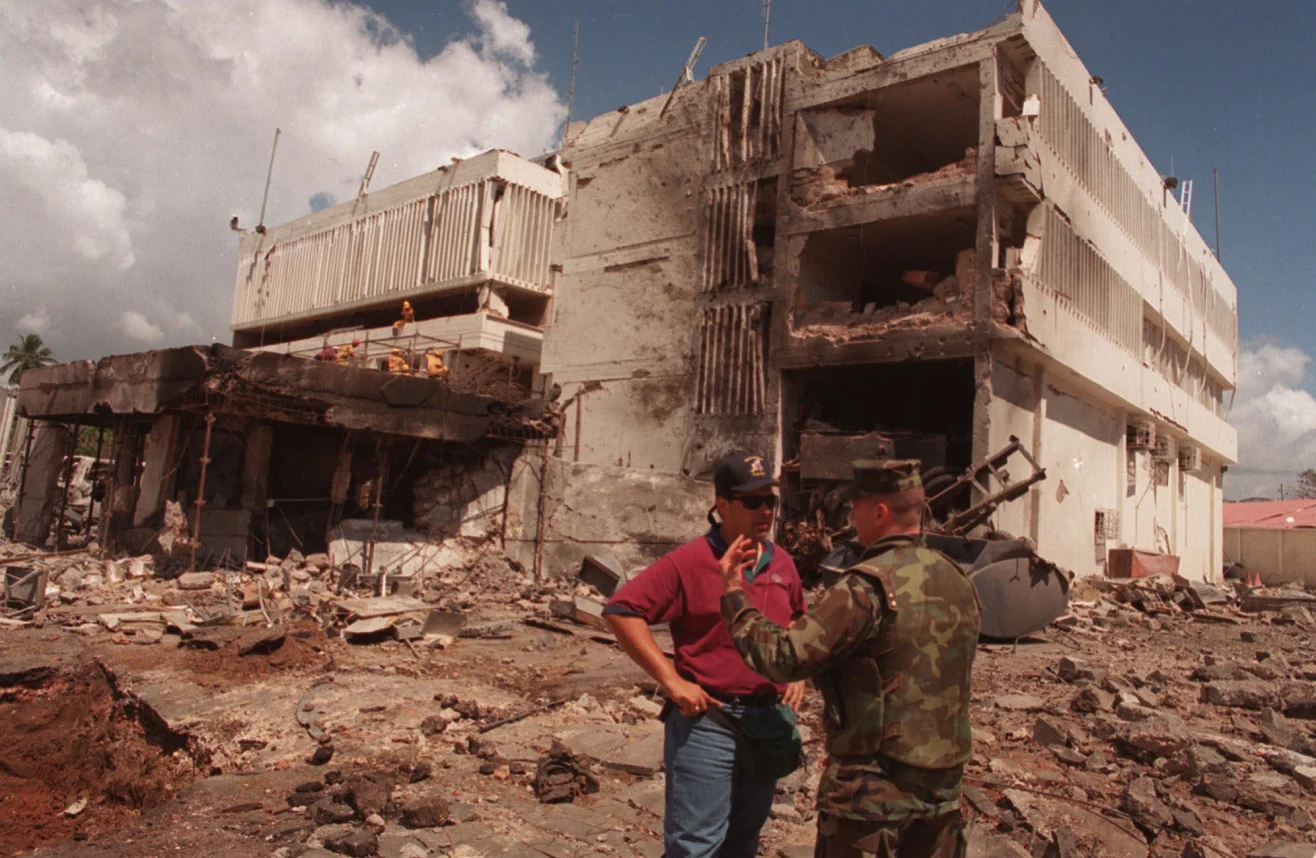
The Tanzania blast went off nearly simultaneously, to the one in Kenya on August 7, 1998, leaving 11 people dead.
A cable that went unanswered
Prudence Bushnell, then US ambassador to Kenya, had flagged the danger well before the bombing. In a cable to Washington on December 24, 1997, more than seven months before the attack, she laid out reports of terrorist and criminal threats against the mission and stressed that the embassy’s lack of standoff distance from the road left it acutely exposed. She asked for backing to build a new, more secure chancery.
The response, in January 1998, was that the post’s existing “medium” threat rating for political violence and terrorism was appropriate, and that the Bureau of Overseas Buildings Operations was not planning a new office building. Washington offered a security assessment team instead, and the exchange ultimately produced a reduction in embassy staff, with some personnel reassigned to Pretoria rather than the building itself being replaced or moved.
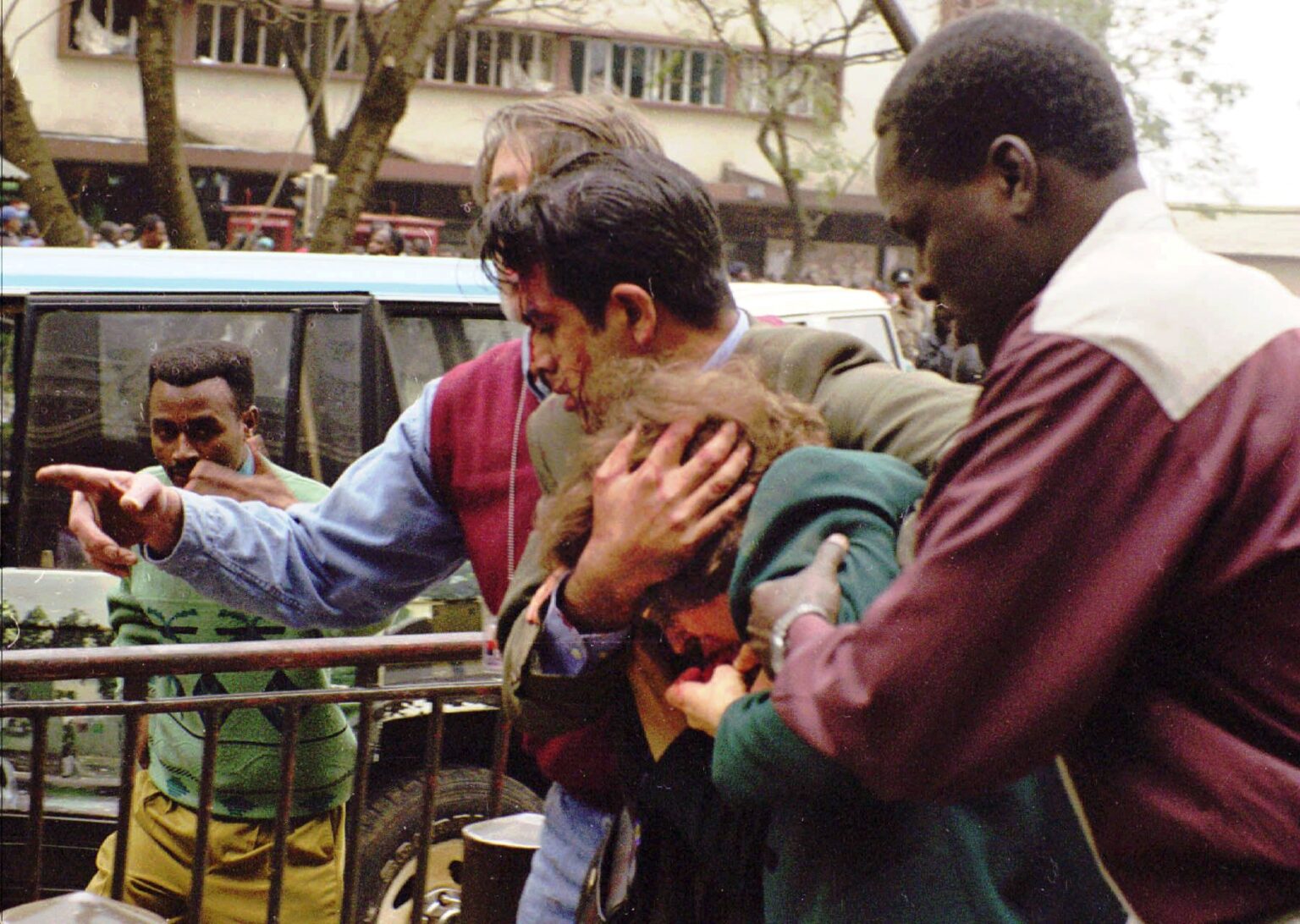
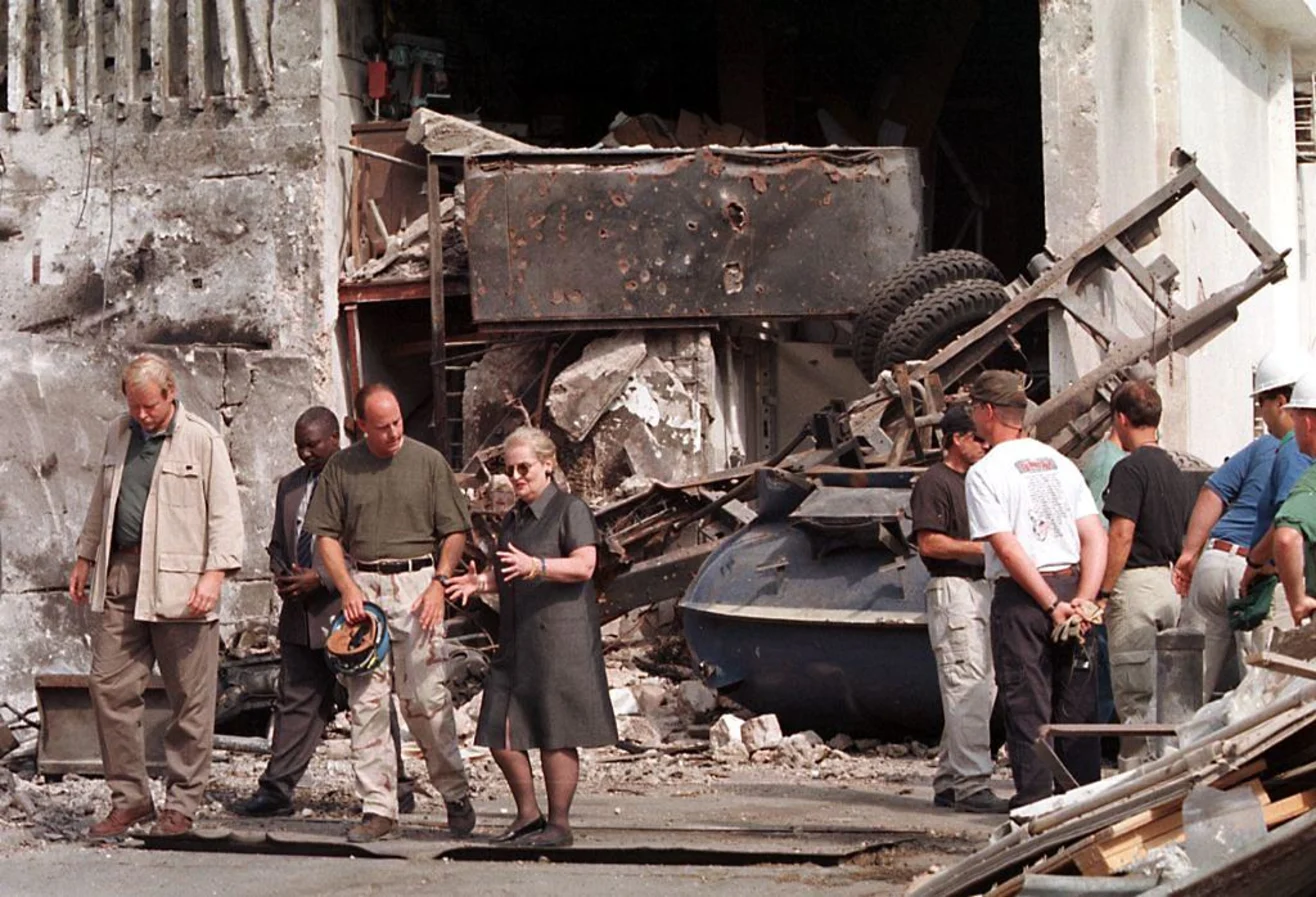
U.S. Ambassador Prudence Bushnell, center, is helped by unidentified men, as she is evacuated from the area of the U.S. Embassy following an explosion in downtown Nairobi, Friday, Aug. 7, 1998.
Bushnell has spent the years since turning that decision into a wider argument about institutional failure. In her 2018 memoir, Terrorism, Betrayal, and Resilience: My Story of the 1998 U.S. Embassy Bombings, she traces how intelligence agencies and policymakers had already been tracking Osama bin Laden’s Nairobi cell since 1996, yet the threat assessments and bureaucratic priorities in Washington failed to translate that scrutiny into protection on the ground. She has also noted that no congressional hearings followed the bombings and that the national security establishment conducted no broad after-action review. At the time, Congress was in recess, and Washington’s attention that week was consumed by the Clinton-Lewinsky scandal.
What the official inquiry found
The State Department’s own investigation, an Accountability Review Board chaired by retired admiral William Crowe, reached a more measured but still damning conclusion in January 1999. It found that security systems at both embassies generally met, and in places exceeded, the standard requirements set for posts rated at medium or low threat, but that those standards had simply never been built to withstand a large vehicle bomb. It also found that both the intelligence community and State Department policymakers had leaned too heavily on narrow, tactical intelligence to gauge the threat level at individual posts, rather than weighing the broader strategic picture building around al-Qaeda.
Despite documenting these systemic gaps, the Board stopped short of finding any individual government employee derelict in their duty, a conclusion that let the officials who turned down Bushnell’s request for a new chancery escape personal accountability, even as the report acknowledged the standoff problem directly contributed to the scale of the Nairobi casualties.
In Dar es Salaam, the picture was different. The Marine Security Guard detachment there had run bomb-response drills in the months before the attack and mobilised within minutes once the blast occurred, a response the review board credited for helping contain the chaos. The main operational failure flagged in Tanzania was logistical: Washington’s Foreign Emergency Support Team was delayed 24 hours in departing after a late decision to add a second aircraft, though the delay did not end up affecting the immediate crisis response.
Scene of the Tanzania bomb blast.
The aftermath that reshaped US diplomatic security
The bombings forced a rethink of how American missions abroad are built and guarded. Congress approved roughly $1.4 billion for new, more secure embassy construction, and the Diplomatic Security Service saw a 25 percent increase in staffing in the years that followed. Regional security officers were given new authority, reporting directly to ambassadors rather than through a longer chain of command. The families of victims also pushed for the creation of the State Department’s Office of Casualty Assistance in 1999, to support the relatives of Americans killed or injured overseas, an office whose recent closure Congressional leaders have criticised as a disservice to the legacy of the 1998 victims.
But as Bushnell has argued in the years since, much of that institutional memory faded fast. Three years later, the September 11 attacks eclipsed East Africa’s bombings in the American public consciousness, turning what should have been a foundational case study in ignored warnings into what she has called “little more than a historical footnote” in Washington.
Compensation, and the gap that remains
American victims and their families pursued compensation for years through US courts, arguing that Sudan and Iran had provided material support to al-Qaeda before the bombings. Federal judges awarded them billions of dollars in default judgments from 2014 onward, upheld on appeal in 2017, though sovereign immunity protections made actually collecting on those judgments difficult. That changed in 2020, when Sudan’s transitional government, seeking removal from Washington’s list of state sponsors of terrorism, agreed to pay $335 million to settle claims from the 1998 bombings alongside other attacks, including the USS Cole bombing.
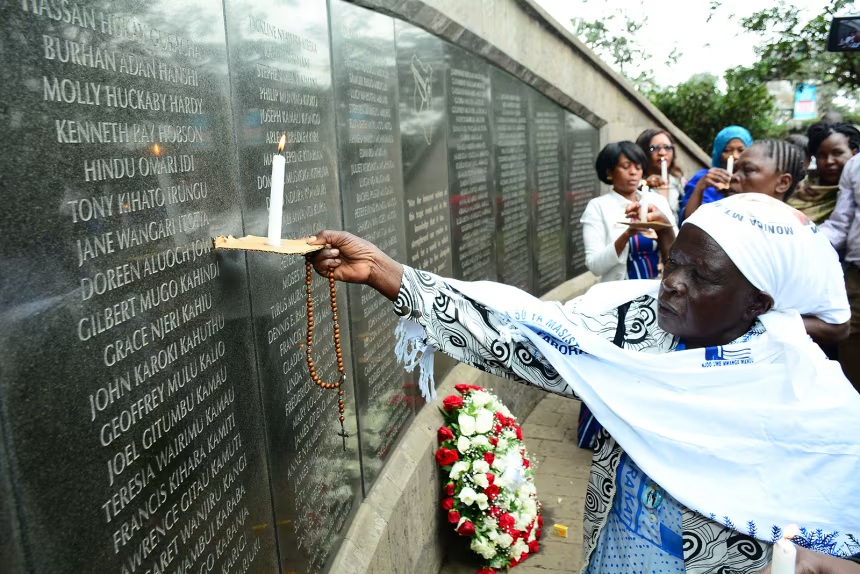
Margaret Achieng, who lost her daughter to the August 7, 1998 bombing of US Embassy in Nairobi seen praying at the August 7th Memorial Park in 2019.
The initial deal drew criticism for paying naturalised US citizens far less than those who held citizenship at the time of the attack, one advocacy estimate put the gap at roughly 8 percent, prompting Congress to pass the Sudan Claims Resolution Act that December, adding $150 million to narrow the disparity. According to a US Government Accountability Office review, the State Department ultimately found 78 people eligible for compensation under the Act, with individual payments ranging from $170,000 to $10 million.
For Kenyan and Tanzanian victims, who made up the overwhelming majority of the dead and wounded, the picture remains far less resolved. Of the 224 people killed, only 12 were American; most of the rest were Kenyans and Tanzanians killed on their own streets or at desks in nearby buildings, with 44 locally hired embassy staff among the dead. US law generally allows lawsuits against state sponsors of terrorism only on behalf of US citizens, government employees or contractors, which excludes most ordinary Kenyan bystanders from the same legal route available to American victims and locally hired embassy staff.
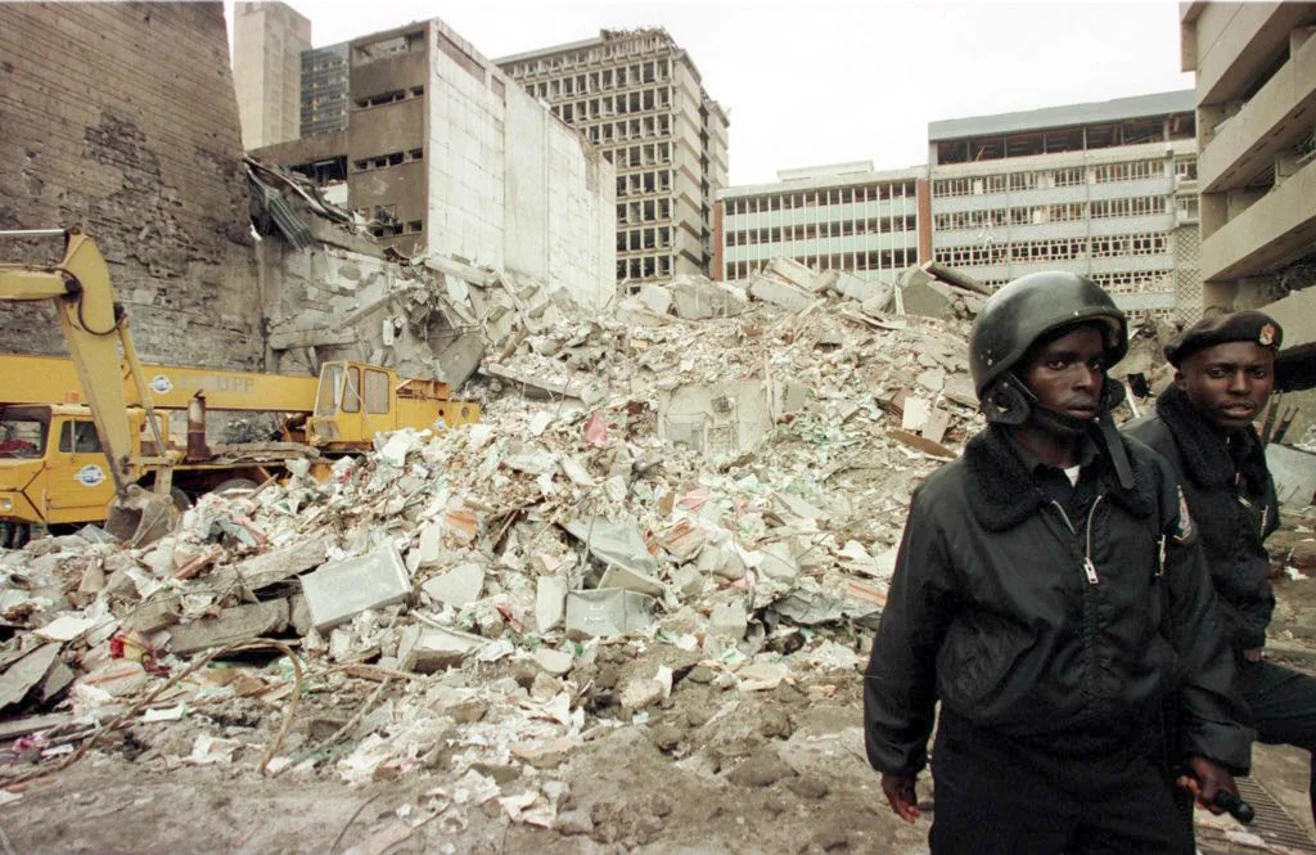
The blast on August 7, 1998 at the U.S. Embassy in Nairobi, Kenya, killed more than 200 people. Kenyan security guards keep watch on August 8, 1998, at the scene of explosion.
Survivors such as Douglas Sidialo, blinded in the Nairobi blast, have spent years appealing directly to Washington, including during President Barack Obama’s 2015 visit to Kenya, for compensation on humanitarian grounds. US officials have said Washington spent tens of millions of dollars assisting victims and families in the years after the bombing, but campaigners describe that assistance as ad hoc rather than a structured scheme comparable to what American victims eventually secured.
Doreen Oport, an American employee of the Nairobi embassy who was badly burned in the blast, put the disparity in blunt terms when the 2020 settlement terms became public:
“It’s unfair when they want to make us feel of a lesser value than Americans. It basically sets a value of human lives, both American and Kenyan… when basically, if it was not for Foreign Service Nationals doing the work, then these embassies or consulates would not stand. The work continues. Human lives should not have a value of who gets what and who doesn’t get what. We are all the same.”
Twenty-eight years on, that imbalance remains the East Africa bombings’ most visible unfinished business, as the legal and compensation framework continues to treat American and Kenyan lives lost in the same attack differently.
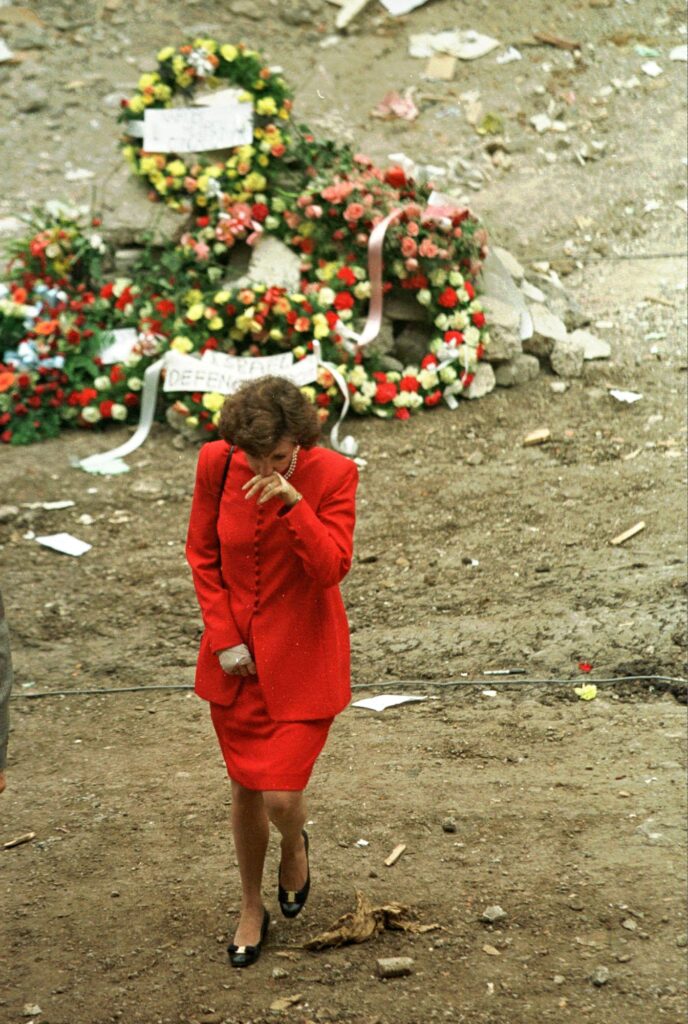
American Ambassador to Kenya Prudence Bushnell is overcome by emotion after laying a wreath at the site of the Nairobi U.S. Embassy bombing Wednesday, Aug. 12, 1998.
Marking the day in Nairobi
In Kenya, the memory has not faded the same way. The site of the old embassy on Haile Selassie Avenue is now the August 7th Memorial Park, opened in 2001, with a wall bearing the names of those who died. Survivors, victims’ families and government officials gather there every year to lay wreaths and light candles. Kenya’s National Counter Terrorism Centre typically marks the day with a renewed public pledge to prevent future attacks, and current and former US ambassadors have made a practice of attending the commemoration. Then-Secretary of State Antony Blinken laid a wreath at the memorial in 2021, and the US mission has continued the tradition at senior levels since.
For Bushnell, who returned to Kenya for the 20th and 25th anniversaries, the park itself has become part of the story she tells about recovery. Reflecting on the site in 2023, she called it “a green oasis on a busy street corner,” and the visible result of a Kenyan and American community that rebuilt after the attack and helped each other heal. Twenty-eight years on, the physical wound has become a green space in the middle of the city. The bureaucratic failure that helped cause it remains a cautionary tale in how governments weigh warnings against the cost of acting on them.
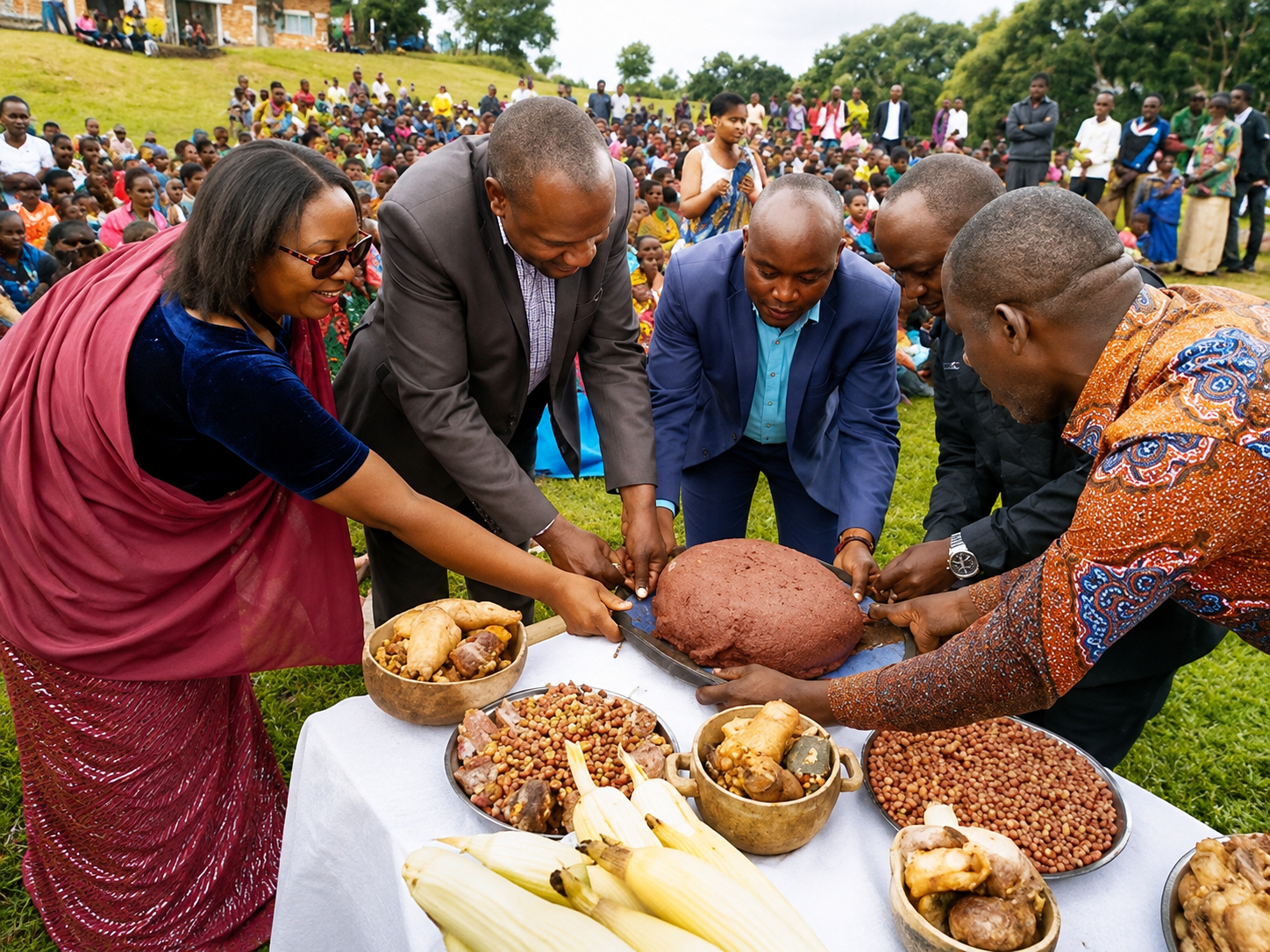
This is the spirit behind Umuganura, one of Rwanda’s oldest cultural traditions.
Celebrated every year on the first Friday of August, Umuganura is commonly described as Rwanda’s harvest festival. But calling it only a harvest festival does not fully capture its meaning.
For generations, Umuganura has been a time for Rwandans to give thanks, celebrate achievements, share with others, strengthen relationships and reflect on what they hope to accomplish in the future.
In 2026, Umuganura is being celebrated today on Friday, August 7.
The meaning and origin of Umuganura
The word Umuganura is linked to the idea of enjoying and celebrating the results of one’s work. Traditionally, it referred to the first harvest and the moment when people gathered to appreciate what they had produced after months of effort.
For Rwandans of the past, agriculture was at the centre of life. A successful harvest meant food, security and prosperity for families and communities.
However, Umuganura was not only about crops. It represented gratitude, unity and responsibility. It reminded people that achievements were the result of commitment, cooperation and respect for one another.
The tradition dates back centuries in Rwanda. Historical accounts describe Umuganura as one of the most important ceremonies in the traditional Rwandan kingdom. At the national level, the celebration was led by the King together with Abiru, royal ritualists who played a significant role in preserving traditional practices.
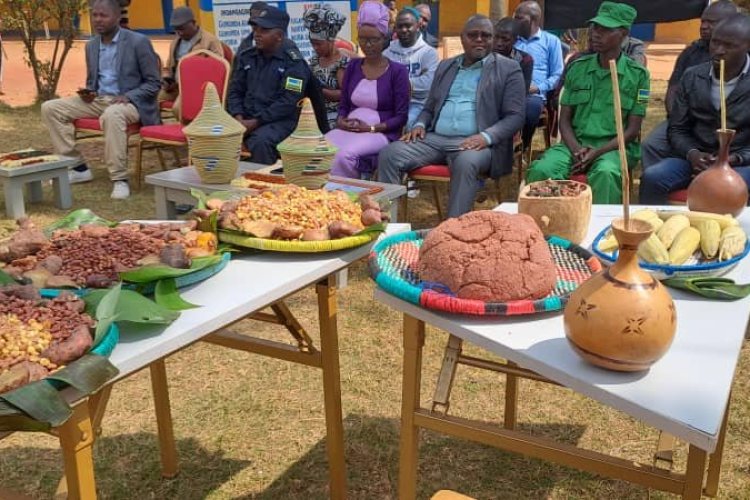
During the ceremony, the first produce from the harvest was presented as a symbol of prosperity and appreciation. Crops such as sorghum held an important place because they were among the products that represented abundance and wellbeing.
The celebration connected the success of individual families and communities with the prosperity of the entire kingdom.
How Umuganura was celebrated traditionally
Although Umuganura was recognized as a national celebration, it was also deeply rooted in family and community life.
Families gathered together to prepare and share food made from their harvest. Relatives and neighbours came together, stories were shared and people celebrated the results of their collective efforts.
Traditional music and dance were important parts of the celebration, creating an atmosphere of joy and togetherness.
One of the most important values behind Umuganura was sharing. A good harvest was not meant to benefit only one person or one family. People were encouraged to share what they had with others, especially members of their community.
This spirit of sharing reflected the belief that prosperity should contribute to the wellbeing of everyone.
Beyond celebration, Umuganura was also a moment of reflection. People looked at what they had achieved during the year and considered what could be improved in the future.
It was a time to celebrate yesterday’s achievements while preparing for tomorrow’s goals.
Rwandans gather to celebrate Umuganura, a tradition rooted in harvest, gratitude and togetherness at a past event.
The interruption and revival of the tradition
Like many cultural practices, Umuganura experienced changes throughout Rwanda’s history.
During the colonial period, the traditional ceremony was interrupted and eventually abolished in 1925. Since the celebration was closely connected to traditional institutions and cultural identity, its disappearance represented a significant loss in public cultural life.
For many years, Umuganura was no longer celebrated as a national tradition.
However, Rwanda later revived Umuganura as part of efforts to preserve and promote cultural heritage. In 2011, the celebration was officially restored as a public holiday, giving it a new place in Rwanda’s national calendar.
The modern Umuganura maintains the spirit of the traditional celebration while adapting to the realities of today’s Rwanda.
Umuganura in modern Rwanda
Today, the meaning of harvest has expanded beyond agriculture.
While farmers continue to celebrate the fruits of their work, Rwanda also uses Umuganura to recognize achievements in different areas, including education, business, technology, sports, culture, tourism and community development.
For a farmer, the harvest may be crops collected from the land.
For a student, it may be completing an education journey.
For an entrepreneur, it may be building a successful business.
For a community, it may be completing a development project that improves people’s lives.
This broader understanding has allowed Umuganura to remain relevant in a changing society.
The celebration encourages Rwandans to appreciate progress while remembering the importance of teamwork and determination.
Why Umuganura remains important today
One of the reasons Umuganura continues to hold importance is because it represents values that go beyond one day of celebration.
First, it promotes gratitude. It encourages people to recognize the effort behind every achievement instead of taking success for granted.
Second, it strengthens unity. By bringing families and communities together, Umuganura reminds people that progress is often achieved through cooperation.
Third, it preserves cultural identity. As younger generations learn about the tradition, they gain a deeper understanding of Rwanda’s history and values.
For young Rwandans, Umuganura provides an opportunity to connect with their heritage while also celebrating the achievements of their own generation.
The tradition shows that culture is not only about remembering the past. It is also about giving meaning to the present and inspiring the future.
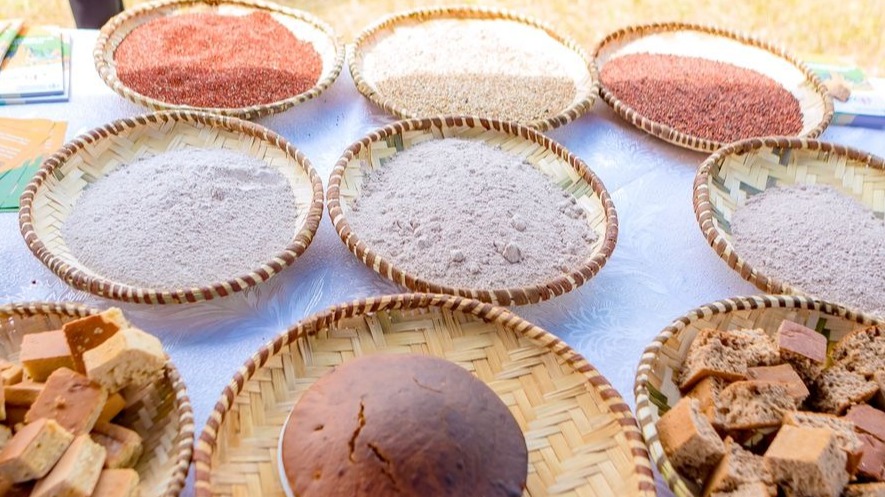
Fresh agricultural produce take centre stage during Umuganura, symbolising the fruits of hard work.Umuganura offers Rwandans a moment to appreciate their achievements, strengthen community bonds and celebrate together. Traditional Rwandan culture comes alive through music, dance and communal celebrations during Umuganura.
The latest enforcement action, announced on Thursday, marks the fourth list of local manufacturers affected by the nationwide operation. Rwanda FDA had previously closed 101 manufacturers in the first phase, followed by another eight in the second and 27 in the third.
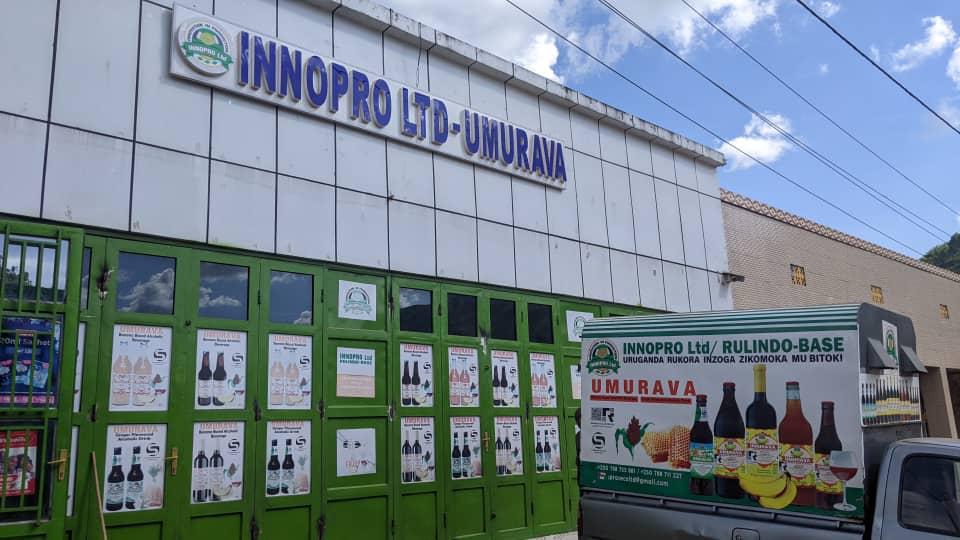
The newly closed manufacturers are INNOPRO Ltd, Rwamagana Banana Wine CPC Company Ltd, Inganzo Flower Drinks Ltd, ALKO Vintage R Ltd, CFRDTA Ltd, J.H Production Ltd, GACELEMUTERI Ltd, Urakire Business Center Ltd, WIPROCO, Ibyiwacu Product Ltd, EMEFRA Company Ltd and USALAMA Ltd.
Their products include a range of banana-based alcoholic beverages, ginger-flavoured alcoholic drinks, wines and other locally produced alcoholic beverages.
In a public announcement, Rwanda FDA said all manufacturing licenses associated with the facilities had been revoked with immediate effect and ordered the withdrawal of all products originating from the affected manufacturers.
The regulator instructed manufacturers to initiate a full product recall, work with distributors to retrieve products already supplied to retailers and consumers, and submit recall reports within three working days.
Distributors and retailers were ordered to immediately stop selling and distributing the affected products and return remaining stock to their suppliers, while consumers were advised to stop consuming the listed beverages immediately.
Rwanda FDA also directed that all advertisements and promotional materials for alcoholic beverages produced by manufacturers listed in the first, second, third and fourth enforcement notices be removed without delay.
“Non-compliance with all the above will result in measures under applicable regulatory provisions,” the regulator warned, adding that additional lists of manufacturers could be published as inspections and regulatory enforcement continue.
The latest action comes a day after the government suspended the importation of 52 alcoholic beverage brands from international markets, including Gilbeys Gin, Konyagi, Kiwingu and 49 other brands, and ordered their immediate nationwide recall.
The suspended products originate from Burundi, India, Kenya, Poland, Tanzania and Uganda, extending the crackdown beyond locally manufactured alcoholic beverages.
The ongoing enforcement campaign is part of government efforts to remove unsafe alcoholic beverages from the market and protect public health.
Speaking to IGIHE earlier this week, Minister of Health Dr. Sabin Nsanzimana said investigations had established links between unsafe alcoholic drinks and more than 50 deaths recorded between January and July.
He added that more than 500 people sought medical treatment after consuming the drinks, over 100 people lost their eyesight, and a nationwide assessment identified nearly 11,000 people struggling with alcohol addiction.
INNOPRO Ltd’s manufacturing plant in Rulindo District, Northern Province, Rwanda, is among those closed in the ongoing crackdown.
In a performance update issued on August 5, BNR Governor Soraya Hakuziyaremye said eKash has maintained an average transaction success rate of 98.6%, highlighting the growing use of interoperable digital payments across Rwanda’s banking and mobile money ecosystem.
The central bank boss also revealed that the number of active users of interoperable digital payment services increased by 166% within weeks of the launch, rising from 740,787 users during the corresponding period in June to 1,971,522 by the end of July.
The central bank attributed the strong uptake to public confidence in the new payment system and thanked customers for their trust and constructive feedback, noting that user input has helped identify areas requiring further refinement.
While the majority of transactions have been completed successfully, NBR acknowledged that some customers experienced delays and failed transactions during the initial rollout.
The regulator said participating financial institutions and the system operator are working under its oversight to resolve the issues, with ongoing measures aimed at strengthening system performance and improving customer service.
“NBR acknowledges the positive response to eKash and thanks the public for their continued trust and constructive feedback, which has contributed to the ongoing improvement of the service,” the governor said in a statement.
She added that a nationwide public awareness campaign is underway to help the public better understand the interoperable instant payment system and the changes it introduces.
Customers who experience challenges while using eKash have been encouraged to first contact their bank or mobile money provider for assistance.
“If the issue is not resolved, they may submit a complaint to the National Bank of Rwanda through the Intumwa chatbot, available via SMS (6005), WhatsApp (+250791700721), and NBR website and official social media platforms,” the governor added.
Launched nationwide on July 14, the unified national digital payment system enables instant person-to-person transfers between bank accounts and mobile wallets across licensed financial institutions, regardless of the service provider.
The interoperable platform allows customers to transfer money from a bank account to a mobile wallet, from a mobile wallet to a bank account, or between accounts and wallets held with different financial institutions without opening new accounts or downloading additional applications.
NBR has capped the maximum transfer amount at Rwf 10 million per transaction, while the highest fee that financial institutions can charge customers is Rwf 20 per transfer, although providers are free to charge less or waive the fee altogether.
The central bank expects eKash to strengthen Rwanda’s payment ecosystem by making digital transactions faster, more accessible and affordable, while advancing financial inclusion across the country.
Governor Hakuziyaremye affirmed that the regulator will continue working with banks, electronic money issuers and other stakeholders to ensure eKash delivers a secure, reliable and seamless payment experience for all users.
In a performance update issued on August 5, BNR Governor Soraya Hakuziyaremye said eKash has maintained an average transaction success rate of 98.6%, highlighting the growing use of interoperable digital payments across Rwanda’s banking and mobile money ecosystem.
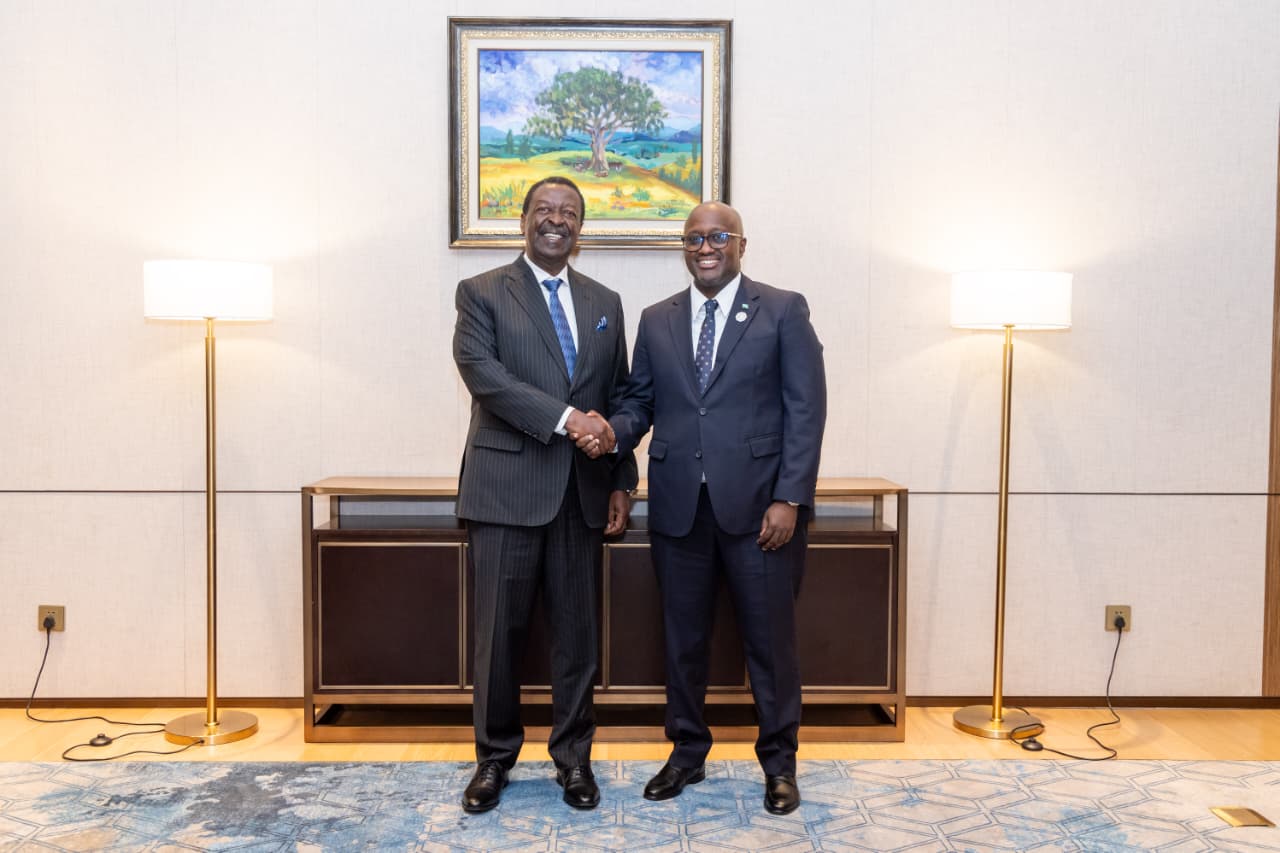
Kenya’s Prime Cabinet Secretary and Cabinet Secretary for Foreign and Diaspora Affairs, Musalia Mudavadi, announced the approval during bilateral talks with Rwanda’s Minister of Foreign Affairs and International Cooperation, Olivier Nduhungirehe, in Addis Ababa.
“The Kenyan Cabinet approves the movement of about 40,000 metric tonnes to Rwanda through our pipeline from Mombasa. We are committed to ensuring a deeper relationship with our neighbours,” Mudavadi said.
The agreement will allow Rwanda to use Kenya’s petroleum infrastructure, including the pipeline network connecting the Port of Mombasa, to facilitate the movement of fuel imports.
Nduhungirehe said the arrangement will help stabilise Rwanda’s fuel supply and support smooth operations across the economy.
“That will be about 52 million litres, which is about our consumption in a month. It will serve us well,” he said.
Rwanda, a landlocked country, relies on neighbouring countries for access to international fuel markets. The country has been working to diversify petroleum import routes through agreements with Kenya and Tanzania to improve supply reliability and strengthen energy security.
In June 2026, Rwanda signed a cooperation agreement with Kenya to facilitate petroleum imports through the Port of Mombasa, granting access to storage facilities, transportation services and distribution infrastructure.
Rwanda later signed a similar agreement with Tanzania in July to import petrol and diesel through the Port of Tanga.
The agreements are part of efforts to expand Rwanda’s petroleum supply network amid global fuel market uncertainties while also positioning the country to participate more actively in regional petroleum trade.
Earlier this month, Minister of Trade and Industry Antoine Marie Kajangwe said the agreements with Kenya and Tanzania could create opportunities for Rwanda to become a regional fuel distribution hub.
“We believe this can strengthen regional trade, allowing Rwanda, given its geographical position, to supply petroleum products to neighbouring countries. Our goal is to have sufficient petroleum products that can meet demand in Rwanda and also serve markets in the region,” Kajangwe said.
Mudavadi said Kenya’s decision to facilitate fuel transit to Rwanda demonstrates the two countries’ commitment to regional integration and shared prosperity.
He added that Kenya remains focused on strengthening regional partnerships and advancing Africa’s role in international institutions. During the talks, Mudavadi also sought Rwanda’s support for Kenyan candidates seeking positions at the International Court of Justice (ICJ) and the International Criminal Court (ICC).
Kenya’s Prime Cabinet Secretary and Cabinet Secretary for Foreign and Diaspora Affairs, Musalia Mudavadi, announced the approval during bilateral talks with Rwanda’s Minister of Foreign Affairs and International Cooperation, Olivier Nduhungirehe, in Addis Ababa.