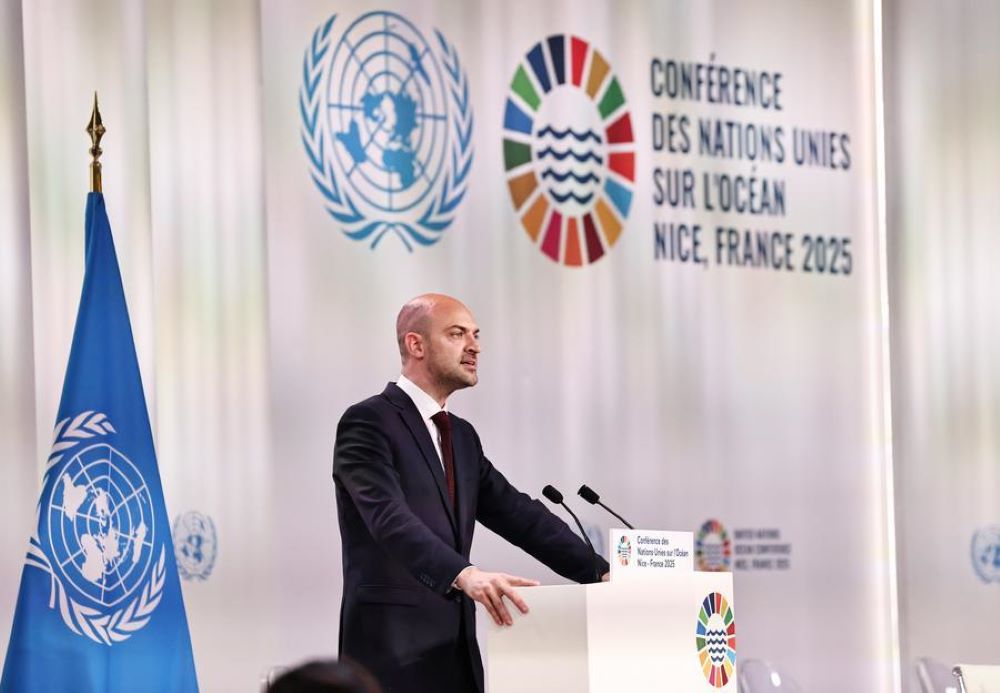
In his remarks to the UN General Assembly on the UN80 Initiative, Guterres said: “Now is the time for bold, systemic change, building on the Humanitarian Reset: to deliver faster, at lower cost and with greater reliability to the millions of people whose lives depend on us in moments of crisis.”
With this goal in mind, the UN chief said, the United Nations has established a New Humanitarian Compact between UN humanitarian agencies — a six-point blueprint to deliver better, restore trust in multilateral action and maximize the impact of every dollar.
“The Compact will bring the UN system together in a new Collaborative Humanitarian Diplomacy Initiative — fostering coordinated negotiation and unified messaging, so that we speak and act as one for those in greatest need,” he said.
Guterres highlighted the measures to be taken, including cutting coordination bureaucracy by simplifying humanitarian response plans, meetings and structures; integrating the supply chains of the principal humanitarian agencies, enabling more cost-effective procurement, pooled freight and shared logistics at global and country levels; and proposing to scale up the use of common services, from office space to fleets and security arrangements.
“Everything that is specific of the activity of an agency should be developed by the agency, but everything that is common should be done together with a larger increase of efficiency and a meaningful reduction of costs,” he said.
Guterres added that the United Nations will strengthen its joint capacities to leverage data for faster, earlier, more targeted and dignified action, and align responsibilities to reduce programmatic overlaps in the fields of food, mobility, beneficiary data, health and nutrition.
In his speech, Guterres also said that to implement the UN80 Initiative, the United Nations has identified targeted efficiencies and cost reductions of over 15 percent in the proposed 2026 regular budget, and about 19 percent in posts. “The purpose is clear: to reduce duplication, strengthen quality and safeguard mandate delivery while responding to Member States’ call for greater efficiency.”
The United Nations has appealed for more than 45.3 billion U.S. dollars for its global humanitarian needs in 2025, but only 21 percent, or 9.6 billion dollars, had been received as of the end of September, a staggering decrease of over 40 percent compared to the same time last year, a UN spokesperson said Tuesday.
This represents a 22.5 percent increase compared to the previous year. Together, they account for 67.4 percent of all regulated financial assets, meaning the banking sector controls roughly two-thirds of the country’s financial system and remains central to Rwanda’s financial stability and growth.
At the core of this expansion are Rwanda’s nine commercial banks: I&M Bank Rwanda Plc, Bank of Kigali Plc, BPR Bank Rwanda Plc, GT Bank Plc, Ecobank Rwanda Plc, Access Bank Rwanda Plc, Equity Bank Rwanda Plc, BOA Rwanda Plc, and NCBA Rwanda Plc. Combined, they manage assets valued at Frw 7.7 trillion.
Their growth has been driven by strong lending activity and solid deposit mobilisation, reflecting a buoyant domestic economy. Customer deposits rose by 27.7 percent to Frw 6.1 trillion, providing a stable funding base for lending. Using these funds, banks expanded their net loans to customers by 17.8 percent, reaching Frw 4.8 trillion.
This sustained credit flow is supporting households and businesses in key sectors such as construction, trade, manufacturing, transport, and hospitality, helping to fuel economic activity across the country.
Rwanda’s banks have also strengthened their financial foundations. Liquidity positions improved significantly, with cash holdings up by 48.1 percent, balances in other banks rising by 39.8 percent, and reserves at the National Bank of Rwanda increasing by 30.4 percent. These indicators point to improved resilience and the ability to withstand potential financial shocks.
The sector’s capital position is also stronger. Total shareholders’ funds rose by 36.1 percent to FRW 1.8 trillion, driven by a 73.1 percent increase in reserves and a 21.6 percent rise in profits, which reached Frw 161 billion. This capital growth enhances lending capacity and provides an important buffer against possible economic disruptions.
While commercial banks dominate in size, specialised institutions continue to play a critical role. The Cooperative Bank, ZIGAMA CSS, manages Frw 1.1 trillion in assets and supports community-based financial services.
The Rwanda Development Bank (BRD) also expanded its balance sheet to Frw 902.6 billion as it focuses on financing large-scale and long-term investment projects. Together, these institutions complement the commercial banks’ activities and contribute to a more inclusive financial ecosystem.
{{Lower borrowing costs boost credit
}}
The banking sector is also benefiting from improved monetary conditions. Following recent reductions in the Central Bank Rate, the weighted average lending rate dropped by 37 basis points to 15.93 percent, making credit more affordable for businesses and households. This has encouraged borrowing and stimulated investment across multiple sectors.
Rwanda’s banking industry is therefore not only expanding in size but also building greater financial strength. With strong deposit growth, rising loan portfolios, and a solid capital base, the sector is well-positioned to support the country’s ongoing economic transformation. These 11 institutions are shaping Rwanda’s financial landscape and powering its ambition for sustained and inclusive growth.
At the heart of Spark Microgrants’ mission lies the Facilitated Collective Action Process (FCAP), a model that empowers communities to organize, plan, and lead their own development.
Yet, as the realities and priorities of these communities evolve, the methods that support them must also adapt.
Recognizing this, Spark launched the Design Fellowship Program, an initiative that transforms experienced Community-Based Facilitators (CBFs) into strategic designers and innovators of process.
For Fellows like Fyson, Mustapher Saidi from Malawi, Sam Namusi (Uganda), Alexis Mbarushimana (Rwanda), and Innocent Nditurende (Rwanda), the fellowship represents a transformative step forward.
“As a CBF, I facilitated weekly sessions. As a Design Fellow, I now help refine the FCAP process and test tools like chatbots,” says Fyson.
Saidi echoes this sentiment, adding, “The fellowship opened my mind. I now work across communities and learn from different realities.”
The fellowship is not merely a title; it’s a platform for practical growth and hands-on learning. Through it, Fellows gain valuable skills in digital literacy, research, facilitation, and community design.
Fyson Ekani from Lilongwe, Malawi, now confidently uses digital tools like Google Meet, Excel, and Sheets while leading focus group discussions and mentoring peers. Saidi and Sam have strengthened their research and coordination skills, and Mbarushimana has refined his abilities in planning, reporting, and analysis.
These newfound competencies are not confined to theory. Fellows apply them daily as they test prototypes, advise on design improvements, and generate insights that guide Spark’s national strategies.
“It taught me how to be independent and set smart goals,” says Saidi.
“I’ve learned to manage conflict and support others,” adds Fyson.
The impact of the Design Fellows extends far beyond their personal growth. Across Spark-supported communities, their influence is tangible.
Fyson helped initiate manure production and tree-planting projects, while Saidi revived a long-stalled maize mill initiative and spearheaded reforestation efforts.
Sam has supported agricultural programs across fifteen sub-counties while piloting new feedback tools. Mbarushimana and Nditurende have guided livestock projects and promoted vital health initiatives, such as insurance enrollment and household improvements.
These stories reveal how the Design Fellows are not just guiding communities but are also testing, adapting, and scaling locally led projects that deliver real results.
“Whenever I was stuck, I got help from my trainers or fellow Design Fellows,” recalls Sam. “The fellowship made me feel part of something bigger,” adds Fyson.
Beyond immediate community change, the Design Fellowship is nurturing the next generation of local leaders. Fyson aspires to become a Trainer, while Saidi and Sam are eager to pursue further opportunities in research and facilitation.
Alexis dreams of enhancing his digital design skills, and Innocent, now a Trainer himself, reflects on his transformation: “The program gave me the confidence and skills I needed to grow.”
Through ongoing mentorship, peer learning, and feedback, the Fellows continue to evolve, charting new paths in leadership while inspiring others to do the same.
What makes the Design Fellowship truly remarkable is its belief that innovation begins within communities themselves.
By blending field experience with creative design thinking, Spark Microgrants is building a network of leaders who are redefining the meaning of sustainable development.
The Design Fellows are not only facilitators of progress; they are co-creators of a movement where communities take the lead in designing their own future.
The event held on Tuesday, October 14, served as a powerful platform to present Rwanda’s rich tourism offerings, including unique travel packages created by local tour operators, to travel agencies and industry professionals in Germany’s Rhine region.
The afternoon sessions brought together a diverse group of travel agencies and tour operators eager to explore Rwanda’s diverse tourism potential.
Kageruka Ariella, Head of Tourism at RDB, captivated the audience with in-depth presentations on Rwanda’s flagship experiences.
These include the renowned gorilla trekking adventures in Volcanoes National Park, breathtaking wildlife safaris, vibrant cultural circuits across Kigali and rural communities, and the country’s commitment to sustainable tourism.
The presentation also spotlighted the country’s high-end accommodations and eco-tourism offerings, showcasing Rwanda’s blend of adventure, luxury, and sustainability.
Rwanda’s Ambassador to Germany, Igor César, welcomed the attendees, emphasizing Rwanda’s unique assets and the abundant opportunities available for German tour operators and travel agents.
The event also featured tailored, modular travel packages designed for both the German and Dutch markets. These packages cater to a wide range of travelers, from solo adventurers and families to groups and corporate travelers, ensuring that Rwanda’s offerings appeal to all.
This roadshow marks an important step in Rwanda’s mission to enhance its visibility as a prime tourism destination in Europe, with a focus on both increasing tourist arrivals and maintaining the high-quality, sustainable tourism experience that the country is known for.
The $274.5 million transaction, initially announced in May 2025, transfers ownership of approximately 1,467 tower sites across the country to Paradigm, establishing it as Rwanda’s leading independent tower operator. The sites underpin the mobile networks that connect more than 5.3 million Rwandans to essential services such as mobile money and digital communications.
Backed by a consortium of international investors, including Convergence Partners, British International Investment (BII), and Proparco, Paradigm Tower Ventures aims to enhance connectivity and lower the cost of cellular services across Rwanda and the region. The deal was arranged and financed by Rand Merchant Bank, a division of FirstRand Bank Limited.
Paradigm said the acquisition would help improve network quality and affordability, driving digital inclusion in line with Rwanda’s national digital transformation goals. Research indicates that a 10 percent increase in mobile penetration can raise GDP per capita by 2.5 percent in African economies.
Stephen Harris, co-founder and chairman of Paradigm, said the company was “delighted to be expanding into the Rwandan market,” pledging to improve infrastructure efficiency and sustainability.
“Our focus is to improve existing infrastructure to be more efficient and environmentally friendly, alongside facilitating the improvement of mobile network coverage and connectivity,” he said.
Andile Ngcaba, Founder and Chairman of Convergence Partners, said the investment represents “the kind of opportunity where shared conviction, capable partners and sound fundamentals come together to create lasting value across the Continent.” He added that the platform would serve as “a critical enabler” for emerging data, cloud, and AI-driven services in Africa.
Abhinav Sinha, Managing Director and Head of Technologies, Telecoms and Sustainable Industrials at BII, said the investment underscores a commitment to bridging Africa’s digital divide.
“By enabling affordable, high-quality connectivity, we’re helping unlock opportunities for millions, whether it’s a student accessing online learning, a small business owner using mobile payments, or a healthcare worker connecting with remote communities,” he stated.
Djalal Khimdjee, Deputy Chief Executive Officer of Proparco, said the transaction reflects the organisation’s “trust and continued support” for Convergence and its mission to expand digital coverage across Africa.
Paradigm’s entry into Rwanda reflects investor confidence in the country’s stable policy environment and strong demand for connectivity. Beyond this initial acquisition, the company plans to build and operate additional carrier-neutral tower assets, supporting mobile operators in expanding coverage and accelerating digital inclusion across Africa.
The list, approved by the National Counter-Terrorism Committee, was prepared under the Prime Minister’s Order No. 001/03 of 22 January 2025. It highlights figures alleged to have led or financed attacks, recruited fighters, or promoted extremist propaganda targeting Rwanda.
According to the document, those designated are linked to the Democratic Forces for the Liberation of Rwanda (FDLR), Rwanda National Congress (RNC), and the Conseil National pour le Renouveau et la Démocratie – Forces de Libération Nationale (CNRD–FLN), among others.
Below is a list of the cited individuals and the charges against them.
{{1. Lt Gen Gaston Iyamuremye (76)}}
Known also as Victor Byiringiro, he is the president of FDLR, accused of planning and coordinating terror attacks against Rwanda, extorting civilians, and financing terrorism through illegal taxation and mineral smuggling in eastern DRC.
He is listed under UN Resolutions 1533 and 2078 and the U.S. Executive Order 13413.
{{2. Maj Gen Pacifique Ntawunguka (61)}}
Alias Omega, commander of FDLR–FOCA, accused of orchestrating cross-border terrorism, resource plundering, and illegal taxation to fund FDLR operations. He is sanctioned by the UN and U.S. authorities.
{{3. Col Sylvestre Sebahinzi (64)}}
Alias Zinga Zinga ZZ, based in Lusaka, Zambia, and a nephew of former president Juvénal Habyarimana.
He is accused of commanding FDLR terror operations (2006–2009), raising funds in Southern Africa, and overseeing executions in FDLR “kangaroo courts.”
{{4. Maj Alphonse Munyarugendo (59)}}
Alias Monaco Dollar, a long-serving FDLR member, coordinating fundraising and logistics for terror activities in the SADC region from Maputo, Mozambique. He was among the founders of ALIR, precursor to the FDLR.
{{5. Faustin Ntirikina (68)}}
Alias Zigabe Pacifique, a French national of Rwandan origin, found guilty in case No. RP0038/2018/HC/HCI for recruiting youth into terror groups including RUD-Urunana and FLN. He is also accused of masterminding the 2019 Kinigi attacks that killed several civilians.
{{6. Maj Gen Antoine Hakizimana (54)}}
Alias Jeva, military chief of CNRD–FLN, accused of planning and financing the Nyaruguru and Kitabi attacks against Rwanda from his base in Bujumbura, Burundi.
{{7. Eric Munyemana (53)}}
A Belgian national and vice president of FLN, responsible for fundraising and coordination of terrorist operations, according to FIC intelligence reports.
{{8. Dr Innocent Biruka (61)}}
Alias Mitali, secretary general of CNRD–FLN, based in Mulhouse, France.
He was found guilty in the same case as Ntirikina for recruiting youth into the P5 coalition. He also claimed responsibility for the 2018 FLN attack on Yanze model village.
{{9. Gen Faustin Kayumba Nyamwasa (67)}}
A founding member of the RNC, living in Pretoria, South Africa, and cited as the architect of grenade attacks in Kigali between 2010 and 2013. He is accused of leading the RNC’s military wing and coordinating terror financing. Court documents link him to FDLR commanders and the UN Group of Experts report (2010).
{{10. Dr Emmanuel Hakizimana (62)}}
A co-founder of RNC, currently in Canada, accused of mobilizing funds and recruiting operatives for RNC and MRCD, another armed opposition group.
{{11. Abdulkarim Ali Nyarwaya (57)}}
Alias Dick Nyarwaya, a UK-based British national, accused of fundraising and supporting P5’s terror campaigns in collaboration with Kayumba Nyamwasa.
{{12. Maj Robert Higiro (55)}}
Alias Gasisi, based in Nairobi, accused of coordinating RNC activities, training recruits, and fundraising for the movement’s operations in the region.
{{13. Frank Ntwali (47)}}
RNC’s representative in Southern Africa, accused of liaising with FDLR and coordinating recruitment and fundraising for RNC’s military operations.
{{14. Ignace Rusagara (39)}}
Spokesperson for RNC in the United States, accused of promoting FDLR objectives, spreading propaganda, and inciting anti-Rwanda sentiments online.
{{15. Jean Paul Turayishimiye (53)}}
A U.S.-based court interpreter and founder of Rwanda Alliance for Change (RAC–Urunana).
He is accused of using his YouTube channel East African Daily to incite terrorism, organize fundraising, and recruit members under the P5 umbrella.
{{16. Gaspard Musabyimana (70)}}
A Belgium-based businessman and founder of Radio Inkingi and musabyimana.net, accused of funding FDLR propaganda and using his media platforms to spread hate speech and justify terror attacks.
{{17. Placide Kayumba (44)}}
Based in Namur, Belgium, accused of forming alliances between FDU–Inkingi and FDLR, and financing terrorism against Rwanda.
{{18. Augustin Munyaneza (62)}}
A Brussels-based taxi driver, alleged to be a sympathizer and fundraiser for FDLR–FOCA and P5 activities targeting Rwanda.
{{19. Michel Niyibizi (69)}}
A teacher in Tournai, Belgium, accused of coordinating fundraising and sanctioning terror plots on behalf of FDLR–FOCA and P5.
{{20. Jonathan Musonera (61)}}
A London-based RNC member, accused of inciting violence and mobilizing funds for RNC’s armed operations, as well as publicly supporting FDLR attacks.
{{21. Dr Theogene Rudasingwa (64)}}
A Washington-based RNC leader, accused of masterminding grenade attacks in Rwanda (2010–2013) and forging the RNC–FDLR collaboration. He is a former senior government official and ambassador.
{{22. Maj Jacques Kanyamibwa (68)}}
Based in Toulouse, France, accused of funding terrorism, recruiting online, and participating in the planning of the 2019 Kinigi attacks in Musanze District.
{{23. Thomas Nahimana (54)}}
Thomas Nahimana is the President of the ISHEMA Party and operator of the Isi n’Ijuru TV YouTube channel.
He is accused of inciting terrorism and coordinating activities with FDLR–FOCA leaders from his base in Le Havre, France.
{{24. Christine Coleman Uwizera (53)}}
A Denver-based pastor and supporter of FLN, accused of inciting violence against Rwanda through her X (Twitter) account, @SOS_Rwanda, and promoting FLN and P5 propaganda.
{{25. Sylvestre Nduwayezu (53)}}
Alias Jet Lee, based in Kampala, Uganda, accused of recruiting fighters, coordinating arms purchases, and planning terror attacks in connection with RUD-Urunana and P5.
Officials say the move reflects Rwanda’s intensified efforts to disrupt terrorist networks and cut off their financing channels, especially those operating abroad.
Analysts note that many of the named individuals have long been under international scrutiny for links to armed groups operating in the Democratic Republic of Congo and neighboring states.
AFC/M23 spokesperson, Lawrence Kanyuka, said on the morning of October 15, 2025, that the attacks were conducted in coordination with other armed groups and militias allied with the FARDC, including the Wazalendo coalition.
“AFC/M23 informs citizens and the international community that, as has often been the case, the coalition of forces under Kinshasa’s command launched heavy bombardments on densely populated areas and on our positions in South and North Kivu, just hours after the ceasefire mechanism was signed in Doha on October 14, 2025.”
Kanyuka explained that other AFC/M23 positions also came under ground assaults, including Kadasomwa and Lumbishi in Kalehe territory, South Kivu Province, as well as Kasake in Masisi territory, North Kivu Province.
The DRC government forces launched these attacks in AFC/M23-controlled zones shortly after representatives from both sides signed an agreement on Tuesday, October 14, in Doha establishing a joint ceasefire monitoring and verification mechanism aimed at consolidating peace efforts in the country’s volatile east.
Facilitated by the State of Qatar, the agreement builds on the Doha Declaration of Principles signed on July 19, 2025, and outlines a structured process for monitoring compliance with the permanent ceasefire. The mechanism will be responsible for investigating and verifying alleged violations and engaging relevant actors to prevent renewed hostilities.
This was considered a significant step forward, aimed at helping both sides continue dialogue without obstacles and ultimately reach a lasting peace accord.
Kanyuka has emphasized that, beyond endangering civilians, the government coalition’s attacks undermine ongoing peace efforts.
Born on January 7, 1945, in Maseno, Nyanza Province, Raila Odinga was the son of Jaramogi Oginga Odinga, Kenya’s first Vice President and a key figure in the country’s independence movement. His father’s legacy shaped Raila’s political consciousness from an early age.
Odinga pursued technical studies in East Germany in the 1960s, training as a mechanical engineer before returning to Kenya to teach and later work at the Kenya Bureau of Standards. His professional career soon gave way to political activism, as he became increasingly involved in the struggle for democracy during the one-party era.
Odinga was arrested and charged with treason after being accused of being among the masterminds of the 1982 coup attempt to overthrow the government of then-President Daniel Arap Moi.
He was released six years later in February 1988, but detained again in August that year to be released in June 1989.
In the 1990s, Odinga was elected Member of Parliament for Lang’ata and emerged as one of the most vocal proponents of multi-party democracy. His persistence positioned him at the heart of Kenya’s pro-reform movement, earning both admiration and criticism for his defiance of entrenched political power.
Odinga’s first presidential bid came in 1997, marking the beginning of a long series of campaigns for the country’s highest office. His 2007 election battle against then-President Mwai Kibaki was one of Kenya’s most contested polls, sparking post-election violence that claimed more than 1,200 lives. The crisis was resolved through a power-sharing deal that made Odinga Prime Minister under a coalition government from 2008 to 2013.
During his tenure, Odinga played a crucial role in the formulation and adoption of Kenya’s 2010 Constitution, a landmark reform that devolved power and strengthened democratic institutions. Despite further presidential bids in 2013, 2017, and 2022, he never attained the presidency but remained an enduring symbol of opposition and reform.
From 2018 to 2023, Odinga served as the African Union High Representative for Infrastructure Development in Africa, further cementing his influence on the continental stage.
In 2022, he contested the presidency against William Ruto and challenged the results in court. The outcome was upheld, sparking protests from the opposition.
At the height of Gen Z economic-related protests in 2024, Odinga joined forces with President Ruto to form a broad-based government, resulting in several of his allies being appointed to key positions. In response to growing criticism, he later explained that his decision was motivated by the need to quell potential political instability.
He also campaigned for the African Union Commission Chairperson position in 2024–2025 but lost to Mahamoud Ali Youssouf of Djibouti.
Raila Odinga is survived by his wife, Ida Odinga, and their children: Rosemary, Raila Jr., and Winnie. His eldest son, Fidel Odinga, passed away in 2015.
Raila Odinga’s passing marks the end of an era in Kenyan politics, that of a resilient statesman whose quest for democracy, social justice, and good governance reshaped his country’s political landscape.
The event, renowned for attracting top emerging professional golfers from across the UK, provided Nsanzuwera an opportunity to test his skills on one of Scotland’s most historic and challenging courses.
According to the official Tartan Pro Tour leaderboard, he appeared on the entry list, completed all rounds, and made the cut to play in the final round, demonstrating both skill and consistency against a highly competitive field. Preliminary results indicate he finished approximately three under par (-3).
In addition to his tournament play, Nsanzuwera had the unique opportunity to train and practice at the Golf Academy at St Andrews Driving Bays, one of the world’s premier golf training facilities.
This experience allowed him to refine his technique, interact with international professionals, and immerse himself in the rich golfing culture of Scotland, often celebrated as the “Home of Golf.”
“Celestin’s dedication and recent successes continue to bring pride not only to Kigali Golf Resort & Villas but also to the entire Rwandan golf community,” said a spokesperson from the Communications Office. “His participation at Duddingston and training at St Andrews exemplify the growing international presence of Rwandan golfers.”
Celestin Nsanzuwera’s appearance at the Duddingston Classic follows a remarkable 2025 season, including victories at the Rwanda Golf Open, the Sunshine Development Tour (East Africa Swing), and the Johnnie Walker Uganda Professional Open, reinforcing his position as Rwanda’s most prominent professional golfer.
Based at Kigali Golf Resort & Villas, Celestin Nsanzuwera is a professional golfer recognized for his precision, composure under pressure, and dedication to representing Rwanda on international golf circuits.
They made the call during the official opening of the Second Africa Skills Week, which is jointly organized by the African Union (AU) and the Ethiopian Ministry of Labor and Skills under the theme “Powering Africa’s Industrial Future: Skills for Innovation, Growth, and Sustainability,” running from Monday to Friday at the AU headquarters in the Ethiopian capital, Addis Ababa.
Addressing the event, AU Commission Chairperson Mahmoud Ali Youssouf emphasized the strategic importance of skills development to advance inclusive growth, create decent jobs, and realize the African Continental Free Trade Area Agreement.
“The urgency of skilling our youth cannot be overstated. We must convert our demographic dividend into a productive, inclusive, and globally competitive workforce. This is why the African Union has placed skills at the heart of Agenda 2063,” he said.
Youssouf also outlined key imperative actions, including harnessing the transformative potential of artificial intelligence and strengthening policy coherence and regional integration for skills development.
The continental gathering brought together policymakers, experts, industry leaders, educators, development partners, and young innovators to deliberate on skills development and youth empowerment across the continent. The event also witnessed the official launch of the 10-year Continental Technical and Vocational Education and Training (TVET) Strategy 2025-2034.
“We are not simply discussing the future. We are here to build foundations that will drive our ambitions and aspirations. The crucial and key force that transforms Africa’s potential into economic power is skill,” said Ethiopian Minister of Labor and Skills Muferihat Kamil.
The Second Africa Skills Week is a platform dedicated to advancing Africa’s skills transformation agenda, focusing on strengthening skills for industrial growth, enhancing TVET, and fostering public-private partnerships.
Zhang Wei, charge d’affaires at the Mission of China to the AU, reaffirmed China’s commitment as a “reliable friend and sincere partner.”
“China stands ready to work hand in hand with the AU and African countries to further deepen cooperation on education and skills development, and help more young Africans master the golden key to employment and contribute to realizing the grand vision of Agenda 2063,” Zhang said at the opening ceremony.
The week-long event features high-level dialogues, technical sessions and exhibitions.
According to the AU, the gathering is expected to generate tangible results, including accelerated implementation of the continental TVET strategy, stronger alignment between skills and industrialization, and greater participation of youth and women in shaping Africa’s industrial future.