The event was the first total solar eclipse visible in Western Europe since 1999, attracting large crowds of residents, tourists and astronomy enthusiasts who travelled to locations along the path of totality.
In Spain, the eclipse crossed the northern part of the country before reaching the Balearic Islands.
Up to six million visitors were expected to gather at viewing locations, with authorities preparing extensive security and safety measures for the large crowds.
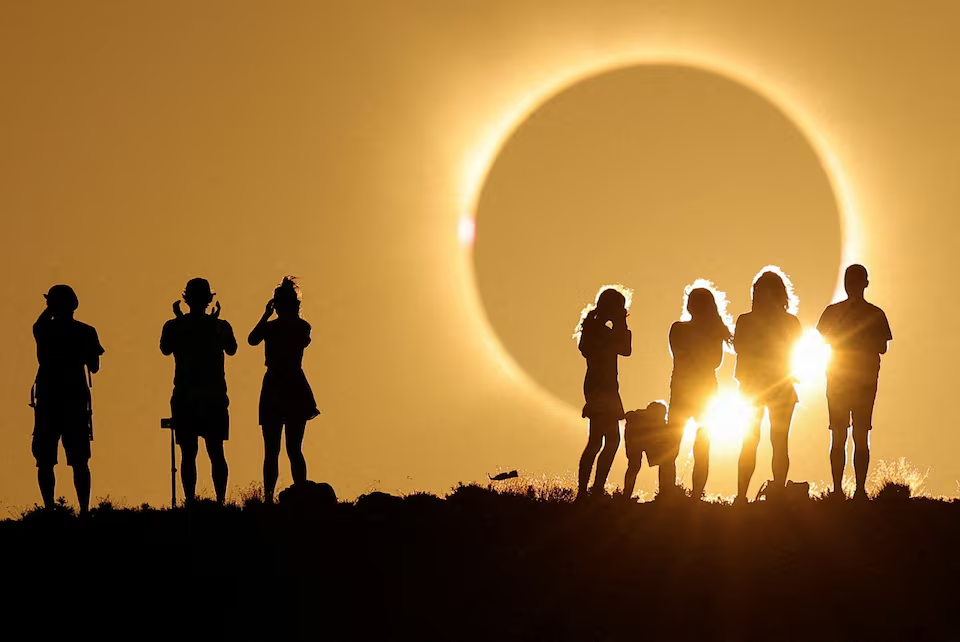
In Buitrago de Lozoya, north of Madrid, spectators watched as the sky darkened during the evening.
The eclipse reached the area at around 8:30 p.m., with totality lasting for nearly a minute. As the Moon completely covered the Sun, spectators applauded and reacted with excitement to the sudden darkness.
The event also attracted well-known figures, including Queen guitarist Brian May, who travelled to Spain to experience the eclipse.
Authorities had prepared for the large influx of visitors, particularly because the eclipse coincided with Spain’s peak wildfire season.
Thousands of police officers and other emergency personnel were deployed to help manage crowds and traffic and respond to potential emergencies.
The eclipse provided an important boost for tourism, with visitors travelling to rural areas and lesser-known destinations to find a good view of the phenomenon.
Several locations had prepared special observation sites and activities for tourists and local residents.
Iceland was another major destination for eclipse watchers. Up to 80,000 visitors travelled to the country, particularly its western regions, where totality was visible.
However, cloud cover and rainy weather affected visibility in some areas.
Despite the challenges, crowds gathered in Reykjavik and other locations, with many people equipped with protective glasses and other eclipse-viewing equipment.
The eclipse was also visible as a partial solar eclipse across other parts of Europe, including the United Kingdom, France and Germany, allowing millions more people to observe the Moon covering part of the Sun.
A total solar eclipse occurs when the Moon completely blocks the Sun’s visible disk. During totality, the sky becomes dark and the Sun’s outer atmosphere, known as the corona, becomes visible.
For Spain, the 2026 eclipse is part of a rare sequence of major solar events.
The country is expected to experience another total solar eclipse in 2027, followed by an annular eclipse in 2028, forming what has been described as the “Iberian Eclipse Trio.”
Leave a Reply