Held from May 18 to 21 in Rwanda’s capital, the summit brought together African leaders, policymakers, energy experts, and international nuclear industry stakeholders to discuss the future of nuclear power on the continent.
At the centre of Rosatom’s participation was its promotion of small modular reactors and floating nuclear technologies, which the company says are particularly suited for remote regions and developing economies with rising energy demand.
The Russian corporation highlighted its operational experience in the SMR segment, including the Akademik Lomonosov, the world’s first floating nuclear power plant commissioned in Russia in 2020. Rosatom also pointed to its first export SMR project currently under implementation in Uzbekistan since 2024 as evidence that the technology is commercially viable and deployment-ready.
Beyond small-scale technologies, Rosatom used the Kigali summit to demonstrate its broader experience in delivering large-scale nuclear infrastructure projects worldwide. The company says it is currently constructing 22 export nuclear power units globally, making it one of the leading players in the international nuclear energy market.
In Africa, Rosatom’s flagship project remains Egypt’s El Dabaa Nuclear Power Plant, where construction is ongoing on all four units simultaneously. The project is considered the largest nuclear construction initiative currently underway on the continent.
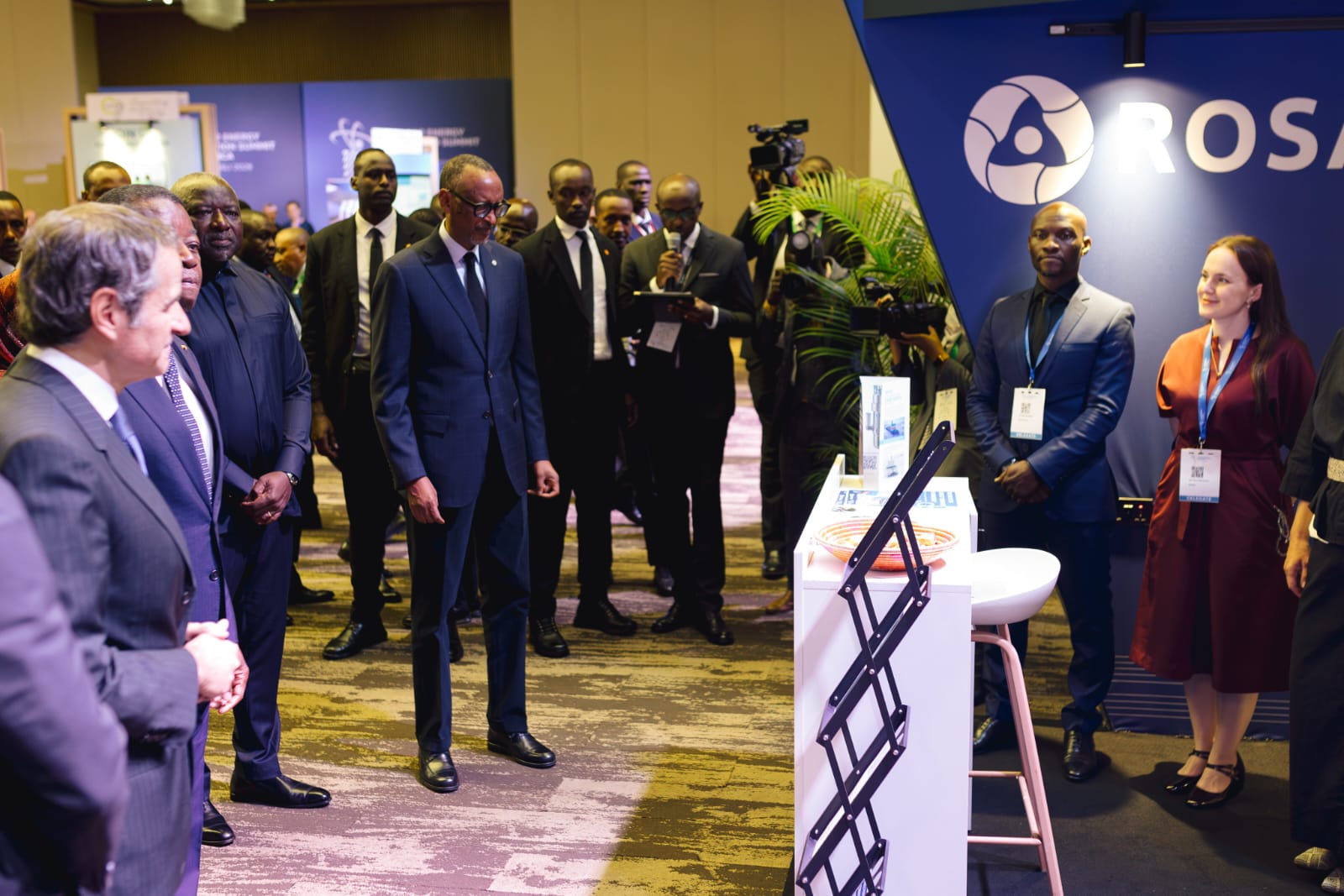
Rosatom’s exhibition booth was visited by several high-profile leaders attending the summit, including Rwanda’s President Paul Kagame, Tanzanian President Samia Suluhu Hassan, Togolese Prime Minister Faure Essozimna Gnassingbé, and International Atomic Energy Agency (IAEA) Director General Rafael Mariano Grossi.
During the summit’s business sessions, Rosatom representatives outlined the company’s strategy for expanding nuclear cooperation across Africa, with discussions focusing on practical deployment of SMRs, advanced nuclear technologies, and long-term industry development.
The summit also provided an opportunity for Russia and Rwanda to discuss next steps related to potential SMR projects and the planned Centre for Nuclear Science and Technology (CNS&T).
“The Rwanda Atomic Energy Board sincerely appreciates Rosatom’s participation in Nuclear Energy Innovation Summit 2026 and the continued collaboration in advancing nuclear energy development in Rwanda,” said Dr. Fidele Ndahayo, Chief Executive Officer of the Rwanda Atomic Energy Board.
Ryan Collyer, CEO of Rosatom Central and Southern Africa, said small modular reactors could offer African countries flexible and scalable energy solutions capable of supporting industrialisation while reducing carbon emissions.
“For many African countries, small modular reactors can become an optimal solution due to their scalability, flexibility of use, and relatively short deployment timelines,” Collyer said.
Rosatom also used the summit to highlight its human capital development programmes aimed at supporting national nuclear industries across Africa. The company showcased partnerships with Rwanda that have already enabled more than 100 students to participate in nuclear-related training programmes, including studies at Russian universities.
Some graduates of these programmes are already working in Rwandan institutions involved in developing the country’s nuclear sector.
By combining technology transfer, infrastructure development, and workforce training, Rosatom is increasingly positioning itself as a long-term strategic partner for African countries pursuing nuclear energy as part of their future power mix.
Leave a Reply