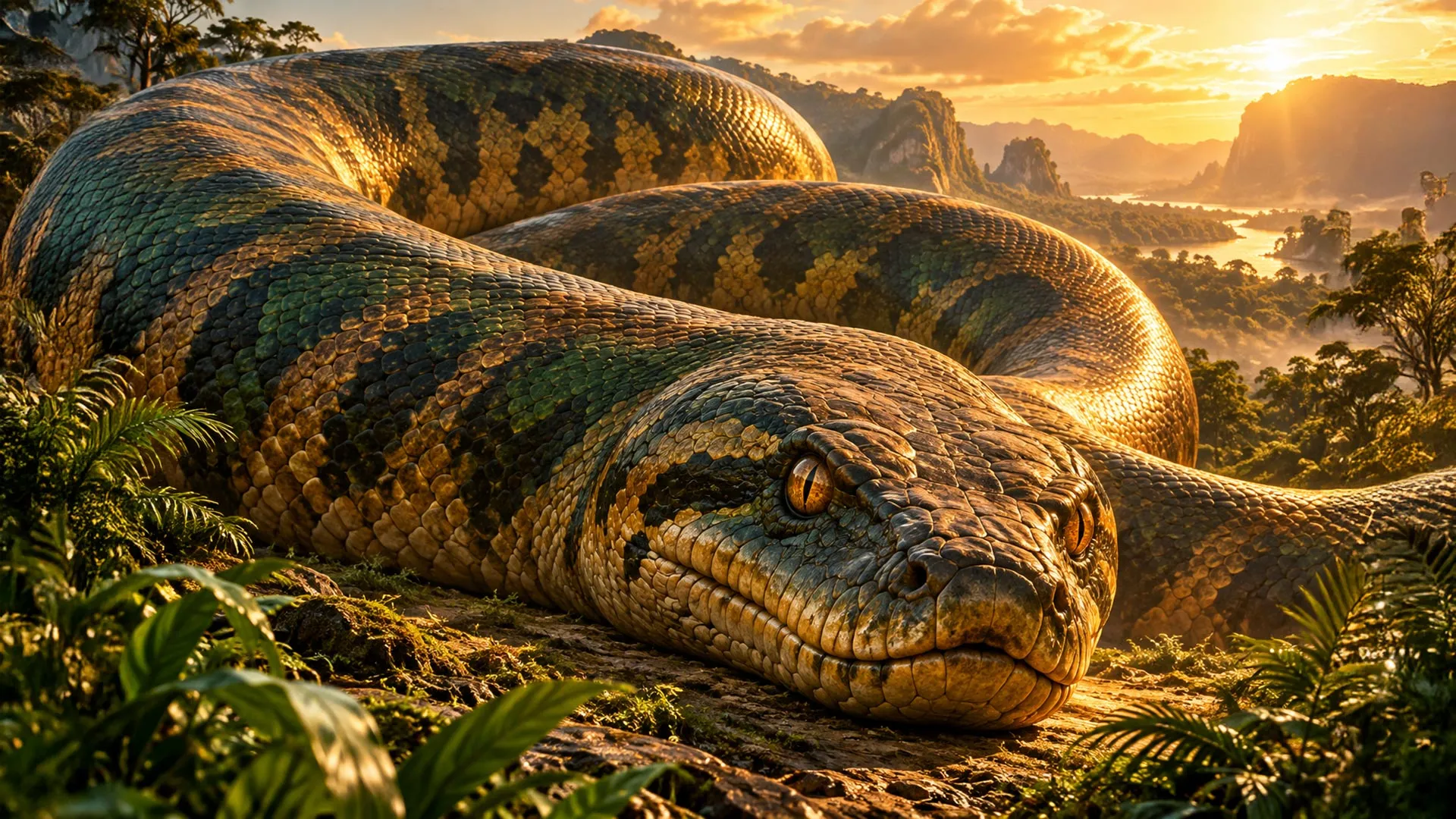
Named Vasuki indicus, the extinct reptile lived during the Middle Eocene, a period when parts of the world experienced warmer climates than today.
Its estimated length of between 10.9 and 15.2 metres would make it comparable to Titanoboa, a prehistoric snake believed to have reached approximately 13 metres.
The fossils were discovered at the Panandhro Lignite Mine in Kutch, Gujarat, western India.
Paleontologists Debajit Datta and Sunil Bajpai of the Indian Institute of Technology Roorkee identified the species after examining 27 fossilised vertebrae, the bones that form a snake’s backbone.
Although researchers did not find a complete skeleton, the unusually broad vertebrae provided clues about the animal’s size.
Estimates based on comparisons with modern snakes produced different results, leaving uncertainty about its exact length.
Scientists therefore cannot confirm whether Vasuki was larger than Titanoboa, which lived in what is now Colombia around 60 million years ago.
The researchers believe Vasuki was a thick-bodied animal that probably relied on ambush rather than speed to capture prey.
Its hunting strategy may have resembled that of modern anacondas and pythons, which use their muscular bodies to overpower animals.
However, its exact diet and hunting behaviour remain uncertain because the available fossils provide limited evidence about how it lived.
The ancient snake inhabited a region characterised by warm, tropical conditions, with average temperatures estimated at approximately 28 degrees Celsius.
Because snakes depend on external heat to regulate their body temperature, such conditions may have supported the growth of large reptiles.
Nevertheless, scientists say temperature alone cannot explain gigantism, as food availability, habitat and evolutionary history also influence animal size.
Vasuki indicus belonged to Madtsoiidae, an extinct family of snakes that existed for roughly 100 million years and whose members lived across several continents, including Africa, Asia, Europe and Australia.
The discovery provides further evidence of the diversity of prehistoric snakes and helps researchers understand how ancient reptiles evolved and spread across different regions.
The findings were published in Scientific Reports in 2024, with the fossils offering a rare glimpse into India’s ancient ecosystems and the enormous predators that once inhabited them.
Leave a Reply