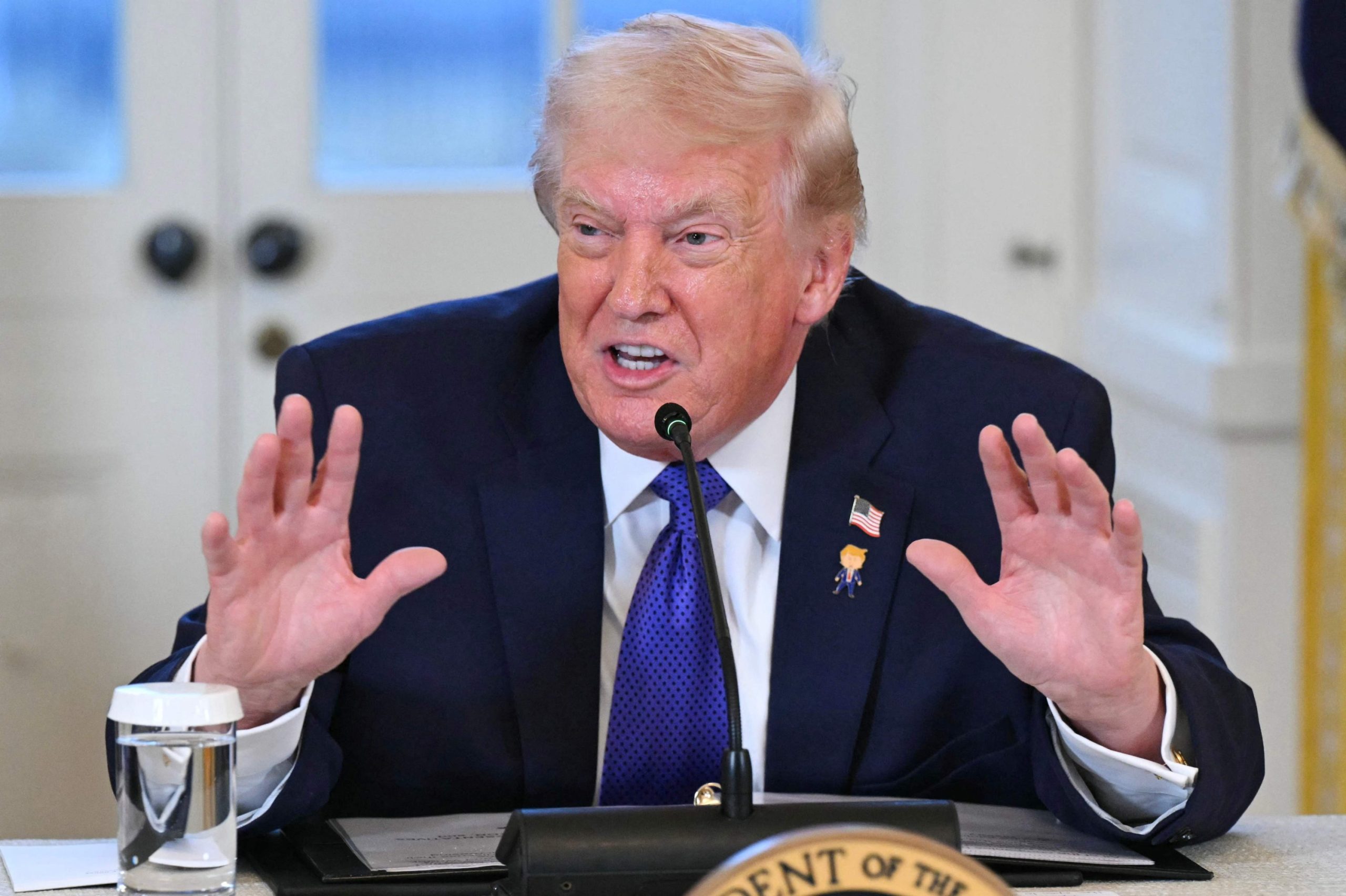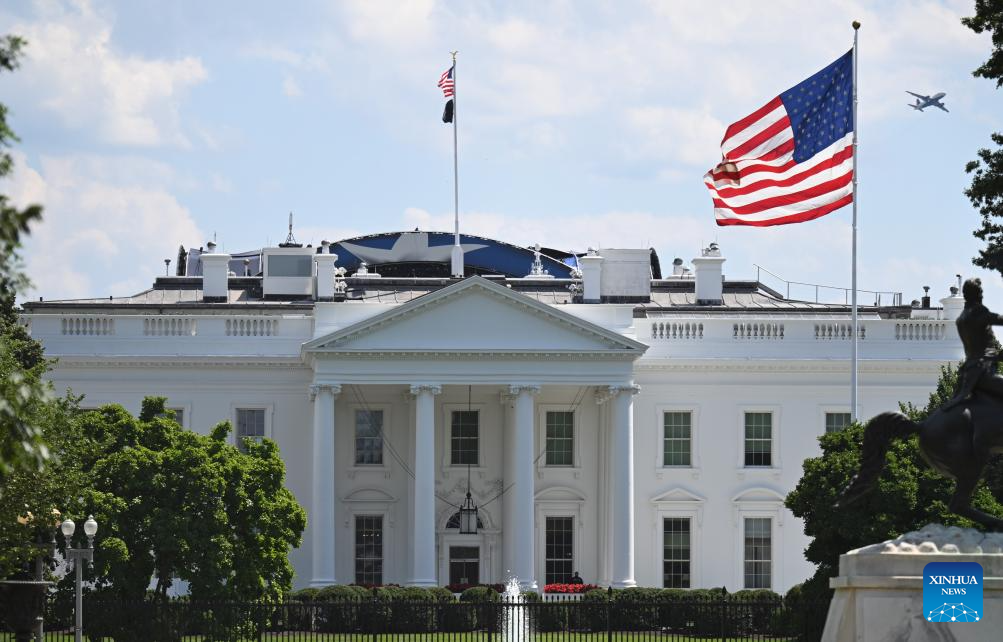
The U.S. “will actively pursue any Iranian-flagged vessel or any vessel attempting to provide material support to Iran,” Dan Caine, chairman of the Joint Chiefs of Staff, said Thursday.
The move will enable the U.S. to take control of Iran-linked vessels around the world, including ships carrying Iranian oil that are already sailing outside the Persian Gulf and those carrying arms that could support Tehran, the report said.
The operation would be carried out in part by the U.S. Indo-Pacific Command, according to Caine.
It marks a new phase of the U.S. pressure campaign against Tehran, dubbed “Economic Fury” by the Trump administration, aiming to maximize economic pressure on the Middle Eastern country as a temporary ceasefire between the two sides is set to expire next week.
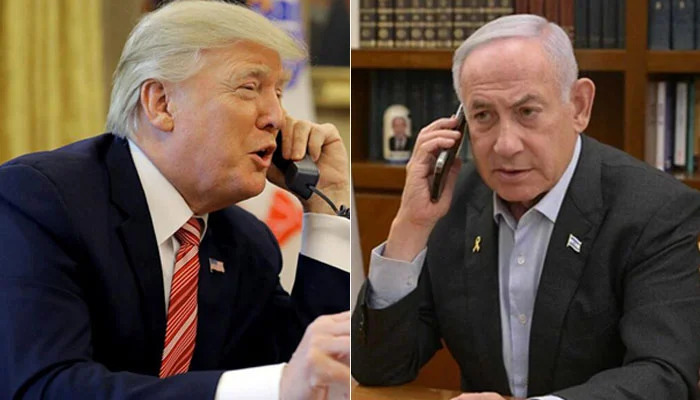
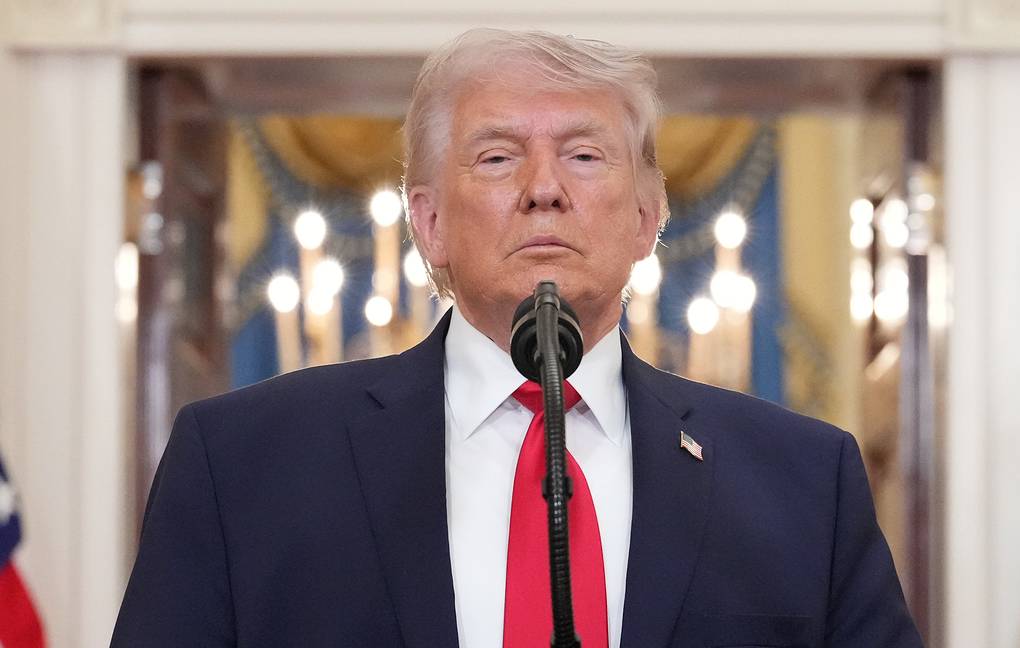
U.S. President Donald Trump is optimistic that the naval blockade, combined with measures imposed under “Economic Fury,” “will help facilitate a peace deal,” White House spokeswoman Anna Kelly was quoted as saying.
The U.S. “will actively pursue any Iranian-flagged vessel or any vessel attempting to provide material support to Iran,” Dan Caine, chairman of the Joint Chiefs of Staff, said Thursday.
The establishment of diplomatic relations was finalised during a meeting between Uzbekistan’s Minister of Foreign Affairs, Bakhtiyor Saidov, and his Rwandan counterpart, Olivier Nduhungirehe. Speaking on Saturday, Saidov said Rwanda becomes the 167th country to establish diplomatic relations with Uzbekistan.
“Rwanda has become the 167th country with which Uzbekistan has established diplomatic relations. Together with the Minister of Foreign Affairs and International Cooperation of Rwanda H.E. @onduhungirehe, we signed a Joint Communiqué on the establishment of diplomatic relations,” Saidov wrote on X.
Key officials from Rwanda and Uzbekistan attended the meeting.
As part of the agreement, the two countries also signed a Memorandum of Understanding between their Ministries of Foreign Affairs. The MoU establishes a mechanism for regular political consultations aimed at enhancing dialogue and cooperation between Kigali and Tashkent.
According to Saidov, the signing of the documents represents an important step toward expanding Uzbekistan’s engagement with countries across the African continent.
The establishment of diplomatic relations was finalised during a meeting between Uzbekistan’s Minister of Foreign Affairs, Bakhtiyor Saidov, and his Rwandan counterpart, Olivier Nduhungirehe.
The establishment of diplomatic relations is expected to open new avenues for cooperation between Rwanda and Uzbekistan in areas of mutual interest, including political dialogue and broader international engagement.
Uzbekistan is a doubly landlocked country in Central Asia, a distinction it shares only with Liechtenstein. Historically, it lay at the heart of the ancient Silk Road and has since evolved from a former Soviet republic into a rapidly modernising state. It is also uniquely positioned as the only Central Asian country bordering all four of its regional neighbours, as well as Afghanistan.
Tashkent is the capital and largest city of Uzbekistan.
In recent years, Uzbekistan has emerged as one of the fastest-growing economies in the region, underpinned by its Development Strategy 2022–2026. The country recorded real GDP growth of 7.7% in 2025, with projections of 6.8% in 2026, supported by strong investment inflows and favorable global commodity prices, particularly for gold.
Its economy is anchored in key sectors such as natural resources, where it is a major global producer of gold and natural gas, and agriculture, which is gradually diversifying beyond its traditional reliance on cotton into higher-value exports. Uzbekistan is also advancing an ambitious green energy agenda, targeting 25% renewable energy generation by the end of 2026, with solar power playing a central role.
Registan Square, a historical landmark in Samarkand, Uzbekistan.
Tourism has become a fast-growing sector, with the country aiming to attract 12 million visitors by 2026, bolstered by new cultural and heritage investments, including the Silk Road Museum in Samarkand and expanded cultural infrastructure.
According to the National Statistics Committee, Uzbekistan’s permanent population stood at 38,382,685 as of April 1, 2026.
The deal was concluded during peace talks held in Switzerland from April 13 to 17, 2026, with support from Qatar and the United States.
Under the agreement, the DRC government is expected to release 311 prisoners linked to AFC/M23, while the rebel group will free 166 individuals held from the government side.
The prisoner exchange is seen as a confidence-building measure aimed at supporting ongoing peace efforts.
Both parties indicated that the list of prisoners to be released was provided by the International Committee of the Red Cross, in line with an agreement previously signed on September 14, 2025.
On April 14, 2026, the two sides also agreed to operationalise a revised international mechanism tasked with monitoring the ceasefire, known as EJVM+. This body will include three representatives from each side.
The decision to establish EJVM+ was initially made during earlier peace discussions held in Doha, Qatar, last year. However, its implementation had been delayed due to persistent tensions between the DRC government and AFC/M23.
The mechanism is now expected to begin overseeing the ceasefire within a week. Troops from the United Nations peacekeeping mission in the DRC (MONUSCO) are also set to support its operations.
The Government of the Democratic Republic of Congo (DRC) and the AFC/M23 rebel coalition have reached an agreement to release more than 400 prisoners within the next 10 days.
Baghaei, speaking on state-run IRIB television, said that recent public statements by Foreign Minister Seyed Abbas Araghchi were made within the framework of the ceasefire between Iran and the United States announced on April 8, not as signals of a new diplomatic opening.
Earlier Friday, Araghchi said the Strait of Hormuz would remain “completely open” to commercial shipping for the duration of the current truce between Iran and the United States.
Baghaei moved to clarify the foreign minister’s position, saying that following a ceasefire in Lebanon on Friday, Tehran chose to apply safe-passage conditions outlined in its agreement with Washington to vessels transiting the strait.
“We have reached no new agreement,” he said. “The ceasefire agreement is the one announced on April 8.”
He accused the United States of failing, from the outset of the truce, to honor a commitment to extend its terms to Lebanon, a provision Iran insists was included in the April 8 agreement. Washington and Jerusalem have rejected that characterization.
Baghaei also warned that Iran would take “countermeasures” if a United States naval blockade of the Strait of Hormuz persisted. He said no talks on extending the ceasefire had taken place, and that mediation efforts led by Pakistan remained focused on ending the conflict and protecting Iran’s interests.
Iran tightened its grip on the strait beginning Feb. 28, when it barred safe passage to vessels belonging to or affiliated with Israel and the United States following joint strikes on Iranian territory.
The United States subsequently imposed its own blockade, preventing ships traveling to and from Iranian ports from transiting the waterway after peace negotiations in Islamabad collapsed over the weekend.
Axios reported Friday, citing people familiar with the talks, that a second round of United States-Iran negotiations is expected to take place in Pakistan this weekend, most likely on Sunday.
Iranian Foreign Ministry spokesman Esmaeil Baghaei speaks at a weekly press conference in Tehran, Iran, April 6, 2026.
Iranian Foreign Minister Abbas Araghchi said in a statement that “the passage for all commercial vessels” through the strait would remain open for the remainder of the truce. The narrow waterway, through which a significant portion of the world’s oil supply passes, has been a focal point of conflict during recent hostilities involving Iran, the United States, and its regional allies.
The announcement triggered an immediate reaction in global markets, with oil prices dropping sharply, falling by more than 10 percent to below $89 per barrel, amid expectations of stabilised supply.
The global impact of disruptions in the Strait of Hormuz has also been felt far beyond the Middle East, including in Rwanda, where fuel prices have surged in recent days. Authorities raised the price of petrol to Rwf 2,938 per litre, up sharply from Rwf 2,303, citing sustained pressure from international oil markets and supply constraints linked to the conflict.
While petrol prices have been increased to align more closely with these global trends, the government has opted to hold diesel prices steady through targeted interventions. Diesel is a key input in Rwanda’s transport and logistics sectors, and keeping its price unchanged is aimed at limiting knock-on effects on public transport fares, goods movement, and overall inflation.
Meanwhile, U.S. President Donald Trump welcomed Iran’s move in a post on Truth Social, writing: “Iran has just announced that the Strait of Iran is fully open and ready for full passage. Thank you!” However, in a follow-up statement, he emphasised that the U.S. naval blockade of Iranian ports would remain in place until a permanent agreement is reached.
“This process should go very quickly,” Trump added, suggesting that most elements of a broader deal had already been negotiated.
Despite the reopening, uncertainty remains over how shipping will operate in practice. Iranian authorities indicated that vessels should follow “coordinated routes” set by the country’s Ports and Maritime Organisation, though it is unclear whether new conditions, such as transit fees, could apply.
The move comes as diplomatic efforts intensify to bring a broader end to the conflict. Talks between U.S. and Iranian officials in Islamabad reportedly identified control and access to the strait as a major sticking point.
Meanwhile, a separate 10-day ceasefire between Israel and Lebanon has taken effect, raising cautious hopes for de-escalation across the region. Celebrations were reported in Beirut, though the humanitarian toll of the conflict remains severe.
More than 2,000 people in Lebanon have been killed over six weeks of fighting, and roughly one in five residents has been displaced. Israel has reported the deaths of two civilians and 13 soldiers.
Iran announced on Friday that the Strait of Hormuz is “completely open” to commercial shipping for the duration of a fragile regional ceasefire.
In exercising its veto on April 7 on the draft resolution submitted by Bahrain on behalf of Gulf states, China upheld international fairness and justice, defended the purposes and principles of the UN Charter and prevented the conflict from expanding further. The veto also created favorable conditions for achieving a temporary ceasefire and launching dialogue and negotiations, said Fu Cong, China’s permanent representative to the United Nations.
“China’s vote represents a choice responsible for peace and for the people of the region. It stands on the right side of history and will stand the test of history,” he told a UN General Assembly meeting on the use of veto in the Security Council.
China attached great importance to the draft resolution and fully understood the Gulf states’ major concerns. At the same time, Security Council actions should be aimed at de-escalation. They must not provide a veneer of legitimacy for unauthorized military operations or authorize the use of force, let alone further exacerbate tensions and add fuel to the fire, thereby leading to an escalation of the conflict, said Fu.
“China does not go along with Iran’s attacks on Gulf states. China believes that the passage and safety of a strait used for international navigation should be safeguarded. We call on Iran to take proactive measures to restore normal navigation in the Strait of Hormuz at an early date,” said Fu.
“Meanwhile, the ramped-up military deployment and targeted blockade by the United States constitute a dangerous and irresponsible move. The issue of navigation in the Strait of Hormuz is a spillover effect of the conflict in Iran. Only a complete ceasefire can fundamentally create conditions for easing the situation,” he said.
China welcomes the announcement of a ceasefire agreement by the relevant parties and supports all efforts conducive to ending the conflict. The U.S.-Iran negotiations in Pakistan mark a step in the right direction toward de-escalation, Fu said.
“The relevant parties should adhere to the ceasefire agreement, stick to the direction of dialogue and peace talks, stay committed to resolving disputes through political and diplomatic means, and take concrete actions to de-escalate regional tensions,” he said.
The international community, he said, should continue to intensify efforts to promote peace talks and unequivocally oppose any actions that undermine the ceasefire or escalate confrontation.
All parties should also earnestly respect Lebanon’s sovereignty, security and territorial integrity, and prevent the escalation of the situation in Lebanon from undermining the ceasefire arrangement, Fu said.
As a sincere friend and strategic partner of countries in the Middle East, China is closely following the regional situation, maintaining an objective and impartial position, and has been engaged in intensive mediation with all parties to actively promote peace talks, he said.
China stands ready to continue facilitating de-escalation, promoting the improvement of relations between regional countries, and playing a constructive role in ultimately achieving enduring peace and stability in the Middle East, he said.
China has called on Iran to take proactive measures to restore normal navigation in the Strait of Hormuz at an early date.
The ceremony took place at Kintele Stadium in the northern suburbs of Brazzaville, the capital city, in the presence of several African heads of state.
In his inaugural address, Sassou Nguesso pledged to implement his development programme, titled “Accelerating the March Toward Development,” with a focus on economic diversification and modernization, agricultural mechanization, infrastructure development, education, youth training, and improvements to the health system.
He said peace, stability and infrastructure development would be the priorities of his new mandate.
The president also called on Congolese citizens to promote Pan-Africanism and strengthen regional integration, while reaffirming his support for initiatives aimed at advancing Africa’s economic development.
President of the Republic of the Congo Denis Sassou Nguesso takes the oath of office during his inauguration ceremony at Kintele Stadium in the northern suburbs of Brazzaville, the Republic of the Congo, April 16, 2026.
Wadagni secured victory in the first round of voting held on April 12, defeating his moderate opposition rival, former culture minister Paul Hounkpe, who obtained 5.73 percent of the vote.
The Constitutional Court, Benin’s highest authority on electoral disputes, said Wadagni and his running mate Mariam Chabi Talata won 4,575,449 votes, while Hounkpe and Rock Judicael Hounwanou received 278,297 votes. Talata will serve as vice president.
The court said that more than 7.89 million voters were registered nationwide, with over 4.85 million casting ballots, representing a turnout rate of 63.57 percent.
Preliminary results released on Monday by the Autonomous National Electoral Commission had already indicated a decisive lead for Wadagni, who secured 94.05 percent of the vote.
Wadagni, 49, previously worked at Deloitte before entering government after Patrice Talon’s election in 2016. He has since served as minister of economy and finance, was reappointed in 2021, and later promoted to senior minister, playing a central role in implementing Talon’s economic policies.
Under Benin’s electoral code, the president and vice president are elected by direct universal suffrage for a seven-year term.
Romuald Wadagni has won Benin’s presidential election with 94.27 percent of valid votes.
The ruling, delivered on Thursday in KuGompo City (formerly East London), stems from an incident at an Economic Freedom Fighters (EFF) rally where Malema was accused of discharging a rifle into the air during celebrations marking the party’s anniversary. Malema, 45, leads the EFF, currently the fourth-largest party in South Africa’s parliament.
Magistrate Twanet Olivier said the court found that Malema’s actions were deliberate and in clear violation of firearm laws.
“It wasn’t… an impulsive act. It was the event of the evening,” Olivier said during sentencing, rejecting arguments that the shots were purely celebratory.
Malema was convicted in October of multiple offences, including unlawful possession of a firearm and ammunition, discharging a weapon in a public space, and reckless endangerment. Prosecutors said video evidence showed him firing a semi-automatic rifle into the air during the rally.
He pleaded not guilty throughout the proceedings, insisting the firearm did not belong to him and that the shots were fired to energise supporters.
Following the sentencing, Malema’s legal team said they would immediately appeal the decision. His lawyers are expected to challenge both the conviction and the prison term in higher courts.
The politically charged case drew large crowds outside the courthouse, where hundreds of EFF supporters dressed in red gathered in solidarity. Party officials have warned of possible protests should the sentence be enforced.
Analysts say the ruling could have significant political consequences, including potentially disqualifying Malema from serving as a member of parliament, depending on the outcome of his appeal.
During sentencing, the magistrate stressed that the ruling was directed at Malema as an individual and not at his political party.
“It is not a political party that has been convicted here, but an individual,” she said.
Malema, however, has repeatedly claimed the prosecution is politically motivated. He has pointed to Afrikaner lobby group AfriForum as a driving force behind the case. AfriForum has long been critical of Malema, particularly over his use of the anti-apartheid chant “Kill the Boer,” which the group argues constitutes hate speech.
South African courts have previously ruled that the chant does not meet the legal threshold for hate speech and must be understood within the historical context of apartheid and the struggle against white minority rule, which ended in 1994.
The case has also drawn international attention. AfriForum has taken its concerns abroad, including to the United States, where footage of Malema has been discussed by political figures. US President Donald Trump previously raised the issue with South African President Cyril Ramaphosa, questioning why Malema had not been arrested.
Malema, once the leader of the youth wing of the African National Congress, was expelled from the ruling party following internal disputes and later founded the EFF. Known for his radical left-wing platform, he has called for the redistribution of land and wealth in South Africa.
After his conviction, Malema told supporters that “going to prison or death is a badge of honour,” vowing to continue his political struggle and appealing the ruling to the Constitutional Court.
The EFF leader now awaits the outcome of his appeal, which will determine whether he begins serving the prison sentence or remains free pending further legal proceedings.
Julius Malema was convicted in October of multiple offences, including unlawful possession of a firearm and ammunition, discharging a weapon in a public space, and reckless endangerment.
Speaking at a Council briefing on the Peace, Security and Cooperation Framework for the DRC and the Great Lakes region on Wednesday, Rwanda’s Deputy Permanent Representative, Robert Kayinamura, said the continued presence of the FDLR in eastern DRC constitutes an “existential threat” to Rwanda and a major obstacle to peace efforts in the region.
“There can be no credible path to peace without its effective and irreversible neutralisation,” he told Council members, reiterating Kigali’s long-standing position on the armed group.
The meeting came a week after Rwanda commemorated the 32nd anniversary of the Genocide against the Tutsi at the UN General Assembly Hall. Kayinamura noted that some of those responsible for the genocide fled into the DRC and remain active today, a factor he said partly motivated the establishment of the regional Peace, Security and Cooperation Framework in 2013.
Rwanda maintained that it has consistently upheld its commitments under the Framework over the past decade, but argued that key drivers of instability have not been addressed. According to Kayinamura, this reflects “a failure of implementation” rather than a weakness in the agreement itself.
He stressed that the FDLR issue has remained unresolved despite repeated engagement with UN officials, regional mediators, and successive Special Envoys.
Rwanda also expressed concern over what it described as escalating hate speech, ethnic targeting, and violence against Rwandophone communities in eastern DRC, including the Banyamulenge. Kayinamura said the continued portrayal of these communities as foreigners undermines the objectives of the Framework.
“These realities point to deep-rooted challenges that must be addressed directly. Sustainable peace cannot be built on avoidance,” he said.
The Rwandan envoy emphasised that peace in the DRC and stability in the broader Great Lakes region are inseparable, warning that selective implementation and accountability would not produce meaningful results.
While reaffirming support for ongoing diplomatic efforts, including ceasefire arrangements and processes in Washington and Doha, Rwanda also backed interim security measures such as a buffer or interposition force to help stabilise the situation as political negotiations continue.
Kayinamura posed two recurring questions Rwanda has raised in implementation discussions: how the root causes of the conflict remain unresolved after 13 years of the Framework’s existence, and why hate speech and persecution of communities continue unabated.
“If these issues remain unresolved, what basis do we have to expect a different outcome?” he asked Council members.
He concluded that after more than a decade, the path forward is clear and requires full and consistent implementation of agreed commitments. Rwanda, he said, remains engaged in good faith but stressed that success depends on all parties meeting their obligations.
“There is no military solution to this crisis,” he said. “Only a genuine return to the principles of accountability, cooperation, and mutual respect will deliver sustainable peace for our region.”
Speaking at a Council briefing on the Peace, Security and Cooperation Framework for the DRC and the Great Lakes region on Wednesday, Rwanda’s Deputy Permanent Representative, Ambassador Robert Kayinamura, said the continued presence of the FDLR in eastern DRC constitutes an “existential threat” to Rwanda and a major obstacle to peace efforts in the region.