The developments follow changes introduced in 2025, when Ecofleet Solutions was tasked with managing public transport services in Kigali and surrounding areas.
The company took over fare collection, while transport operators retained responsibility for employing drivers and managing service delivery.
The changes were introduced to address longstanding challenges, including delays at bus terminals and stops, where some operators previously waited for buses to fill up before allowing them to depart.
Other measures included increasing the number of buses, introducing dedicated bus lanes and allocating specific time slots for buses to help reduce delays caused by traffic congestion.
200 digital displays planned for bus stops
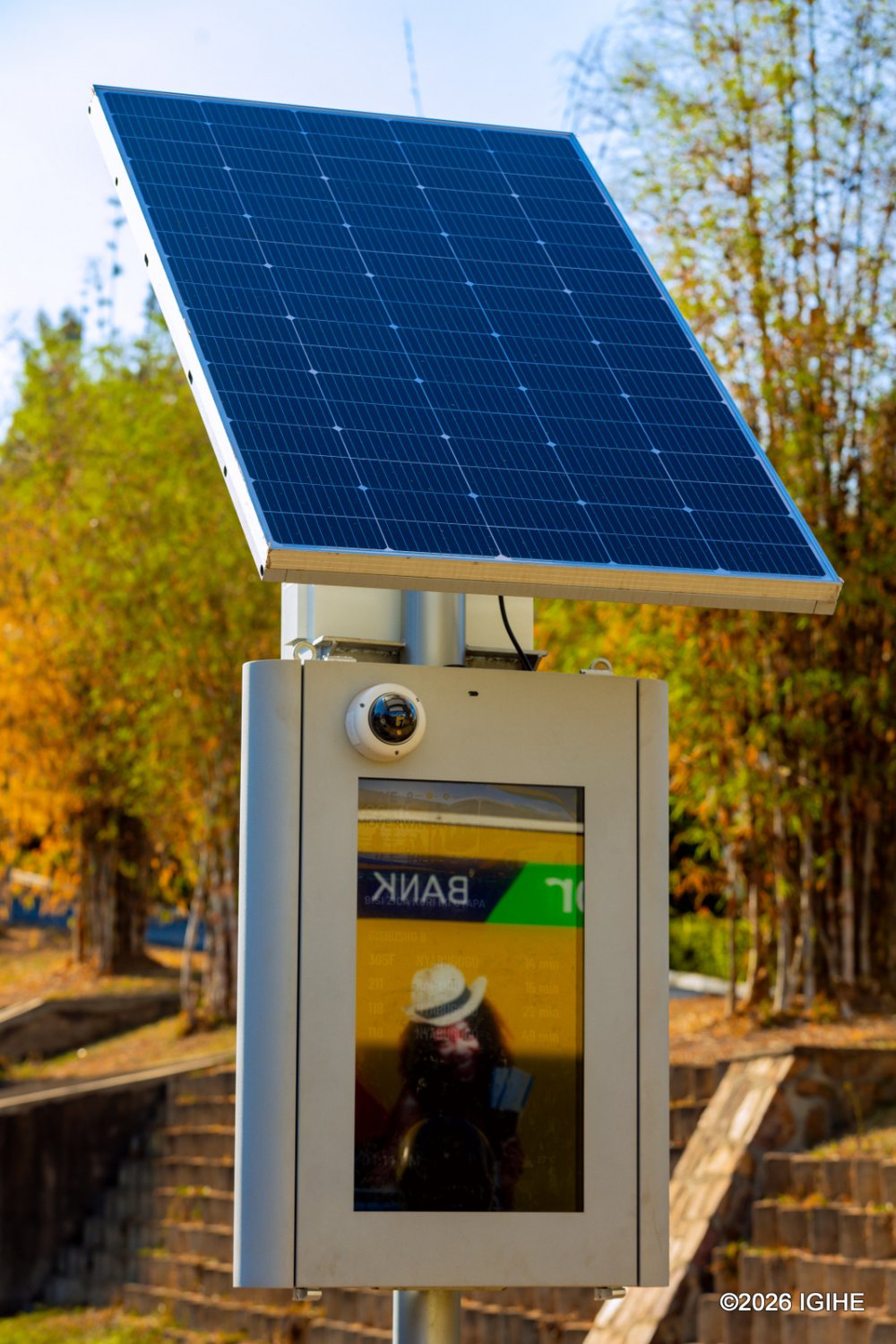
Two displays are currently being tested in Kigali. One is installed near Sonatubes at a bus stop serving passengers travelling towards Remera, while the other is at Gishushu, where commuters board buses heading to the city centre.
The displays use bus location data to estimate arrival times, helping passengers know whether their bus is still at a terminal or has already departed.
Ecofleet Solutions Chief Executive Officer Rukera Aubin told IGIHE that the current trial is the company’s second attempt to test the technology, following an earlier trial that did not produce the expected results.
He said that if the current trial is successful, the company will order an additional 200 digital displays for installation at bus stops across Kigali.
“If the trial goes well, we will decide at the end of this month to order another 200 digital displays.
“Considering the time required, once we place the order, delivery will take at least one and a half months, followed by the other necessary steps.
“We expect them to arrive by February 2027, allowing us to install them at bus stops and have them operational by March of that year, provided nothing changes,” he said.

Mobile application to help commuters plan journeys
In addition to the digital displays, Ecofleet Solutions is developing a mobile application that will help passengers identify nearby bus stops, check when buses are expected to arrive and determine where to board to reach their destinations.
The application is intended to help commuters plan their journeys in advance and reduce the time they spend waiting for buses.
Rukera explained that passengers would be able to use the technology to find the information they need before leaving for their destinations.
“For example, someone travelling from Gikondo to Kabuga will be able to identify the nearest bus stop, see when the bus is expected to arrive and where it will stop, and then plan their journey accordingly. We are still developing the system and gradually adding more features until we achieve the technology we want,” he said.
Both the digital displays and the mobile application will use Global Positioning System (GPS) technology to track bus locations and estimate their arrival times at stops.
The information will be consolidated at a dedicated control centre, where staff will monitor public transport operations.
Passengers welcome technology but call for improvements
Passengers interviewed by IGIHE at the Gishushu bus stop said the technology was already helping them estimate how long they would have to wait for buses.
They said the information helped them decide whether to keep waiting or use alternative means of transport, depending on the expected arrival time.
“When there is no heavy traffic congestion, the technology works because it helps us avoid standing in queues for long periods without knowing when the bus will arrive,” one passenger said.
However, passengers said the system still needed improvement, particularly during periods of heavy traffic congestion.
They noted that buses sometimes arrived later than the times displayed on the screens, with some arriving at the same time as buses scheduled to follow them.
They called for the system to update estimated arrival times to reflect prevailing traffic conditions.


Leave a Reply