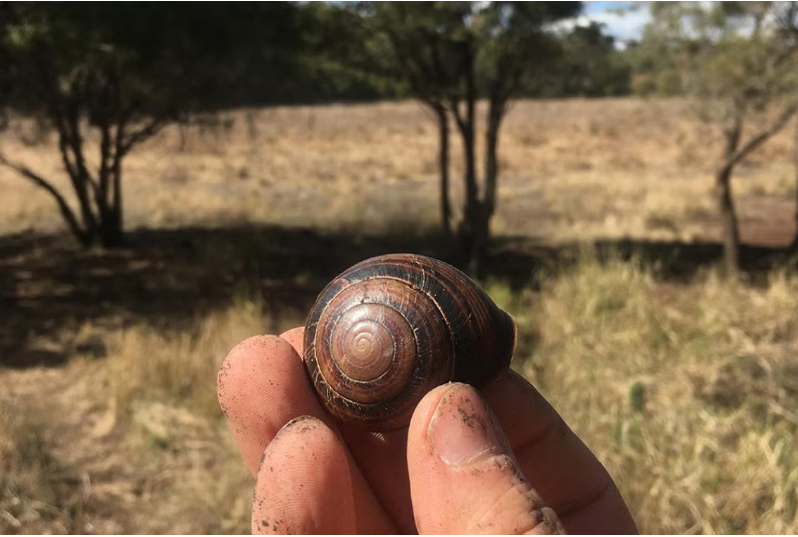
Researchers examined the rings on the shell of a Biggenden Banded Snail collected from Coalstoun Lakes National Park in Australia’s southeast Queensland, linking its bands to weather records, according to a statement released Monday by Australia’s University of Queensland (UQ).
Tiny samples taken from the shell at millimeter intervals were analyzed using high-resolution radiocarbon dating, revealing the age of the snail, when it lived and the weather during its lifetime, said Nicholas Patton, lead author of the study published in The Holocene.
“It contained elevated levels of radiocarbon from the nuclear tests in Australia in the 1960s, meaning we could date the growth bands and reveal the snail had lived for about 4.5 years,” Patton said, adding that analyzing the oxygen and carbon stable isotopes of the different bands revealed insights into the rainfall the snail experienced.
Researchers found that the shell did not grow continuously during the snail’s life, with periods of rapid growth separated by periods of little or no growth. They initially expected rapid growth to correspond to years of heavier rainfall, making more food available for the snail, but found the snail was responding to extreme rainfall events rather than annual wetness.
The study showed the growth spurts were linked to periods immediately following cyclones in 2015 and 2017.
“It shows that snail shells could be used to map extreme weather events for periods before modern meteorological records,” said Honorary Professor Jamie Shulmeister in UQ’s School of the Environment.
“It was surprising and quite exciting that the humble snail could be a tool to reconstruct the paths of past cyclones even in prehistoric times,” he said.
The researchers’ next step is to test the method using shells preserved in different sediment layers and combine the individual shell records to extend this information further back in time.
Leave a Reply