The warning came as the DRC government launched an emergency initiative Thursday to reinforce surveillance along the Congo River, seeking to prevent one of Central Africa’s busiest transport corridors from carrying the virus toward major cities, including the capital Kinshasa.
According to the latest figures from the DRC’s health authorities, as of Aug. 18, 5,208 confirmed cases, including 2,476 deaths, had been reported across six provinces, with a case fatality rate of 47.5 percent. Another 1,115 patients had recovered.
Hidden casses, missing transmission chains
The Africa Centers for Disease Control and Prevention (Africa CDC) said Thursday that modeling conducted jointly with the DRC’s National Institute of Biomedical Research and other partners suggested that the actual burden was substantially higher than confirmed figures indicated.
“We are detecting just 30 to 40 percent,” Kyeng Mercy, an Africa CDC official, said at an online press briefing Thursday. “If you have to look at the real burden, we should be over 10,000 to 15,000 cases.”
Mercy cautioned that the figures were model-based estimates and therefore subject to uncertainty, but said multiple indicators consistently pointed to significant under-detection.
“Models also have their caveats in terms of uncertainty,” said Mercy. “We are just saying that we are not detecting as much as we should, based on certain indicators.”
Yap Boum II, head of emergency preparedness and response at Africa CDC, said Thursday at the online briefing that based on the assessment, the outbreak could be three times the current size in terms of the number of confirmed cases.
He also said that fewer than 10 percent of detected cases are currently among known contacts, while fewer than 40 percent of cases have an epidemiological link to another confirmed infection.
The relatively milder and less typical clinical presentation of Bundibugyo Ebola, compared with disease caused by the Zaire ebolavirus, may also discourage some infected people from seeking treatment, further obscuring the outbreak’s true scale, he added.
Jean Kaseya, director-general of Africa CDC, told Congolese media Wednesday that the epidemic “is not under control,” warning that the outbreak could eventually surpass the scale of the 2014-2016 West Africa epidemic unless major changes were quickly made to the response.
“We may go further than what we’ve seen in West Africa,” Boum also warned, while stressing that a shift in response strategy could still bend the epidemic curve.
Kaseya has also said evidence suggests transmission may have begun around February, months before the outbreak was formally declared on May 15. The number of infections and deaths during that undetected period remained unknown and could substantially add to the current official tally, he added.
Congo River becomes new front line
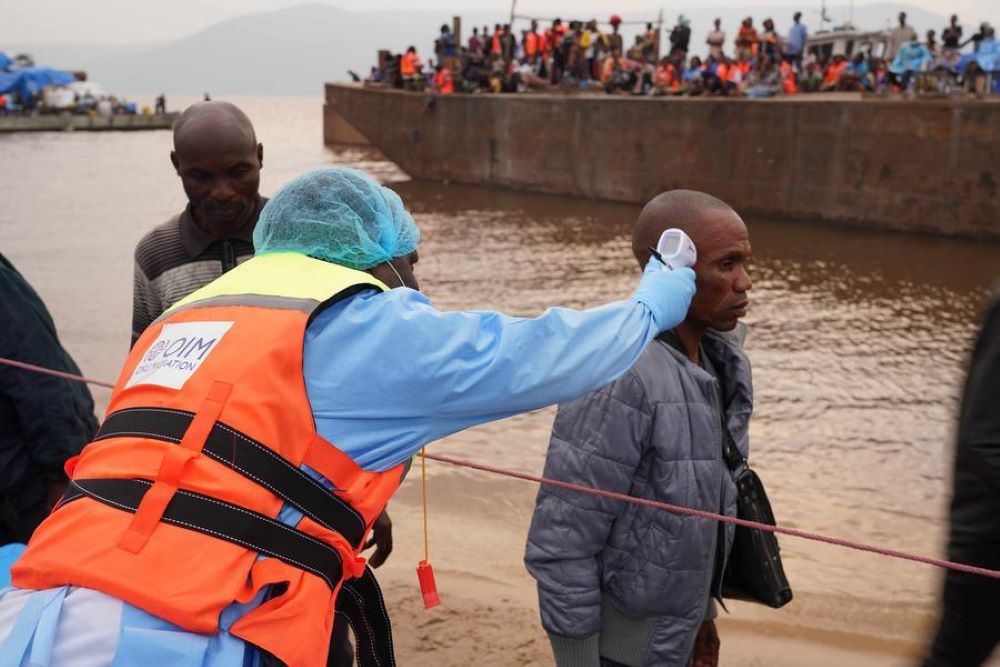
Against that backdrop, the DRC government on Thursday launched the “Congo River Without Ebola” initiative, aimed at preventing the country’s main river transport artery from becoming another route for the virus to spread.
The plan is designed to block transmission toward major riverside population centers, particularly Kinshasa, a megacity of nearly 20 million people where no Ebola case has been confirmed, while reducing the risk of cross-border spread to the Republic of the Congo and the Central African Republic.
The Congo River is one of Central Africa’s main economic and transport arteries, carrying thousands of passengers, traders and transport operators each day, according to the regional bureau of the WHO.
Health officials fear that such intense mobility could allow undetected infections to travel long distances before symptoms are recognized.
Measures under the initiative include reinforced screening and surveillance at ports and along river routes, community early-warning networks, expanded isolation and treatment capacity in key hubs, as well as mobile floating laboratories and preparations for the possible quarantine of vessels.
The initial intensive phase will last three months, focusing on equipping control points, strengthening local response capacity and raising awareness among riverside communities.
Body Ilonga, secretary-general of the DRC’s health ministry, said Thursday the priority is to rapidly identify suspected infections and break chains of transmission.
The initiative is supported by an inter-agency mechanism involving the WHO and several other UN agencies, with 9 million U.S. dollars in catalytic funding mobilized through the UN Office for the Coordination of Humanitarian Affairs.
The river plan adds a new geographic layer to an outbreak that has already expanded rapidly overland. Africa CDC said Thursday that growing transmission in the DRC’s northern Bas-Uele province, near the Central African Republic, has also made cross-border surveillance increasingly urgent.
“The entire continent has to be on high alert,” Mercy said, adding that the highest risks were currently concentrated in parts of East and Central Africa.
Response shifts to villages, vaccines
Health authorities are meanwhile seeking to overhaul the response after Kaseya acknowledged Wednesday that “the approach has not been the best.”
Africa CDC and the DRC government are increasingly shifting from conventional contact tracing toward what they call a “village-centered response,” particularly in hotspots where transmission has become too widespread for individual contact lists to capture.
Under the approach, village chiefs and community health workers would help conduct house-to-house searches, report alerts, identify suspected infections and link families directly with health facilities and response teams.
The strategy is also intended to address persistent distrust that has partly led to delayed treatment, community deaths and resistance to response teams.
Vaccination is also set to become a larger part of the response. An initial 70,000 doses of Ervebo vaccine would be allocated to the DRC, although the vaccine is licensed against Zaire ebolavirus rather than the Bundibugyo strain.
According to the WHO, the International Coordinating Group on Vaccine Provision informed the DRC government of the immediate release of an initial 70,000 doses.
The DRC authorities plan to use the doses both for research and among frontline and at-risk populations, based on emerging evidence that the vaccine may offer some cross-protection.
Kaseya said Wednesday that the first doses were expected to arrive within days.
“The current trajectory must change, and it should change,” Kaseya said.
“I think the population can hope that, with all the measures we are going to put in place, we will be able to stop this outbreak,” Kaseya added.
Leave a Reply