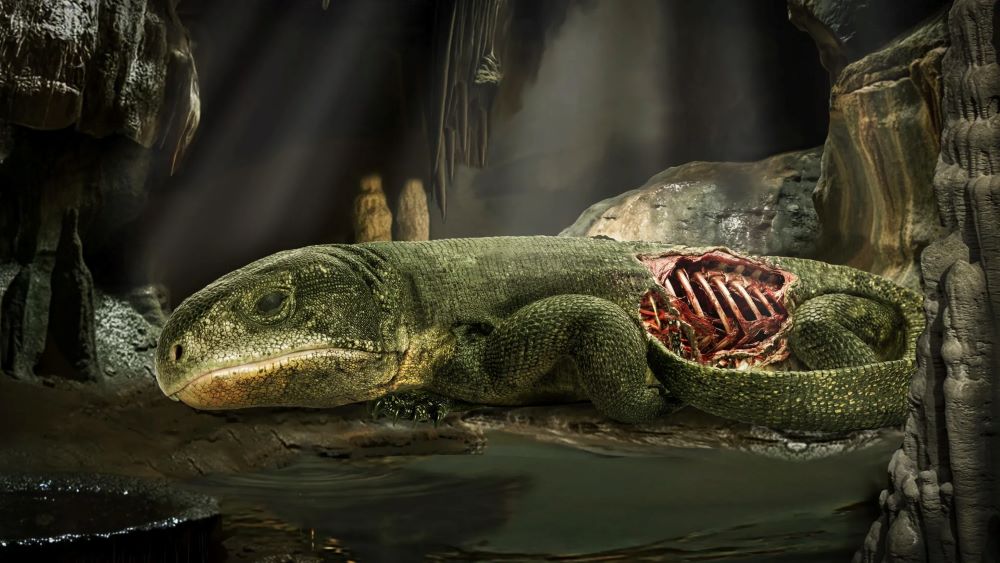
The fossil belongs to Captorhinus aguti, a small lizard-like reptile discovered in a cave system in Oklahoma.
Unlike most fossils, which preserve only bones, this specimen contains traces of skin, cartilage, and even proteins, offering rare insight into early life on land.
“These early reptiles were among the first animals to fully adapt to life outside water,” said Ethan Mooney, one of the study’s lead authors.
“Captorhinus is an interesting lizard-looking critter that is critical to understanding early amniote evolution,” he added.
Using advanced scanning technology, researchers were able to examine the fossil in detail without damaging it. The scans revealed preserved skin wrapped around the body.
“I started to see all these structures wrapped around the bones,” Mooney said, “they were very thin and textured. And lo and behold, there was a nice wrapping of skin around the torso of this animal.
The scaly skin has this wonderful accordion-like texture, with these concentric bands covering much of the body from the torso and up to the neck.”
More importantly, the fossil showed how the reptile breathed. Scientists identified a rib-based breathing system, similar to the one used by humans today, where muscles expand and contract the chest to move air in and out of the lungs.
“We propose that the system found in Captorhinus represents the ancestral condition for the kind of rib assisted respiration present in living reptiles, birds, and mammals,” said Robert R. Reisz, a professor at the University of Toronto and co-author of the study.
This system allowed animals to take in more oxygen and become more active on land.
“It was a game changer that allowed these animals to adopt a much more active lifestyle,” Mooney said.
The findings offer a clearer picture of how life evolved on land and how modern breathing systems began.
Leave a Reply