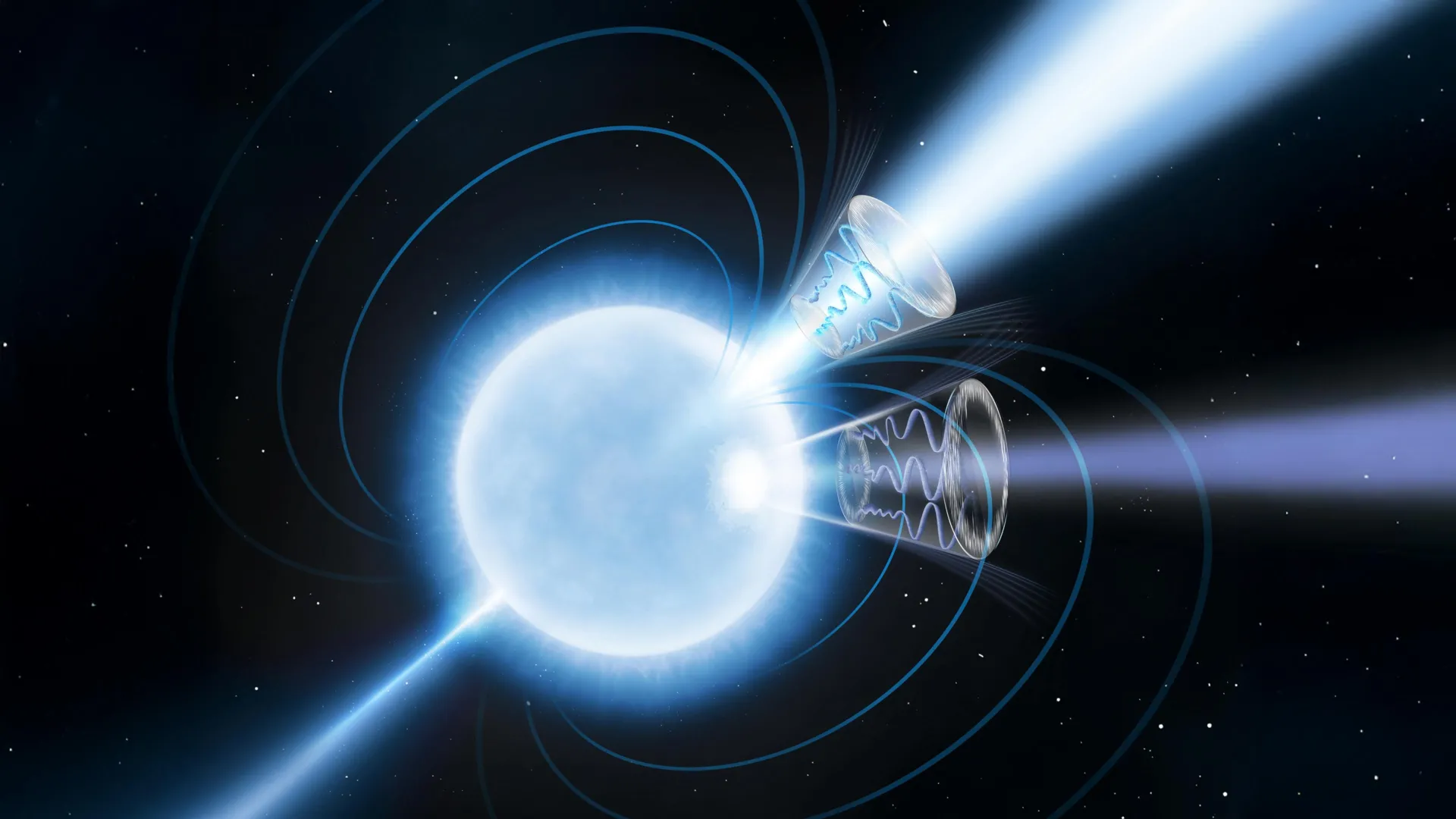
Researchers studying a highly magnetic neutron star called a magnetar observed signs of a phenomenon known as vacuum birefringence.
This effect occurs when extremely strong magnetic fields change the way light travels through what appears to be empty space.
The idea was predicted in the 1930s through work associated with quantum electrodynamics.
According to the theory, a vacuum is not truly empty because quantum fluctuations can produce temporary changes involving virtual particles.
Under normal conditions, these effects are far too weak to detect. However, the enormous magnetic fields surrounding magnetars could make them visible.
The research team studied the magnetar 1E 1547.0-5408, using NASA’s Imaging X-ray Polarimetry Explorer, or IXPE, together with the NICER X-ray telescope and Australia’s Murriyang Parkes radio telescope.
The scientists examined X-rays and radio signals from the magnetar and found an unusual pattern in the polarization of the X-rays.
The polarization was closely connected to the star’s magnetic field and matched observations of its radio emissions.
The researchers say the results provide compelling evidence for vacuum birefringence, although more observations are needed to completely confirm the explanation.
Magnetars are especially useful for this research because they possess some of the strongest magnetic fields known in the universe.
These fields are estimated to be more than 100 million times stronger than anything scientists can create on Earth.
If future observations confirm the discovery, it could provide an important test of quantum physics under extreme conditions and help scientists better understand how light, space and matter behave in the most powerful environments in the universe.
Leave a Reply