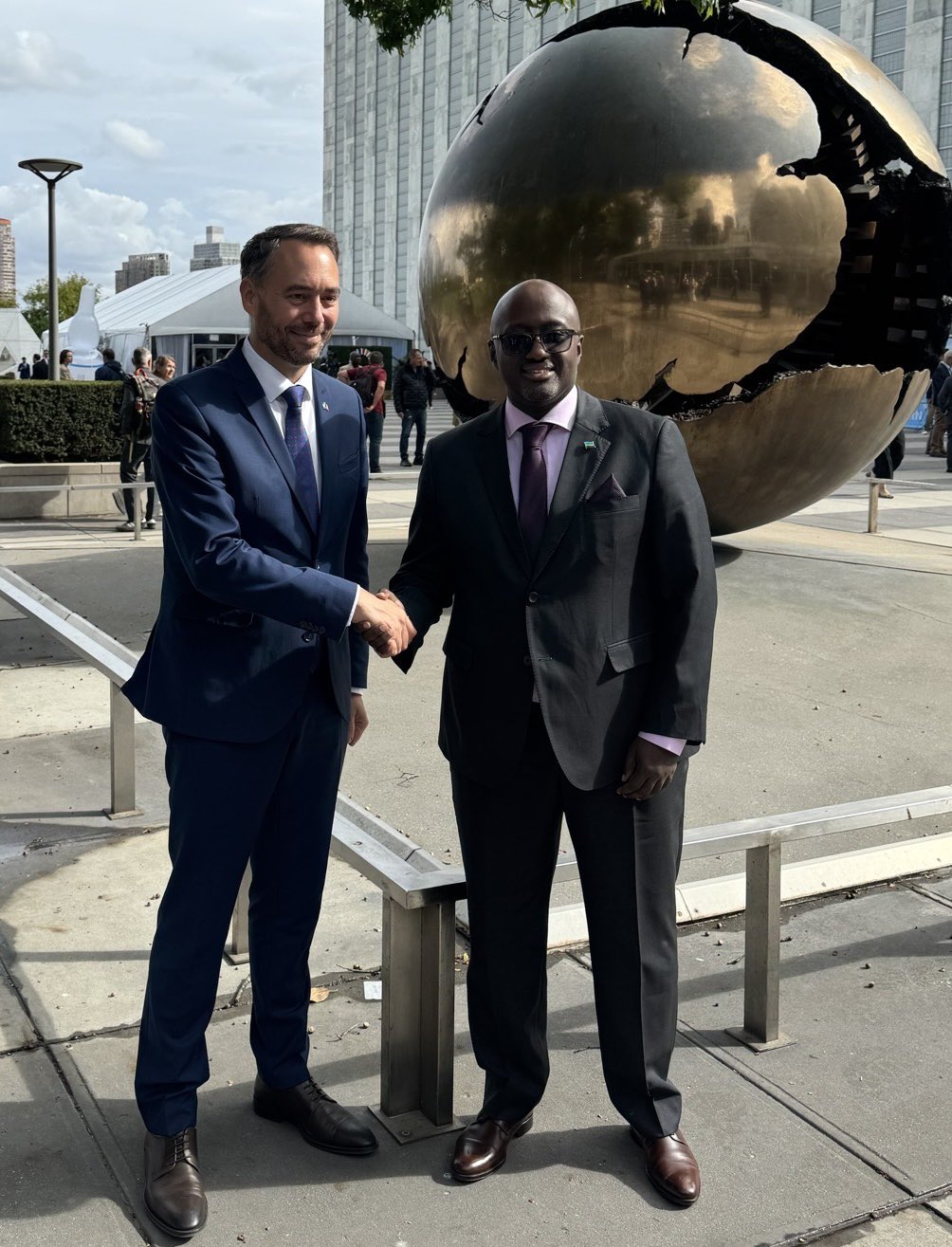
The move comes as the country continues to face a worsening security crisis nearly two weeks after an alliance of jihadist fighters and separatist rebels launched nationwide assaults. During the attacks, Defence Minister Sadio Camara was killed in an apparent suicide truck bombing targeting his residence near Bamako.
A decree read on state television on Monday confirmed Goïta’s new role as defence minister. He will be supported by army chief of staff Gen Oumar Diarra, who has been named minister delegate.
Goïta’s decision to hold both the presidency and the defence portfolio is widely seen as an effort to tighten his control amid growing pressure on his leadership.
The unrest began on 25 April when residents across Mali woke to gunfire and explosions as the separatist Azawad Liberation Front and the al-Qaeda-linked JNIM group launched coordinated attacks. Since then, the insurgents have reportedly imposed partial blockades on Bamako and other major cities.
The offensive, which also forced Malian and allied Russian forces to withdraw from the northern city of Kidal, has raised questions about the strength of Goïta’s military government, which came to power following a coup in August 2020.
Authorities say several soldiers have been arrested for alleged links to the attacks, with investigations suggesting involvement of both former and serving military personnel in planning and execution.
Mali has also coordinated with Niger and Burkina Faso to carry out air strikes against the insurgents. The three military-led countries, which form the Alliance of Sahel States, have expelled French troops and turned to Russian support in their fight against armed groups. However, insecurity persists, with large areas still outside government control.
Mali’s military leader Gen Assimi Goïta has taken over as defence minister after the officer who previously held the post was killed in a wave of surprise attacks.
The ministry confirmed that the sounds heard in scattered areas of the country were the result of the successful interception of the aerial threats.
It urges the public to obtain information from official sources, verify the facts, and adhere to all public safety measures upon receipt of warning messages.
Meanwhile, the UAE National Emergency Crisis and Disasters Management Authority said air defenses are responding to a missile threat, urging residents to remain in safe locations and follow official updates.
This photo taken on Oct. 17, 2024 shows a city view of Dubai, the United Arab Emirates.
The USS Truxtun and USS Mason, supported by Apache helicopters and other aircraft, faced a series of coordinated threats during the passage, said the report, citing Pentagon officials, who spoke under condition of anonymity.
No U.S. warship was struck, though Iran launched small boats, missiles and drones against them as a sustained barrage, the officials were quoted as saying.
None of the projectiles launched by Iran reached the U.S. vessels, they said, adding that the U.S. military’s assisting efforts, bolstered by air support, successfully intercepted or deterred each incoming threat.
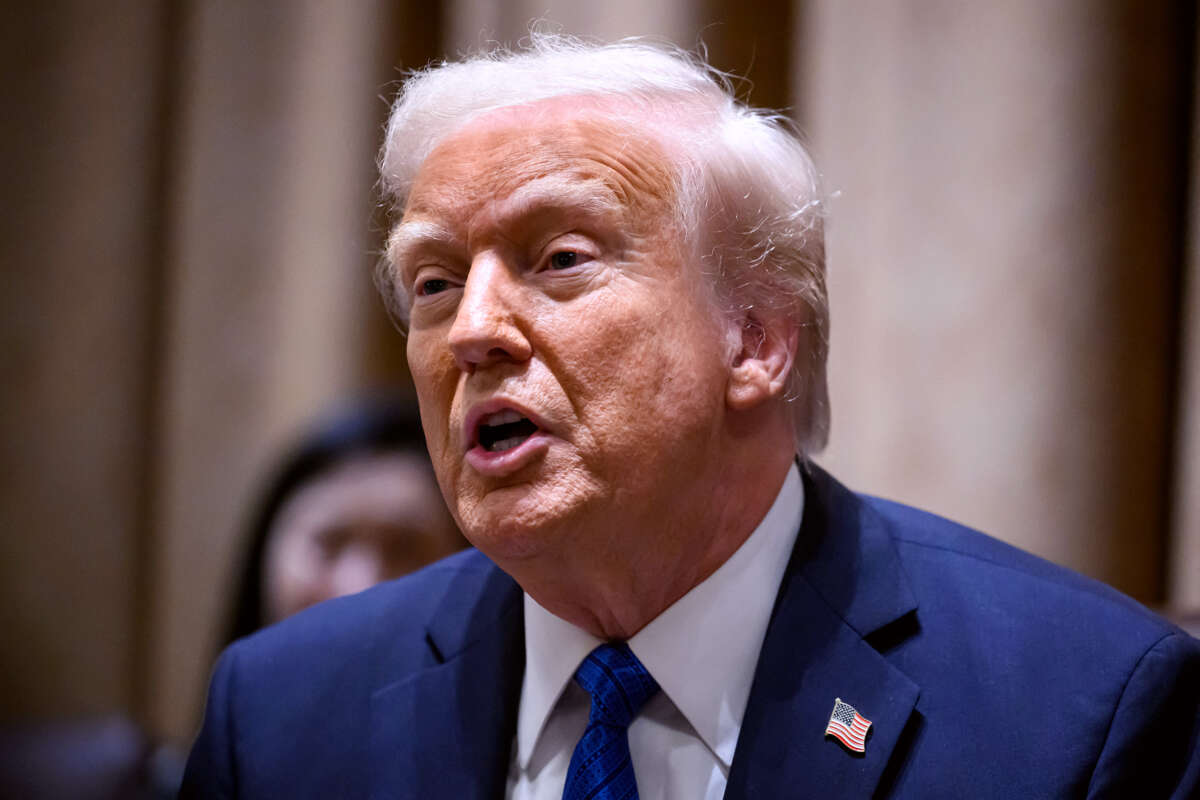
U.S. President Donald Trump told Fox News on Monday that the Iranians are “more malleable” than they were before.
In a phone interview with Fox News, the president threatened that if Iran targets U.S. ships in the Strait of Hormuz as the Pentagon begins operations to restore commercial shipping transit through the strait, they would be “blown off the face of the Earth.”
However, in another phone interview with ABC News on Monday, Trump stopped short of saying Iran’s Monday attacks had violated the U.S.-Iran ceasefire.
“[It was] not heavy firing,” Trump said, downplaying the attacks.
Brad Cooper, chief of the U.S. Central Command, told reporters earlier on Monday that Iranian forces had launched “multiple cruise missiles, drones, and small boats at ships we are protecting.”
U.S. forces have sunk six Iranian small boats targeting civilian vessels in the Strait of Hormuz and intercepted several Iranian missiles and drones, said Cooper.
Iran later rejected the U.S. claims, saying that “no commercial vessels or oil tankers” have transited the Strait of Hormuz, the semi-official Tasnim News Agency reported.
On Feb. 28, the United States and Israel launched joint strikes on Tehran and other Iranian cities, killing then-Supreme Leader Ali Khamenei, senior military commanders and civilians. Iran responded with waves of missile and drone attacks on Israel and U.S. targets across the region and restricted passage through the Strait of Hormuz for vessels linked to Israel and the United States.
A ceasefire took effect on April 8, followed by talks between Iranian and U.S. delegations in Islamabad that ended without a deal.
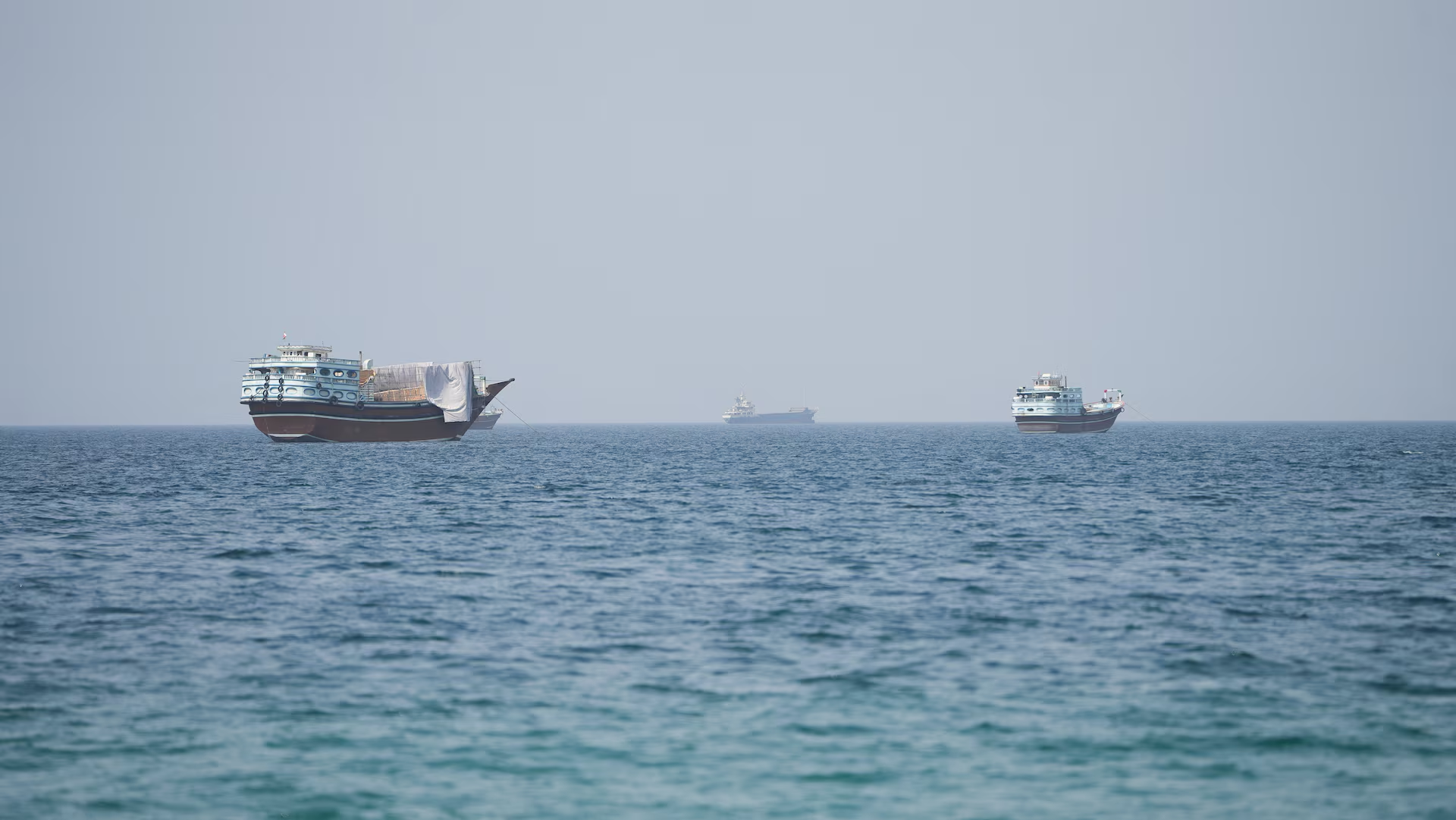
Two U.S. Navy destroyers have passed through the Strait of Hormuz and entered the Gulf after navigating an Iranian barrage, U.S. media outlet CBS News reported on Monday night.
The announcement, made on May 4, 2026, said the plan would start on Monday and is intended to help ships that have been unable to leave the strategically important waterway because of heightened hostilities in the region.
Trump described the initiative as a “humanitarian effort” aimed at guiding merchant ships safely through the sometimes dangerous strait so they can resume their journeys. Many of these ships and their crews had been “locked up” for weeks, with limited supplies, after Iran restricted access through the passage.
The U.S. Central Command said it will back the operation with a large force that includes thousands of U.S. military personnel, more than 100 aircraft, and naval support. Officials said the effort would combine both diplomatic coordination and military planning to keep the strait secure while maintaining a naval blockade on Iranian ports.
Despite these actions, Trump did not outline detailed plans about how the operation will unfold or whether U.S. warships will directly escort commercial vessels. Comments from the White House and Pentagon were limited at the time of the announcement.
Not long after the U.S. statement, the United Kingdom Maritime Trade Operations (UKMTO) reported that a commercial tanker had been struck by unknown projectiles roughly 78 nautical miles north of Fujairah in the United Arab Emirates. Fortunately, all crew members aboard the ship were reported safe, and details about the cause of the attack were still emerging.
This incident highlights the growing maritime security concerns in the Strait of Hormuz, a crucial chokepoint through which a large portion of the world’s oil flows. Tensions in the region, involving Iran’s blockade and responses by other nations, have already disrupted shipping and contributed to fluctuations in global energy prices.
U.S. moves to help ships stuck in the Strait of Hormuz.
He made the remarks in an interview with state-run IRIB TV while noting that the U.S. response is being reviewed.
He stressed that Iran’s plan is exclusively focused on ending the war, and “nothing pertaining to the nuclear field’s details exists in it.”
“At present, we are focused on the parameters related to ending the war in the region, including Lebanon,” Baghaei added, stressing “we have no nuclear negotiation at this stage.”
Also on Sunday, Iranian Foreign Minister Seyed Abbas Araghchi briefed his Omani and German counterparts on Iran’s latest diplomatic efforts and initiatives to end the war.
In separate phone calls, Araghchi exchanged views with Omani Foreign Minister Sayyid Badr bin Hamad bin Hamood Albusaidi and German Foreign Minister Johann Wadephul on the latest regional and international developments, according to statements released by the Iranian Foreign Ministry.
On Feb. 28, Israel and the United States launched joint strikes on Tehran and other cities, killing Iran’s then-Supreme Leader Ali Khamenei, senior commanders, and civilians. Iran responded with waves of missile and drone attacks targeting Israel and U.S. interests in the region.
A ceasefire took effect on April 8, followed by talks between Iranian and U.S. delegations in Islamabad that failed to produce a deal.
On Feb. 28, Israel and the United States launched joint strikes on Tehran and other cities, killing Iran’s then-Supreme Leader Ali Khamenei, senior commanders, and civilians. Iran responded with waves of missile and drone attacks targeting Israel and U.S. interests in the region.
The announcement was made by President Paul Kagame during a joint press briefing in Dar es Salaam on Sunday, following high-level talks with his host President Samia Suluhu Hassan.
Rwanda, President Kagame said, will soon publicly honour Tanzanians whose actions during that time demonstrated exceptional heroism and compassion.
“Rwanda is currently in the period of commemoration of the Genocide against the Tutsi of 1994, and we shall soon have the opportunity to publicly recognise some Tanzanian citizens whose actions during that time demonstrated exceptional heroism and compassion,” he stated.
Tanzania was among the countries that hosted Rwandan refugees during the 1994 Genocide against the Tutsi.
Previously, particularly during the 30th commemoration in 2024, President Kagame highlighted Tanzania’s role in supporting Rwanda during that period, especially in facilitating the Arusha Peace Process, and paid tribute to the late former Tanzanian President Julius Nyerere for his contribution to laying the foundation for that process.
Speaking on Sunday, the Head of State also thanked Tanzania for its longstanding partnership, noting that the two countries share historic ties rooted in friendship, culture, and decades of cooperation.
President Kagame said discussions with President Samia were constructive and focused on strengthening the long-standing relationship between the two countries.
“Today, the President and I had a very constructive discussion building on the long-standing relationship between our two countries,” he said, adding that Tanzania remains a key partner for Rwanda across multiple sectors, particularly trade and logistics.
On her part, President Samia Suluhu Hassan said bilateral trade between the two countries has continued to grow steadily, reaching significant levels in recent years.
“Trade between our two countries has grown strongly, reaching about 644 billion Tanzanian shillings (approximately Rwf 360 billion) last year,” she said, noting that this reflects deepening economic cooperation and increased private sector engagement on both sides.
She added that Tanzania remains committed to further strengthening trade and investment ties with Rwanda through improved infrastructure and removal of trade barriers.
Kagame highlighted progress in trade and logistics cooperation, noting that discussions focused on strengthening systems to manage the growing volume of business between the two countries and advancing joint development projects.
He also underscored the importance of regional integration, citing collaboration within the East African Community and the African Union as key frameworks supporting bilateral relations.
The two leaders reaffirmed their commitment to ensure the full implementation of agreed projects, amid what they described as a period of global geopolitical uncertainty that calls for regional unity and shared purpose.
On economic cooperation, both sides agreed to deepen trade and investment ties, improve transport and logistics systems, and enhance infrastructure connectivity, including road and rail networks such as the Isaka–Kigali railway project.
Energy cooperation also featured in the discussions, including the Rusumo Hydropower Project involving Rwanda, Tanzania, and Burundi, as well as plans to expand electricity trade between TANESCO and the Rwanda Energy Group (REG).
The leaders also discussed telecommunications infrastructure, including strengthening cross-border fibre optic connectivity to improve digital services.
Kagame said Rwanda remains committed to working closely with Tanzania for the benefit of citizens in both countries and expressed appreciation for the warm reception extended to him and his delegation.
President Kagame said Rwanda will soon recognise Tanzanian citizens for their acts of courage and compassion during the 1994 period of the Genocide against the Tutsi.President Kagame arrived in Tanzania on Sunday for a one-day working visit.
President Kagame is in Tanzania for a one-day working visit, where he held talks with President Suluhu before addressing a joint press conference on Sunday afternoon.
Welcoming the Rwandan leader, President Samia described Tanzania and Rwanda as long-standing partners and historic friends whose relations are anchored in shared culture, close people-to-people ties, and decades of cooperation dating back to pre-colonial times.
“Tanzania and Rwanda are not only neighbours, but also brothers and friends. Our brotherhood and friendship is historic and rooted in shared history and values,” President Samia said.
She noted that the two countries continue to work closely at bilateral, regional, and multilateral levels, including within the East African Community (EAC), the African Union (AU), the Non-Aligned Movement, and the United Nations.
The leaders highlighted the role of the Joint Permanent Commission for Cooperation (JPC), established in 1976, which remains the main framework guiding collaboration across sectors such as trade, investment, agriculture, energy, petroleum, transport infrastructure, defence, security, and immigration. The 16th session of the commission was held in Kigali last July.
Trade and investment featured prominently in the discussions, with President Samia noting that bilateral trade reached 644 billion Tanzanian shillings last year (approximately Rwf 360 billion).
“We are encouraged by the steady growth in trade between our two countries, which reflects the strength of our partnership,” she said.
She also pointed to growing investment flows, including 42 projects from Rwanda worth 325.5 million US dollars registered since March, which have created more than 2,200 jobs in Tanzania.
She further highlighted Tanzanian investments in Rwanda, including companies such as Bakhresa, Magodoro Dodoma, Discount Centre, Jambo Plastics, Sagar Enterprises, Buffalo Travel & Tours, Maxcom Africa, Gasabo Grain Milling Company, LCM Delta Company, and Matrix Integrated Consultancy, underscoring expanding private sector participation in both economies.
A central focus of the talks was transport and logistics, particularly the role of Tanzanian ports in facilitating regional trade. President Samia noted that about 70 percent of Rwanda’s cargo passes through Tanzanian ports, amounting to approximately 1.6 million tonnes annually.
“It is our responsibility, as we are the ones with ports in this region, to ensure efficient and reliable services to our neighbours who are land-linked,” she said.
The two leaders agreed to strengthen port operations through special logistics arrangements to improve the efficiency of cargo handling for Rwanda. They also reaffirmed commitment to advancing road and rail connectivity, with particular attention to the Isaka–Kigali railway project, which is expected to significantly improve the speed and cost of transporting goods between the two countries.
Energy cooperation was another key area of discussion, with both leaders reaffirming commitment to the Rusumo Hydropower Project, a regional initiative involving Rwanda, Tanzania, and Burundi that generates 80 megawatts of electricity.
“We are committed to ensuring that regional energy projects like Rusumo deliver shared benefits to our people,” President Samia said.
They also agreed to strengthen electricity trade between TANESCO and the Rwanda Energy Group (REG) to support industrial growth and regional energy integration.
President Kagame welcomed the progress in bilateral cooperation, noting that Tanzania remains a key partner for Rwanda in trade and logistics.
“Tanzania has been a key partner for Rwanda. Over the years, we have strengthened our cooperation across many sectors, particularly trade and logistics, which has helped connect Rwanda to global markets,” he said.
He emphasized the need to further improve systems that can efficiently manage growing trade volumes and ensure full implementation of joint development projects.
“Our discussions focused on how to build further on this foundation and ensure our systems are well equipped to handle the growing volume of business between our two countries,” he added.
In the communications sector, the leaders discussed expanding telecommunications infrastructure, including enhanced use of Tanzania’s fibre optic network in Rwanda to improve digital connectivity and service delivery.
Beyond economic cooperation, President Samia and President Kagame also exchanged views on peace, security, and regional stability, reaffirming their commitment to continued collaboration within international frameworks.
Additionally, President Kagame noted that Rwanda, currently in the commemoration period of the 1994 Genocide against the Tutsi, would soon recognise Tanzanian citizens who demonstrated exceptional courage and humanity during the time.
President Kagame is in Tanzania for a one-day working visit,President Kagame held bilateral talks with his Tanzanian counterpart, Samia Suluhu, before addressing a joint press conference on Sunday afternoon.
The visit follows that of Tanzania’s Minister of Foreign Affairs and East African Cooperation, Mahamoud Thabit Kombo, who visited Rwanda at the end of March 2026, with the aim of advancing cooperation between the two nations.
Upon arrival at Dar es Salaam International Airport, President Kagame was received by Minister Kombo and other senior officials.
He is expected to hold talks with his counterpart, President Dr. Samia Suluhu Hassan, focused on deepening bilateral cooperation and strengthening existing partnerships, which will be followed by a joint press conference.
Rwanda has consistently highlighted the strong and long-standing relations with Tanzania, particularly appreciating access to the Port of Dar es Salaam on the Indian Ocean, through which about 70% of its imports are routed.
Citizens of both countries have also established two friendship associations aimed at fostering closer ties: RWATAFA (Rwanda–Tanzania Friendship Association) and TARAFA (Tanzania–Rwanda Friendship Association).
The two countries have signed multiple cooperation agreements in key sectors, including trade, agriculture, security, technology, transport, and industrial development, concluded over different periods.
In July 2025, Rwanda and Tanzania agreed to establish a Tanzania Ports Authority (TPA) office in Kigali, a move expected to enhance and accelerate trade facilitation between the two countries.
As members of the East African Community (EAC), Rwanda and Tanzania also continue to collaborate on major regional infrastructure projects, including the planned railway line linking Isaka and Kigali, aimed at improving the movement of goods and boosting regional integration.
President Paul Kagame arrived in Tanzania on May 3, 2026, for a one-day working visit.The visit follows that of Tanzania’s Minister of Foreign Affairs and East African Cooperation, Mahamoud Thabit Kombo.President Kagame and his host, President Samia Suluhu Hassan of the United Republic of Tanzania, are scheduled to hold a tête-à-tête meeting, which will be followed by a joint press conference.The talks will be focused on deepening bilateral cooperation and strengthening existing partnerships.
“The U.S. president escalates his threats of military aggression against Cuba to a dangerous and unprecedented scale,” Cuban President Miguel Diaz-Canel wrote on X.
Diaz-Canel called on the international community and the American people to decide whether they would allow “such a drastic criminal act” to serve the interests of a small but wealthy and influential group seeking revenge and domination.
He said that no aggressor, “no matter how powerful,” would find surrender in Cuba, but rather “a people determined to defend sovereignty and independence.”
Cuban Foreign Minister Bruno Rodriguez also said on X the same day that Trump’s “clear and direct” threat of a military attack had raised aggression against Cuba to dangerous levels.
Rodriguez said popular support for the Cuban Revolution was demonstrated “massively” during May Day celebrations on Friday.
Speaking at an event in Palm Beach, Florida, Trump said the United States would take control of Cuba “almost immediately” after “finishing a job,” referring to the conflict with Iran in the Middle East.
He added that he “could” send the aircraft carrier USS Abraham Lincoln to the Caribbean and have it stop about 100 yards off Cuba’s coast “on the way back from Iran.”
Cuban President Miguel Diaz-Canel on Saturday denounced the escalation of Washington’s military threats against the country by US President Donald Trump.
In an exclusive interview with IGIHE, Niyonzima explained that the FDLR was built on a deep-rooted ideology that viewed Tutsis as enemies everywhere, insisting that no country should be governed by a Tutsi.
“What we were mainly taught was the evil nature of the Tutsi, just as we had been taught while still in Rwanda,” he said.
In 2000, he underwent training in intelligence work, a field he later led within the FDLR leadership structure prior to his return to Rwanda.
He described the FDLR leadership system as being organized into commissions similar to ministries, each with its own leadership and operational staff.
His responsibilities included gathering intelligence related to the group, assessing operational risks, recruiting new fighters, and managing relations with other armed groups such as Nyatura, FARDC and Congolese communities more broadly.
Deep-rooted ideology and ethnic targeting
Niyonzima revealed that due to genocidal ideology and anti-Tutsi hatred, anyone perceived to resemble a Tutsi could be targeted, accused of collaboration, or even placed on the front lines.
He emphasized that the FDLR ideology was built on the belief that Tutsis were enemies everywhere.
“We considered every Tutsi an enemy, whether in Uganda, Burundi, Congo, or Rwanda,” he said.
He further noted that the group opposed any possibility of a Tutsi leading a country, viewing them as perpetual adversaries.
False prophecies and ideological indoctrination
As a pastor within the group, Niyonzima said he used the Bible alongside what he described as false prophecies claiming divine support for their cause, including the belief that they would eventually conquer Rwanda.
He explained that each commander had a group of so-called prayer leaders who played a role in mobilization and decision-making, including leadership changes.
“When they wanted to replace a leader, they would use a so-called prophet who would fall down and ‘prophesy’ while covered. This was used to justify decisions,” he said.
Niyonzima also revealed that the group gradually shifted toward promoting ethnic identity over language, deciding to emphasize “Hutu” identity instead of Kinyarwanda.
“We said we should no longer speak Kinyarwanda but Hutu language. We were told we were Hutu and our enemy was the Tutsi,” he said.
He added that the group justified its actions by linking their narrative to grievances about regional conflicts involving Hutus in neighboring countries.
He further stated that intelligence structures within the FDLR monitored individuals planning to leave the group or communicating with people in Rwanda. Such individuals could be targeted and killed under suspicion of betrayal.
“When you believe you are fighting an enemy, everything you do feels justified. We would say: if this person leaves, they will one day become a threat. So we eliminate them early.”
Recruitment of youth and Congolese civilians
Niyonzima rejected claims that the FDLR is composed only of elderly fighters, explaining that the group actively recruited children, including those as young as 14, as well as young Congolese civilians.
He said the recruits were indoctrinated with hatred narratives, teaching them that the Tutsi was their enemy.
He also revealed that recruitment networks existed in neighboring countries, including Burundi and Uganda, and within Congolese communities.
Regret and reflection
Looking back, Niyonzima expressed deep regret for the years he spent in the Congolese forests, saying he lost valuable time that could have been used for personal development.
“My biggest regret is the time I wasted living in fear of nothing. I was afraid to return, but when I eventually did, I found people I left behind doing well. I have nothing to show for those years,” he said.
Niyonzima also expressed remorse for having spread extremist ideology. “What pains me most is that I taught people false ideas that Tutsis are evil, enemies, and cruel. But when I returned, I saw how people live together peacefully. I ask for forgiveness because I acted in ignorance,” he added.
Niyonzima called on former comrades still in eastern Congo forests to return home, urging them not to continue wasting their lives.
He also encouraged cooperation between regional actors, including the Congolese leadership, stressing that confrontation with Rwanda is not a viable path forward.
Niyonzima explained that the FDLR was built on a deep-rooted ideology that viewed Tutsis as enemies everywhere