The Argentine captain scored twice in the Group J clash in Dallas to move onto 18 World Cup goals, surpassing former Germany striker Miroslav Klose’s long-standing record of 16. The brace also took Messi’s tally at the tournament to five goals in just two matches, following his hat-trick in Argentina’s opening 3-0 win over Algeria.
The historic evening did not begin smoothly for the 38-year-old. Messi had an early opportunity to break the record after Argentina were awarded a penalty in the eighth minute following a foul on Lautaro Martinez. However, the Inter Miami forward fired his effort wide, leaving the record temporarily out of reach.
Messi responded in trademark fashion. In the 38th minute, Thiago Almada cleverly allowed Facundo Medina’s pull-back to run through his legs, giving Messi the chance to sweep a first-time finish into the net from inside the penalty area. The goal sparked celebrations and confirmed his place alone at the top of the World Cup scoring charts.
Austria, managed by Ralf Rangnick, threatened to equalise in the second half, but goalkeeper Emiliano Martinez produced a fine save to deny Marcel Sabitzer’s powerful free-kick on his 100th international appearance.
Messi then put the result beyond doubt in stoppage time. After Julian Alvarez’s effort was blocked by goalkeeper Alexander Schlager, the Argentine star reacted quickest to fire home from a tight angle and seal victory.
The goals marked another milestone in an extraordinary career. Twelve of Messi’s 18 World Cup goals have come after turning 35, while he also became only the third player to score in six consecutive World Cup matches.
The victory lifts Argentina to six points and guarantees their progress to the knockout stage. They conclude their group campaign against Jordan on June 28, with Messi now aiming to extend a record that may stand for years to come.
World Cup top goalscorers
18 Lionel Messi (Argentina, 2006-2026)
16 Miroslav Klose (Germany, 2002-2014)
15 Ronaldo (Brazil, 1994-2006)
15 Kylian Mbappe (France, 2018-2026)
14 Gerd Muller (West Germany, 1970-1974)
13 Just Fontaine (France, 1958)
12 Pele (Brazil, 1958-1970)
11 Sandor Kocsis (Hungary, 1954)
11 Jurgen Klinsmann (West Germany and Germany, 1990-1998)
10 Helmut Rahn (West Germany, 1954-1958)
10 Gary Lineker (England, 1986-1990)
10 Gabriel Batistuta (Argentina, 1994-2002)
10 Harry Kane (England, 2018-2026)
10 Teofilo Cubillas (Peru, 1970-1982)
10 Thomas Muller (Germany, 2010-2022)
10 Grzegorz Lato (Poland, 1974-1982)
The Argentine captain scored twice in the Group J clash in Dallas to move onto 18 World Cup goals, surpassing former Germany striker Miroslav Klose’s long-standing record of 16. Messi celebrates after scoring his first goal against Austria.
British Prime Minister Keir Starmer announced on Monday that he would resign as leader of the governing Labour Party and leave office once a successor is chosen.
Less than two years ago, Starmer led Labour to a landslide election victory that ended 14 years of Conservative rule. His early departure under mounting pressure from within Labour exposed the party’s governing difficulties and adds uncertainties to a prolonged political instability in Britain.
Analysts said the emphatic victory of Andy Burnham, then the mayor of Greater Manchester, in the recent Makerfield parliamentary by-election triggered Starmer’s resignation, but Britain’s deeper economic and political problems will confront whoever succeeds him.
From winner to loser
Starmer entered Downing Street in July 2024 promising “change,” faster economic growth, better public services and tighter control of illegal immigration. Yet his government soon became caught between efforts to limit public spending and demands from Labour lawmakers, trade unions and traditional supporters for greater social investment.
Moves to restrict winter fuel payments for pensioners and reform disability benefits provoked strong opposition. Subsequent concessions and policy reversals brought further criticism that the government lacked a clear direction.
The controversy surrounding former British Ambassador to the United States Peter Mandelson’s links with the late U.S. financier Jeffrey Epstein also raised questions about Starmer’s political judgment. The departure of senior Downing Street aides further weakened confidence in his administration.
A man leaves a polling station after voting for local elections in London, Britain, May 7, 2026.
What dealt another critical blow to Starmer were Labour’s heavy losses in May’s local and regional elections as Reform UK challenged it from the right, particularly on immigration, while the Green Party attracted some disillusioned voters on the left.
Stuart Wilks-Heeg, a political expert at the University of Liverpool, told Xinhua that Starmer could no longer remain in office once large numbers of Labour lawmakers and senior cabinet members concluded that he had to go.
“If you don’t have the command of your parliamentary party, you really are in trouble as a prime minister,” he said.
Wilks-Heeg said Starmer had succeeded in transforming Labour from a party widely considered unelectable after its 2019 defeat into the 2024 general election winner. However, he was unable to transfer that success into governance, with repeated policy reversals and “unforced errors” steadily eroding his authority.
Burnham emerges as front-runner
Burnham is widely regarded as the front-runner to succeed Starmer. He previously served as culture secretary and health secretary under former Prime Minister Gordon Brown and twice ran for the Labour leadership.
Burnham has returned to the House of Commons after winning the Makerfield by-election on Friday. On Monday, he voiced willingness to be “part of this process,” referring to the selection of Starmer’s successor.
This file photo taken on September 24, 2024, shows Keir Starmer in Liverpool, Britain. British Prime Minister Keir Starmer announced in a speech outside No. 10 Downing Street on Monday that he would resign as leader of the governing Labour Party and set out a timetable for his departure from the government.
Former Health Secretary Wes Streeting, previously regarded as a potential contender, expressed support for Burnham and called on other Labour figures to back him.
Burnham’s victory in Makerfield, where he defeated the Reform UK candidate Nigel Farage by a wide margin, strengthened his claim that he could halt the adversary’s advance. “It was almost like a jolt of electricity back into the Labour Party,” said David Bailey, an economics professor at the University of Birmingham.
Ian Scott, a professor at the University of Manchester, said Burnham combines long political experience, strong regional popularity and a direct style that resonates with voters. However, moving from Greater Manchester to Downing Street would be a major test. “He’s got an awful lot to prove,” Scott said.
Burnham’s policy agenda may distinguish him from Starmer, but it also raises questions about how additional investment and public service reform would be financed.
“The new prime minister faces a lot of the same constraints that the previous one faced,” Steve Nolan, a senior lecturer in economics at Liverpool John Moores University, said, adding, “There is wiggle room to play with, but not much.”
Britain’s Office for Budget Responsibility forecast in March that the country’s economy would grow by just 1.1 percent in 2026. Official statistics also showed that output per worker fell by 0.1 percent year on year in the first quarter.
A man walks past a shop in Manchester, Britain, May 11, 2023.
Nolan also noted bond markets would pay particular attention to whether the next government remained committed to Britain’s fiscal rules. High public debt and elevated borrowing costs would make any attempt to loosen those rules a “serious constraint” for a new leadership.
Set for seventh PM in decade
Starmer’s stepping down means his successor will become the seventh prime minister to enter Downing Street in roughly a decade since the 2016 Brexit referendum, highlighting the instability at the top of British politics.
Nolan said such frequent changes “do not signal a stable political economy.” He argued that replacing the prime minister does not alter Britain’s underlying conditions, as any new leader will face the same constraints of weak growth and public services.
Yang Fang, a researcher at the China Institutes of Contemporary International Relations, said tensions between Britain’s political system and party culture and the needs of its modern economy and society have weakened governance and fueled public dissatisfaction.
“Both Labour and the Conservatives have responded to crises by changing leaders to preserve power, but this approach cannot resolve deeper structural problems and instead risks creating ‘a low-efficiency cycle of repetition,’” she said.
The agreement was formalised on Sunday in Israel, bringing together Hapoel Hadera, Benfica Lisbon and the Tony Rwanda project in a partnership focused on youth development, professional training and creating opportunities for young players.
The signing in Israel also comes at a time when Tony Rwanda and Benfica have been discussing a wider project with the Government of Rwanda.
Sources involved in the talks said Tony Rwanda and Benfica have been in discussions with Rwandan authorities since early last year, following a visit to Portugal by Minister of Sports Nelly Mukazayire, over a broader partnership that would establish a large campus in Rwanda to serve as a regional hub for football talent development.
Some people close to the process say that, as the discussions with Hapoel Hadera have now materialised, Benfica and Tony Rwanda are also holding talks with other African countries over the possibility of establishing the proposed regional hub.
For Rwanda, the Hapoel Hadera and Benfica deal is important because it gives young talents connected to Tony Rwanda a possible pathway into a more competitive football environment outside the country.
In the first phase, a player from Rwanda is expected to join Hapoel Hadera’s youth setup, with the hope that more players could follow if the project succeeds.
The partnership comes as Hapoel Hadera enters a new phase under the leadership of Itay Ben-Zeev, the CEO of the Israel Stock Exchange, who recently bought the club. Asi Rahamim will serve as the owner’s representative, while continuing his role as sporting director of Tony Rwanda. He will also help strengthen Hapoel Hadera’s professional and operational structure.
Ben-Zeev said the idea was to connect different pieces of the same vision.
“For the past three years, Benfica Lisbon has been working together with Tony Rwanda,” he said during the launch. “When I spoke with Assi Rahamim and Hapoel Hadera, I said: ‘Why don’t we connect everything?’”
He said the project should not only benefit young players in Rwanda, but also create opportunities for children in Israel.
“Now this project will not only affect youth in Rwanda, but also in Israel, in Hadera,” he said.
The agreement was formalised on Sunday in Israel, bringing together Hapoel Hadera, Benfica Lisbon and the Tony Rwanda project in a partnership focused on youth development, professional training and creating opportunities for young players.The signing in Israel also comes at a time when Tony Rwanda and Benfica have been discussing a wider project with the Government of Rwanda.In the first phase, a player from Rwanda is expected to join Hapoel Hadera’s youth setup, with the hope that more players could follow if the project succeeds.
For Rwanda, the Hapoel Hadera and Benfica deal is important because it gives young talents connected to Tony Rwanda a possible pathway into a more competitive football environment outside the country.
Leading the local organization, Noel Musoni, President of the Rwandan diaspora in the Hamburg region, expressed great satisfaction with the success of the event, which brought together young people from across the country, some of whom travelled more than six hours to reach northern Germany.
Over the course of the two-day event, participants had the opportunity to get to know one another, exchange ideas about their backgrounds, projects and experiences, and reconnect with the values that define Rwandans, while learning how to balance their identity with the multicultural realities they encounter in their daily lives abroad.
This edition was also marked by the introduction of newly elected regional youth leaders who will represent the various Rwandan diaspora communities across Germany.
These include Sadi Isingizwe, President of the Hamburg and Lower Saxony regions; Delice Ikirezi and Gatete Deogratias, Co-Presidents of the North Rhine-Westphalia (NRW) and Rhineland-Palatinate (RP) region; Mugwaneza Francine, President of the Rhein-Main-Neckar region; Gabiro Vainqueur, President of the Berlin region; and Mafurebo Andy Kanobayita, President of the Bavaria region.
In an interview with IGIHE, Noel Musoni highlighted the importance of this initiative for the future of Rwandan youth in Germany.
“This year, we had the honour of hosting Rwanda Youth Connect in the city of Hamburg. We are pleased to see that all regions where the Rwandan diaspora is organized now have youth representatives. This will further strengthen connections among young people, who are an important and dynamic part of our community in Germany.”
He also welcomed the achievement of this year’s objectives, particularly bringing young people closer together, fostering collaboration among them and encouraging their active involvement in Rwanda’s development.
Noel Musoni, President of the Rwandan diaspora in the Hamburg region, expressed great satisfaction with the success of the event, which brought together young people from across the country, some of whom travelled more than six hours to reach northern Germany.The initiative is aimed at strengthening ties among Rwandan youth living in the diaspora.Young Rwandans from different regions across Germany gathered in Hamburg for Rwanda Youth Connect Germany.Over the course of the two-day event, participants had the opportunity to get to know one another, exchange ideas about their backgrounds, projects and experiences, and reconnect with the values that define Rwandans. Rwanda’s Ambassador to Germany, Igor Cesar, reminded participants that they are not mere observers of Rwanda’s development but active contributors to its future. Rwanda Youth Connect Germany 2026 demonstrated that, beyond geographical distances, a united, organized youth deeply connected to its roots can become a true force for development.
The commitment was announced following a Tripartite High-Level Ministerial Meeting held in Addis Ababa on Monday, June 22. There, the three parties reviewed progress under existing repatriation frameworks and adopted the 2026–2027 Tripartite Technical Working Group Road Map on Voluntary Repatriation and Reintegration.
The meeting was convened under the framework of the Tripartite Agreements signed in 2010 and comes amid efforts to improve relations between Kigali and Kinshasa following the signing of the Accords for Peace and Prosperity in Washington in December 2025.
In a joint communiqué issued after the meeting, the parties reaffirmed their commitment to durable displacement solutions, stating that the “voluntary, safe, dignified, and informed return” remains “a cornerstone of durable solutions and a contribution to peacebuilding and regional stability.”
According to UN data presented during the meeting, the DRC database holds records for 196,289 Rwandan nationals and asylum seekers, including 75,421 who have been biometrically registered, while Rwanda hosts 84,456 Congolese refugees and asylum seekers.
The parties noted steady progress in facilitating the return of Rwandan returnees from eastern DRC. Since January 2025, a total of 8,394 Rwandans have voluntarily returned home, including 2,347 repatriated during the first half of 2026. Encouraged by this momentum, the parties endorsed an operational planning target of 10,000 voluntary repatriations for 2026 and agreed on measures aimed at accelerating implementation.
Among the decisions taken was the organization of formal quarterly cross-border meetings to strengthen coordination among the governments and UNHCR, with the first meeting scheduled for September 2026.
The parties also agreed to utilize the Kamanyola border crossing in South Kivu and the Bugarama border post in Rwanda to facilitate the return of more than 3,600 Rwandan citizens currently dispersed across the southern part of South Kivu Province who have expressed a willingness to return home. To support the process, the DRC committed to establishing a viable transit route to the border crossing point for candidates located in outlying areas of southern South Kivu.
The communiqué further noted the situation of more than 400 Rwandan nationals who have been waiting for over a month in transit centres in North and South Kivu pending repatriation. Rwanda pledged to continue receiving these returnees while strictly observing the prevailing regional health situation and public health guidelines related to Ebola virus disease management.
The meeting also addressed the future return of Congolese refugees living in Rwanda. While no voluntary repatriation of Congolese refugees has yet taken place, the parties agreed that beginning in October 2026, the DRC will identify priority areas of return based on refugee intention surveys and location data provided by the Rwandan authorities.
The ministers welcomed recent political and technical developments between the two countries and acknowledged the support of the African Union, the United Nations, and the Office of the Special Envoy of the UN Secretary-General for the Great Lakes Region in advancing peace, security, and durable solutions for displaced populations.
The next Tripartite High-Level Ministerial Meeting is scheduled for June 2027, with the date and venue to be communicated through diplomatic channels.
The commitment to continue repatriation processes was announced following a Tripartite High-Level Ministerial Meeting held in Addis Ababa on Monday, June 22.
The meeting was convened under the framework of the Tripartite Agreements signed in 2010 and comes amid efforts to improve relations between Kigali and Kinshasa following the signing of the Accords for Peace and Prosperity in Washington in December 2025.
The investment, announced on June 22, follows Spiro’s earlier $215 million equity funding round backed by a consortium of institutional, international and regional investors. The latest financing reinforces investor confidence in Africa’s rapidly growing electric mobility sector and positions Spiro among the continent’s best-funded clean energy and e-mobility companies.
The company said the fresh capital will accelerate the expansion of its battery-swapping network, manufacturing capabilities and next-generation EV infrastructure across high-growth African markets.

Spiro currently operates in seven countries, Rwanda, Kenya, Uganda, Nigeria, Benin, Togo and Cameroon, where it is helping replace fuel-powered motorcycles with electric alternatives.
The company has deployed more than 100,000 electric motorcycles, established over 2,500 battery-swapping stations and completed more than 30 million battery swaps, making it Africa’s largest operator of battery-swapping infrastructure for electric two-wheel vehicles.
Spiro has deployed more than 100,000 electric motorcycles across its seven markets.

Beyond expanding its network, the partnership with NewTrails Capital is expected to strengthen Spiro’s manufacturing ambitions by supporting the localisation of production and supply chains in Africa, particularly through collaboration with Chinese suppliers.
Spiro Founder and Chairman of Equitane, Gagan Gupta, welcomed the investment, saying it reflects growing confidence in the company’s vision and progress.
“Partnering with NewTrail Capital’s deeply experienced team marks a powerful new chapter for Spiro as we prepare for the next steps of our pan-African and international expansion”, he stated.
NewTrails Capital Founding Partner Yufan Zhang said the investment reflects the firm’s confidence in Spiro’s business model and long-term prospects.
“Spiro’s core strengths lie in its deeply localized operating capabilities, vertically integrated supply chain, digitally enabled ecosystem, sound unit economics, and strong ability to scale rapidly,” Zhang noted.
The latest financing reinforces investor confidence in Africa’s rapidly growing electric mobility sector and positions Spiro among the continent’s best-funded clean energy and e-mobility companies.
Zhang added that the company has successfully integrated electric vehicles, batteries, energy replenishment, payments and service networks into a solution tailored to African markets, and that Chinese financing and supply chains can play an increasingly important role in supporting Africa’s clean energy transition.
The investment comes as many African countries seek to reduce dependence on imported fossil fuels, strengthen energy security and modernise urban transport systems. It also highlights increasing global investor interest in scalable EV infrastructure across the continent.
Founded to accelerate Africa’s transition to clean mobility, Spiro is expanding regional production and assembly operations with the goal of manufacturing electric vehicles in Africa for African and international markets.
Beyond expanding its network, the partnership with NewTrails Capital is expected to strengthen Spiro’s manufacturing ambitions by supporting the localisation of production and supply chains in Africa, particularly through collaboration with Chinese suppliers.
Starmer said he would step down as both prime minister and leader of the Labour Party, but would remain in office until the party elects a successor to ensure an orderly transition of power.
Speaking outside 10 Downing Street in London, an emotional Starmer described becoming prime minister as “the proudest moment of my life,” saying his government had helped restore Britain’s international standing, attract investment and strengthen workers’ rights.
However, he acknowledged that many Labour lawmakers no longer believed he was the right person to lead the party into the next general election.
“I have heard the answer from my parliamentary party. I accept that answer with good grace. I will resign as leader of the Labour Party,” he said.
Starmer’s resignation follows months of growing dissatisfaction within Labour after the party suffered heavy losses in local elections held in May. His government also faced criticism over fiscal policy, welfare reforms and a series of political controversies that weakened his standing among MPs and the wider public.
An Ipsos poll published last week found that 52% of Britons believed Starmer should step down, while only 35% wanted him to remain in office.
His departure comes less than two years after he led Labour to one of its biggest parliamentary majorities in the 2024 general election, ending 14 years of Conservative rule.
The resignation is expected to trigger a leadership contest that could make Britain home to its seventh prime minister in just 10 years. Former Greater Manchester mayor Andy Burnham, who recently returned to Parliament after winning a by-election, is widely viewed as the frontrunner, although other senior Labour figures could also enter the race.


The next prime minister will inherit significant economic challenges, pressure over public spending and an increasingly complex international environment.
For Rwanda, Starmer’s legacy is associated with his decision to cancel the UK-Rwanda Migration and Economic Development Partnership on his first day in office in July 2024. The agreement, signed under former Prime Minister Boris Johnson’s Conservative government in 2022, had sought to relocate some asylum seekers from the UK to Rwanda as part of efforts to deter illegal Channel crossings.
Although Starmer scrapped the policy, his government continued to face criticism over rising irregular migration, an issue that remained politically sensitive throughout his premiership.
Political analysts say the outcome of Labour’s leadership contest could influence the party’s future direction on immigration, public spending and foreign policy as it seeks to rebuild public confidence ahead of the next general election.
Starmer’s departure comes less than two years after he led Labour to one of its biggest parliamentary majorities in the 2024 general election, ending 14 years of Conservative rule.
Unveiled in Lagos by the Federal Ministry of Industry, Trade and Investment over the weekend, the initiative connects Nigeria to key regional markets including Kigali, Lusaka and Harare, while also offering improved access to Nairobi and Johannesburg through RwandAir’s network.
Officials say the corridor is designed to reduce logistics barriers that have long limited the competitiveness of Nigerian exports. Cargo rates on RwandAir-operated routes are expected to fall to below $2 per kilogram for exporters holding AfCFTA Certificates of Origin issued by the Nigeria Customs Service.
Before the rollout of the expanded corridor, exporters reportedly paid between $3 and $10 per kilogram to ship goods to East and Southern African markets, a cost structure that significantly reduced profit margins and restricted market reach.
Officials say the new arrangement is part of Nigeria’s broader strategy under President Bola Ahmed Tinubu’s Renewed Hope Agenda to translate AfCFTA commitments into practical trade opportunities for businesses.
Speaking at the launch, Minister of Industry, Trade and Investment Jumoke Oduwole said the initiative reflects government efforts to dismantle trade barriers and expand continental market access for Nigerian companies.
“Our goal is clear: to make it easier and cheaper for Nigerian businesses to trade across Africa,” she said, noting that the corridor builds on a previous phase launched in 2025.
She added that the expanded network will particularly benefit exporters in agribusiness, fashion and textiles, cosmetics, processed foods and light manufacturing, sectors seen as key drivers of Nigeria’s non-oil export growth.
RwandAir’s Director of Cargo Services, Jean Bosco Gakwaya, said the partnership will enhance connectivity and strengthen economic ties across the continent by enabling more efficient movement of goods.
“This partnership between RwandAir Cargo and Nigeria’s Federal Ministry of Industry, Trade and Investment enables us to connect Nigerian manufacturers to key markets across East and Southern Africa using our RwandAir network,” he said.
He described the initiative as a “pivotal moment” for intra-African trade, highlighting the growing role of air cargo in supporting regional economic development.
The corridor follows an earlier arrangement launched in 2025 in partnership with Uganda Airlines, which connected Nigerian exporters to Entebbe, Nairobi and Johannesburg. The inclusion of RwandAir now broadens destination options and increases flexibility for traders across the continent.
Officials say the expansion is also a reflection of deepening economic cooperation between Nigeria and Rwanda, following recent engagements between President Bola Tinubu and President Paul Kagame at the Africa CEO Forum in Kigali.
The Nigerian government has urged exporters, logistics operators and small businesses to take advantage of the new corridor, which is expected to lower costs, improve efficiency and strengthen Nigeria’s non-oil export performance within Africa’s growing integrated market.
Unveiled in Lagos by the Federal Ministry of Industry, Trade and Investment over the weekend, the initiative connects Nigeria to key regional markets including Kigali, Lusaka and Harare, while also offering improved access to Nairobi and Johannesburg through RwandAir’s network.Officials say the new arrangement is part of Nigeria’s broader strategy under President Bola Ahmed Tinubu’s Renewed Hope Agenda to translate AfCFTA commitments into practical trade opportunities for businesses.The Nigerian government has urged exporters, logistics operators and small businesses to take advantage of the new corridor, which is expected to lower costs, improve efficiency and strengthen Nigeria’s non-oil export performance within Africa’s growing integrated market.
The result marked Egypt’s first win at the World Cup in their ninth appearance, moving them to the brink of qualification for the last 32 and easing the disappointment of previous campaigns.
New Zealand made a bright start and took the lead in the 15th minute when Finn Surman rose to head home from a set-piece, putting Egypt under early pressure. However, the African side responded strongly after the break and turned the match around with a dominant second-half display.
Mostafa Mohamed restored parity in the 58th minute after being set up by Salah, before the Liverpool forward put Egypt ahead just nine minutes later with a composed finish in the 67th minute. Mahmoud Hassan ‘Trezeguet’ sealed the historic victory in the 82nd minute, converting from a well-delivered corner to complete the 3-1 comeback.
Salah’s influence was decisive throughout, as he continued to carry Egypt’s attacking threat after a slow start to the tournament, which had included a subdued performance in their opening draw against Belgium. Just when it seemed his World Cup struggles might continue, the 34-year-old delivered a match-winning display to lift his nation.
The win also highlighted Egypt’s resilience, as they recovered from conceding early to produce one of their most important results in World Cup history. It leaves them in a strong position in Group G and on course for a possible place in the knockout stage.
Egypt will now turn their attention to their final group match against Iran, where another positive result could confirm progression to the round of 32.
Salah, who now has 68 international goals, described the victory as “a great achievement for all the players” and praised the team’s spirit in overcoming adversity on the world stage.
Mixed fortunes for other African nations
While Egypt celebrated a historic triumph, the other African representatives in action on Sunday experienced contrasting fortunes as the second round of group-stage matches continued.
In Group H, debutants Cabo Verde produced a stunning, resilient display to secure a dramatic 2–2 draw against two-time World Cup winners Uruguay at Miami Stadium. The Blue Sharks made history in the 21st minute when Kevin Pina swept home a sensational 34-yard free-kick, recording the nation’s first-ever FIFA World Cup goal.
Uruguay responded aggressively before the break, turning the game on its head with quick-fire goals from Maximiliano Araújo and Agustín Canobbio to take a 2–1 halftime lead.
However, Cabo Verde refused to back down. In the 61st minute, forward Hélio Varela capitalized on a defensive mix-up in the Uruguayan box to slot home a deserved equalizer. The hard-fought point keeps Cabo Verde firmly alive in the race for the knockout rounds, leaving them tied with Uruguay on two points in Group H.
It was a far more sobering evening for Tunisia, who were officially eliminated from the tournament after suffering a heavy 4–0 defeat against a ruthless Japan side at Estadio Monterrey. The Group F clash, which marked the historic 1,000th match in FIFA World Cup history, was entirely dominated by the Asian giants.
Daichi Kamada opened the scoring for Japan after just four minutes, netting the fastest World Cup goal in his country’s history. Striker Ayase Ueda doubled the advantage on the half-hour mark before winger Junya Ito added a third in the 69th minute.
Ueda capped off his stellar performance with a looping header late in the game to complete the rout. The comprehensive loss leaves the Eagles of Carthage bottom of the group without a point, spelling an early exit from the competition.
The victory marked a huge milestone for Egyptian football, ending the nation’s long wait for a first World Cup match win after several appearances on football’s biggest stage.
According to figures released by the DRC health ministry, the country has reported 1,003 confirmed cases, including 254 deaths, with an overall case fatality rate of 25.3 percent.
A total of 365 patients are currently in isolation or hospitalized, while 100 patients have recovered, the update said. The contact follow-up rate across the three affected provinces stood at 58 percent.
Despite the rise in cases, Ebola response efforts remain active, with heightened surveillance, intensified community outreach, and ongoing efforts to strengthen case management and diagnostic capacity, authorities said.
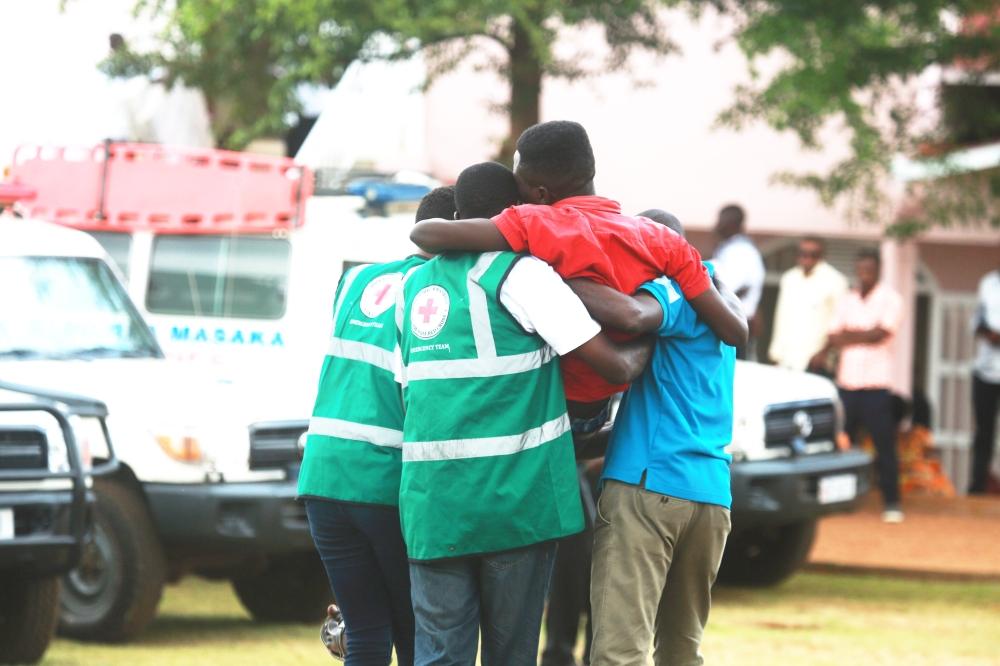
Red Cross workers bury an Ebola victim at the Rwampara Cemetery, in Rwampara, Congo, Saturday, May 23, 2026.