Following a string of vessel attacks and seizures since April, the International Maritime Organization (IMO), a specialized agency of the United Nations regulating maritime transport, issued a warning on August 24 highlighting the rise in piracy and confirming that over 90 seafarers remain held hostage by pirate networks.
Experts emphasize that a persistent lack of economic opportunities, compounded by widespread illegal fishing by foreign vessels, is driving more Somalis toward piracy, viewed by many both as a form of socio-economic protest and a desperate survival strategy.
Mohamed Husein Gaas, director of the Raad Peace Research Institute, a think tank, noted that the security vacuum created as international naval forces shifted attention to the Red Sea crisis has given Somali pirate networks renewed operational freedom.
“Somali piracy is back not because the underlying problem disappeared, but because the security architecture that suppressed it has weakened,” Gaas told Xinhua in a recent interview in Mogadishu, the capital of Somalia.
He noted that while international naval patrols and vessel defense measures previously suppressed piracy, root causes like weak coastal enforcement, poverty, and lack of governance remained unresolved.
“Piracy was suppressed, not solved,” Gaas said.
Gaas said that the Houthi conflict has “changed the equation” by shifting shipping routes and diverting naval resources, creating ripple effects for maritime traffic near Somalia.
However, he cautioned against treating allegations of direct operational ties between Houthi networks and Somali pirate groups as established fact.
Meanwhile, commercial consequences are mounting in the region.
Abdirizak Sabriye, a member of the Somali Chamber of Commerce and Industry, the apex umbrella body for Somalia’s private sector, noted that global ocean carrier Maersk has suspended new bookings to and from the Port of Berbera in northern Somalia citing operational scheduling conflicts and broader regional route realignments.
While Sabriye did not link the decision solely to piracy, he emphasized that it underscores the widespread logistics disruption hitting Horn of Africa trade.
For Somalia, an import-dependent economy, prolonged maritime disruptions threaten to drive up freight and insurance premiums, tighten domestic supply chains, and trigger consumer price inflation.
Yusuf Mohamed Mahadale, a prominent capital goods importer known locally as “Shakirow”, said that these cost pressures are already spilling over into local markets.
“The prices of construction materials, fuel and even cooking gas have risen sharply in recent months,” Shakirow said, linking the price hikes directly to growing risks along shipping routes and the broader regional maritime crisis.
Because much of Somalia’s construction material is imported from China, Shakirow emphasized that the Indian Ocean-Gulf of Aden corridor serves as a vital economic lifeline for Somali businesses.
“When shipping companies avoid taking such risks, supply becomes tighter while market demand remains high,” Shakirow told Xinhua.
Analysts have warned that the long-term economic fallout could escalate significantly if piracy evolves from isolated incidents into a sustained, systemic threat to Indian Ocean trade corridors.
“If piracy becomes sustained, shipping companies could again avoid the Gulf of Aden, raising insurance, freight and fuel costs and ultimately consumer prices,” Gaas said.
“For Somalia, that would mean higher import costs and weaker maritime investment, while the wider region and global trade would absorb the larger shock,” he cautioned.
Rising piracy highlights a shift in regional security dynamics as Western naval forces pivot toward broader Middle Eastern conflicts, opening space for Turkey, China, and Gulf nations to expand their influence around the Red Sea.
To address these vulnerabilities, a Somali government official stated that Mogadishu plans to join the Mecca Joint Defense Agreement with Saudi Arabia, Turkey, and Pakistan.
Speaking on condition of anonymity, the official noted Somalia will also consult with China to strengthen its naval capabilities and reduce reliance on Western defense coalitions.
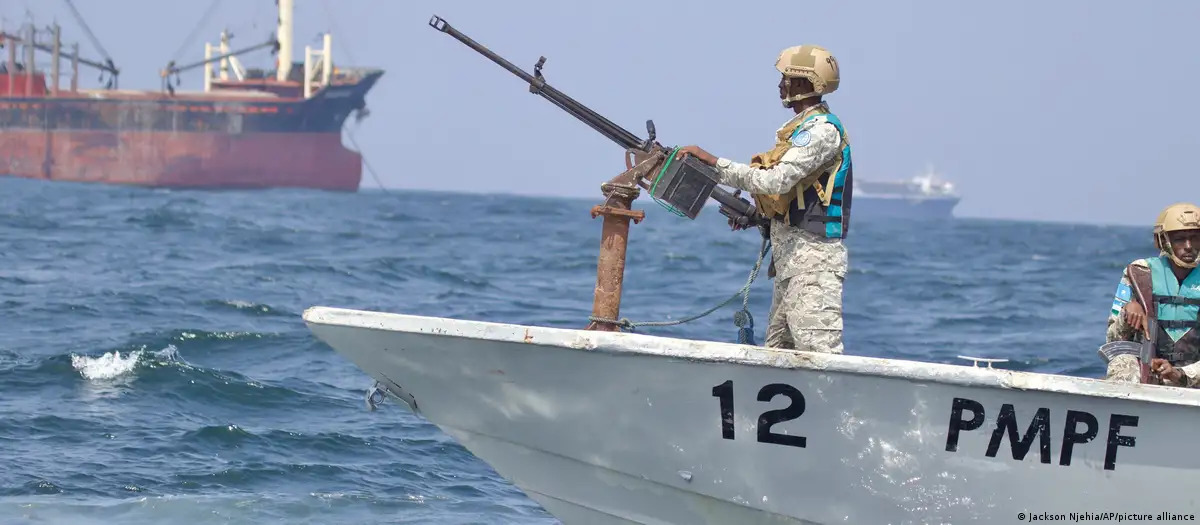
Though Somalia’s potential entry into the defense pact remains an unconfirmed diplomatic effort, Mogadishu is expanding domestic counter-piracy operations.
The foreign ministry reported ongoing land and sea interventions, highlighting the August 29 liberation of the hijacked cargo ship MV Lutuf as a key success.
“Somalia will not permit its waters to become a haven for maritime crime,” the ministry said.
The government is calling for international naval support to align with its national security framework and bringing the piracy issue before the UN Security Council, supported by Parliament’s recent passage of updated anti-piracy legislation.
Gaas noted that naval patrols are insufficient on their own, arguing that lasting solutions depend on strong coastal governance, improved enforcement, and genuine economic opportunities for local communities.
Leave a Reply