The study, led by researchers from the University of Oxford and published in Nature Astronomy, suggests that Mars could have experienced complex geological processes similar to those associated with Earth, despite lacking Earth-style plate tectonics.
Mars is generally described as a “stagnant lid” planet because its outer shell is not divided into moving tectonic plates like Earth’s.
On Earth, plate tectonics plays an important role in volcanism, recycling crustal material and the formation of continents.
Because Mars does not have this system, scientists have traditionally thought that its crust developed through relatively simple volcanic processes.
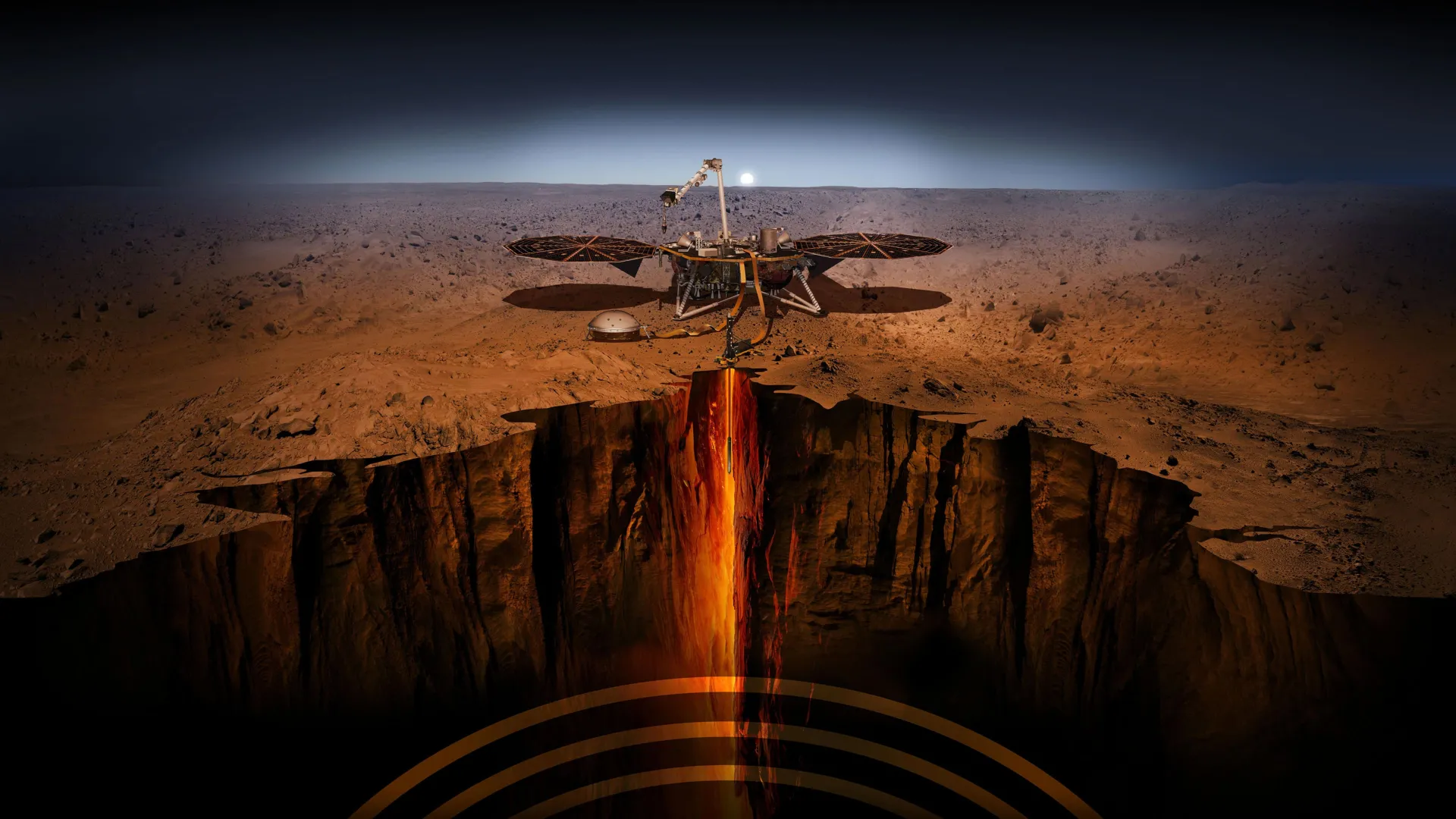
Researchers analysed seismic data collected by NASA’s InSight mission, including signals produced by marsquakes and meteoroid impacts.
They focused on an unusual boundary located about 24 kilometres below the Martian surface.
Although scientists had previously identified the boundary, its origin was not fully understood.
The research team compared the seismic measurements with hundreds of possible rock compositions.
Using thermodynamic modelling and statistical analysis, they found that the material below the boundary was most consistent with ultramafic rocks, which are rich in iron and magnesium but contain relatively little silica.
The rocks above the boundary were more consistent with mafic material, which contains a higher proportion of silica.
According to the researchers, the difference could have been created by large quantities of molten rock accumulating deep within the Martian crust and gradually separating into different materials.
As the magma cooled, heavier crystals could have settled deeper underground while lighter, chemically evolved molten material moved upward.
Similar processes occur on Earth beneath volcanic regions and can contribute to the formation of continental crust.
The researchers believe the geological system on Mars may have been much larger than previously imagined.
The buried layer could extend across hundreds or potentially thousands of kilometres in the planet’s northern hemisphere.
This suggests that ancient Mars may not have been dominated only by isolated volcanic centres. Instead, large interconnected magma systems may have operated throughout significant portions of the planet’s crust.
The process is known as transcrustal magmatism, in which molten rock moves and evolves through much of a planet’s crust.
The study provides evidence that such complex magmatic activity may have occurred on Mars even without Earth-like plate tectonics.
The discovery could also change how scientists think about potentially habitable planets.
On Earth, geological recycling helps influence the atmosphere, oceans and long-term cycling of water and other elements.
Plate tectonics is an important part of this process, leading scientists to consider tectonic activity potentially significant for maintaining habitable environments.
However, the Mars findings suggest that complex geological recycling may not always require plate tectonics.
If Mars was capable of developing a chemically evolved crust through large-scale internal recycling, similar processes could potentially occur on other rocky planets that do not have Earth-like tectonic systems.
The researchers say this raises the possibility that planets previously considered less promising because they lack plate tectonics could still develop geological conditions relevant to habitability.
The findings were made possible by NASA’s InSight mission, which landed on Mars in 2018 and carried the first seismometer specifically designed to study the planet’s interior.
By analysing seismic waves travelling through Mars, scientists have been able to investigate structures deep beneath its surface that cannot be directly observed.
The study, titled Seismic evidence for a melt-depleted lower crust and transcrustal magmatism on Mars, was conducted by researchers from the University of Oxford, the University of Bristol and Oxford’s Department of Statistics.
The findings do not mean that Mars currently has an active Earth-like system of plate tectonics.
Instead, they provide evidence that the planet’s ancient geological history may have been far more complex than previously believed.
The discovery adds to growing evidence that Mars once had a much more dynamic interior and could help scientists better understand how rocky planets evolve, including worlds beyond our solar system.
Leave a Reply