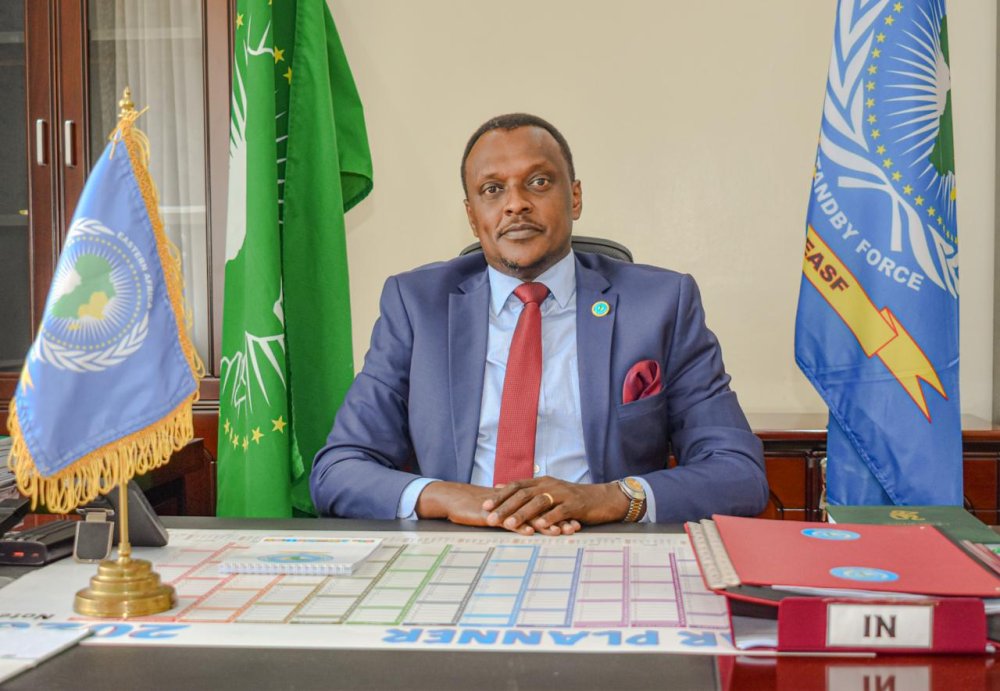
Political differences between Rwanda and Burundi should not hinder professional cooperation between their armed forces, Brig Gen Ronald Rwivanga, Director of the Eastern Africa Standby Force (EASF), has said.
Rwivanga made the remarks during an interview with The New Times’ The Context podcast, where he discussed the role of the EASF, regional security cooperation and the challenges facing the Eastern African region.
Asked whether tensions between Rwanda and Burundi could affect cooperation within the EASF, Rwivanga said the organisation had not been affected by disputes between its member states.
“Surprisingly, this organization has not been affected in any way by the conflicts between individual states,” he said.
He pointed to previous tensions between Rwanda and Uganda, saying that despite bilateral disagreements, the two countries continued participating in regional security initiatives through the EASF.
The same principle, he said, applies to Rwanda and Burundi.
According to Rwivanga, both countries have remained consistent in participating in the EASF’s military, police and civilian engagements despite their differences.
He said regional security cooperation requires member states to distinguish political disagreements from their professional responsibilities.
“Whatever transpires between nations, as professional forces, we need to go beyond the political issues between nations and work as professionals in the military field,” Rwivanga said.
He added that countries in the region have to continue working together because they share the same security environment and face challenges that do not respect national borders.
“Whether we like it or not, we are in the region together and we have to work together,” he stressed.
Regional security
Rwivanga, who recently took up his new role at the EASF headquarters in Nairobi after serving for nearly six years as Rwanda Defence Force spokesperson, said regional cooperation remains essential in addressing security threats.
He identified terrorism, cross-border crime, maritime insecurity and cyber threats among the key challenges facing the region.
He argued that stronger cooperation between regional organisations and neighbouring countries would help address such threats more effectively.
“Working together helps to deal with all the grey areas, the blind spots along the border,” he noted.
He cited cooperation between Rwanda and Uganda, as well as Rwanda and Tanzania, as examples of joint efforts to address cross-border insecurity.
EASF readiness
Rwivanga also sought to clarify the role and readiness of the Eastern Africa Standby Force, which was established in 2004 as one of the African Union’s five regional standby arrangements.
The force brings together military, police and civilian components from countries in the Eastern African region and is mandated to support peace support operations, conflict prevention, crisis response and post-conflict reconstruction.
Rwivanga said the EASF reached full operational capability in 2014 after verifying the forces and capabilities pledged by member states.
He stressed that being a standby force does not necessarily mean that it must constantly deploy troops.
“The best generals are those who can win without necessarily going to war,” he said, explaining that conflict prevention and diplomacy are also central to the organisation’s mandate.
He said member states have participated in various regional and international operations, providing experience that can serve as a foundation for collective
deployments.
Focus on disasters
Beyond traditional security threats, Rwivanga said the EASF is increasingly preparing for humanitarian emergencies and natural disasters.
He revealed that member states are pledging additional capabilities, including strategic airlift, medical evacuation, air reconnaissance and search-and-rescue capacity.
Ethiopia, he said, has pledged C-130 aircraft for strategic airlift, while Rwanda has pledged medical evacuation capabilities and Kenya has pledged air reconnaissance.
The aim, according to Rwivanga, is to enable the region to respond collectively to emergencies that may overwhelm an individual country.
He cited earthquakes and other climate-related disasters as examples of crises that could require a regional response.
“We should not just look at the enemy in the sense of rebel forces. You should look at the enemy even within, with climate-related issues that could easily spiral out of order,” he argued.
Rwivanga highlighted that the EASF’s priority over the next three years would be to strengthen cohesion, readiness and the ability of member states to respond collectively to security and humanitarian crises.
He said regional cooperation would remain critical even when individual member states have political differences.
“In regional integration, we have to work together to find solutions,” he stressed.
Leave a Reply