The star collapses under its own colossal weight, crushing its matter into an infinitely dense, infinitely small point known as a singularity, the heart of a black hole.
However, singularities present a massive headache for physicists because they are places where the known laws of nature completely break down.
Now, a groundbreaking study by theoretical physicists Daniel Jampolski and Professor Luciano Rezzolla from Goethe University Frankfurt offers a radical alternative to this cosmic dead end.
Their new mathematical model, utilizing Albert Einstein’s equations of General Relativity, suggests that a collapsing star could trigger the birth of a miniature, expanding universe hidden inside itself.
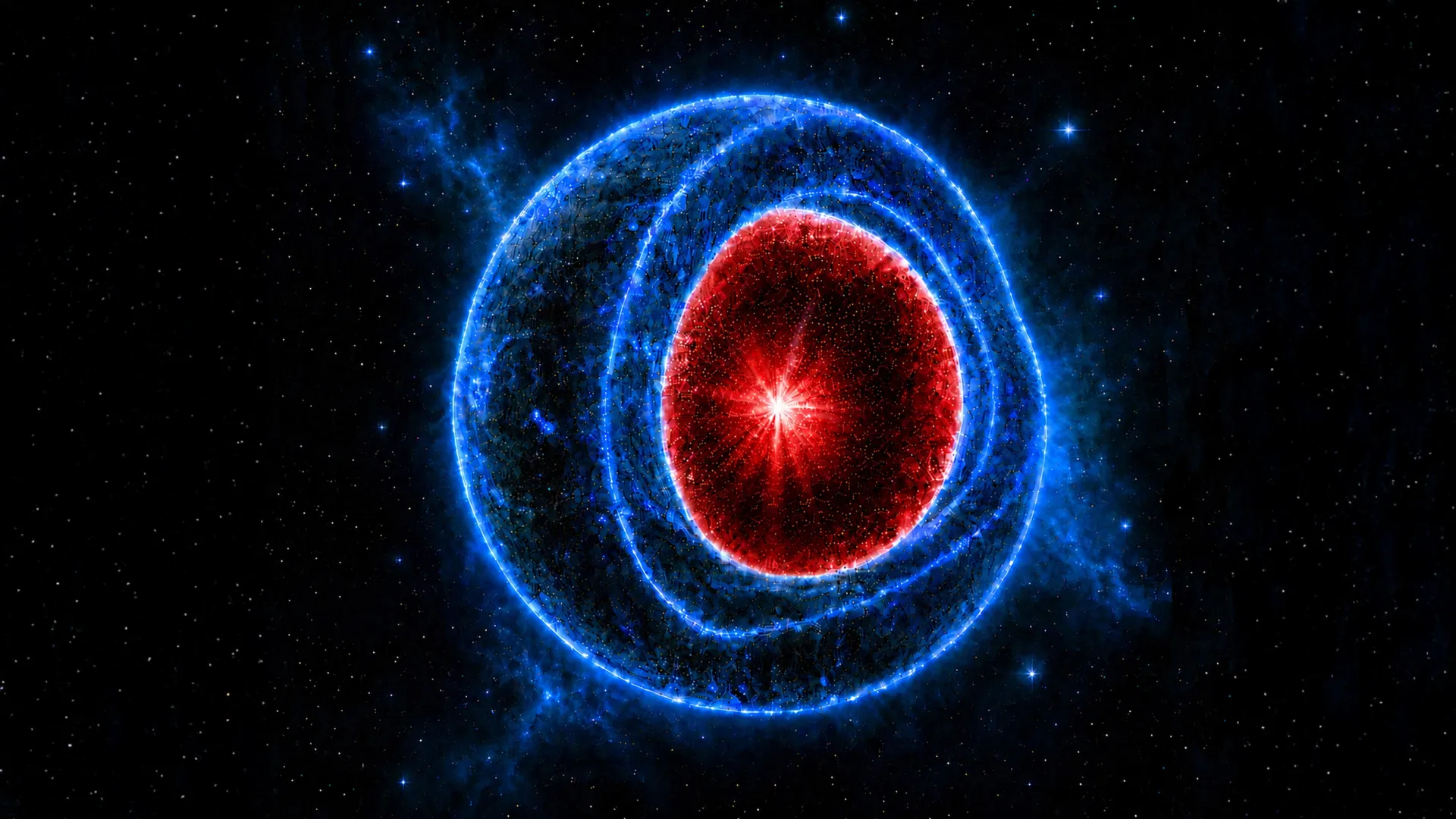
This mind-bending theory relies on an exotic, hypothetical object known as a “gravastar” (gravitational vacuum star). From the outside, a gravastar looks and acts exactly like a black hole, possessing the same immense mass and crushing gravitational pull.
Internally, however, it contains no singularity. Instead, beneath a thin shell of ordinary matter, a gravastar’s core is filled entirely with dark energy. Because dark energy exerts a powerful outward, repulsive pressure, it perfectly counteracts the inward crush of gravity, halting the star’s total collapse.
While physicists have theorized about gravastars for 25 years, no one could explain how a dying star could actually transform into one.
Jampolski and Rezzolla finally cracked this mystery. Their model demonstrates that as a massive star collapses and reaches an unimaginable density, the extreme compression of matter triggers a phenomenon akin to a miniature “Big Bang.”
Deep inside the dying star, an infant universe is born. Driven by dark energy, this new interior cosmos rapidly expands, pushing outward against the collapsing stellar material. The result is a perfect, stable stalemate: the outer layers of the dying star form a protective shell around a freshly born, expanding universe.
Ultimately, this research provides a vital mathematical roadmap for exploring the unknown boundaries of space physics. It also paints a breathtakingly poetic picture of the cosmos: the death of a single star in the universe might not be an ending at all, but the precise moment a new universe begins.
Leave a Reply