The attack bore similarities to the Nyange school massacre of March 19, 1997. Passengers were ordered to separate themselves along ethnic lines—Hutu on one side and Tutsi on the other—but they refused, insisting that they were all Rwandans.
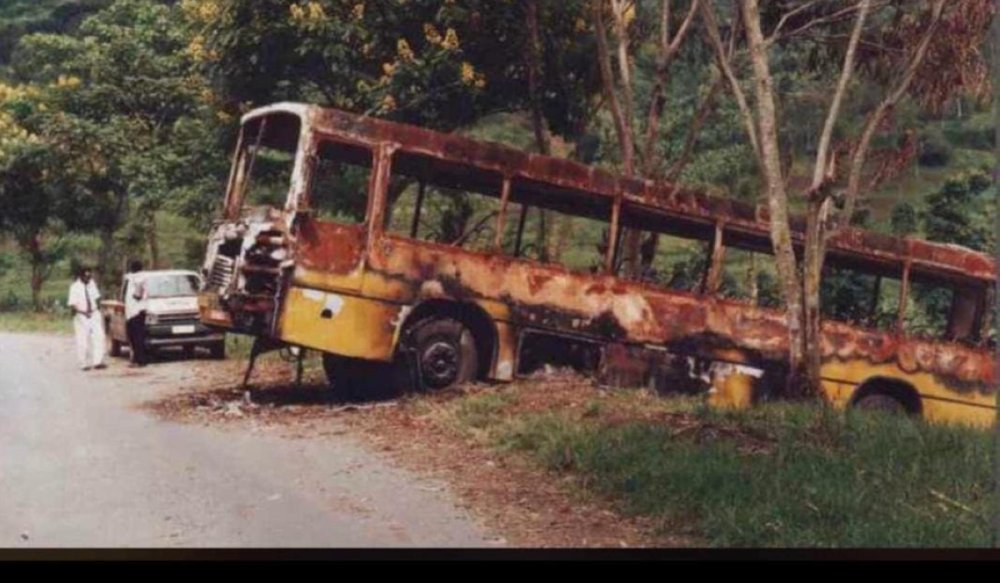
The assailants, armed with guns and traditional weapons, first shot at the bus tires, forcing it to stop. They then boarded and again demanded that passengers divide themselves. In unison, the victims responded, “We are Rwandans.”
The attackers opened fire. Even after the shooting, they repeated their demand, but the response remained the same. Enraged, they poured petrol over the bus, which was carrying about 74 people, and set it ablaze. Some victims died inside the burning vehicle, while others who tried to escape were killed outside. Only a few survived.
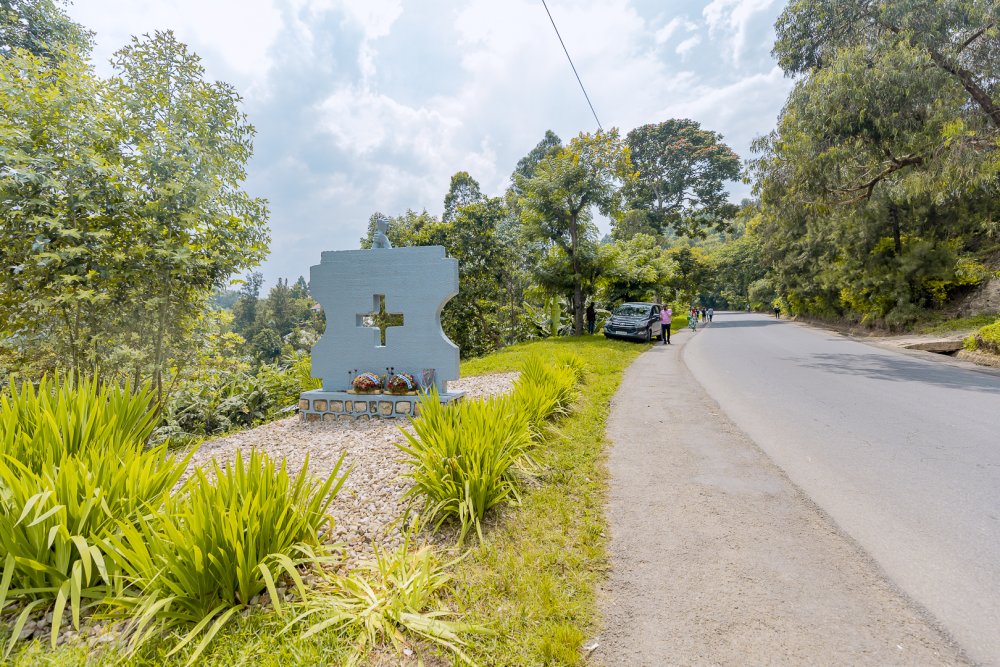
The incident occurred in Gitsimbi, then part of Nyamyumba Commune, now Nyamyumba Sector in Rubavu District, early in the morning as workers were heading to their jobs.
At the time, Rwanda’s current ambassador to Indonesia, Sheikh Abdul Karim Harerimana, was serving as Minister of Internal Security. In an interview with IGIHE, he recounted how he learned of the attack and the atmosphere it created in the former Gisenyi Prefecture.
He said he was informed of the attack that same morning by the then-prefect of Gisenyi. Shortly after gunfire was heard, Rwanda’s security forces were deployed to respond.
“The army was immediately alerted and intervened,” he recalled. “The prefect was on the ground and informed them. I set off to follow up on what had happened, assess the situation, and comfort the population.”
While on his way to the scene, he instructed the prefect to coordinate with the military to confront the attackers and assist victims.
At the time, infiltrator attacks were frequent in several regions, including Ruhengeri, Kigali Ngari, and Byumba, and occasionally reached Gitarama. Harerimana noted that although some planned attacks were thwarted thanks to intelligence, others occurred without prior warning.
He explained that in this particular case, authorities had no prior intelligence, partly because infiltrators from groups such as PALIR and ALIR had local collaborators, especially in Gisenyi, who provided them with information.
“We did not know about it in advance,” he said. “Had we known, we would have prevented it, as we often did. There were many collaborators in Gisenyi who worked closely with these groups and shared information about our forces.”
However, he noted that the brutality of the attack became a turning point. Residents who had previously cooperated with infiltrators were shocked by the violence and began to distance themselves, eventually providing information to authorities.
“People saw with their own eyes what had happened,” he said. “The victims were ordinary residents of Gisenyi. That is when people realized that those they had been hiding were actually the ones responsible for such atrocities.”
Following the attack, cooperation between citizens and security institutions improved, which contributed to efforts to dismantle infiltrator networks.
Harerimana described the scene upon arrival as tense and frightening. Fighting was still ongoing, with security forces exchanging fire with the attackers while some people tried to extinguish the burning bus.
Civilians watched in fear, some taking cover as the confrontation unfolded. He noted that several infiltrators were killed, some captured alive, while others managed to escape.
He recalled addressing residents afterward, reassuring them that the government’s responsibility was to protect them and condemning those responsible for the violence.
“We told them that those causing insecurity were known—the infiltrators,” he said. “We visited the site, the town, and hospitals, and also held a meeting in Gisenyi. Gradually, confidence began to return.”
He also revealed that before this shift, some residents used coded language and indirect communication to collaborate with infiltrators, making it difficult for authorities to gather intelligence.
According to Harerimana, the attack illustrated how extremist agendas could drive perpetrators to commit acts of violence without regard for human life, believing they could blame the government.
He explained that the attackers targeted known residents with the intention of spreading fear and undermining confidence in state protection, while also attempting to create the impression that the government was responsible.
He added that individuals captured during such operations were not mistreated. Instead, they were sensitized and, in some cases, reintegrated, with some later joining national security forces.
At the time, Paul Kagame — then Vice President and Minister of Defence —had instructed that captured fighters be treated humanely and not harmed, a directive that guided how they were handled after arrest.

Leave a Reply