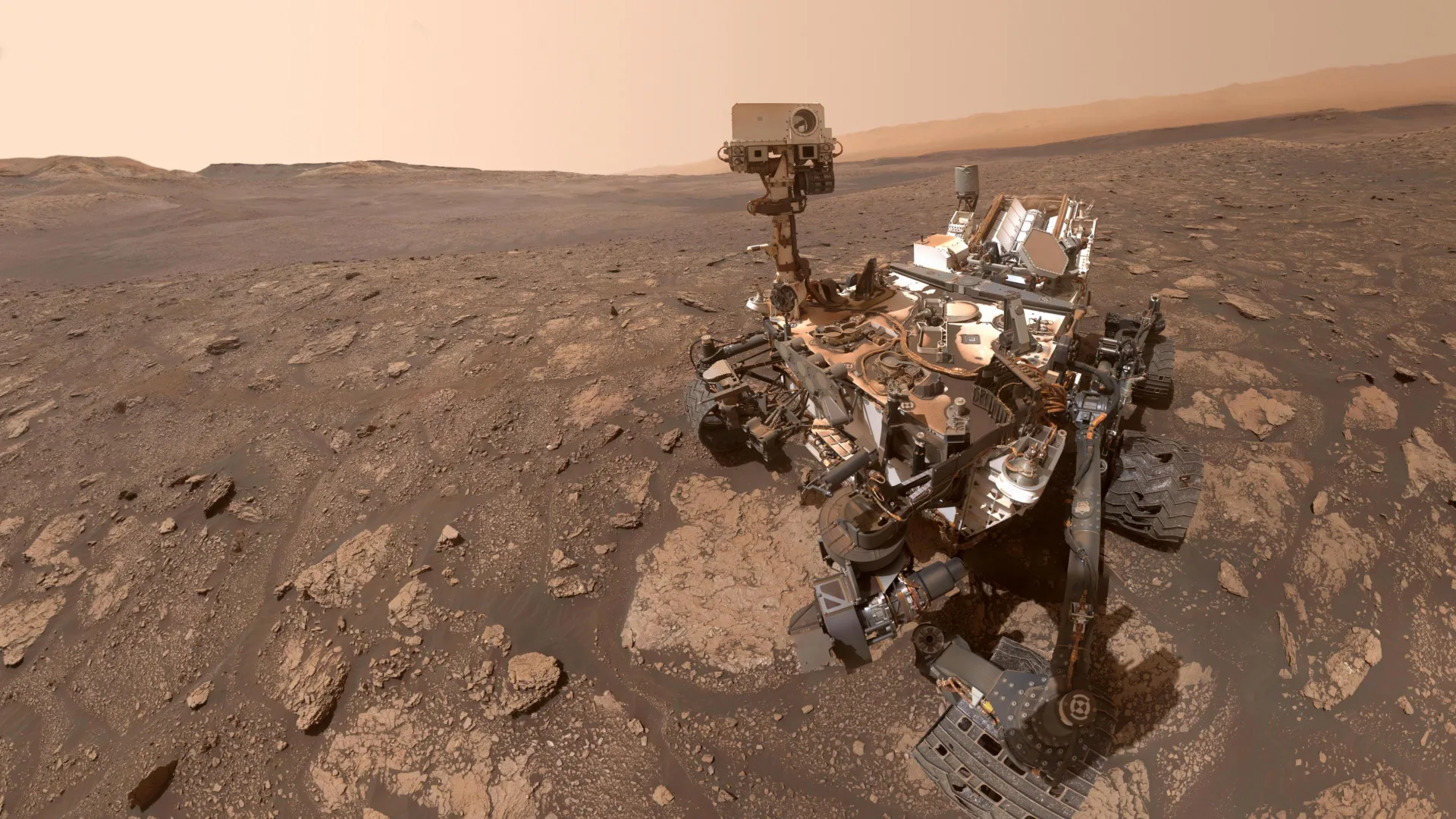
Curiosity had been studying the ancient rocks of Gale Crater, a place long believed to have once held water. In clay‑rich layers that formed billions of years ago, the rover detected more than twenty different organic molecules. These aren’t just ordinary chemicals. Many of them are deeply linked to the kind of chemistry that makes life on Earth possible.
One of the most exciting finds was a molecule with a structure similar to the building blocks of DNA. DNA is the code that carries the instructions for life on Earth, and discovering something that resembles its ingredients so far away sent ripples of excitement through the scientific world.
But scientists are careful this doesn’t prove that life ever existed on Mars. Instead, it suggests that the ancient Martian environment may have once been much more welcoming than we imagined.
Researchers believe these molecules have been preserved for about 3.5 billion years in the rocks, protected from harsh conditions by clay minerals. These clays act like time capsules, holding onto chemical secrets from Mars’s distant past. The amazing thing is that this preservation gives scientists a rare glimpse into the planet’s ancient chemistry, and possibly its potential to support life long ago.
The discovery came from a carefully planned chemical experiment using Curiosity’s onboard instruments. Because there was only a small amount of the chemical needed for the test, the scientists had to choose the perfect place to conduct the experiment and it paid off in a big way.
While this breakthrough doesn’t mean we’ve found Martian life, it does mean that the ingredients for life were present and preserved. Future missions might build on this work, possibly even bringing samples back to Earth for more detailed study. For now, the molecules discovered by Curiosity remind us that our universe is full of surprises and that even a seemingly barren world like Mars may hold clues about our own origins.
Leave a Reply