Rwanda is allowed to resume flights to Europe along with Albania, Australia, Israel, Japan, Lebanon, New Zealand, the Republic of North Macedonia, Serbia, Singapore, South Korea, Thailand, the United States of America and China which is subject to confirmation of reciprocity.
The statement released by the European Union Council yesterday indicates that the list will continue to be reviewed every two weeks.
The council also urged member states to gradually lift the travel restrictions at the external borders for citizens from selected countries.
Rwanda’s national flight carrier, RwandAir operates flights in different countries of Europe including Belgium and England.
Despite the recent surge in COVID-19 cases, Rwanda has heightened response to the pandemic where the prevalence of new infections is at 6% while the rate of deaths stands at 1.3%.
Rwanda is among African countries that have been providing regular updates on status of the pandemic.
The country confirmed the first Coronavirus case on 14th March 2020. Since then, 30048 people have been tested positive of whom 26 393 recovered, 3277 are active cases, 16 are critically ill while 378 have succumbed to the virus.
A total of 390, 339 people have been vaccinated since Rwanda began countrywide inoculation program on 5th March 2021.
These activities align with Rwanda’s vision to create new off-farm jobs and reduce migration to Kigali city.
As enshrined in the National Strategy for Transformation (NST1), Rwanda set ambitious targets to accelerate sustainable urbanization from 18.4 to 35 percent by 2024.
In line with the country’s blueprint, six secondary cities have been undergoing infrastructure development including the construction of new roads expected to facilitate movements and connectivity and paving the way for economic growth.
The six secondary cities include Muhanga, Huye, Rusizi, Rubavu, Musanze and Nyagatare where US$100 million have been allocated to build roads and water drainage channels.
The first phase of this project spanning from June 2016 to November 2018 saw 28.3 kilometer-roads and 13.3 kilometer water drainage channels completed at a cost of US$28 million.
So far, more 43.9 kilometer-roads and 12.15 kilometer-water drainage channels have been constructed in the second phase that began in December 2018 expected to be completed in July 2021.
These infrastructures are an addition to the upgrade of informal settlements in Kigali city including 12.46 hectares in Boryogo, 20.1 hectares in Kiyovu and 26.42 hectares in Rwampara.
The project saw settlements equipped with decent basic infrastructures including tarmac roads which facilitated people’s daily businesses and easy access to other services.
The two phases implemented under Rwanda Urban Development Project (RUDP) will be followed by two more phases to upgrade more slums in secondary cities and different parts of Kigali.
Under the new phases, new roads will be built in four slums of Kigali city staring with 2021-2022 fiscal year.
It will focus on building new roads, pedestrian ways, drainages, street lights, electricity and others.
In Kigali city, the project will construct a road in Gitega sector and set up more infrastructures reducing slums in Gatenga , Kicukiro; Nyabisindu in Remera sector; and Nyagatovu in Kimironko sector, Gasabo district.
Of the Rwf 160 billion, US$ 40.2 million have been allocated for preservation of Gikondo wetland in the former industrial park and containing floods in most parts of Kigali prone to disasters including Kinamba, Rugunga, Rwandex-Majerwa, Mulindi, Masaka and Gacuriro.
The Minister of Infrastructure, Amb. Claver Gatete has told the media that containing floods is of crucial relevance to maintain other infrastructures including roads.
“Preserving environment also needs special attention. For instance, floods might cause serious damages to roads in case no action is taken to build proper drainages to contain water flowing from Mont Kigali, Jali, Rebero and Magerwa,” he said.
“That is why this phase will cater for the conservation of Gikondo Industrial Park. We need to build proper drainages for water coming from uphill to contain damages to infrastructures when it rains,” added Gatete.
He explained that building roads in slums doesn’t intend to relocate residents but rather expand basic infrastructures.
The second phase of RUDP II will be implemented from 2021 to 2025.
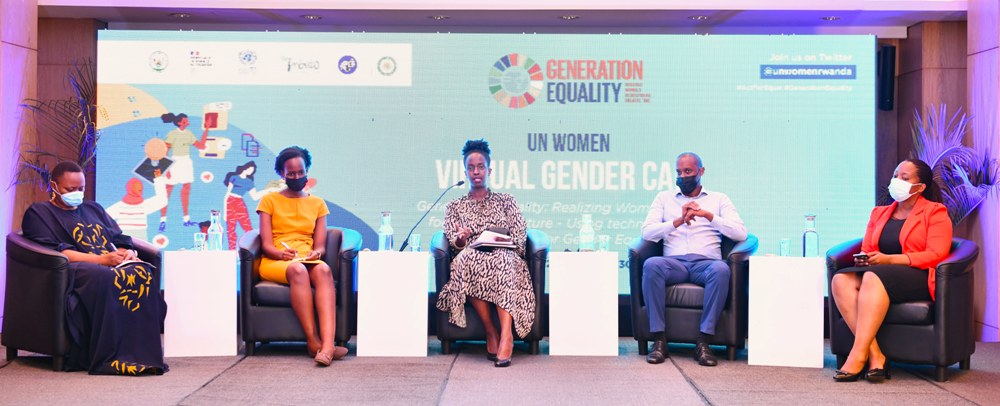
The call was made on Thursday 17th June 2021 at the Virtual Gender Café aimed at tackling issues lagging behind gender inequality.
UN Women is the United Nations Entity for Gender Equality and the Empowerment of Women.
The discussions held for the 5th time was attended by various leaders including the Country Representative of UN Women Rwanda and Fatou Lo; the Minister of State in charge of ICT & TVET Claudette Irere among others.
Fatou commended Rwanda for helping girls and women to meet their aspirations and reflected on the country’s efforts expended in ‘HeForShe’ campaign initiated in 2015.
“HeForShe” campaign is geared towards encouraging men in tackling social and cultural barriers that prohibit women and girls from achieving their full potential.
The campaign challenges governments, corporate institutions and members of the academia to commit to end gender inequality in their areas of jurisdiction.
Even though a lot has been achieved in Rwanda, Fatou observed that more efforts are still needed to maximize gender inclusion.
“As President Paul Kagame says, you cannot win a war or game while half of the team is on leave. So, it is paramount to eradicate gender inequality at this era when the world is adapting to new technologies. This requires everyone’s collaboration including men, women, boys and girls to become successful,” she said.
Irere explained that Rwanda continues to support women representation in decision making positions and promoting girls in science and ICT.
“Rwanda is moving fast towards involving more women in leadership roles. In our efforts to make sure that girls are accessing equal opportunities, we have over 23 girl schools that promote Science, Technology, Engineering, and Mathematics [STEM] subjects,” she noted.
Men who attended the virtual discussions also urged fellows to actively contribute to the cause.
“The world cannot maximize gender equality without men’s active involvement. The time is now to bring needed transformations,” said Sangwa Rwabuhihi.
“Men should support women to realize their dreams especially empowering girls in ICT. Girls should also feel confident because they have potential to achieve great things like their male counterparts,” stated Aristide Mugabe, the captain of Patriots BBC.
Gender Café’ was organized to exchange ideas paving the way to reaching common understanding on solutions for gender inequality in different aspects and gender based violence among others.
These discussions coincided with the launch of a generation equality campaign organized by UN Women Rwanda themed “Realizing Women’s Rights for an Equal Future” that backs using technology and innovation for Gender Equality.
Figures from the United Nations Children’s Fund (UNICEF) show that nearly one in four girls between 15 and 19 age bracket globally is neither employed nor in education or training compared to 1 in 10 boys of the same age.
This suggests that even in childhood, girls’ aspirations for education and employment compete with gender biases in the labour market and societal expectations of girls.
Ndayambaje was arrested at about 7pm, by the Police in partnership with local residents.
The Western region Police spokesperson, Chief Inspector of Police (CIP) Bonaventure Twizere Karekezi said Ndayambaje was reported by the would-be victim.
“Ndayambaje is a resident of Karago Sector (also in Nyabihu); he had gone to Kiraza Village in Mutaho Cell, Rambura Sector to buy drinks in the shop of one Chantal Nikomeze whom he gave a note of Frw5,000 to pay Frw1000 for a drink he had taken. Nikomeze, however, noticed that the bill was fake and she called the Police,” said CIP Karekezi.
He added: “Police officers arrived immediately and arrested Ndayambaje at the scene, searched and found on him other nine counterfeit bills in the denominations of Frw5,000.”
Mviyekure said that he got the couterfeit bills from someone, whom he declined to diclose.
He has since been handed over to RIB at Mukamira station for further investigation.
Article 269 of the law determining offences and penalties in general states that any person who, fraudulently counterfeits, falsifies or alters coins or bank notes which are legal tender in Rwanda or abroad, notes issued by the Treasury with its stamp or brand, either banknotes or alike that have legal tender in Rwanda or abroad, or one who introduces or issues in Rwanda such effects or notes with knowledge that they are forged or falsified, commits an offence.
Upon conviction, he/she is liable to imprisonment for a term of not less than five years and not more than seven years.
The majority of new cases was found in Kigali: 219, Kamonyi: 37, Gicumbi: 37, Rubavu: 32, Musanze: 27, Rulindo: 19, Burera: 17 and Bugesrea: 10.
Rwanda confirmed the first Coronavirus case on 14th March 2020. Since then, 30048 people have been tested positive of whom 26 393 recovered, 3277 are active cases, 16 are critically ill while 378 have succumbed to the virus.
A total of 390, 339 people have been vaccinated since Rwanda began countrywide inoculation program on 5th March 2021.
Coronavirus symptoms include coughing, flu, and difficulty in breathing. The virus is said to be transmitted through the mucous membranes of the respiratory tract.
Rwandans are urged to adhere to COVID-19 health guidelines, washing hands frequently using soaps and safe water, wearing face masks and respecting social distancing.
The Minister of Local Government, Jean Marie Vianney Gatabazi, while officially closing the symposium, said that peace and security dynamics of the 21st century are growing very complex than ever before mainly due to the changing nature of security threats including cyber and high-tech crimes, environment related threats, terrorism, transnational organised crimes, and the changing nature of pandemics.
“In confronting the emerging security threats, there is a compelling need to have an awareness of their trends and impacts in order to be able to reshape policy, legal and operational frameworks both at national and regional level in view of the new developments,” said Minister Gatabazi.
He added that engaging police senior command and staff course students and other participants from 13 different countries into such interactions on dynamics of global and regional peace security and justice is a “better way to raise the number of strategic leaders with the ability to address the emerging security threats and ensure a favorable environment for social economic activities in their respective countries.”
{{Panelists’ insights}}
On the issue of environmental challenges, the Minister of Environment Jeanne d’Arc Mujawamariya said that climate and environmental changes can cause conflicts that compromise security.
“They affect the ability of people to earn a livelihood. We cannot live without security, neither can we live without good environment. These two complements each other,” said Minister Mujawamariya.
David Smith, the United Nations Environment Programme (UNEP) Programme Manager in Nairobi, said that the key to minimizing security challenges arising from environmental effects is building climate resilience and institutional capacities and that Rwanda is a model in addressing environmentally related security challenges.
To this, Juliet Kabera, the Director General-Rwanda Environment Management Authority (REMA) noted that in building the resilience to climate change, constitutional provisions on environmental protection and rights for the people must be applied.
“We have a long-term vision of 2050 t ensue low carbon emissions. By 2030, we need to have achieved the Nationally Determined Contributions (NDCs) toward a resilient environment,” said Kabera.
{{Transnational organized crimes: A growing security threat for Africa}}
Gideon Kimuli, the Head of Interpol Regional Bureau in Nairobi, who echoed on transboundary crimes in Africa, said that responding to transnational crimes requires building centres in countries that specialize in responding to sophisticated crimes of this era.
Prosecutor General, Aimable Havugiyaremye observed that technology is changing how some long-established types of crimes are committed.
“Law enforcement and the judiciary must be fit for the digital age; they need to use modern technology and be equipped with tools and skills to keep up with modern crime,” said Havugiyaremye
{{COVID-19 Pandemic Impact on Africa: Rwanda in Perspective}}
On the threats posed by pandemics, Dr. Theophile Dushime, Chief Technical Advisor in the Ministry of Health outlined strong leadership, active partnership, multi-sectional and regional collaboration, community engagement, continuity of essential services, data science and innovation as some of the key factors in Rwanda’s preparedness and response plan.
Leonard Rugwabiza Minega, Economic Advisor in the Ministry of Finance and Economic Planning said that to recover the economy ruined by pandemics, Africa must be industrialized, including manufacturing vaccines and medical supplies.
“As we have seen, we can’t depend on others when it comes to our livelihood,” said Rugwabiza.
Rwanda National Police (RNP) spokesperson, CP John Bosco Kabera said that as the force charged with enforcing COVID-19 prevention measures, RNP had to mobilize and deploy officers in areas at risk, educate and create awareness, and build public trust.
“To help Rwandans understand the danger of COVID-19, our communications had to be consistent with simple but actionable messages, engaging on all platforms and educative. We embraced the use of technology to carry messages such as drones. After all, we want citizens to take responsibility to protect themselves first,” said CP Kabera.
These include Lieutenant Colonel Jean Paul Nyirubutama promoted to Colonel and appointed Deputy Secretary General of the National Intelligence and Security Services (NISS).
Other officers promoted to the rank of Colonel include RDF Spokesperson, Lt Col Ronald Rwivanga, Lt Col Callixte Kalisa and Lt Col Francis Ngabo Sebicundanyi.
Col Nyirubutama who has been appointed Deputy Secretary General of NISS is among 47 officers who recently graduated at RDF Command and Staff College in Nyakinama where he emerged the overall best student.
Col Nyirubutama held different positions including Deputy CEO of RwandAir and and first advisor in Rwanda’s Embassy to South Africa.
Col Kalisa is currently serving as the Director General in the Ministry of Defense of Rwanda (MOD) in charge of coordinating all Ministries’ Agencies including ZIGAMA CSS. He was appointed to this position in July 2016, after working as the Director of Finance in the same Ministry for 8 Years (July 2009-2016).
As experienced banker, he was appointed to the Board of Directors of ZIGAMA CSS in November 2011 where he served as Non-Executive Director and cumulated the functions of Head of Management, Asset and Liability Committee, Head of Credit Sub-Committee and Member of Executive Committee and serves as the Vice Chairman of ZIGAMA CSS Board among others.
Col Kalisa is the Vice Chairperson of the Board of MOD Complementary Pension Scheme (12 January 2017) and Board Member of Armed Forces Shop since 19 January 2018.
Col Rwivanga is the spokesperson of RDF since December 2020. He replaced Lt Col Innocent Munyengango who had served in the same capacity since 2017.
Prior to his appointment, Col Rwivanga was Course Coordinator at the RDF Senior Command and Staff College based in Musanze District.
He was also chief editor of the Warrior Magazine, a publication of the Command and Staff College.
Among others, Col Rwivanga served as an exchange military lecturer with the East African Community where he worked as directing staff at the Tanzania People’s Defence College Command and Staff College based in Arusha, Tanzania.
He once served in the Republican Guard Unit of the RDF where he headed the operations and training department.
Col Ngabo is also among officers who recently graduated at RDF Command and Staff College in Nyakinama where he emerged the second overall best student and awarded for his best college research paper.
According to a statement released on Friday 18th June 2021 by RDF, the promotions and appointment take immediate effect.
“My heartfelt condolences to the family of President Kenneth Kaunda and the people of Zambia. His commitment to Africa’s liberation will never be forgotten. His leadership on the continent and legacy of Pan-Africanism will live on for generations to come,” he tweeted.
The Zambia’s founding president and liberation hero, died on Thursday 17th June at a military hospital in the capital, Lusaka, where he was being treated for pneumonia. He was 97.
Kaunda ruled Zambia from 1964, when the country obtained independence from Britain, until 1991, and afterwards became one of the most committed activists against HIV/AIDS in Africa.
Following his demise, Zambia declared 21 days of mourning.
Kaunda will also be remembered for his role as an anti-colonial fighter who stood up to white minority rule in Southern African countries such as Angola, Mozambique, Namibia, South Africa and Zimbabwe.
In 2017, President Kagame held talks with Kaunda when he visited Zambia.
During Sheikh Tamim Bin Hamad Al Thani International Anti-Corruption Excellence Award held in Kigali 2019, Kaunda was bestowed the anti-corruption lifetime/outstanding award for his efforts in promoting transparency and fighting corruption.
He wrote eight books including ‘Letter to My Children’, ‘The Political Philosophy of President Kenneth D. Kaunda of Zambia’ and ‘Zambia will be Free’ among others.
The seminar to create awareness of the business opportunities available in the two countries brought together over 200 participants. It was also attended by Ambassador of Rwanda to Zimbabwe James Musoni, Ambassador of Zimbabwe to Rwanda Charity Manyeruke together with high level officials from the Rwanda Development Board (RDB) and Zimbabwe Investment Development Agency (ZimTrade) among others.
Zimbabwe is a Southern Africa country covering a land area of 390,757 square kilometers. The population demographic survey conducted in 2012 shows that the country’s population was estimated at over 13.1 million of whom 94, 7% are reported to be literate.
Tourism is among main contributors to the country’s economic growth with 12% along with agriculture (11%) and mining (9%) while the service sector contributed 16%.
While addressing Rwanda- Zimbabwe Trade and Investment virtual conference, the CEO of RDB, Clare Akamanzi explained that both countries enjoy existing relations and cooperation in different areas that building relationships upon trade and investment is the current priority.
Akamanzi lured investors from Zimbabwe to tap into presented opportunities in different sectors including trade and agriculture among others.
“Energy, agriculture, trade, hospitality and hotels and financial sector are areas with top investment opportunities in the country,” she revealed.
Akamanzi emphasized that the country registered remarkable economic growth in 2019 by 9.4% before COVID-19 pandemic.
“Rwanda continues to position itself as a proof-of-concept country for innovations. This is why we were able to attract some of the investments we have in the country like an assembling plant for Volkswagen, Zipline which is doing delivery of blood using drone,” she said.
As he highlighted the relevance of promoting cooperation between both countries, the CEO of ZimTrade Allan Majuru said there has been an insignificant trade between Rwanda and Zimbabwe noting that the investment conference is set to unlock various opportunities of trade between the two countries.
In Rwanda, agriculture accounts for 24% of the economy while industries and services contribute 18% and 49% respectively.
The fact that Rwanda is a member of EAC exposes Zimbabwe to a wider East African market with over 117 million population not considering the Democratic Republic of Congo DRC which has also submitted application to join the regional bloc.
Majuru stressed that another meeting is planned in the near future where quite a big number of business people from Zimbabwe will come to Rwanda in a conference expected to increase trade and investment between both countries.
“ZimTrade will be taking 100 companies to Rwanda for this investment conference and we will stand guided by our hosts on the numbers with regards to the Covid-19 protocols. The delegation travelling will be led by Foreign Affairs Minister Shava. We believe the trade between Rwanda and Zimbabwe has been insignificant and this investment conference will play a huge part in unlocking investment opportunities between the two countries,” Majuru said.
“We are also trying not to look for trading opportunities but we are also looking at creating a platform where Rwanda uses Zimbabwe as a platform to extend its services to countries this side of the region. We might be called landlocked as Zimbabwe but we call ourselves land linked and the same applies to Rwanda,” he added.
The Rwanda-Zimbabwe Trade and Investment Conference is slated from July 28 to 30 in Kigali, Rwanda.
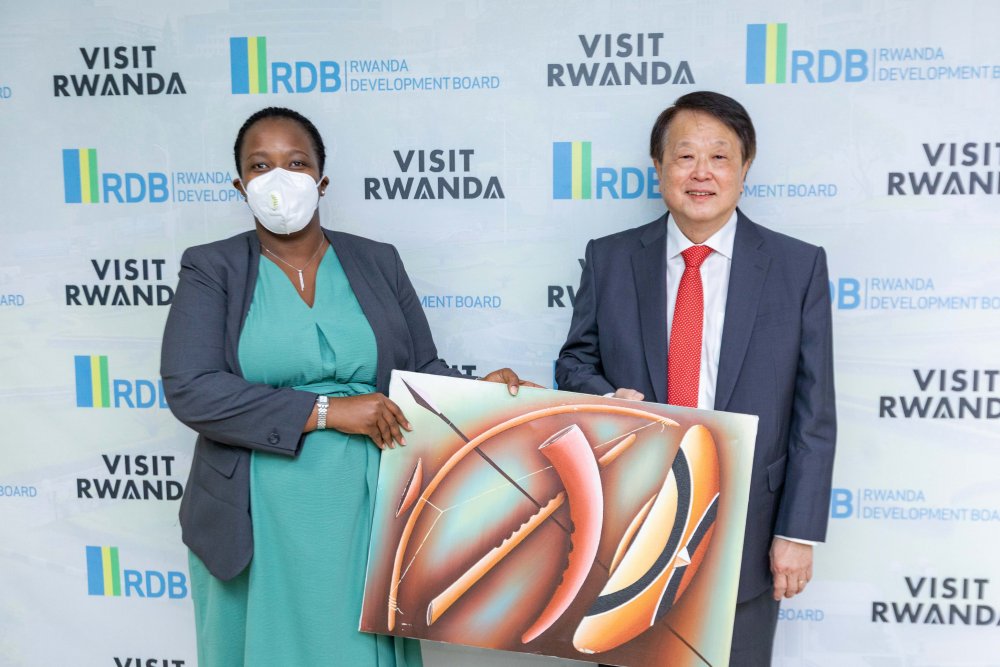
Speaking to participants, the CEO of RDB Claire Akamanzi said that Rwanda is ready to welcome the business delegation from Zimbabwe.
“We have been working together as two countries. We are ready to welcome the business delegation coming from Zimbabwe. We hope this conference is going to increase trade between the two countries as well as new investment opportunities,” she noted.
Akamanzi reiterated Rwanda’s commitment continue offering a conducive environment for investment on a market with high economic growth rate.
Investors also expressed willingness to tap into presented opportunities.
“This cooperation presents huge opportunities to both sides. We are ready to facilitate the shipment of cargo from Rwanda to Zimbabwe and vice versa,” said Michael Shyaka, the Managing Director of Pan African Logistics.
Benson Mbewe, the CEO of AB Communications which owns media houses including Business Times, ZiFM Stereo, 98.4 FM Midlands and Hevoi FM highlighted that such meetings are crucial to expand opportunities.
“This is going to be a wonderful experience for the business community and we are still finalizing conference packages at the moment,” he noted.
Rwanda and Zimbabwe are both members of the Common Market for Eastern and Southern Africa (COMESA) where both countries stand to benefit from reduced customs duties.
Zimbabwe is also a member of South African Development Community (SADC).
Rwanda has vast opportunities for Zimbabwean businesses wishing to do trade and to invest in its fast-growing economy while Zimbabwe is keen on growing its exports to Rwanda with market survey results by ZimTrade, indicating that locals could ride on this destination to generate more earnings.
In 2019, Zimbabwe generated US$3 million from exports while Rwanda earned US$152,000 from exports to the country.
Increasing trade with Rwanda is expected to enhance access to markets in the East African Community and in turn, increase Zimbabwe’s exports to the region with a combined GDP of more than US$177bn.
The four-year policy involves different activities to promote inclusive technology, increase the participation of persons with disabilities in employment and other sectors, establish various special needs of PwDs for full participation in all agricultural programs and initiatives, subsidise the provision of assistive devices and disability related health care services to PwDs and promote social and cultural activities as well.
The Executive Secretary of the National Council of PwDs, Emmanuel Ndayisaba has explained that the policy is expected to bridge gaps in different aspects of life impeding welfare and development of persons with disabilities.
“It sets a framework for needed actions, identifies all stakeholders and needed interventions,” he said.
For the last ten years, Successive Education Sector strategic plans (ESSP) have continued to note high school dropout rates for vulnerable children (28.3% in Primary 5 and 10.2% in Primary 1) since 2005. For example, the Rwanda Education Sector Strategic Plan (ESSP) of 2013-2018 confirmed that more Children with Disabilities (CwDs) have never attended school than those without any (27% versus 14%) and more CwDs dropped out of school than those without (9% versus 6%).
The Ministry of Education (2017)19 report indicates that out of 185,666 children enrolled in pre-primary education, 1,545 children are CwDs, representing less than 1% of enrolled students. The number of CwDs enrolled at the primary, secondary, and tertiary levels are similarly very low and well below the expected proportion of PwDs (approximately 15% of the population using WHO’s definition of disability or 5% using Rwanda’s definition).
Ndayisaba highlighted that the policy will also address barriers hindering persons with disabilities from attending schools or occasioning school drop outs yet education is considered the backbone for development.
Other barriers are reported in healthcare, employment and accessibility.
Accessing healthcare in all its forms is also said to be challenging for PwDs because of associated costs, distance from service providers, and systemic and institutional healthcare practices and barriers.
Health service access data does not disaggregate by disability which undermines planning and decision making.
Eleven of the Sustainable Development Goals (SDGs) require disaggregation by disability. Disaggregated disability data is important if achievements in health care recorded by Rwanda are to be extended to all citizens. In addition, there is little documented evidence about the physical and social barriers that PwDs may face in accessing health services.
The present policy is particularly concerned about access to rehabilitation and therapeutic services, assistive aids, and other key health provisions that enable PwD equal access participation to socio-economic activities.
Being unable to detect road signs, waterways along the road among others also presents difficulties depending on the nature of disabilities.
Ndayisaba has expressed optimism that many of these challenges will be addressed in the new policy.
“A blind person should not wait for green to cross red lights. He/she should have a switch to detect red lights or zebra crossing. The new policy incorporates these concerns. We are optimistic that a lot of things will be addressed within the four years,” he affirmed.
With allocated budget of Rwf 41,458, 014, 440, the new policy for persons will be implemented through different ministries to bridge loopholes in the sectors of education, health, social protection (impact the welfare and wellbeing of children and adults with disabilities), agriculture, infrastructure, employment, justice, child protection, sports and leisure among others.
The Rwandan law No 01/2007 of 20/01/2007 aligns with the medical model and defines disability as the condition of a person’s impairment of health ability which consequently leads to deficiency compared to others.