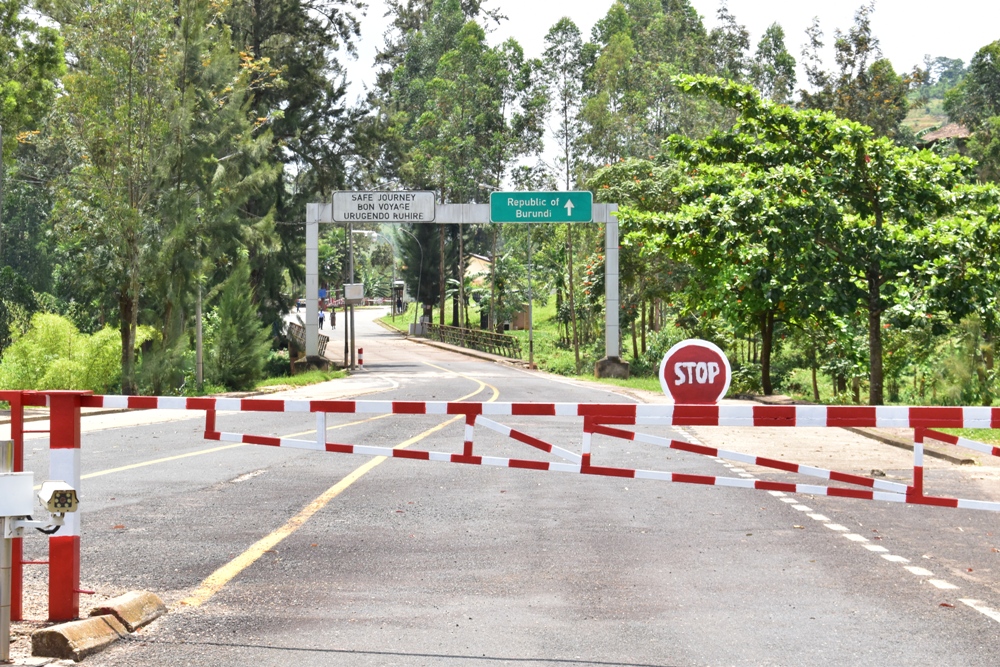
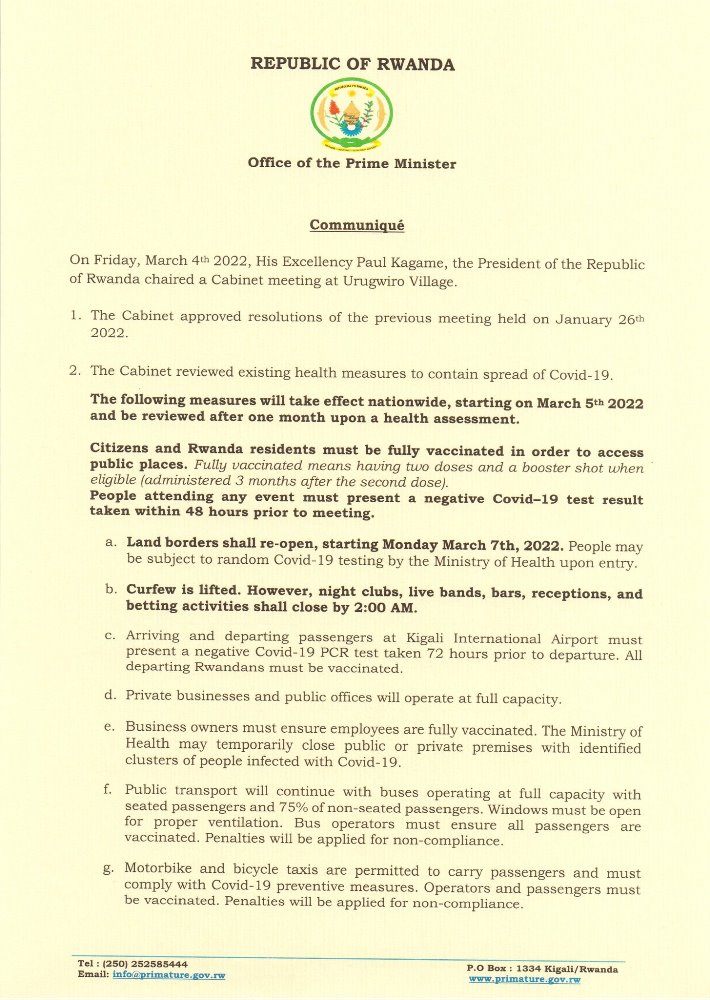
The decision takes effect from Monday 7th March 2022. The resolution to reopen borders also reads that incoming passengers might be tested for COVID-19, if need be, before crossing to Rwanda.
Except the border with the Democratic Republic of Congo (DRC), other land borders between Rwanda and Burundi, Tanzania and Uganda have been under closure for quite some time.
For instance, the border with Burundi was under closure for seven years since the onset of spoilt relations between both countries while borders with Uganda were closed in 2019.
The Minister of Local Government, Jean Marie Vianney Gatabazi has told the Voice of America that air borders had been opened before.
“Citizens were only allowed to cross the border on DRC side. The reopening concerns free movement between Rwanda and Uganda, Tanzania, Burundi and Congo. All regulated borders are open for outgoing and incoming passengers,” he said.
Gatabazi has however advised citizens against crossing through illegal entries noting that whoever caught doing so will face the law.
He explained that the borders are open for people and goods.
Even though the borders have been reopened, there is need for collaboration between the neighboring countries to ease free movement.
For instance, Gatuna border was opened towards the end of January 2022 but did not ease free movement immediately due to discussions that had to be held between both countries regarding measures to contain the spread of COVID-19.
“When we open borders, it should also be noted that other countries have collaboration with emigration and immigration officials as well as services offered through the Ministry of Foreign Affairs. The decision to reopen borders is a positive development but there will also be several considerations between concerned ministries of foreign affairs and ministries of health,” he said.
As Minister Gatabazi revealed, these considerations include unique governance system and processes to receive passengers.
The recent cabinet meeting also resolved that businesses will operate 24 hours per day instead of the previous curfew set at 12:00 midnight.
However, concerts, night clubs, bars, gaming activities and other reception venues shall close at 2:00 a.m.
Speaking to RBA, Minister Gatabazi has urged citizens to continue adhering to instituted COVID-19 preventive measures and make sure they are full vaccinated.
Umutoni is the woman seen in a video circulating on social media platforms, lying on a tarmac road helplessly drunk and half necked.
In the video, which was captured by the onlookers, at Kisementi, Remera Sector of Gasabo District; Umutoni was with a friend identified as Anitha Uwase, who was also drunk.
RNP spokesperson, Commissioner of Police (CP) John Bosco Kabera said that law enforcement organs are are still searching for Uwase for the similar offences.
“The indecent behaviours and actions occurred in the night of February 26, at about midnight, and they caused public disorder. These acts are punishable by law,” CP Kabera said.
He advised the public to drink responsibly to prevent such offensive and indecent acts.
“People cannot be prevented from drinking. However, it should be done in a way that does not disrupt public order or contrary to the law,” CP Kabera explained.
Article 268 of the law determining offences and penalties in general; any person who is drunk in public, in the streets, squares, paths, bar, in a gymnasium or any other public places, commits an offence. Upon conviction, he/she is liable to imprisonment for a term of not less than eight (8) days but not more than two (2) months and a fine of not more than twenty thousand Rwandan francs (Rwf20,000) and not more than one hundred thousand Rwandan francs (Rwf100,000) or only one of the penalties.
In article 135, any person convicted for indecent assault is liable to imprisonment for a term of not less than one year and not more than two years, and a fine of not less than Rwf100, 000 and not more than Rwf300, 000.
If indecent assault is committed in public, the offender is liable to imprisonment for a term of not less than two years and not more than three years, and a fine of not less than Rwf00, 000 and Rwf1 million.
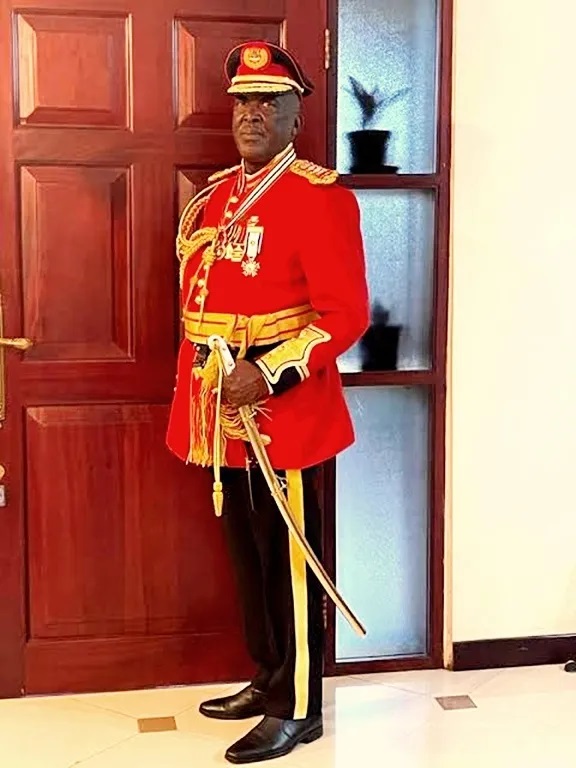
President Yoweri Kaguta Museveni appointed Maj Gen (Rtd) Robert Rusoke as Uganda’s High Commissioner to Rwanda with residence in Kigali in December 2021. He replaced Oliver Wonekha who was transferred to China.
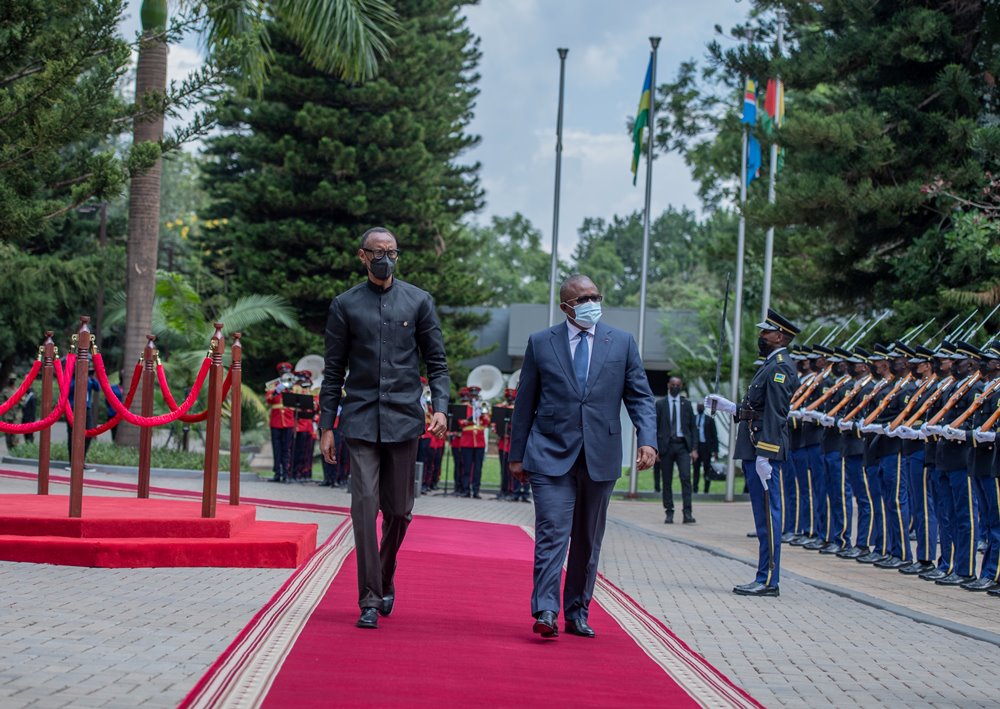
Other ambassadors approved on Friday include Zahra Ali Hassan of Somalia with residence in Tanzania, Firas F. Khouri of Jordanie with residence in Nairobi, Kenya and Isatu Amina Bundu of Sierra Leone with residence in Nairobi.
Esmond St. Clair Reid of Jamaica will also represent his countries interests in Rwanda with residence in Abuja while Pauline Okumu has been approved to represent World Vision International in Rwanda with residence in Kigali.
Kaori Yasuda has been approved to represent the International Union for Conservation of Nature (IUCN) Eastern and Southern Africa Regional Office with residence in Kigali.
Maj Gen Robert Rusoke was among UPDF senior officers sent to retirement in August last year.
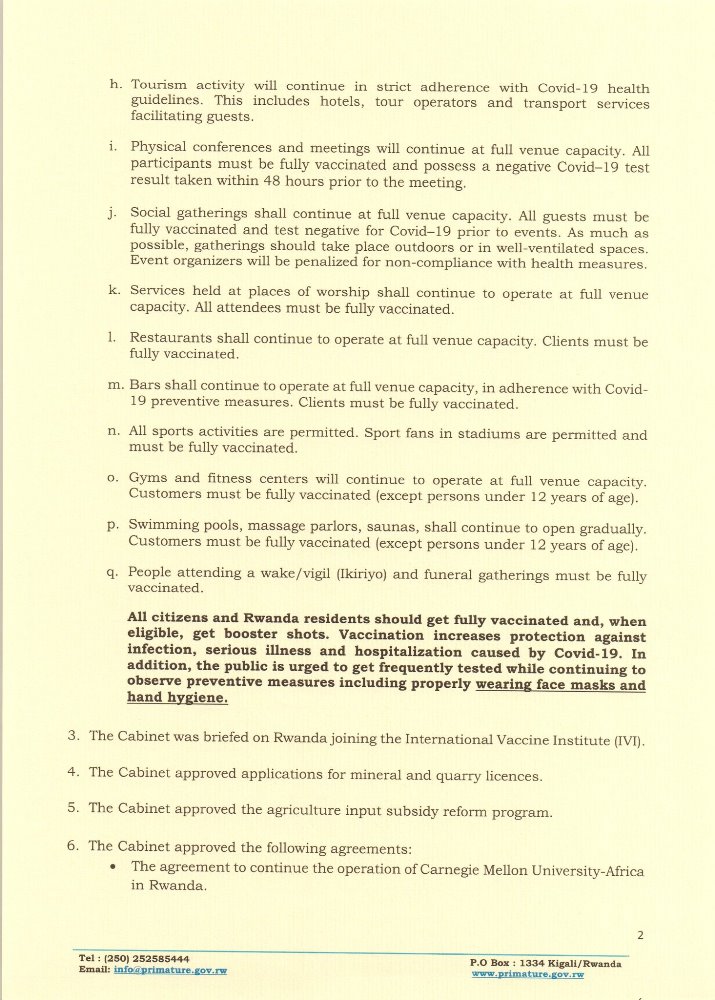
Except activities set to close by 2.a.m, others businesses will run operations 24 hours per day from the previous curfew that was set at 12:00 midnight.
Public buses are allowed to continue operations at full capacity with seated passengers and 75% of non-seated passengers.
Places of worship, restaurants, bars, gyms and stadiums, swimming pools and massage parlors are permitted to operate at full venue capacity while all attendees and clients must be fully vaccinated.
Only children aged below 12 are not allowed to present vaccination proof. Among others, people attending a wake/ vigil and funeral gatherings must be fully vaccinated.
The deceased identified as Jean Pierre Nshimiyimana was a porter at the beverage company.
The executive secretary of Musasa sector, Clemence Uwamariya has confirmed their arrest and advised residents against violence.
“His body was found in River Koko with no wounds. He was found with a phone and coins. Circumstances of his death have not yet been established but young men suspected of complicity have been arrested. They are apprehended because they saw the deceased last as they returned home together from the plant,” he said.
Uwamariya appealed on residents to shun crimes, tighten security and provide information on time.
The body has been taken to Murunda Hospital for postmortem while suspects are detained at Ruhango Police Station.
In 2010 MIGEPROF released its vision 2020 policy regarding gender balance. The policy has been revised to address remaining gaps in mainstreaming gender across sectors.
The new policy also proposes mechanisms expected to address the persistent cultural norms and stereotypes hindering the effectiveness of gender equality and equity.
Some of the new policies that are being designed are meant to ensure equal access and control of productive resources and economic opportunities for women and men and accelerate women’s economic empowerment.
The policies insist in strengthening the mechanism for promoting women’s meaningful participation in leadership and decision making positions in public sectors.
Research conducted before the development indicated that active participation and engagement of men and boys in women empowerment and gender equality and equity is still low.
The policy which has shifted from vision 2020 to vision 2050 is meant to improve gender transformation to involve the private sector, institutionalize men and boys as partners and also insist on accountability.
Speaking at the event to announce the approved gender police recently, Silas Ngayaboshya, the Director-General of Gender Promotion and Women Empowerment at the Ministry of Gender and Family Promotion said that it was a must for the ministry to review and adjust to the ongoing situation after 11 years of constant trend change in the country.
“Although we are achieving a lot, we realized that we still have some loopholes. For instance, we could not see a private sector that fully engaged in gender equality promotion and women’s empowerment,” he said.
Despite efforts expended by Non-Governmental organizations like The Rwanda Men’s Resource Centre (RWAMREC), Ngayaboshya said, men’s engagement was not institutionalized at a desired extent, hence leading to the revision of the policy.
Ngayaboshya underscored that the new policy is addressing existing realities.
“With the revised policy, we are moving from gender sensitivity to gender transformation. Else, the policy is propelling the private sector in the gender mainstreaming initiative. It is also about accountability in public and private institutions,” he said.
Mireille Batamuliza, the Permanent secretary in MIGEPROF said that the ministry is working with partners to ensure smooth implementation of the policy.
“We want to hold every level accountable and every sector to be engaged in the implementation of the policy,” he said.
She explained that gender equality starts from the household where men’s engagement would be a great pillar to achieving the desired outcome.
Among others, Batamuliza urged all participants to use the policy in ‘making the needed transformation and act as agent of change in their respective working places and communities’.
The executive secretary of Shingiro sector, Augustin Nteziryayo has said that the body was taken to hospital for autopsy.
“We were alerted by residents from neighboring Musanze sector because the body was found in a stream separating the two sectors. We have taken the body to hospital awaiting his burial and investigation into circumstances of the death. We have not yet identified any suspect,” he said by press time.
Nteziryayo explained that the man disappeared on Sunday 27th March 2022 when he left home to attend a wedding ceremony. His family alerted local leaders where the search continued until the body was found.
Eric Mazimpaka, 27, and Aphrodis Hakizimana, 21, were arrested on Thursday 3rd March 2022 with a stolen flat television screen, computer Desktop (hp), two sound speakers and an amplifier, among others.
Superintendent of Police (SP) Bonaventure Twizere Karekezi, the Police spokesperson for the Western region, said the suspects were arrested red-handed after breaking into a resident’s house located in Ikinyambo Village, Mbugangari Cell, Rubavu Sector.
“Police received a call at about 4:30 am, from the would-be victim, about a group of people who had broken into his house,” said SP Karekezi.
He added: “It was a ring of four suspected thieves. Two of them had entered through a hole they had drilled in the wall as others stayed outside. During the operation, the two people, who were outside managed to flee but their accomplices, who had entered the house were arrested as they came out with assorted valuables.”
The suspects along with the exhibits were handed over to RIB at Gisenyi station for further investigation while the search of other members of the ring is still ongoing.
Article 166 of law determining offences and penalties in general states that; any person convicted of theft is liable to imprisonment for a term of not less than one (1) year and not more than two (2) years and a fine of not less than Rwf1 million and not more than Rwf2 million, community service in a period of six (6) months or only one of these penalties.
In article 167, the penalty for theft doubles if the offender committed the crime through burglary, climbing or possession of keys other than the owner; the theft is carried out during the night or the theft is carried out by more than one (1) person.
Prof. Rugimbana holds a BSc. (Ed) degree from the University of Dar-es Salaam, a Master of Business Administration from University of Newcastle and a PhD from Macquarie University. He brings to this new role many years’ experience in important university academic roles such as lecturing at Newcastle University, Griffith University, University of Technology Sydney, Macquarie University; and governance roles such as Executive Dean, Campus Rector, Associate Dean, Director of a Graduate School and Head of Department.
As an accomplished academic researcher, Professor Rugimbana’s main research interests are in the areas of International Consumer Psychology, Cross-Cultural Marketing and Poverty alleviation, Enterprise Development & Entrepreneurship, International Marketing Education, Corporate Social Responsibility as well as Diffusion of Technologies in the 4th Industrial Revolution. His works appear in prestigious journals, such as the European Journal of Marketing, the Journal of African Business, Journal of Business Research, International Journal of Non-Profit and Voluntary Sector Marketing, Australasian Journal of Marketing, Journal of Marketing Management, Journal of Financial Services Marketing, Journal of Psychology & Marketing.
He has also published several book chapters and internationally-refereed and accredited journal and conference papers. He completed an edited book on Cross-Cultural Marketing published by Thomson Learning International Business Press – UK in 2002, co-authored an award-winning Principles of Core Marketing textbook published in 2008 by McGraw-Hill, Australia, an adaptation of Kotler & Armstrong – South African edition 2010 and 2015 and recently Applied Strategic Marketing, 5th Edition in 2020. He is currently a co-author of a Marketing Text book titled “Essentials of Marketing” by Routledge Publishing, UK.
Acknowledging welcome messages from members of the Executive Organ, the new Vice Chancellor thanked UoK’s Board of Directors for their confidence in him and assured the team of an inclusive leadership style which will value contributions from the various stakeholder groups of the university.