In an interview with the Financial Times, RwandAir Chief Executive Officer (CEO) Yvonne Makolo expressed optimism that the talks, which have been ongoing for about five years, would soon yield the desired results.
“It’s been going on for a while; we have been discussing it for almost five years. So, now, we’re really at the tail-end of it,” Makolo told the British daily.
Senior executives close to the negotiations intimated to the publication that the agreement could be executed as early as next month – July.
The deal is expected to help RwandAir expand its operations, including increasing the number of aircraft and destinations, as well as enhancing the skills of its employees.
It will also help Qatar Airways increase the number of flights it operates in Africa.
“We access over 70 points on their network, and they access a number of points, especially in central Africa, where they don’t have a presence,” Makolo added.
Officials say the deal between RwandAir and the Qatar-based airline was partly delayed by the COVID-19 pandemic and by Qatar hosting the FIFA World Cup.
{{Codeshare deal
}}
But the two airlines have been working together since late 2021 when they signed a codeshare agreement aimed at offering travelers more choice, enhanced service, and greater connectivity to more than 65 destinations across Africa and the rest of the world.
As part of the agreement, the state-owned carrier launched non-stop flights between Kigali and Doha.
“This codeshare agreement will give our customers significantly more choice and flexibility, allowing RwandAir to strengthen its global presence and build on its strong and loyal African customer base. As we continue to grow out of the pandemic, this partnership represents yet another extremely important step on our recovery runway, and we hope to deliver more commitments like this to our customers in the very near future,” Makolo stated while welcoming the partnership in October 2021.
In a separate agreement reached in 2019, Qatar Airways agreed to take a 60 percent stake in Bugesera International Airport in Kigali, being built at a cost of $1.3 billion.
Makolo says the new airport, expected to be operational in 2027 and have an initial capacity for eight million passengers, would turn Kigali into “a major transit hub” on the continent.
This issue was highlighted by Edmond Dufatanye, the head of RSPN, during the 16th international conference held in Rwanda by the International Association for Psychiatric Nurses (IAPN), which concluded on August 14, 2024.
Psychiatric-mental health nurses have played a significant role in caring for Rwandans with mental health issues, being the first to receive training domestically from international experts after the 1994 Genocide against the Tutsi. The first group completed their Advanced Diploma in 1999 at what was then the Kigali Health Institute (KHI).
Although there was no Bachelor’s degree program previously, the University of Rwanda has introduced one this year, 2024. However, current professionals cannot enroll yet as they must wait until next year for the first-year students to reach the Advanced Diploma level.
Edmond Dufatanye emphasized the need for current professionals to further their education, warning that the delay might lead to some leaving the field for other opportunities. He stated, “The primary demand from professionals is the opportunity to study. The study opportunities provided only reached the Advanced Diploma level. […] Our main request is for a program that helps those at the Advanced Diploma level to attain a Bachelor’s degree.”
The Rwanda Nurses and Midwives Union (RNMU) also highlighted that the lack of continued education for psychiatric-mental health nurses limits their competitiveness in the job market both in Rwanda and internationally.
Dr. Philomene Uwimana from the University of Rwanda urged these nurses to be patient until next year, as this is the current solution available. She said, “They should be patient because many did not wait and shifted to other fields since there was no program available. Now that the courses have started, I believe it will work out well, and they will follow their chosen path.”
A study conducted by RSPN, which included responses from 98 psychiatric-mental health nurses, revealed that 78% of them have an Advanced Diploma, only two have a Bachelor’s degree obtained abroad, and one holds a Master’s degree, also from abroad.
These cases prosecuted from 2019 to 2024 include 35 cases involving suspects in possession of grenades, 34 cases involving suspects in possession of firearms, 12 cases involving possession of ammunition (magazines), and 10 cases related to individuals found with illegal substances.
RIB spokesperson Dr. Murangira B. Thierry, during an interview with RBA, indicated that these confiscated arms indicate various criminal intentions.
He said, “Those found with firearms face charges including illegal possession, criminal intent, and malicious acts… There are also cases where someone is found with a single firearm and claims it is for self-defence or protection against threats.”
RIB points out that the weapons in the country are linked to the liberation war and the subsequent “Abacengezi” war that lasted from 1997 to 2000.
The weapons involved included grenades, boxes of ammunition, and AK-47 rifles confiscated from various locations.
Rwanda National Police spokesperson, ACP Boniface Rutikanga, emphasized that possession of weapons is strictly regulated by law, and anyone found with them will face legal consequences due to their threat to public safety.
He also stated that since 2019, armed violence and crimes such as robbery and terrorism have not been observed in Rwanda.
The WHO boss sent five names of the candidates eyeing the coveted regional seat to member states on June 14.
The five candidates include Rwanda’s Dr. Richard Mihigo, who is considered a strong contender for the position. Dr Mihigo will run against Dr. N’da Konan Michel Yao from Côte d’Ivoire, Dr. Boureima Hama Sambo from Niger, Dr. Ibrahima Socé Fall from Senegal, and Dr. Faustine Engelbert Ndugulile from Tanzania.
All the shortlisted candidates have the backing of their countries, a key requirement for the regional role.
Dr. Mihigo met with President Paul Kagame on Saturday, June 15, to discuss his bid for the post, ahead of the government’s intense lobbying to secure the seat.
The Regional Committee of the WHO African Region will vote to nominate the next Regional Director in a closed meeting during its seventy-fourth session from 26 to 30 August 2024 in Brazzaville, Republic of Congo.
The nominee will then be submitted for appointment by the 156th session of the WHO Executive Board, set for January 2025 in Geneva, Switzerland.
The newly appointed Regional Director will take office on February 1, 2025, for a five-year term and will be eligible for reappointment once.
Dr. Mihigo’s name was submitted to the WHO Director-General by the Ministry of Foreign Affairs on May 16, 2024.
The 57-year-old Rwandan, born in Bukavu, Democratic Republic of Congo (DRC), is considered a strong candidate for the post due to his rich career profile and extensive education in the medical field.
Dr. Mihigo holds a Master of Public Health (MPH) degree in International Health from Boston University School of Public Health, USA, obtained in 2003, and a Bachelor of Medicine and Bachelor of Surgery (M.B., Ch.B.) from the Faculty of Medicine, Université de Kisangani, DRC, obtained in 1994.
Dr. Mihigo boasts of several other trainings, including an Executive Leadership Programme at the World Health Organization’s Regional Office for Africa in Johannesburg in 2019. He also completed a Certificate program in Complex Humanitarian Emergencies at Boston University School of Public Health in Massachusetts, USA, from February to May 2002. Additionally, he undertook a Certificate program in Quality Assurance Management Methods for Developing Countries at Johns Hopkins University, School of Public Health, in Baltimore, Maryland, from June to July 2000.
Dr. Mihigo has held numerous positions, including advisor roles at WHO, UNICEF, and GAVI (the Global Alliance for Vaccines and Immunization). He also served as an advisor at USAID-Rwanda, working in various health sectors.
He currently serves as the Senior Director of Programmatic and Strategic Engagement at the African Union/Africa CDC. He has held this position at GAVI, The Vaccine Alliance, in Geneva, Switzerland, since March 2024.
Previously, from April 2022 to February 2024, Dr. Mihigo served as the Global Lead and Senior Director for COVID-19 Vaccine Delivery, Coordination, and Integration at GAVI. Prior to that, from June 2014 to March 2022, Dr. Mihigo held the role of Regional Coordinator for the Immunisation and Vaccine Development Programme at the World Health Organization’s Regional Office for Africa in Brazzaville.
From June 2008 to May 2014, Dr. Mihigo served as the Team Lead for the Immunisation & Vaccine Development Programme at the World Health Organization’s Regional Office for Africa in Brazzaville, Republic of Congo.
Earlier, from August 2006 to May 2008, Dr. Mihigo was the Immunisation and New Vaccines Officer at the Inter-Country Support Team for West Africa countries, World Health Organization, based in Ouagadougou, Burkina Faso.
From July 2004 to July 2006, he worked as a Monitoring & Evaluation Officer at the Inter-Country Programme for Central Africa countries, World Health Organization, based in Yaoundé, Cameroon.
From January to June 2004, Dr. Mihigo served as the Permanent Secretary of the Country Coordinating Mechanism (CCM). Additionally, From 2000 to 2003, Dr. Mihigo served as the National Programme Director of the Expanded Programme on Immunisation (EPI) at the Ministry of Health in Rwanda.
From 1999 to 2000, he held the position of the Provincial Medical Director at the Ministry of Health, overseeing Provincial Health Services in Butare District.
Previously, from 1996 to 1999, Dr. Mihigo was the District Medical Director at the Ministry of Health, overseeing District Health Services in Nyanza Province, and from September 1994 to 1996, he served as the first Medical Director of Nyanza Hospital in the difficult period following the end of the Genocide against the Tutsi.
Dr. Mihigo, proficient in English and French, has received four awards for his contributions to healthcare and has published 32 research papers on health.
Speaking with students and teachers at the school, His Excellency highlighted that science and technology are at the center of the UAE’s commitment to key sectors such as renewable energy, the space industry, and Artificial Intelligence, all aimed at advancing the country’s economy.
“The UAE recognizes that enhancing its economy to an advanced stage requires accelerating work on localizing advanced technology, and investing in a base of national cadres possessing knowledge in the field of modern technology,” H.E. Al Qahtani said.
The ambassador told students that the UAE is a major player in the exploration of outer space, thanks to the UAE Space Agency, which was established in 2014, and the subsequent launch of the first Arab and Islamic orbiter to Mars. This mission, led by an Emirati team, embarked on a scientific exploration to the Red Planet.
“The UAE currently has the largest active space sector within the Gulf region and the Middle East. In 2019, Hazza Al Mansouri became the first Emirati astronaut to reach space,” he added.
Ambassador Al Qahtani also discussed that the UAE intends to significantly increase reliance on clean energy and reduce carbon emissions by 70 percent by 2050.
“The UAE aims to reduce carbon dioxide emissions by around 70%, increase reliance on clean energy by 50%, and enhance energy consumption efficiency by approximately 40% by the middle of the 21st Century,” the ambassador noted, adding that the UAE’s Mohammed bin Rashid Al Maktoum Solar Park, which has significantly contributed to the production of clean energy, is one of the world’s largest renewable projects based on an independent power producer model.
Regarding Artificial Intelligence, the ambassador explained that the UAE has made several significant advances, including the launching of the UAE Artificial Intelligence Strategy in October 2017 and the establishment of the Mohamed bin Zayed University of Artificial Intelligence in October 2019. The university is the first of its kind globally in specialized postgraduate studies in AI research.
He also highlighted the collaborations between the Rwanda Space Agency and the UAE Space Agency as a demonstration of the UAE’s commitment to science and technology development. The two agencies signed an MoU to establish collaboration frameworks in civil space activities, fostering research and development, space technologies, geospatial data sharing, and initiating joint space sector projects on the sidelines of COP28 last year.
Ambassador AlQahtani stressed that the progress made by the UAE in the sectors of renewable energy, Artificial Intelligence, and space exploration began with investing in science education within schools and the development of institutions of research.
The ambassador’s talk aimed to inspire students at the school to embrace science to solve emerging challenges in the world.
The Secondary School for Sciences at the Islamic Cultural Center is among the schools being supported by the UAE. Established in 1985, the school’s enrollment has increased from 80 to 734 students in 2024, both at the ordinary and advanced levels.
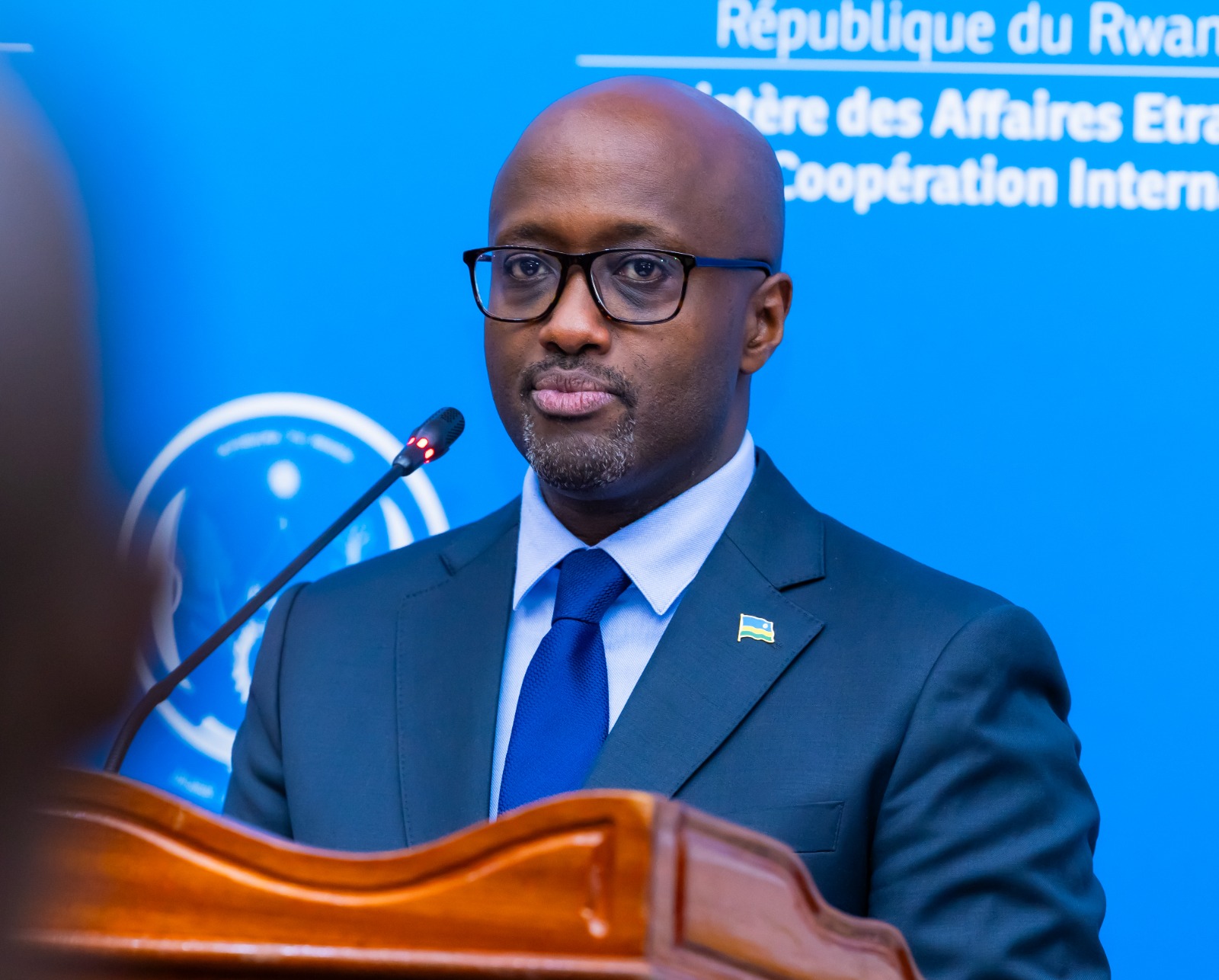
Those who took the oath include Amb. Olivier Nduhungirehe: Minister of Foreign Affairs and Cooperation, Yussuf Murangwa: Minister of Finance and Economic Planning, and Consolee Uwimana: Minister of Gender and Family Promotion.
Also sworn in were Mutesi Rusagara: State Secretary for State Investments and Financial Mobilization in the Ministry of Finance and Economic Planning, and Olivier Kabera: State Secretary in the Ministry of Infrastructure.
Other leaders who took the oath include Aimable Havugiyaremye: Secretary General of the National Intelligence and Security Service (NISS), and Angelique Habyarimana: Chief Prosecutor.
Additionally, the Chief of Health Services, Maj. Gen. Dr. Ephrem Rurangwa, and his Deputy, Brig. Gen. Dr. John Nkurikiye, also took the oath.
After the swearing-in ceremony, President Kagame provided guidance, emphasizing the expected contributions of the new leaders towards the development of the citizens.
He stated, “You represent various sectors. Your primary responsibility is to protect the interests of all Rwandans without discrimination. This responsibility may seem easy, but in practice, it proves to be challenging. However, it is essential to fulfill these responsibilities effectively.”
He added, “Leadership involves setting an example for others to follow, starting with those you lead and extending to others, especially the youth. This role includes making sound decisions whenever necessary. A leader who cannot make decisions fulfills only a small part of their responsibilities. Tasks should be completed promptly without unnecessary delays.”
President Kagame further stated that a good leader knows their responsibilities and does not need constant reminders.
He said, “It is not acceptable for leaders to constantly need reminders about their duties, as if there are individuals assigned to remind them. Tasks that can be completed in a week should not take two weeks, a month, or longer. If you ask why there is a delay, no one can provide a reason; they simply apologize and promise to address it.”
He added, “I often say it is good to apologize and commit to doing the task, as it is your responsibility, but that is not the main issue. The main issue is understanding why the time was wasted and why the task, which was within your responsibilities, was not completed.”
In this ceremony, President Kagame also dissolved the House of Deputies as its term ended, as stipulated by the Rwandan Constitution.
The graduation ceremony for the 12th intake was presided over by the Minister of Justice and Attorney General, Dr. Emmanuel Ugirashebuja.
It was also attended by heads and representatives of allied Police forces in Africa, the Inspector General of South Sudan National Police Service, Gen. Atem Marol Biar, Somalia Police Commissioner, Gen Sulub Ahmed Firin, as well as families of the students.
The students include 21 from Rwanda National Police (RNP), Rwanda Investigation Bureau (RIB), National Intelligence and Security Service (NISS) and Rwanda Correctional Service (RCS).
Other 13 allied students are from Botswana, Kenya, Lesotho, Malawi, Somalia, Namibia, South Sudan and Tanzania.
Minister Ugirashebuja said that the graduation is another significant milestone in the professional development of senior officers from African law enforcement organs.
“As Senior Command and Staff officers, you are the leaders and decision-makers who will continue to shape the future of our police forces and law enforcement bodies from different flags you represent,” the Minister said.
The insights and strategies gained, he added, should add value to addressing complex issues that comes with ever-evolving landscape of security and criminal activity.
“Policing is not an isolated endeavour; it requires collaboration and partnership with various stakeholders, including other law enforcement agencies, government bodies, and the communities we serve within national borders and beyond,” said Minister Ugirashebuja.
He pointed out that by fostering these relationships, it drives comprehensive and effective strategies that address the root causes of crime and promote public trust and confidence.
The Commandant of NPC, Commissioner of Police (CP) Rafiki Mujiji thanked the students for the highest standard conduct throughout the course, and being part of the legacy of leadership committed to excellence.
He also thanked the academic partners; University of Rwanda, the African Leadership University, and the Centre of Excellence for Stability Police Units as well as families of the graduands, for their invaluable contribution to the success of the highly demanding course.
The Acting Vice Chancellor of UR, Assoc. Prof. Didas M. Kayihura, said that ‘the unique collaboration between UR and NPC underscores the critical role of education in fostering peace and security in our society’.
He urged them to be guided by integrity, embrace innovation and technology, building community trust, navigate global challenges, and be good leaders and mentors.
The ALU Vice Chancellor, Dr. Nhlanhla Thwala, urged the students to become the bedrock and champions of the ethical and entrepreneurial promotion of justice, peace and security on the continent in the execution of their duties.
The issue of petrol shortages in this country led the police in May 2024 to order vehicle owners in Bujumbura City not to queue at petrol stations knowing there was no fuel available, warning that those who defy the order would be punished.
During various parliamentary sessions, deputies continued to express concerns about this issue and the widespread poverty affecting citizens.
On June 12, 2024, Deputy Hatungimana Athanase said that due to the decision made by the Burundi Police, some deputies are now walking on foot because their cars are parked at home.
These issues were brought up again on June 13, 2024, but Ndabirabe expressed his displeasure at hearing the complaints, stating that some members of the National Assembly were among those causing the problem.
Ndabirabe stated, “But there is something you keep saying about limited resources and people being poor. Is what you are saying true? Recently, when there was currency devaluation, did you see what happened? Didn’t citizens withdraw millions and millions from banks?”
He continued, “Now you are saying people are poor, and they are selling maize, many of them saying they have nowhere to sell it. Do you believe what you are saying? Find another way to describe it. Burundians are eating, if you want every Burundian to have an airplane or a car, I think that is unlikely to happen.”
Regarding petrol, Ndabirabe said that some people are hiding it in their homes, with some being caught with 5000 or 3000 liters, and that among those doing this are deputies or their associates. He said these actions are causing people to claim that Burundi is out of petrol, which he believes could incite unrest among citizens.
He said, “People continue to bring petrol, even now it is coming in. Where is this petrol going? We should ask the government to reinstate the death penalty for those caught stealing petrol because they are causing problems for the citizens. They should be executed, perhaps it would decrease. People in the government are staying up all night to ensure this petrol is available. There are some things you say, making one wonder if you see anything. Are there no Burundians going abroad to say ‘don’t give Burundi petrol’? You don’t see or mention them?”
For those saying foreign currency is scarce, Ndabirabe mentioned that some deputies are trading it, using it to build expensive houses. He suggested that those handling it illegally should have their hands cut off, preventing them from continuing to use it unlawfully.
The AP is an important partner of Xinhua, and the two sides have maintained an amicable relationship for a long time, said Fu, who leads a delegation in the United States.
Fu expressed the hope that the two sides further extend cooperation in news and information services, strengthen exchanges on the application of new technologies in the media industry, and deepen cooperation under multilateral mechanisms.
The AP and Xinhua have a relationship going back over 50 years, and it has stood the test of time, said Veerasingham.
“We have seen many changes in the world, but I think the relationship that the two organizations have forged together for so long is a really important indicator for how we can strengthen our relationship in the years ahead,” said Veerasingham.
The two sides exchanged signed copy of their cooperation agreement on the distribution of photos, videos and press releases, and also discussed challenges and opportunities like the utilization of artificial intelligence and the coverage of Olympic Games.
Building upon bilateral cooperation in nearly 70 years, the two sides have seen frequent high-level exchanges and new developments in cooperation in recent years, said Fu, who heads a delegation in the United States.
Fu expressed his hope that the two organizations reinforce mutually beneficial cooperation on the utilization of emerging technologies, international news services, and others.
Bascobert said the two sides jointly built the World Media Summit, which became a very important conference for the media industry, and he looks forward to sharing the latest developments of artificial intelligence in the industry at the next World Media Summit.
Bascobert noted the importance of working together and helping to guide different cultures toward mutual understanding.
The two sides also exchanged ideas on artificial intelligence, video services, and opportunities in tourism promotion.