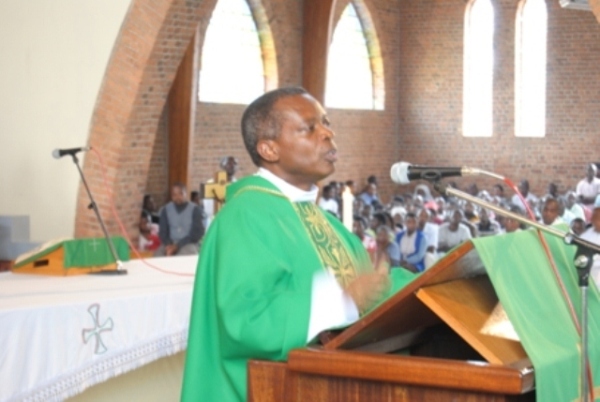
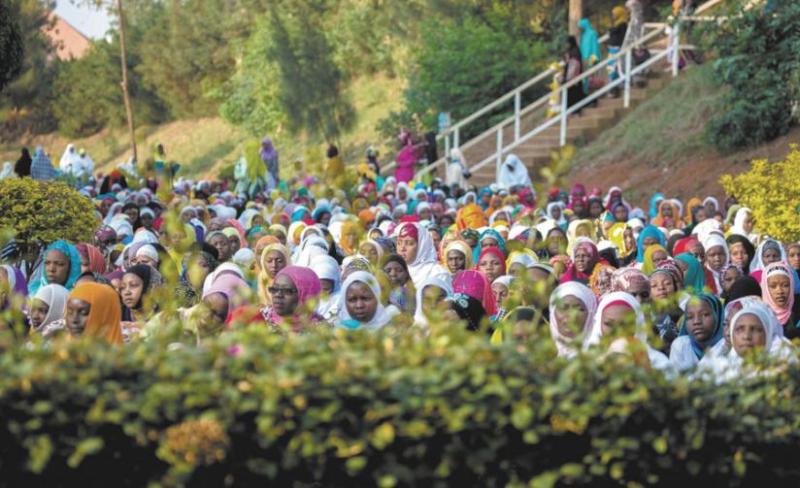
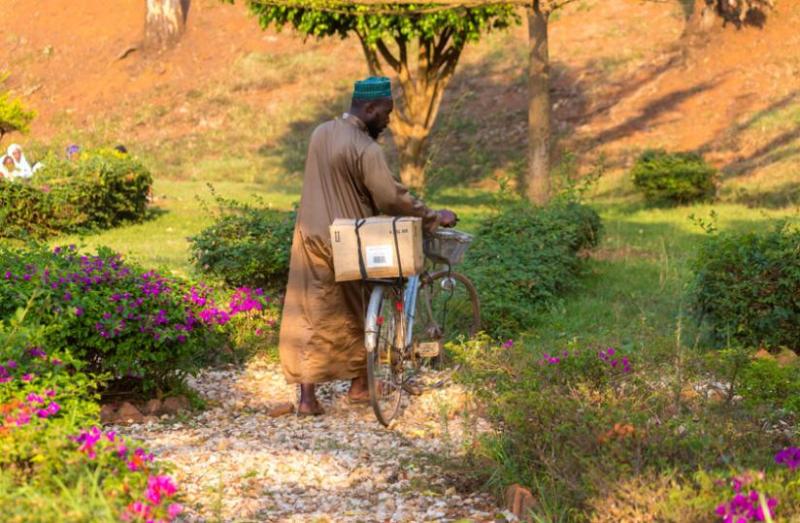
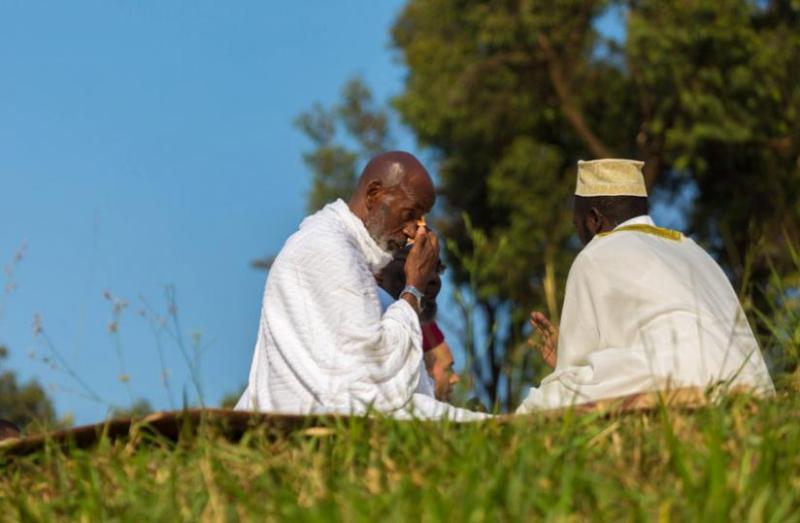
{The number of Catholics in the world has increased with growth registered across all five continents. The figures are taken by the Fides news agency from the latest edition of the Church’s Book of Statistics updated to 31 December 2012. }
These show that on that date the number of Catholics in the world stood at 1,228,621,000 with an overall increase of more than 15,000,000 compared to the previous year. The Americas and Africa registered the biggest increases followed by Asia, Europe and Oceania. The world percentage of Catholics stood at 17.49 %, a decrease of 0.01% compared to the end of 2011.
The total number of priests in the world increased by 895 to 414,313. Europe once again registered the largest decrease (-1,375) followed by the Americas (-90) and Oceania (-80). In Africa the number of priests grew by 1,076 and in Asia by 1,364.
There was an overall decrease in the number of women religious worldwide, whose numbers dropped by 10,677 to 702,529. Once again Africa and Asia showed increases whilst Europe and the Americas showed the biggest decrease in the number of women religious.
The number of lay missionaries in the world is 362,488 with an overall decrease of 19,234.
In the field of education, the Catholic Church runs 71,188 kindergartens, 95,246 primary schools and 43,783 secondary schools. Charity and healthcare centres in the world run by the Church are 115,352.
{As Christians around the world celebrate Christmas, historians and theologians question whether the holiday really celebrates the birth of the so called ‘son of god’ or the ‘sun-god’. {{}}}
Christians around the world celebrate Christmas, which is marking what in common Christian culture is believe to be the birthday of Jesus Christ. This is a tradition that is centuries old, and dates back to the mid-fourth century when the Romans officially accepted the Trinitarian narrative of Christianity at the Council of Nicaea in 325.
A Roman Christian scholar by the name of Valentinus produced the first documentation of Christmas being celebrated on December 25 as a special feast in the year 354. Particularly, a Greek Saint from that era called Saint Nicolas, who lived in what is today known as Turkey, was also well-known for delivering presents to children on that day. His tradition continued, developing into the character of Santa Claus. Although in the past century, which has seen the rise of secular materialism and a decline in spirituality, it can be argued that Christmas has lost its significance as a religious holiday, but it is still nonetheless celebrated worldwide, albeit in a commercialized fashion.
However, it is virtually impossible to find any evidence that Jesus and his disciples celebrated on December 25. In fact, it is highly unlikely that he was even born on that date. Christians of the East Orthodox Church traditionally celebrated Christmas on January 7, while Jeffery Sheler’s 1996 report ‘In Search of Christmas’ states that a document found in North Africa dated back to the year 243 suggests that Jesus was born on March 28. Furthermore, Luke 2:7-8 clearly states that Jesus was born in a time when the shepherds of Palestine were out with their flocks, which due to the cold, is not possible in the winter.
Regardless of when exactly Jesus was born, the date of December 25 has always played a significant role in the calendar, even before Jesus was born. In pre-Christian pagan belief, December 25 marked what was known as the Winter Solstice. Sol is the ancient Latin word for ‘Sun’, and Stice literally means ‘standing still’. It was celebrated by sun-worshippers as the day signaling the middle of winter, the shortest day of the solar calendar. This day was celebrated in different ways by different people all over the world.
For the pre-Christian Romans, December 25 marked their most important holiday, Saturnalia. This was later renamed to ‘Sol Invicti’, which means ‘the unconquerable sun’, in honor of the Syrian sun-god Apollo. Ancient Egyptians also used to celebrate December 25 in worship of Ra, or Horus, the sun-god child of Isis and Orisis. In Mesopotamia, the mythical god Marduk, who was believed to fight against the cold and darkness, was also worshipped on this day. The Aztecs on this day would sacrifice children in worship of their sun-god, Huitzilopochli. North-western Europe hosted festivities for the Nordic god Balder, while the Ancient Greeks dedicated the day for Adonis and Dionysos. For the Ancient Persians, December 25 represented the birth of Mithra, the sun-god.
Mithraism in particular was transferred to Europe from its land of origin, Iran, via the Greeks, who had conquered the Persian Empire under Alexander of Macedon in the fourth century B.C.E. It became widespread throughout Europe, and was even existent at the time the Romans had decided to adopt Trinitarian Christianity.
Before its adoption, Christians were heavily persecuted by the sun-worshipping Romans, and was not so much seen as a religion, but rather a renegade sect of Judaism, which mainstream Jews themselves rejected. Trinitarian Christianity finds its roots in the teachings of Paul, an ex-bounty hunter of Jewish origin who used to persecute Christians under the command of his Roman masters. However, after he claimed to have a vision in which Jesus supposedly told him that he was the son of God, he began to preach Trinitarianism – the concept of three gods in one. His counterpart, a Jewish companion of Jesus by the name of Barnabas, who is believed to have preached the oneness of god, was against preaching to the non-Jews, unlike Paul. Meanwhile, the Jews in the Roman Empire were revolting. Barnabas himself was killed during one of these revolts in his homeland Cyprus.
However, the idea of one god – otherwise referred to as Unitarianism – lived on and thrived, particularly in North Africa. Arius, a Libyan Unitarian, represented the call for one god during the early fourth century, while the strand of Trinitarian Christianity preached by Paul also flourished. Ultimately, after Roman Emperor Constantine chose to convert to Trinitarianism, Arius was killed along with many of his followers. The rise of Trinitarianism then saw the gradual merger of Jewish traditions and Mithraism, or Roman sun-worship, with the celebration of December 25 as the birthday of Jesus Christ as a symbol of this unholy marriage.
{The Tower of Babel in Genesis 11 was waterproofed to withstand a future flood. St. Paul mocks the Roman Empire in Acts 26. And King Herod’s appearance in Matthew 2 explains the context of Jesus’s arrival on earth. But these and many other central facts about the Bible’s narrative escape the modern Bible reader.}
The problem is that background information that was once too obvious to write down has now been largely forgotten.
Just as modern publications don’t remind readers that France is in Europe, or that Hitler was evil, or that Democrats and Republicans disagree, some facts were so widely known 2,000 years ago that there was no reason to include them in the Bible. But readers today lack this once-common knowledge, so they are often unable to appreciate the original depth of the Bible. Fortunately, other ancient sources fill in the blanks, restoring the Bible’s original impact. Here are three examples.
According to Genesis 11:3, the Tower of Babel was crafted with “brick for stone” and “bitumen for mortar.” Modern readers pay little attention to these engineering specifications, so they don’t appreciate the importance of the bitumen.
A 1st-century AD historian named Josephus helps out. He explains that the bitumen was to make sure that water didn’t enter the tower. Bitumen, it turns out, was a common waterproofing agent, used here as well as for Noah’s ark and for the basket that carried Moses safely down the Nile. The point of the Tower of Babel was to defend against a future flood, and Babel marks the end of the Flood narrative. But modern readers who are not experts in ancient materials sciences miss the role of the Tower and its connection to the Flood.
A second example comes from St. Paul’s imprisonment. After being arrested in connection with his disputes with some Jews, the Christian leader defends himself before a series of Roman rulers. Modern readers generally ignore the names — Felix, Festus, and Agrippa — and focus instead on Paul’s words. But the names are the key to understanding what Paul says.
Acts 25:13 refers to “King Agrippa and Bernice” who travel together. The obvious assumption is that Bernice is Agrippa’s queen, and that she has nothing to do with Paul’s observation in Acts 26 that Agrippa is “especially familiar with all the customs” of the Jews.
But we learn from Josephus that Bernice is actually Agrippa’s sister, and that the king is having an incestuous affair, in violation of the most basic of Jewish (and Christian) customs. Paul publicly praises the Roman for his knowledge of all things Jewish while inwardly ridiculing the man for his most heathenly, non-Jewish (and non-Christian) behavior. The trial is a farce. But most modern readers don’t know it.
Thirdly, few biblical passages are more familiar than Matthew 2:1: “In the time of King Herod,” wise men, or magi, came to Jerusalem after Jesus was born. Modern readers focus on Jesus and on the wise men, and disregard Herod. But Herod is central here.
Herod was widely seen in his day as an especially vicious Roman tyrant. For ancient readers, the brief reference to King Herod would have evoked images of a heathen monarch smothering God’s holy city of Jerusalem, much the way “Stalinist Russia” sets a dismal tone today.
Matthew’s point in chapter 2 is not just that Jesus has been born. It’s that a savior has arrived just at the time when the denizens of Jerusalem most need him. In this context, the arrival of the Messiah takes on heightened importance.
In these places and many more, the full impact of the Bible comes through only in light of the background to the text. But readers have to search elsewhere for that background.
{Dr. Hoffman is author most recently of The Bible’s Cutting Room Floor, which explores the relationship between extra-biblical material and the Bible itself.
}
{News reports suggesting Pope Francis said dogs can go to heaven grabbed headlines Friday. But in an example of getting lost in translation, the pontiff never actually commented about whether pets get a pass to the afterlife — an idea that gained traction among animal lovers and roused theologians. }
The confusion began when Pope Francis last month spoke broadly about the world during a speech later posted to the Vatican’s website. One particular part of his talk — “Holy Scripture teaches us that the fulfillment of this wonderful design also affects everything around us” — was highlighted and analyzed by Italy’s Corriere della Sera. The newspaper interpreted it to mean the pope believes animals go to heaven, and drew an analogy with another pope who spoke on the subject.
“It is said that Paul VI consoled a tearful child whose dog had died, and told him: ‘One day, we will see our animals again in the eternity of Christ,’” the newspaper said.
That’s where the message apparently got mixed up. Many news organizations, including The New York Times and NBC News, attributed the Pope Paul VI quote to Pope Francis. Adding to the confusion, neither the Vatican nor the pope clarified the remarks.
Sex Mountain in Indonesia attracts thousands of Muslim pilgrims, who believe having sex out of wedlock at this holy site will bring them wealth and good fortune. Dateline follows them as they take part in this unusual ritual.
Married men, cheating housewives, government officials and prostitutes revelling in a mass ritual of adultery and sex. This is what happens on Gunung Kemukus in Indonesia, otherwise known as Sex Mountain.
“I come here to seek good fortune,” regular visitor Mardiyah told me as I follow her journey on tonight’sDateline at 9.30pm on SBS ONE.
She is one of thousands of pilgrims who journey to a mysterious hilltop in Java to perform this ancient ritual. Most of those who take part in the ritual consider themselves devout Muslims
Mardiyah prays at Sex Mountain, in the hope that the ritual will help provide money to pay her debts.
There are several versions of the mythic tale that date back to the 16th century. Legend has it a young Indonesian Prince Pangeran Samodro had an affair with his stepmother.
They ran away and hid on Gunung Kemukus. One day, while mid-coitus, they were caught, killed and buried atop the mountain. It’s now an Islamic shrine where this sex ritual takes place.
The story goes: pilgrims must copulate on the mountain every 35 days for seven consecutive times and blessings and wealth should come their way.
But for the magic to work and the money to flow, it’s believed their sex partner for the ritual should not be their spouse.
Gepeng travelled hundreds of kilometres to reach Gunung Kemukus, or Sex Mountain.
I meet Gepeng, who like many others has travelled hundreds of kilometres from across the archipelago to get to sex mountain.“You go there to look for a different partner, not the one you have at home. Historically that’s how it works,” he said.
Another man travelling with him explained: “I don’t tell my wife. There’s no way my wife will find out.”
Pilgrims first pray and make offerings at the grave. They then must wash themselves at sacred springs nearby and once that’s been completed, they have sex.
This ritual isn’t seen anywhere else in Indonesia or the rest of the Muslim world. It’s a very Javanese blend of religious ideals with Islamic, Hindu and Buddhist influences.
A visit to Sex Mountain includes rituals combining Islamic, Hindu and Buddhist influences.
Professor Keontjoro Soeparno, a social psychologist from Gadjah Mada University in Yogyakarta, has been studying the ritual for more than 30 years.
“It’s a strange thing. A paradox: there’s a mosque, shrine – but outside – there’s a place for having illicit sex,” he said. “The fact is – it’s hypocritical.”
It’s impossible to ignore that the ritual is riddled with contradictions. Islam views adultery as a sin, so the ‘out of wedlock’ sex clearly goes against the mainstream law of the religion.
Karaoke bars and ‘sex shacks’ line the hillside. Some are privately owned, others built and funded by the local government. But they’re loathe to publicly admit there is any sex going on at Gunung Kemukus.
‘Sex shacks’ offer rooms by the hour for those who’ve found a new partner to have sex with.
“Pilgrims should come here with pure hearts and clean bodies,” a gatekeeper employed to look after the mountain shrine said.
“We’ve never said the sex is a condition of the pilgrimage. It’s what they want to do.”
The territory has become prime real estate for commercial sex workers. Professor Keontjoro estimates about half of the women who show up now are prostitutes.
“The government facilitated the rise of prostitution. The Islamic religion forbids all this, but the government would rather not know about that. Because they’re more interested in profit – they leave their religion behind,” he said.
Some say if you pay for sex the ritual doesn’t work. The reality is the local government makes a sizeable profit from sex mountain. They charge the stalls to set up shop and the pilgrims pay a toll to enter the site.
With up to 8,000 pilgrims arriving on the busiest nights and an entry fee of around 5000 rupiah, or 50 cents, a time, it’s big business in Indonesia.
So it’s not surprising officials and religious leaders turn a blind eye.
Up to 8,000 people visit Sex Mountain on its busiest nights, with seven visits required to complete the ritual.
The question remains though – how do we know this ancient tradition actually works. Does sex with a stranger really boost your bank account?Mardiyah genuinely believes it does, attributing sex mountain and its spiritual powers to her recent success.
“Praise be to God, after coming here, even though I have a few debts, my business is making a bit of a profit. Even though it’s small, I still give thanks that I’ve received blessings from here,” she said to me.
I don’t know how willing I am to believe in the legacy of Prince Samodro and his stepmother lover, but I can understand the attachment to the myth.
{
During a recent visit to the former capital of the Ottoman Empire, the pope labored mightily to bring Islam into dialogue with Christianity. But does he really accept that God is God?}
At the famous Blue Mosque during a papal visit to Istanbul, Pope Francis stood beside the grand mufti of Istanbul and prayed for two minutes, bowing his head, closing his eyes. At the end of his prayer, the grand mufti whispered aloud: “May God accept it.”
One can’t help wondering: Did the grand mufti doubt that God would accept a prayer from the head of the Roman Catholic Church? Indeed, does Francis, or any Christian, genuinely accept that God is God, whether his name be Allah or God?
As in previous visits to Islamic countries, the busiest pontiff in recent memory had labored mightily in Turkey to bring Islam into dialogue with Christianity: not an easy thing, although both are Abrahamic religions, in theory accepting the notion that God revealed himself to Abraham and his descendants.
A long-running argument exists over whether Christians and Muslims worship the same God. In my view, they certainly do. The creator—he or she—brought the world into being. The gender business interferes in odd ways, as the Arabic word for God is apparently quite neutral, whereas God is often seen as masculine in the Judaic tradition, the ultimate patriarch, as in Psalm 89: “Thou art my father, my God.” The situation is complicated by Christianity, where Jesus becomes the son of God, though his equal as well, having a place beside the Holy Spirit as part of a Trinity—with equal weight on each foot of the tripod. (To many outside Christianity, this looks a bit like polytheism!)
Judaism, Christianity, and Islam are firmly monotheistic religions, in fact. This puts them at odds with the countless polytheistic religions, where many gods compete for prominence. The ancient Greeks and Romans were comfortable with any number of deities and were quite open to allowing conquered nations to continue to worship in whatever ways they saw fit, as long as they didn’t mind having an emperor who required taxes and tributes. Jews in ancient Palestine were, under Roman occupation, moderately free to follow their Temple-oriented religion without interference until, a few decades after the death of Jesus, anti-imperial zealots openly rebelled against the empire, drawing the wrath of a vast and well-equipped army on their heads, precipitating the terrible destruction of the Second Temple in Jerusalem in 70 CE.
The God of the Jews was known by various names, including YHWH—the vowels are deliberately missing, although we derive the name Jehovah from this combination of consonants as written in Latin letters. Other names of God were Elohim, and Adonai, although these latter are often seen as reflections of God’s attributes, not separate names. One is, of course, inevitably up against the problem of translation when speaking of names. God is God, but he has various names in different languages, and each strand of monotheistic religion has multiple ways of describing the godhead.It has never been more important for Jews, Christians, and Muslims to understand that they worship the same God and “inhabit a common moral universe.” Pope Francis would seem to agree.
The God of Islam—who has as many as 99 names, all subsumed in Allah—often seems very like the Jewish creator: a remote God, merciful but all-powerful. Allah seems unlikely to enter into a “personal” relationship with Muslims, who readily submit to the divine will. Allah can’t truly be called a male figure in Islam, so “his” doesn’t really work as a descriptor. The God of Israel did indeed enter into dialogue with human creatures, meeting Adam and Eve in Eden, speaking to Moses in the burning bush, demanding sacrifices, issuing commandments. The various writings that eventually made up the Hebrew scriptures—the five books of Moses, the books of the prophets, and the so-called writings—characterized the human relationship with God in complex ways; but it was clearly a relationship.
The Christian God is more available to his followers: the head of a family, as depicted in the roles of father and son, making him appear more human than either the Jewish or Islamic creator. One can approach a father, and Jesus could speak to God as Abba or father, encouraging his followers to do the same, as in the Lord’s Prayer. Jesus offered a way of communicating with God that felt intimate.
There has been, as one might guess, a lot of disagreement about whether Christians and Muslims worship the same God, but Miroslav Volf, a well-known professor at Yale Divinity School, has done a good deal of work on this subject, concluding that both religions “believe in one God, one God who is a sovereign Lord and to whom they are to be obedient. For both faiths, God embodies what’s ultimately important and valuable.” He suggests that it has never been more important for Jews, Christians, and Muslims to understand that they do, indeed, worship the same God and, in fact, “inhabit a common moral universe.”
Pope Francis would seem to agree. He is, in many ways, working to repair damage done by Benedict, the previous pontiff, in his infamous lecture at the University of Regensburg in Germany, where some of his remarks were taken, possibly out of context, to be anti-Islam. As if in reaction, the current pontiff has gone out of his way to forge alliances with Islam, praying that religious tolerance will ultimately prevail in the Middle East.
That is a lot to pray for, but Pope Francis is praying for all of us.
This article was published on {{thedailybeast.com}} by {{Jay Parini}}
{Christians at the United Christian Church of Rwanda were urged to contribute money for the purchase of their pastors’ vehicles, IGIHE reports.}
Bishop Rwandamura Charles told Christians on 18 Oct. 2014 that they have to take money out of their pockets and buy Pastors ‘cars because pastors are the ones who carry out the burden of their problems.
He said a pastor is someone who is wealthy, eats lunch in Serena Hotel and lives in a good house so someone who is not able to get all of that “is not a pastor.”
He called upon Christians to make sure that their pastors are wealthy people adding that church leaders should get their privilege as high profile people and Christians will be explained why and how their offerings will help in making good life for their shepherds.
Bishop Rwandamura said “A Bishop without money is not a bishop; Apostle without money is not an Apostle. Apostle has money; he takes food in Serena Hotel. They are Kings, they are special people. We get tasks from God, no where you can apply for this work; this is a duty as well as a pledge.”
Rwandamura further explained that Christians must understand well the reason behind that call because Bishops, Apostles and pastors transport their problems and their bad sprits to God for the purification.
He says “We carry your burdens, your illness, your problems and your devils. We fight them day and night. Pastors are in front of you with your problems, your sterility, your AIDS and even you poverty.”
{{Christians speak out}}
Christians raise mixed feelings about the issue where some of them called it a dictatorship.
They said that asking them to buy all of the staff for their pastors is exaggerating.
Nyirimanzi{{*}} says “I think this is like leading with dictatorship. Sometime they terrorize us by saying that those who don’t give money to buy their cars will be cursed, unfortunate, etc.”
He added that “When you hear how they preach you become panicky and give money very quickly to avoid a curse and bad luck. They also say that those who offer will get blessed throughout their works”
Another Christian who spoke to us said “Even if none of the pastors come and force you to give money but they use a fear-provoking language that pushes us to dreadfully give our money.”
{Nyirimanzi*: The name withheld }
More on this article contact angedelavictoire@igihe.com or emma@igihe.rw
{The Divine Network International Ministries opens a new branch in Kampala, Uganda where it anointed Prophet Bisimwa Emile Prince as its Kampala representative and one of the shepherds in DNIM.}
After divine revelation, DNIM was founded by a Rwandan National Habineza Jean Claude currently living in the U.S.
The church has succeeded in opening different branches around the World.
It has branches in USA, Asia, Africa, and Dubai, Haiti, South Sudan and Canada as well as the newly opened branch in Uganda.
At the official launching of Kampala branch, the East African President of Divine Network International Ministries “DNIM”, Africa, Apostle Ntakoritagira Marcel said that DNIM has the objective of guiding followers in spiritual way as well as supporting their personal development through discussions, training, projects and helping each other.
He said all people, without discriminating, are allowed to come to DNIM for spiritual and Divine guidance.
He added that the church is planning to extend God’s Kingdom all over the world.
In Rwanda the God’s Ministry is represented by Niyonsenga Alphonse who is also the Senior Advisor.
DNI was launched on 14th July 2014. Its Founder is a Rwandan National Jean Claude Habineza who is living in the United States Of America.
{For the tens of thousands who hang on his every uplifting word and seek solace from the supernatural powers many contend he channels, they don’t like when he leaves them.}
“People in Rwanda say, ‘You abandoned us. You left us,’” the Rev. Ubald Rugirangoga said earlier this week.
The beloved “Father Ubald” has good reason for taking periodic sabbaticals outside his Central Africa homeland. Tens of thousands more people in other parts of the world have beseeched the presence of the longtime priest with a unique mysticism.
Rugirangoga is in the early stages of his latest transcontinental tour. He started in Germany last month before coming to the United States in early September.
After visits to Jackson Hole, Wyo., and Denver, Rugirangoga arrived in Green Bay this week. A capacity congregation is expected for the healing Mass he will give at 11 a.m. Friday in the chapel at The Shrine of Our Lady of Good Help in Champion.
“We usually pack the house. This is one of our biggest healing Masses,” said Karen Tipps, the coordinator at the shrine. “Whenever Father Ubald is here, we have standing-room-only usually in the church. They’re anxious to get here. And, they come from Chicago and Minnesota and everywhere when we have a healing Mass.”
Tipps advises those with an interest in making the journey to the popular shrine northeast of Green Bay to arrive early to secure a parking spot and a seat in the sanctuary.
Rugirangoga, who will be celebrating with facility rector the Rev. Peter Stryker, has come to the shrine a handful of times the last few years. It is one of Rugirangoga’s favorite destinations when he makes his rounds through the U.S. and North America – this purpose-filled trip continues with upcoming stops in Nashville, Tenn., and Dallas, then on to Canada before he returns to Rwanda in early November.
“I am with friends,” Rugirangoga, 58, said. “I am at the shrine. I pray.”
Sending up prayers in the name of forgiveness, reconciliation, hope and healing is what Rugirangoga does without reluctance or fatigue practically 24/7.
The Vatican has stripped the former papal envoy to the Dominican Republic of his diplomatic immunity, opening the way for him to be extradited to face sex abuse allegations in the country.
The Polish priest Jozef Wesolowski was found guilty of sexually abusing young Dominican boys by the Vatican in June.
Correspondents say the Caribbean state was unhappy at his immediate recalling by the Church when the claims surfaced.
He is the most senior Vatican official to be investigated for sex abuse.
Pope Francis has pledged a crackdown on clerics and employees of the Church who exploit minors, comparing their actions to a “satanic mass”.
Wesolowski had served as ambassador to the Dominican Republic for five years.
‘A serious and delicate case’
In a statement late on Monday, Vatican spokesman Federico Lombardi denied that the Vatican had tried to cover up the case by immediately recalling Wesolowski.
He said the 66-year-old former archbishop no longer had immunity and “might also be subjected to judicial procedures from the courts that could have specific jurisdiction over him”.
Pope Francis wants to see justice done and the Vatican had moved without delay in its investigation, he insisted.
“Far from any intention of a cover-up, this action demonstrates the full and direct undertaking of the Holy See’s responsibility, even in such a serious and delicate case,” he added.
The case is seen as highly sensitive because Wesolowski was an ambassador for the Church and had been ordained both a priest and a bishop by Pope John Paul II.