The walk concluded at BK Arena, where a vigil for the 32nd Commemoration of the 1994 Genocide against the Tutsi took place, with the President and First Lady joining participants in honoring the victims.
The walk began at the Gasabo District offices and was attended by youth from various sectors, artists, social media influencers, journalists, football players, film actors, government officials, and other members of the community.
April 7 is recognized globally as the International Day for Reflection in the 1994 Genocide against the Tutsi.
According to the census conducted by the Ministry of Local Government between 2000 and 2002, 1,074,017 Tutsis were killed over a span of 100 days, from April 7 to July 1994.
The 2004 report documented where the victims lived, their ages, their names, and in many cases, the circumstances of their deaths.
At the start of the 32nd Commemoration Week and the 100 days of remembrance, President Kagame reassured that the dark chapter in Rwanda’s history would never happen again in Rwanda.
President Kagame also highlighted that remembrance carries deep significance for Rwanda, serving as a way for the nation to overcome divisions that once threatened to destroy it.
He delivered the message on April 7, 2026, at Kigali Genocide Memorial, where genocide commemoration at national level brought together Rwandans, friends of Rwanda, and members of the diplomatic corps, among others, to honor the victims.
Rwanda’s commemoration period, known as Kwibuka, begins on April 7, with a week of national mourning and continues over 100 days, reflecting the duration of the genocide in which more than one million victims were killed.
This year’s commemoration is observed under the theme “Remember, Unite, Renew”.
In his address, Kagame emphasized the importance of survivor testimonies in preserving the truth about what happened in 1994, describing them as a vital foundation for collective memory and national identity.
“These testimonies keep memory alive for all of us and for those who will follow us,” he said.
He added that survivors are not alone, noting that their stories form a shared moral resource for the country. “They provide a reservoir of humanity that feeds our nation’s soul,” he said.
Kagame stressed that remembrance goes hand in hand with responsibility, saying every Rwandan has played a role in rebuilding the country, from documenting crimes through community-based justice systems to rejecting division and choosing unity.
The President also pointed to ongoing challenges in how the genocide is understood and described globally, warning against efforts to distort or minimize the truth.
“In 2018, the United Nations General Assembly adopted a resolution that called the genocide against the Tutsi by its proper name. The truth is undeniable, and yet we still find people sowing doubt and twisting the facts up to today. This is not just a matter of ignorance, but something much deeper,” he said.
“It means that the risk of seeing history repeat itself is a constant danger, if we allow ourselves and our friends to become indifferent.”
President Paul Kagame and First Lady Jeannette Kagame lit the flame of hope at the start of 32nd commemoration of Genocide against the Tutsi.
Kagame warned that genocide denial often begins long before violence erupts, taking root in subtle and dangerous ways.
“Genocide denial begins long before the genocide itself is committed. There is a pattern of looking away from the warning signs or taking them lightly,” he said.
“Hate speech turns into hate acts, dismissed as expressions of popular discontent. Behavior that should be immediately condemned is rationalized and minimized. The preparations are masked by narratives of popular grievance and fear.”
He rejected claims that the genocide was spontaneous, insisting it was deliberately planned and executed.
“All of these elements were present in our own history. There are some who pretend that the Genocide against the Tutsi was a spontaneous event. That’s not true. It was carefully prepared and carried out in plain sight.”
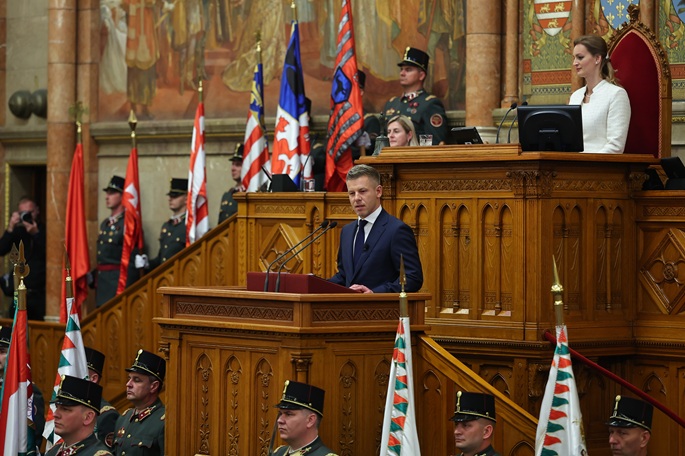
President Kagame delivers remarks at the Kwibuka 32 launch in Kigali, where he warned against genocide denial and global indifference.
Kagame also criticized the international community’s failure to act despite clear warning signs, noting that more lives could have been saved.
“The lives saved by the United Nations peacekeepers who were allowed to remain makes clear how much more could have been done with political will. Even as the killings accelerated, the language used to describe what was happening itself became a matter of calculation.”
Despite that failure, he highlighted the role of the former Rwandan Patriotic Army (RPA), now the Rwanda Defence Forces (RDF), in stopping the genocide and protecting civilians, saying its legacy continues to shape Rwanda’s security philosophy.
“It guides the conduct of our forces who serve abroad in peace-building missions, earning universal respect. Indeed, no sanctions or insult from outside can ever tarnish the honor and integrity of Rwanda’s Defense and Security Forces who are among the finest that can be found anywhere.”
President Kagame highlighted the dangers of moral passivity and the global failure to act during the 1994 Genocide against the Tutsi.
Reflecting on post-genocide security challenges, Kagame recalled the insurgency that followed the collapse of the genocidal regime in 1994.
“This was the period known as the Abacengezi Insurgency. And the western border was only fully secured by the end of the 1990s through the combined efforts of our army and the brave residents of those areas.”
“And since then, our defensive measures have been aimed at ensuring that such attacks can never again be made across our borders. This is not a problem that should be left to Rwanda alone. Doing so only rewards those behind the threat, while Rwanda is penalized for standing up for itself.”
He warned against double standards in addressing security concerns and used a metaphor to illustrate the dangers of inaction in the face of rising threats.
Kagame likened it to a farmer watching a small fire spread while others assume it will burn out on its own, even as “a pyromaniac is secretly adding fuel to the fire.”
Turning to the broader African context, he called for vigilance and responsibility across the continent.
“Africans, more than most, should understand the danger of moral passivity in the face of hatred and violent extremism,” he said.
While acknowledging the importance of national sovereignty, Kagame cautioned against its misuse.
“Bad actors must not be allowed to hide behind the principle of sovereignty,” he said, warning that “we cannot afford to repeat the mistakes of the past,” as genocide ideology spread in the region has the power to take people backwards again, if left unchecked.
President Kagame used a powerful metaphor of a spreading fire to illustrate the dangers of inaction in the face of rising extremism.
On April 7, 2026, Rwanda, alongside the international community, began the 32nd commemoration of the 1994 Genocide against the Tutsi.
MINUBUMWE stated that the Commemoration Week officially begins at the Kigali Genocide Memorial, which also hosts the national-level Kwibuka ceremony.
On the evening of April 7, a “Walk to Remember” will start in Gasabo District and conclude at BK Arena, where the Evening of Remembrance will take place.
At the community level, commemorative activities will include talks and guidance on the day’s messages. MINUBUMWE emphasized that after the Kwibuka activities, all regular work and services may continue as usual.
Essential services, such as pharmacies, hospitals, and health centers, will remain operational to serve the public, and hotels are allowed to continue providing services to their guests.
At the village level, no additional talks are planned during the Commemoration Week, except for those scheduled on April 7.
On April 11, 2026, in Kigali’s Kicukiro District, another Walk to Remember will start at IPRC/Kicukiro and conclude with an Evening of Remembrance at the Nyanza Genocide Memorial.
MINUBUMWE also stated that commercial activities, individual sports, team training, and other income-generating activities are allowed to continue throughout the Commemoration Week.
The ministry further announced that during Commemoration Week, the national flag will be flown at half-mast.
On April 13, 2026, the Commemoration Week will conclude at the Rebero Genocide Memorial at the national level. On that day, political figures who were killed for opposing the genocide will also be remembered.
The ministry clarified that no additional district-level closing activities are planned. It also reminded organizers that Kwibuka ceremonies should not exceed three hours.
Remembrance activities in government institutions, private organizations, businesses, and foreign embassies in Rwanda will be held on designated days between April 8 and July 3, 2026, with talks led by knowledgeable facilitators.
Schools will organize special remembrance days with lectures, visits to memorial sites, and activities aligned with Kwibuka program once students return from holidays.
It was also emphasized that evening vigils held before Kwibuka ceremonies or genocide victim burials should conclude by 10:00 p.m.
After the Commemoration Week, all remembrance symbols will be lowered, but may be reused only for specially organized genocide remembrance events.
During the 32nd commemoration of the Genocide against the Tutsi, Rwandans, particularly the youth, are encouraged to actively participate in remembrance activities and follow commemorative programs broadcast on radio, television, and social media.
President Kagame and First Lady Jeannette Kagame lighting the Flame of Hope in 2025 during the 31st commemoration of the Genocide against the Tutsi.
In a statement issued on the occasion of the International Day of Reflection on the 1994 Genocide against the Tutsi in Rwanda, Guterres reflected on the horrors of 1994 while stressing the urgent need for accountability and prevention.
“Thirty-two years ago, Rwanda endured one of the darkest chapters in human history. In just 100 days, more than a million people were murdered,” he said.
The UN chief noted that the day serves not only to honour the victims but also to confront the failures of the international community at the time.
“On the International Day of Reflection on the 1994 Genocide Against the Tutsi in Rwanda, we mourn the victims and honour their stolen dignity. We pay tribute to the survivors, whose resilience shows the strength of the human spirit,” he stated, adding that the world must also recall “with humility and shame, the international community’s failure to heed warnings and take immediate lifesaving action.”
Guterres emphasized that remembrance alone is not sufficient, urging nations to take deliberate steps to prevent similar tragedies.
“It’s not enough to remember the dead. We must learn from past failures and protect the living – by rejecting hatred, inflammatory rhetoric and incitement to violence; by investing in the social fabric to deepen community resilience; and by strengthening institutions that help prevent mass atrocities,” he said.
He further called on all countries to commit to international legal frameworks aimed at preventing genocide.
“I call on all countries to become parties to the Genocide Convention without delay and to implement it fully,” he added.
So far, 153 countries have signed the international convention on the prevention and punishment of the crime of genocide.
Reaffirming the United Nations’ solidarity, Guterres said, “The United Nations stands with the people of Rwanda. And we stand with all those, everywhere, who refuse to surrender our future to fear, division, or silence.”
He concluded by urging a renewed global commitment to action, saying, “Let this day reaffirm our commitment to remember, to listen, and to act. With history as our guide, and the prevention of genocide as our goal.”
Rwanda’s commemoration period, known as Kwibuka, begins on April 7, with a week of national mourning and continues over 100 days, reflecting the duration of the genocide in which more than one million victims were killed.
This year’s commemoration is observed under the theme “Remember, Unite, Renew”.
Guterres has urged action beyind remembrance as Rwanda marks the 32nd commemoration of Genocide against the Tutsi.
The night of March 31, 2026, was filled with celebration across the country as the national team defeated Jamaica 1-0, securing a World Cup spot for the first time in 52 years.
Residents in regions under AFC/M23 control, including the city of Goma, also celebrated the victory, demonstrating a sense of shared joy with citizens in other parts of the country, despite being under the rule of opposing factions.
On April 5, 2026, during festivities in Kinshasa honoring the team and thanking the players for their achievement, President Tshisekedi noted that the happiness of people in the eastern regions reinforced his confidence in reclaiming these areas.
He stated, “You saw the footage—there is joy in these territories controlled by the enemy, and we will reclaim them soon because of these forces, because of this momentum.”
The Head of State expressed optimism about regaining the regions, even as AFC/M23 maintained that it had no plans to relinquish control and warned that any government attacks would be dealt with.
Whenever the Congolese government has tried to retake lost areas, AFC/M23 has countered effectively, often seizing additional territory.
The international community has emphasized political negotiations as the only viable solution to halt the conflict, but President Tshisekedi has remained adamant.
There are reports that peace talks between the DRC government and AFC/M23 could resume in April 2026, though not in Doha, Qatar, due to the ongoing conflict in the Middle East; suggesting the venue may be moved to Switzerland.
President Tshisekedi noted that the happiness of people in the eastern regions reinforced his confidence in reclaiming AFC/M23 controlled areas.
In a joint policy brief issued Saturday, the AU, the United Nations (UN) Economic Commission for Africa, the African Development Bank, and the UN Development Program warned that the longer the conflict lasts and the more severe the disruption on shipping routes, energy, and fertilizer supplies, the greater the risk of a significant growth slowdown across Africa.
With most African countries still growing at rates below the pre-COVID time, the brief projected a loss in output growth of 0.2 percentage points on Africa’s gross domestic product for 2026 if the conflict exceeds six months.
The organizations stressed that the conflict, which has already triggered a trade shock, could quickly become “a cost-of-living crisis” through higher fuel and food prices. Rising shipping costs, insurance premiums, exchange rate pressures, and tighter fiscal conditions could further compound the crisis, with vulnerable households bearing the heaviest burden.
The Middle East accounts for 15.8 percent of Africa’s imports and 10.9 percent of exports, which highlights the critical implications of the current situation for African economies, according to the brief.
Highlighting that the fertilizer channel may prove more consequential than oil shocks for some countries, the brief noted that disruptions to Gulf liquid natural gas supply would affect ammonia and urea production, raising fertilizer costs during the crucial March-to-May planting season.
It warned that the phenomenon will put further upward pressure on food prices and hit vulnerable households hardest, with significant negative impacts on food security in Africa.
Expressing concern over potential geopolitical spillover effects that could reshape Africa’s security, it also warned that a wider conflict could intensify competition for influence in Africa, with regional conflicts in Sudan, Somalia, and Libya already reflecting external sponsorship.
The brief emphasized the importance of strengthening energy security, safeguarding and restoring fiscal space, accelerating the implementation of the African Continental Free Trade Area, and establishing financial safety nets across Africa as essential strategies for building resilience.
Smoke rises after airstrikes in Tehran, Iran on March 13, 2026. (AA Photo)
Making public the cabinet decisions, Minister for Education, Science and Technology Sasmit Pokharel said the decision of holidays on Saturday and Sunday will be enforced with immediate effect. Nepal has been practicing a one-day weekend on Saturdays.
He also informed that the cabinet has decided to prepare laws necessary to facilitate conversions of fossil fuel vehicles into electric vehicles.
The Nepali government on Sunday decided to introduce two-day weekly holidays in the government offices and academic institutions in a measure to counter disruptions in petroleum supplies.
On March 21, Trump threatened to “hit and obliterate” Iranian power plants if the country fails to fully open the strait within 48 hours. Two days later, he postponed strikes on power plants for five days, claiming to have held “productive conversations” with Tehran.
On March 26, Trump again pushed the deadline back, saying that he will pause planned strikes on Iranian energy facilities for 10 days, to April 6, the upcoming Monday at 8 p.m. Eastern Time. On Saturday, Trump reaffirmed that Iran has 48 hours to strike a deal on opening up the strait or face “Hell.”
However, in the post on Sunday, Trump appeared to hint at extending the deadline for Iran to reopen the strait for another time.
In a post earlier Sunday, the U.S. president threatened that Tuesday would be “Power Plant Day, and Bridge Day, all wrapped up in one” for Iran, and again urged Iran to open the Strait of Hormuz.
In an interview with The Wall Street Journal on Sunday, Trump threatened to destroy all of Iran’s power plants if the country’s leaders don’t agree to reopen the strait by Tuesday evening.
“If they don’t come through, if they want to keep it closed, they’re going to lose every power plant and every other plant they have in the whole country,” Trump said.
In a phone interview with Fox, Trump said that a deal to end the conflict in Iran could be reached by Monday.
However, Trump’s optimism does not seem to be echoed by the other side. Iran has rejected a U.S. proposal for a 48-hour ceasefire, which was recently sent through one of its “friendly countries,” the semi-official Fars news agency reported Friday, citing a source.
In a post earlier Sunday, the U.S. president threatened that Tuesday would be “Power Plant Day, and Bridge Day, all wrapped up in one” for Iran, and again urged Iran to open the Strait of Hormuz.
Speaking on his social media platform, Truth Social, Trump declared, “We got him,” revealing that the rescued officer, a highly respected colonel, had been trapped deep in Iran’s mountainous terrain after the aircraft went down two days earlier. Despite sustaining injuries, the pilot is expected to recover.
According to Trump, the rescue followed hours of intense planning and coordination, with military leaders closely monitoring the pilot’s location while he remained behind enemy lines. He praised the operation as a moment of national pride, highlighting the professionalism and determination of US forces involved.
Reports indicate that the mission involved a specialized commando unit backed by heavy air support and included a firefight during the extraction. While the pilot has been secured, officials said the operation remained sensitive until all forces safely exited the area.
This marks a rare instance where two US pilots have been rescued separately from hostile territory following the same incident. The first pilot had been recovered earlier, but confirmation was delayed to avoid compromising the second mission.
The incident stems from escalating tensions after Iranian forces reportedly shot down the US F-15 jet, as well as an A-10 Warthog aircraft in the region on Friday. Both sides had launched search efforts for the missing crew members in the aftermath.
U.S. officials confirmed on Friday that two U.S. rescue helicopters, including a UH-60 Black Hawk, which undertook the search-and-rescue operations for the jets, were also struck.
Repeated armed conflicts and unsafe ammunition storage have left a widespread legacy of explosive ordnance contamination across Libya, affecting residential areas, roads and agricultural land, UNSMIL said in a statement.
Issued on the International Day for Mine Awareness and Assistance in Mine Action, the statement stressed the importance of mine action in protecting civilians and supporting peace and stability in Libya.
UNSMIL said large-scale armed clashes in Tripoli in May 2025, along with four accidental explosions at ammunition depots in populated areas over the past two years, have underscored the severity of explosive ordnance contamination in Libya.
Risks remain even in areas where active conflict has subsided, particularly due to unsecured weapons and stockpiles, posing an immediate danger to displaced families returning home, according to the statement.
UNSMIL reaffirmed its commitment to supporting Libyan-led efforts to enhance the security of weapons and ammunition stockpiles and to clear explosive ordnance contamination. The mission called on national authorities, international partners and civil society to strengthen coordinated and sustained support for mine clearance efforts.
Libya remains divided between the UN-recognized Government of National Unity in the west and a rival eastern administration headed by Osama Hammad and backed by Khalifa Haftar’s Libyan National Army.
Libyan Ministry of Interior personnel stand guard in front of the Central Bank of Libya in Tripoli, Libya, August 27, 2024. REUTERS/Ayman Sahely