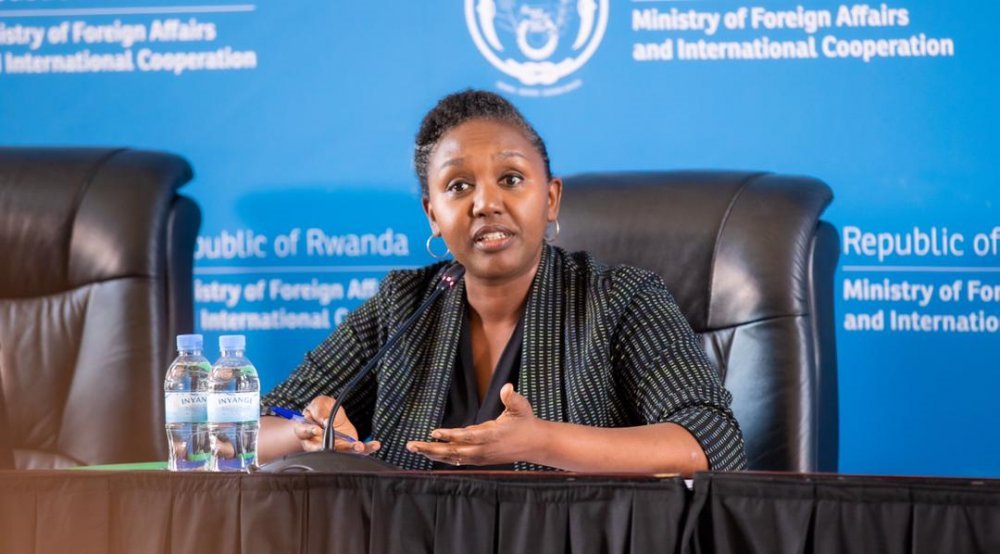
This follows the 45th Ministerial Conference of the Francophonie (CMF) held Thursday September 3, 2024 chaired by IOF Secretary General Loiuse Mushikiwabo, also attended by Foreign Affairs Minister Olivier Nduhungirehe.
Held under the theme “Create, innovate, and do business in French,” the 19th Francophonie Summit, also called Villers-Cotterêts Summit, will have a special focus on youth employment.
During the preparatory meeting, Minister Nduhungirehe announced to his peers the anticipated reception of the 46th Ministerial Conference of the Francophonie in Kigali in 2025.
On the first day of the Summit tomorrow, the President and First Lady will attend the opening ceremony of the 19th Francophonie Summit in Villers-Cotterêts, a town 80 km north-east of Paris where French was declared the official language of France in 1539, replacing Latin.
Later in the evening, they will join other dignitaries for a dinner hosted by French President Emmanuel Macron and First Lady Brigitte Macron at the Élysée Palace.
On the second day of the Summit, President Kagame will attend a closed roundtable session on “Renewed Multilateralism” chaired by President Macron, followed by a closed door session.
The Summit will conclude with the adoption of the Villers-Cotterêts Declaration.
While Israel’s defense systems, supported by the United States, managed to intercept many of the missiles, the situation still posed a significant threat to civilian life.
Speaking with IGIHE, Israel’s ambassador to Rwanda, Einat Weiss, described the situation as “surreal,” with over 10 million people forced into temporary shelters across the country.
This latest attack is seen by Israel as part of a broader strategy by Iran to destabilize the region and support militant groups such as Hamas and Hezbollah.
{{Unprecedented missile attack}}
The missile barrage came just hours after a deadly train station attack in Israel, which killed seven civilians.
Speaking with IGIHE, Ambassador Weiss recounted the events, highlighting the sheer magnitude of the missile strike.
“We had 181 missiles launched at Israel for an hour, primarily targeting Tel Aviv. The streets, the country was shut down basically,” she said.
Weiss emphasized that the Israeli government’s decision to instruct millions of civilians to take shelter was not taken lightly.
“Think about it—these ballistic missiles weigh around one ton each. Without our defense capabilities, particularly the Hetz missile system, which intercepted many of the missiles, we would have seen thousands of casualties. It’s no wonder the Home Front Command took immediate action.”
Despite Israel’s ability to neutralize many of the threats, Weiss noted that the silence from the international community has been “mind-boggling.”
She expressed frustration that Iran’s direct assault on civilians has not been met with global condemnation.
“If Israel had launched 181 missiles at another country, the international outcry would have been immediate. But when Iran does this, the world remains silent,” she remarked.
{{Facing conflict on multiple fronts}}
In addition to the missile strikes from Iran, Israel is engaged in an ongoing battle with Hamas in Gaza and Hezbollah in Lebanon. Ambassador Weiss outlined the scope of the threat, explaining that Israel is being forced to defend itself from all sides.
“We have Hezbollah in the North, Hamas in the South, and now Iran, 2,000 kilometers to the East. This is not a normal situation.”
Israel’s military operations in Lebanon are a direct response to intelligence suggesting that Hezbollah was planning an attack similar to Hamas’s October 2023 assault on Israel, which left over 1000 civilians dead.
“We had intelligence confirming that Hezbollah was planning an attack on Galilee, using a network of tunnels like those in Gaza. We had no option but to act,” Weiss explained.
She stressed that Israel’s response is driven by the need to protect its citizens and prevent further loss of life.
“These terrorist groups are not leaving us with any option,” she said.
{{Iran’s role in the conflict}}
Following the recent missile attack, Iran’s Chief of Staff, Maj Gen Mohammad Bagheri, announced on state television that Iran would target critical infrastructure across Israel if Israel chose to retaliate.
Bagheri warned that the strikes would intensify and focus on key infrastructure sites across the country.
Iran framed the attack as a response to what it described as the “violation of its sovereignty” and the death of Hamas political leader Ismail Haniyeh, who died in an explosion in Tehran in July—a blast for which Iranian officials blamed Israel, though Israeli authorities have not officially claimed responsibility.
The attack is also linked to the killing of Iranian-backed Hezbollah leader Hassan Nasralla in Israeli airstrikes on September 27, 2024. Iran’s Supreme Leader Ali Khamenei had vowed to avenge Nasrallah’s death.
However, Iran’s involvement in the conflict is seen by Israel as a clear demonstration of its strategy to use proxies to destabilize the region.
Weiss accused Iran of using Hezbollah, Hamas, and the Houthi militia in Yemen as tools to further its agenda.
She also pointed out that Iran’s aggression extends beyond Israel, posing a broader threat to international security.
Despite these threats, Israel continues to call for the enforcement of international agreements, particularly UN Resolution 1701, which demands Hezbollah’s disarmament in Lebanon.
“This is an international resolution, not an Israeli one,” Weiss stated. “Yet it is not being enforced, and Hezbollah continues to operate freely in Lebanon.”
{{Frustration with global inaction}}
Ambassador Weiss expressed deep frustration with the international community’s reluctance to hold Iran accountable for its actions.
She highlighted what she perceives as a double standard in how Israel’s actions are viewed compared to those of its adversaries.
As she said, Iran is being embraced by the international community despite their direct involvement in terrorism while Israel is the one facing criticism for defending itself.
Weiss noted that while Israel is doing everything it can to minimize civilian casualties, including issuing warnings before attacks, the international response remains skewed against Israel.
“We go out of our way to avoid civilian casualties, even putting our own soldiers at risk. When we retaliate and people die for collateral damage, because that’s war, then the blame instead of being on Hamas is being on Israel. Now, the expectation that we do not retaliate is insane.”
This, she argued, is contributing to a dangerous precedent, where terrorist organizations like Hamas and Hezbollah are emboldened by the lack of consequences for their actions.
“The biggest winner of this year is Iran. They continue to support terrorism with no repercussions. The international community needs to send a clear message that this behavior will not be tolerated.”
{{A call for global support}}
As Israel continues to defend itself on multiple fronts, it is calling for greater support from the international community.
Weiss emphasized that the world cannot afford to ignore Iran’s actions, as the consequences will not be limited to Israel.
“Iran is against everything that is liberal or different from them. They will go after anyone who doesn’t align with their ideology,” she warned.
Despite the challenges, Weiss remains hopeful that Israel’s resilience will see the country through this difficult period.
“Our goal is simple: to protect our people and ensure they can return to their homes safely. We want peace, but we cannot allow these terrorist groups to continue attacking us without consequence.”
{{Way forward}}
As the conflict drags on, Ambassador Weiss made it clear that Israel will not back down.
She explained that Israel has to defend itself noting that the international community cannot expect the country to sit by while its citizens are under attack.
Weiss also expressed concern that Iran’s aggression could spill over into other regions, particularly Europe and Africa and called on the international community to take a stand against Iran’s actions.
Daniel Chapo, running for the presidency on the ruling FRELIMO party ticket, is almost certain to win, succeeding Filipe Nyusi, who is retiring after two terms. His challengers include Ossufo Momade, the leader of Mozambique’s main opposition party and former rebel movement, Renamo, as well as Lutero (MDN) and Simango Venancio Mondlane (independent).
The 47-year-old former university professor, campaigning under the slogan “Let’s get to work,” is expected to oversee the revival of two liquefied natural gas (LNG) projects currently stalled due to insecurity in northern Cabo Delgado province.
Local analysts argue that Chapo’s development goals will heavily depend on the continued military support from the Rwandan forces, first deployed by Nyusi in 2021 to assist local troops in containing the insurgency.
“The Rwandans are undeniably competent,” Tertius Jacobs, lead Mozambique analyst at risk consultancy Focus Group, told Reuters. “Mozambique … has little to no better alternative.”
Jacobs notes that Nyusi’s introduction of Chapo to Rwandan President Paul Kagame in June signals a likely continuation of Rwandan involvement.
Rwandan forces, operating in the volatile northern province, are tasked with securing the area around the Afungi site, where TotalEnergies and ExxonMobil are planning LNG projects. TotalEnergies halted its $20 billion project when the skirmishes erupted in 2021.
Robert Besseling, CEO of consultancy Pangea-Risk, emphasized that the presence of Rwandan troops will remain crucial to the next administration’s efforts to neutralize terrorist threats, which have hindered Mozambique’s ambition to become a major gas exporter.
“They have thousands of troops there to protect the LNG sites,” Besseling remarked.
Rwanda began deploying its security forces to Mozambique on July 9, 2021. Initially, the contingent included 1,000 troops from the Rwanda Defence Force and Rwanda National Police.
By late 2022, the Rwandan troop presence had increased to approximately 2,500, reflecting an expanded mandate to pursue and dislodge terrorists from their strongholds.
Since 2021, Mozambique has also received military support from the Southern African Development Community (SADC), but SADC forces began withdrawing in April 2024 as their mandate ended. This withdrawal has left Rwanda with a greater share of responsibility in assisting local forces in addressing the ongoing security crisis.
Before the intervention of Rwandan troops in 2021, the insurgency had claimed the lives of 3,000 civilians, and more than 800,000 people had been displaced. The insecurity also brought all development projects in insurgent-controlled areas to a halt.
Rwanda’s most recent troop deployment to Mozambique was in August 2024, led by Major General Emmy Ruvusha. The troops are responsible for securing several key areas and communities in Mocimboa da Praia, Chinda, Palma, Afungi, Pundanhar, Macomia, Ancuabe, and Pemba.
The event was graced by Khalid Musa, the Chargé d’Affaires at the Sudanese Embassy in Rwanda.
Speaking at the inaugural event to welcome the new students, Dr. Rose Mukankomeje the Executive Director of the High Education Council (HEC) emphasized the importance of education and health for Rwanda’s development.
“Education and health are very key for us as a country and we thank the government’s support in expanding higher education institutions in the medical field,” she explained
“We need more such institutions, but the quality is paramount,” she added, stressing the goal of improving medical services within Rwanda to reduce reliance on foreign healthcare.
She said that Rwanda’s reputation for beauty, security, and cleanliness is not enough. The country is constantly striving to transform into hub for knowledge and welcoming new students like these is a good step in the right direction.
“Health goes hand in hand with wealth to produce better results in terms of development. I welcome you to feel at home here in Rwanda kindly remember to work hard. Work until it hurts and work until it heals,” she told the new students.
She encouraged them to prepare for life beyond school, emphasizing the importance of discipline and forward planning for the future.
Today, Rwanda has four medical training schools including the University of Rwanda College of Medicine, School of Medicine at the Adventist University of Central Africa (AUCA), Africa Health Sciences University based at King Faisal Hospital and UMST.
On her part, Dr. Suzan Homeida, the Deputy Chairperson of the University Board of Trustees, implored the students to understand that impacts of joining a university that is deeply committed to excellence in education and healthcare.
“Medicine is a noble profession that requires hard work, compassion, and a deep sense of responsibility to others. In the coming years, you will grow, learn, and develop the skills needed to make a real difference in people’s lives. We are here to guide and support you on this journey,” she said
In the same spirit, Prof Samir Shaheen, the Vice Chancellor at UMST advised the new students to embrace Rwanda’s rich culture and history saying it is a place that values unity, progress, and resilience—qualities that should inspire the students during their time of studies
He reminded them that the path they have chosen is challenging, but also incredibly rewarding and reiterated commitment to help them achieve their goals and dreams
“The University’s dedicated teachers and staff are here to provide you with the best education possible, and to help you become the best healthcare professionals you can be. We believe in your potential to not only succeed but also to contribute to the betterment of healthcare in your communities and beyond,” he said.
Dr. Africa Gasana, the Chairperson of Rwanda Medical and Dental Council (RMDC) says that a moment to receive new medical students at UMST is a milestone not just for the students but the entire healthcare sector in Rwanda.
“We recognize that training and nurturing the next generation of healthcare professionals is a responsibility of immense importance as it addresses the growing need for skilled, dedicated and ethical medical practitioners in Rwanda,” he pointed out.
He tasked the new students with the unique responsibility to set a high standard for those who will follow after receiving the knowledge, skills and attitudes necessary to navigate the complexities of healthcare.
“One of the most important lessons you will learn throughout your journey is the value of interprofessional collaboration. Healthcare is a team effort that involves working closely with other professionals to provide comprehensive care for patients,” he said.
UMST was established in Sudan’s capital Khartoum in 1996 with a main campus comprising two Faculties namely, Medicine and Medical Laboratory Technology.
From 2 faculties and 60 students, it grew over the years and in 2021 it had 17 faculties and over 7000 students, and more than 27 postgraduate degrees in both medical disciplines and humanities.
Over half of the people displaced are children, said Stephane Dujarric, spokesman for the UN secretary-general, at a daily briefing.
He said the Office for the Coordination of Humanitarian Affairs is deeply concerned by rising displacement in recent months, as escalating gang violence deepens the country’s humanitarian crisis.
About three-quarters of the displaced seek shelter in other provinces, with the Grand Sud region alone hosting nearly half of the total displaced population. In Port-au-Prince, the capital, where the security situation remains highly unstable, a quarter of those displaced live in overcrowded sites, with limited access to basic services, said Dujarric.
The school year started in Haiti on Tuesday, and UN humanitarian partners have been working closely with the authorities to support the national back-to-school campaign. Some 1.4 million students and teachers have experienced severe disruptions to education over the past year due to ongoing insecurity.
Dujarric said that in partnership with local organizations, the UN Children’s Fund is offering various forms of support, including by providing cash transfers so that families can cover school-related costs, helping displaced children integrate into host schools, distributing school kits, and ensuring schools are rehabilitated and have adequate supplies.
“However, these response efforts remain significantly underfunded,” he said, adding that just 30 percent of the 30 million U.S. dollars needed to provide education support to children in Haiti this year has been received.
Overall, the humanitarian response plan for Haiti this year remains only 39 percent funded, with 264 million dollars of the 674 million dollars required to provide life-saving assistance to the people of the country, said Dujarric.
The dinner was attended by high-ranking officials, including Rwanda’s Minister of Foreign Affairs, Amb. Olivier Nduhungirehe, and Minister of National Unity and Civic Engagement, Dr. Jean Damascene Bizimana.
President Kagame expressed his gratitude to his counterpart of Latvia, Rinkēvičs for the warm reception extended to him and his delegation.
“President Edgars Rinkēvičs, once again, thank you for hosting me and my delegation on this historic visit. I am convinced that Latvia and Rwanda have a lot to offer one another. We look forward to becoming not only friends but also partners,” said Kagame.
The dinner followed a series of discussions between the two Presidents. They covered topics including the strengthening of bilateral relations, addressing security challenges in both Africa and Europe, and enhancing cooperation in international organizations.
Rinkēvičs emphasized the historic nature of the visit, noting that President Kagame is the first African leader to pay an official visit to Latvia.
He also highlighted Latvia’s interest in expanding bilateral cooperation, particularly in economic and trade sectors.
“There is potential for collaboration in the field of information and communication technologies, which is also demonstrated by the growing interest of Latvian companies in the African market,” said Rinkēvičs.
Following their bilateral talks, Kagame told members of the press that Rwanda and Latvia share strong bonds of friendship. He emphasized that the purpose of his visit was to explore new opportunities for the mutual benefit of both nations.
As part of the visit, the two Presidents unveiled a commemorative plaque at the National Library of Latvia, dedicated to the victims of the 1994 Genocide against the Tutsi in Rwanda.
Rinkēvičs reflected on the genocide, calling it a dark chapter in world history.
“Thirty years ago, the world witnessed one of its darkest moments. The 1994 Rwandan genocide against the Tutsi served as a reminder of how hatred can poison people’s minds. The atrocities of 1994 in Rwanda cannot be described and must not be forgotten,” said Rinkēvičs.
“Three decades later, we continue to remember the victims and honor the survivors of the genocide. Rwanda has demonstrated to the world how to overcome an unimaginable tragedy by making a determined effort to heal society and forge unity,” he added.
Drawing a parallel with Latvia’s history, marked by wars, occupations, and violent repressions, Rinkēvičs remarked that Latvia deeply understands the importance of preserving historical memory.
President Kagame’s official visit to Latvia is set to conclude on October 3, 2024. Diplomatic relations between Rwanda and Latvia were first established on April 10, 2007.
The Rwandan Head of State made these remarks during a joint press conference with Latvian President Edgars Rinkēvičs. Kagame is on a three-day official visit to Latvia, which commenced on October 1, 2024.
During his visit, President Kagame toured the Latvian Occupation Museum, which showcases the country’s history and struggle for independence. Kagame and his counterpart, Rinkēvičs also held a private meeting, followed by broader bilateral discussions with their respective delegations.
Speaking to the press after these engagements, Kagame expressed gratitude for the warm hospitality extended to his delegation and reflected on the strong bilateral ties and mutual interests between Rwanda and Latvia.
“Following my discussion with the President and between our delegations, it is evident that Rwanda and Latvia share strong bonds of friendship. […] The purpose of this visit is to explore new opportunities for the mutual benefit of our people,” Kagame remarked.
Among the key areas of cooperation, Kagame highlighted a growing interest in sustainable agriculture and expressed his appreciation for the visit to the Museum of the Occupation of Latvia, noting that it holds a universal message about the protection of rights and freedoms.
The President went on to share more values shared between both countries and areas of priority.
“What also unites Rwanda and Latvia is a common understanding that we can no longer do business as usual. We need a multilateral system that is more fit for purpose and which treats everyone equally,” he stated.
“We also need to prioritize growth areas such as information technology. […] Ultimately, the mindset we have is to work together to find solutions to our unique set of challenges,” Kagame added.
Kagame also described Latvia’s efforts to build a strong innovation ecosystem in Latvia as an example to be emulated.
He explained that Rwanda has also been doing its part, beginning with digitizing almost all public services.
The President further emphasized that Rwanda and Latvia are willing to support each other on a range of issues, notably peace and security and global development.
Latvian President Edgars Rinkēvičs, in a message shared on his X account, expressed his zeal for deepening cooperation with Rwanda.
“Welcome, Your Excellency President Kagame, to Riga. Very much looking forward to developing strong political and trade cooperation between Latvia and Rwanda. It is also important to work together to uphold principles of international law both globally and regionally,” he wrote.
Latvia has fostered diplomatic relations with Rwanda since 2007, further strengthened by Rwanda’s appointment of an ambassador in January 2022.
Kagame’s visit marks the first official visit by a Rwandan president to the Baltic States, which comprise Latvia, Estonia, and Lithuania. It is also the first official visit by an African president to Latvia.
Located in northeastern Europe, Latvia is one of the smaller countries on the European continent, covering an area of 64,589 square kilometers. It shares borders with Lithuania to the south and Estonia to the north and has a population of approximately 1.88 million people.
The country gained independence from the Soviet Union in 1991 after decades of occupation. Latvia’s landscape features rolling hills, dense forests, and sandy beaches along the Baltic Sea coast.
Riga, the capital and largest city of Latvia, is renowned for its stunning architecture, which includes Art Nouveau buildings and medieval churches. The official language, Latvian, is a Baltic language with ancient roots.
Mr. Butera brings a wealth of experience and a proven track record in mining industry, positioning Ngali Holdings Ltd for its next phase of growth and innovation.
With over six years of leadership experience in mining, Mr. Butera has held prominent roles at LuNa Smelter Ltd – Rwanda, where he served as both the Managing Director and Deputy Managing Director among other roles. Known for his strategic vision, innovative approach, and industry expertise, Mr. Butera will spearhead Ngali Holdings Ltd’s efforts to expand its market presence.
The Chairperson and the Board of Directors of Ngali Holdings Ltd expressed their enthusiasm and confidence in Mr. Butera’s leadership and look forward to seeing the company reach new heights under his guidance.
He is set to work closely with the executive leadership team and all employees to continue driving the company’s mission to unlock economic potential and eliminate growth barriers in Africa; and deliver value to its customers, partners, and stakeholders.
Ngali Holdings is a Rwandan company investing in a wide range of industries across the continent of Africa. The company aspires to see African markets grow and specialize in long-term, wide-scale infrastructure projects with a holistic focus.
The UK High Commissioner to Rwanda, Alison Heather Thorpe, told the media in Kigali on Wednesday, October 2, 2024, that the British government stands ready to assist Rwanda in responding to the health emergency through, among other measures, the provision of protective kits and medical experts.
“We are looking at a whole variety of measures, from the provision of kits, such as personal protective equipment and testing kits, to potentially sending out some epidemiologists and medical support staff,” Thorpe stated.
She added, “We are also examining whether we have any vaccines under trial that we could develop. In fact, there’s a team from Oxford University currently in the country supporting the WHO in their efforts.”
“So we stand ready to help in whatever way we can. The government of Rwanda needs to tell us what they would most like from us, and then we can set our wheels in motion to deliver that.”
The UK’s support will complement efforts from other partners, including the Centers for Disease Control and Prevention (CDC), which has also offered to collaborate with the Rwandan government in the fight against Marburg.
CDC, the national public health agency of the United States, announced on Monday that it is deploying experts to assist Rwanda’s investigation and response to the Marburg outbreak.
“The staff will use their experience from responding to outbreaks of Marburg virus disease and similar diseases in other countries to support epidemiology, contact tracing, laboratory testing, disease detection and control along borders, and hospital infection prevention and control,” the CDC said in a statement.
Rwanda confirmed its first-ever Marburg outbreak six days ago, with 29 cases and 10 deaths reported as of Tuesday, October 1, 2024.
To control the spread of the virulent disease that causes hemorrhagic fever, the government has implemented several measures, including suspending hospital visits, banning wakes and home vigils (locally known as Ikiriyo) for Marburg-related deaths, and limiting burials for Marburg deaths to a maximum of 50 people.
Additionally, all healthcare facilities have been directed to implement a protocol for receiving and providing services to clients exhibiting symptoms of Marburg virus disease, with strict adherence to infection prevention and control (IPC) measures.
Currently, there are no vaccines or antiviral treatments approved by the World Health Organization (WHO) for Marburg virus disease. However, supportive care—rehydration with oral or intravenous fluids—and treatment of specific symptoms can improve survival.
This clarification comes after British Prime Minister Keir Starmer, elected in July 2024, canceled the agreement initially signed in April 2022.
The decision was made on the grounds that the deal would not effectively prevent illegal migrants from entering the UK.
In response, the Rwandan government expressed its continued willingness to contribute to addressing the migrant crisis and emphasized that it had no involvement in the termination of the deal.
The agreement’s cancellation sparked speculation over whether Rwanda would need to return the £270 million provided by the UK for the implementation of the asylum scheme.
However, Rwanda’s Deputy Government Spokesperson, Alain Mukuralinda, said that a refund was not stipulated in the agreement.
During a press briefing on October 2, 2024, High Commissioner Thorpe addressed these concerns directly, stating, “As far as I’m aware, there is no intention to ask Rwanda for any of the money back.”
When asked whether the UK might reconsider and reinstate the partnership, she indicated that this was unlikely in the near future, as the UK has introduced new strategies to tackle illegal migration.
These include enhanced border security measures aimed at preventing small boat crossings.
The diplomat also explained that, following Prime Minister Starmer’s decision to cancel the deal, the UK Parliament is expected to approve the formal termination.
Once approved, the UK government will notify Rwanda of its decision to officially withdraw from the agreement.
Despite the migration deal’s cancellation, High Commissioner Thorpe emphasized that the broader UK-Rwanda relationship remains strong.
“The new government in the UK has ended the migration partnership with Rwanda, but that absolutely doesn’t mean they’ve ended the relationship with Rwanda,” she assured.
High Commissioner Thorpe added, “In fact, the relationship has always been far broader than just migration. The new government is very keen to continue a strong relationship with Rwanda.”
The diplomat further pointed to the visit of the UK’s new Minister for Africa, Lord Collins, to Rwanda in early September 2024 as a testament to the enduring ties between the two nations.
She explained that it was intended to underscore the UK government’s commitment to strengthening ties with Rwanda in the coming years.
Thorpe also highlighted the UK’s desire to continue collaborating with Rwanda on key issues such as promoting trade, economic growth, and tackling climate change.