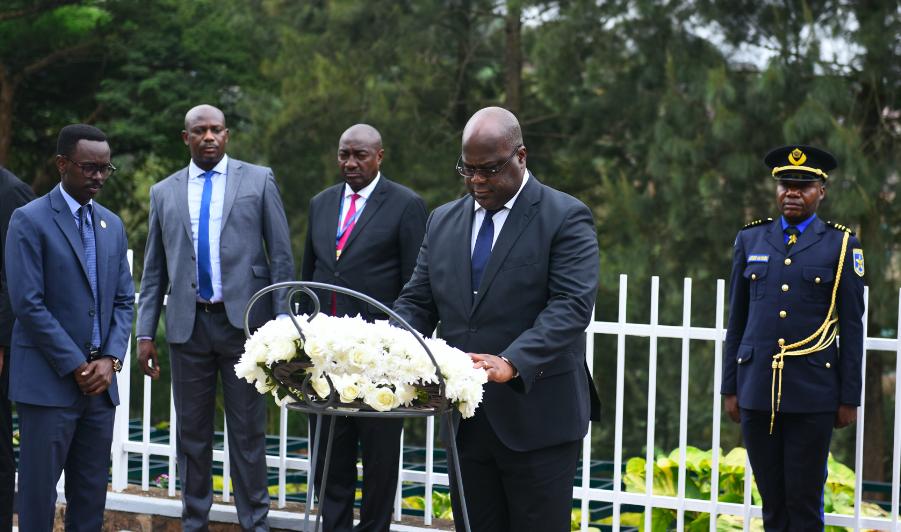
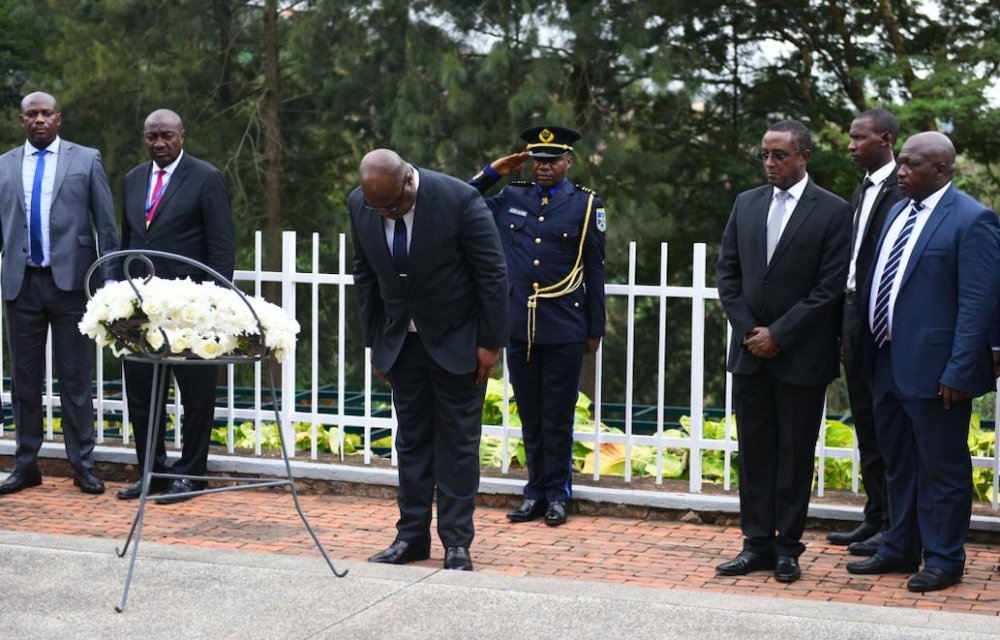
Tshisekedi is in Rwanda since Sunday to attend Africa CEO summit.
He was accompanied by Rwanda’s Minister of Sports and Culture, Esperance
Nyirasafari, the Minister of Environment, Vincent Biruta and the Chief Executive
Secretary of the National Commission for the Fight Against Genocide, Dr Jean
Damascène Bizimana.
Tshisekedi toured different facilities at Gisozi memorial and received explanations of the
history of the 1994 Genocide Against Tutsi.
He laid a wreath at the memorial and observed a moment of silence in honor of
genocide victims.
Tshisekedi comes to Rwanda for the first time since he took office as DRC president in
January 2019.
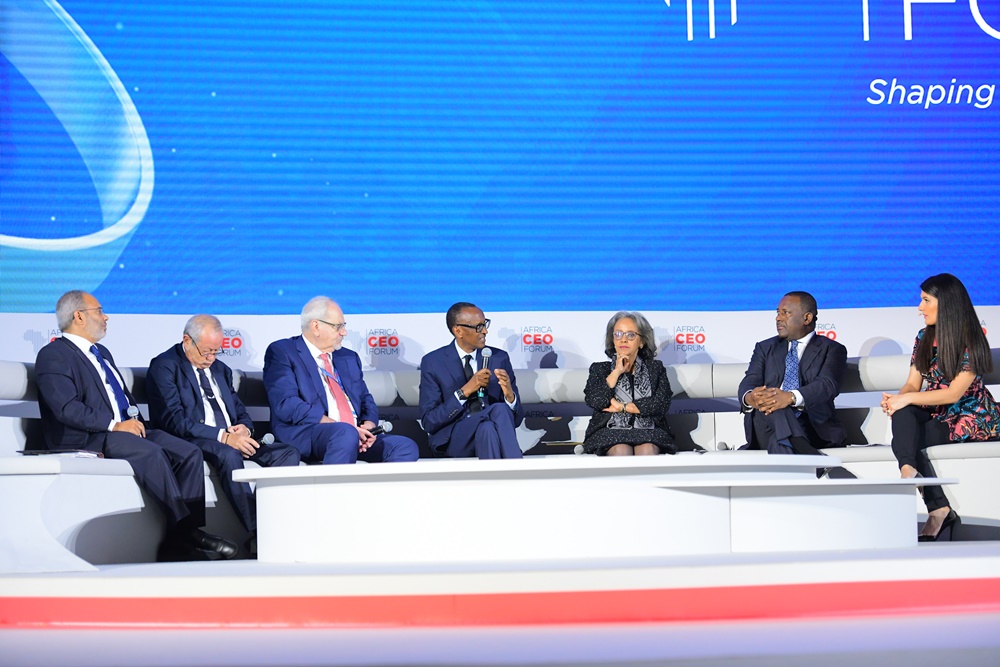
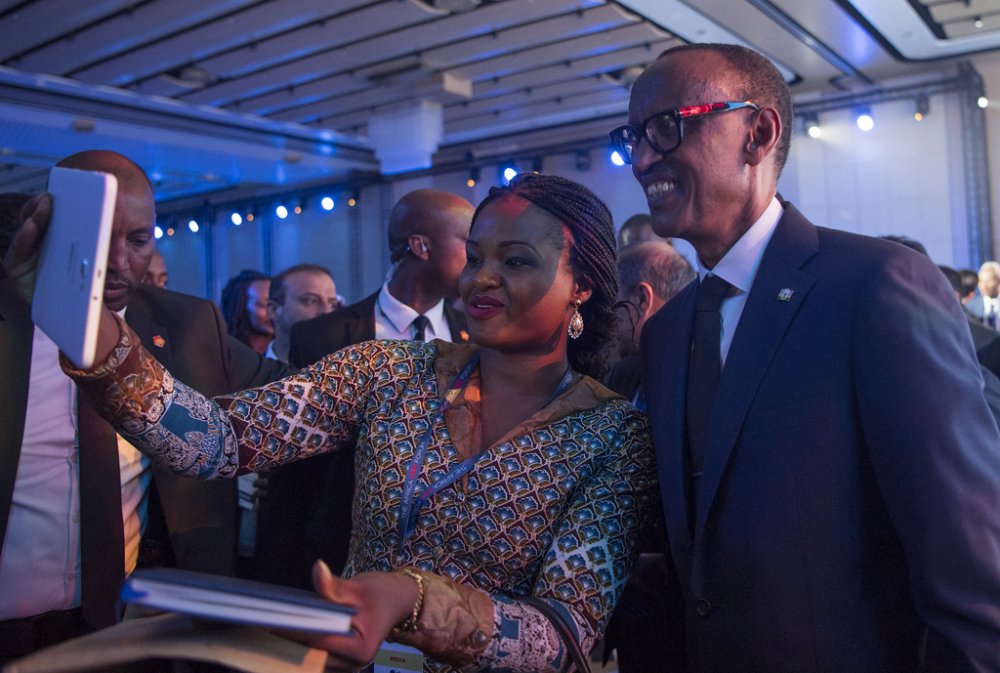
Kagame made the remarks today as he opened the 7th edition of the Africa CEO Forum, a two-day forum, held at Kigali Convention Center bringing together four Heads of States, ministers and over 200 CEOs from across Africa.
Other Presidents at the Forum include DR Congo’s President Felix Antoine Tshisekedi, Togolese President Faure Gnassingbé and Ethiopian President Sahle-Work Zewde.
Kagame said Africa is on the right track of its unity after 44 African countries last year signed the African Continental Trade Area agreement that needs only one more ratification to come into force.
“One year ago, in this very room, 44 countries signed on to the African Continental Free Trade Area, and more have done so since. Just as importantly, the Protocol on the Free Movement of Persons was also adopted. The Continental Free Trade Area is on the cusp of coming into force. I understand that only one more ratification is needed. However, as we all know, this is where the hard work begins. So it is very timely, for us to gather here today, to discuss how to make the most out of this historic agreement, among other important issues. We only reached this point, because Africa came together with a strong unity of purpose, that is rooted in the rising aspirations of our young people, for a better future. That same spirit should drive us forward to success.”
“Whatever we try to do, even in terms of economic development, the result comes back to the politics surrounding it. If the politics is bad, everything else is bad. That is why open, responsive, and accountable governance is so critical,” Kagame said.
President Kagame highlighted the urgent need of change in the private sector.
“No one should be satisfied with business as usual. This is the right time for private sector leaders to reflect on what needs to be changed and improved on their end, as well. So that we have a situation where the private sector and the public sector will challenge and push each other to make more than progress,” he explained.
The United Nations projects that Africa will have the biggest workforce by 2050 with 1.1 billion working-age population, which Kagame said calls for hard work so that the statistic becomes no burden to Africa itself and the world in general.
“We don’t have any time to waste to do what is necessary, so that this statistic becomes Africa’s greatest asset, rather than a burden for our continent and the world. It is our responsibility to ensure that deeper integration translates into prosperity and well-being for Africa’s people,” he said.
“Overall, what we need is much more business activity, above all with each other so that we see the emergence of global African firms with continental scope and scale, which champion the interests and ambitions of our people,” he explained adding that “the public and private sectors must work even more closely together, to provide the education and training that will equip Africa’s young workers with the skills to excel in manufacturing, services, and technology.”
The key factor to achieve this, Kagame said, is the ‘mindset’ which he emphasized is not expensive.
“It might be difficult, but we can afford to effect it. Mindset has no price, yet nothing has greater value,” Kagame said.
The President of the Africa CEO Forum, Amir Ben Yahmed urged the African business community to work with commitment to help Africa reach the development others have attained. He said it is time for business people to seize opportunities offered by the AfCFTA.
“Business is like sports, it is a competition. Companies, countries and continents compete; but everywhere, setting targets, commitment and hardworking are key to success,” he said.
It is projected that projects worth US$1 billion will be financed during the 7th edition of Africa CEO Forum.
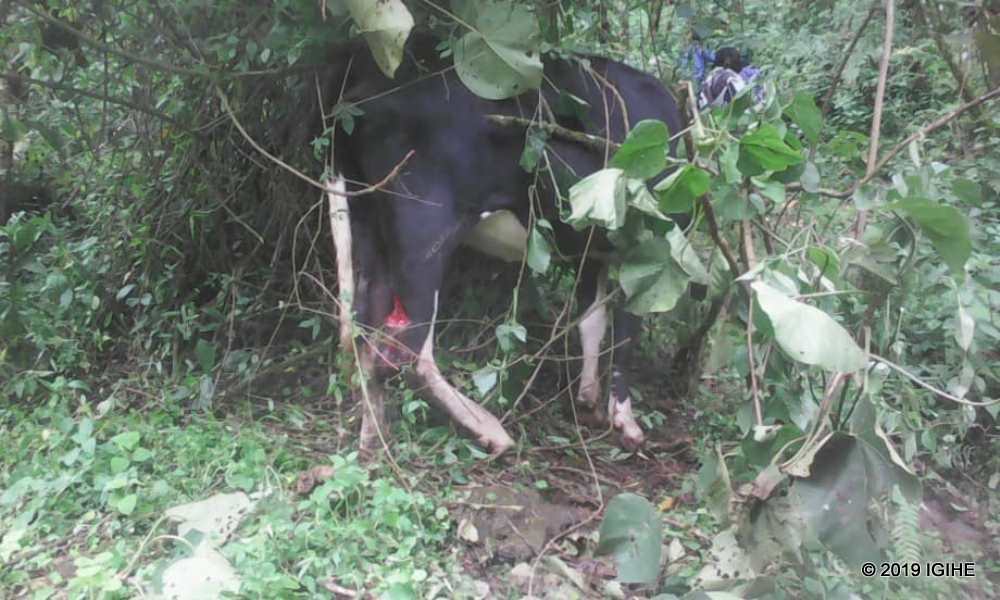
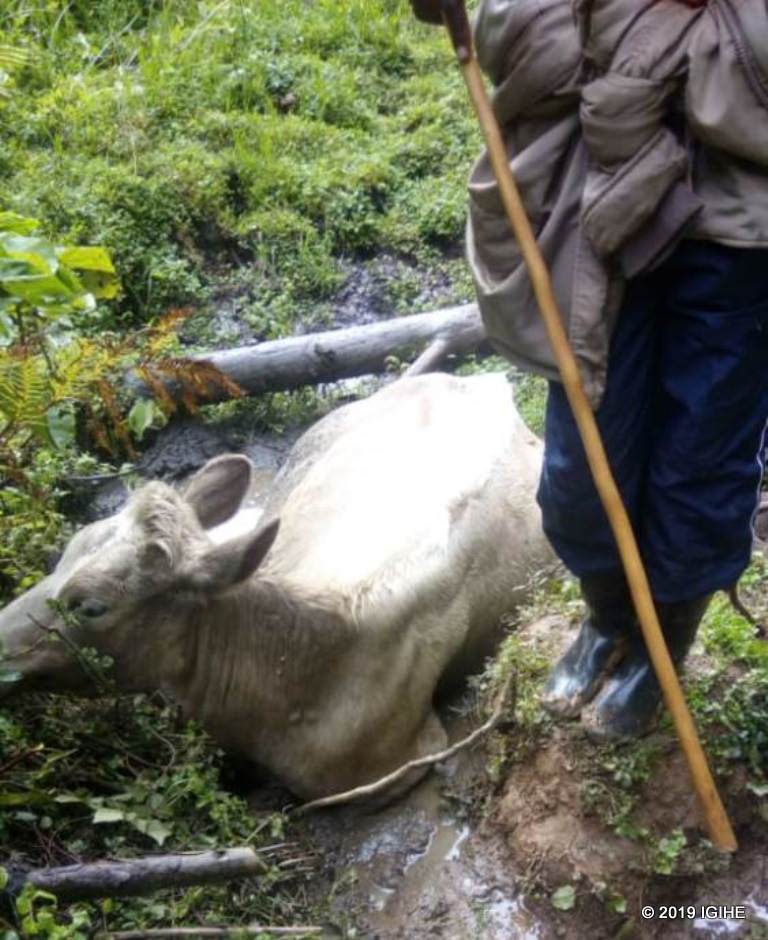
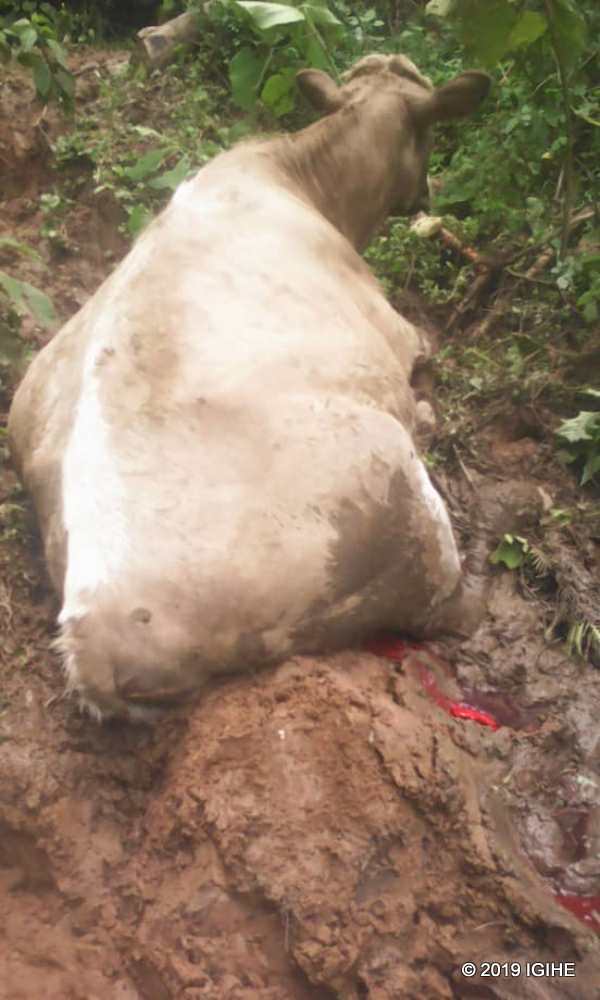
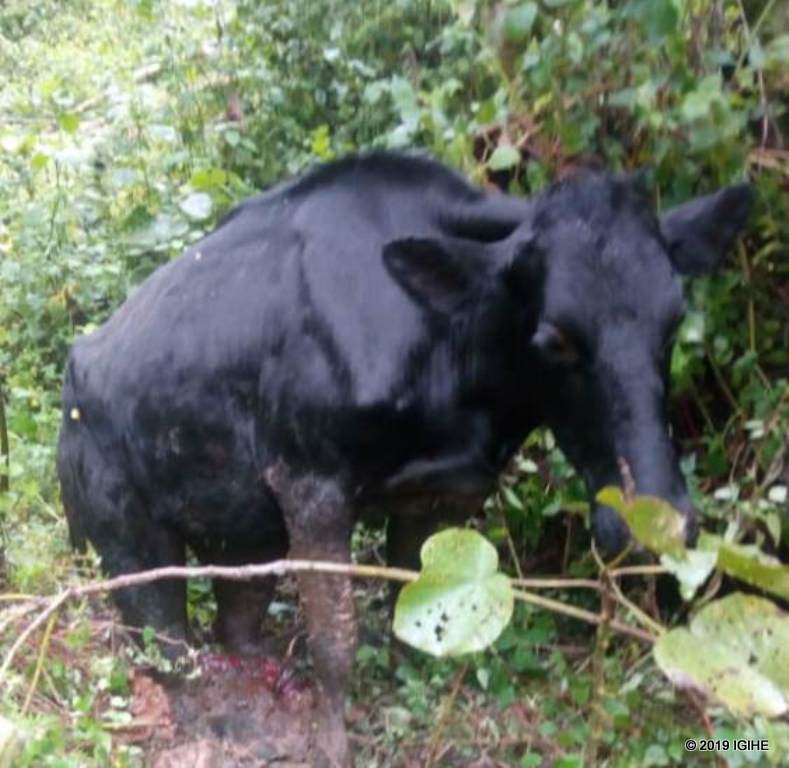
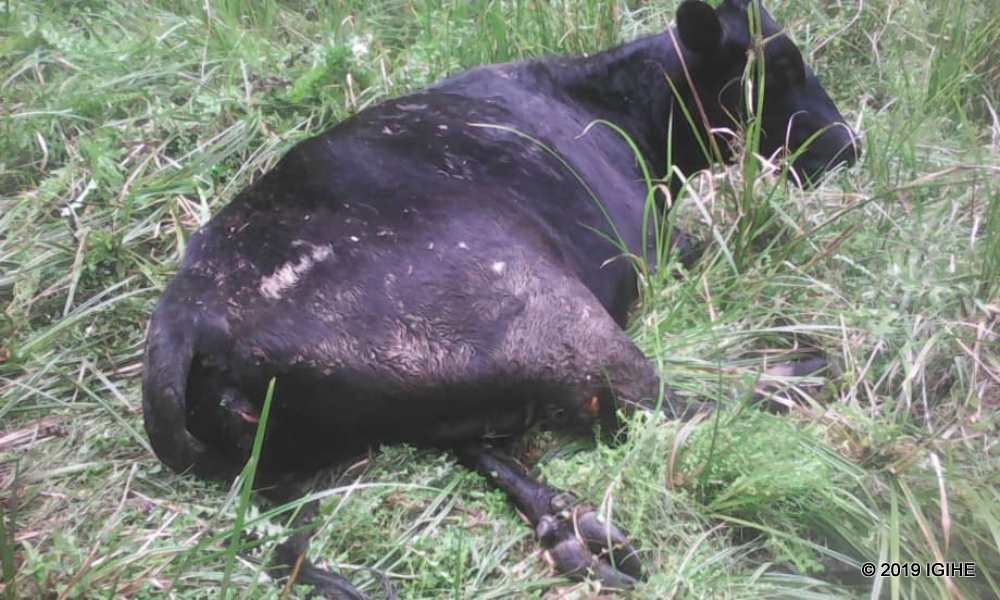
The gruesome act happened in the night of Sunday February 24th at around 9PM after Mr. Ndabarinze left his cattle in the farm last evening.
Ndabarinze was shocked on Monday after he woke up and found his cows severely cut with machetes.
The Spokesperson of the Rwanda Investigation Bureau (RIB), Modeste Mbabazi told IGIHE the investigation is underway to catch all those who might have had a role in the attack that left the cows severely injured.
“No suspect has been yet arrested. Some neighbors and cow keepers are suspected. The investigation has started to identify the criminals and will be brought before justice,” Modeste Mbabazi said.
Ndabarinze, a resident of Gakamba Village, Mulinga Cell of Mulinga Sector in Nyabihu District is a survivor of the 1994 genocide against the Tutsi but it has not yet been established if acts done on his cattle relate to the genocide ideology.
The incident took place yesterday as police officers with the delegation assessing churches meeting standards established that Amazing Grace Church based in Rubilizi reopened without approval.
The crackdown followed complaints from residents of Kanombe sector of Kicukiro district who expressed concern over noise pollution from the closed church that reopened recently.
Talking to IGIHE, the police spokesperson in Kigali city, CIP Marie Goretti confirmed the arrest.
“He was asked about who licensed the reopening, but, instead, tried to strangle the police officer. He was arrested for confronting security officials and held at Kanombe police station,” she said.
She advised church owners to notify concerned parties in case they feel that standards are met before reopening.
The decision to shut down churches failing to meet minimum standards went into effect at the end of February last year and left 714 churches closed at the outset.
Lack of toilets, operating in residential houses, lacking parking, operating between residential houses were among reasons for closure for the said churches.
AERG is a body that brings together genocide survivors studying in university and secondary schools.
The project was revealed on Saturday as AERG marked 22 years in Huye district.
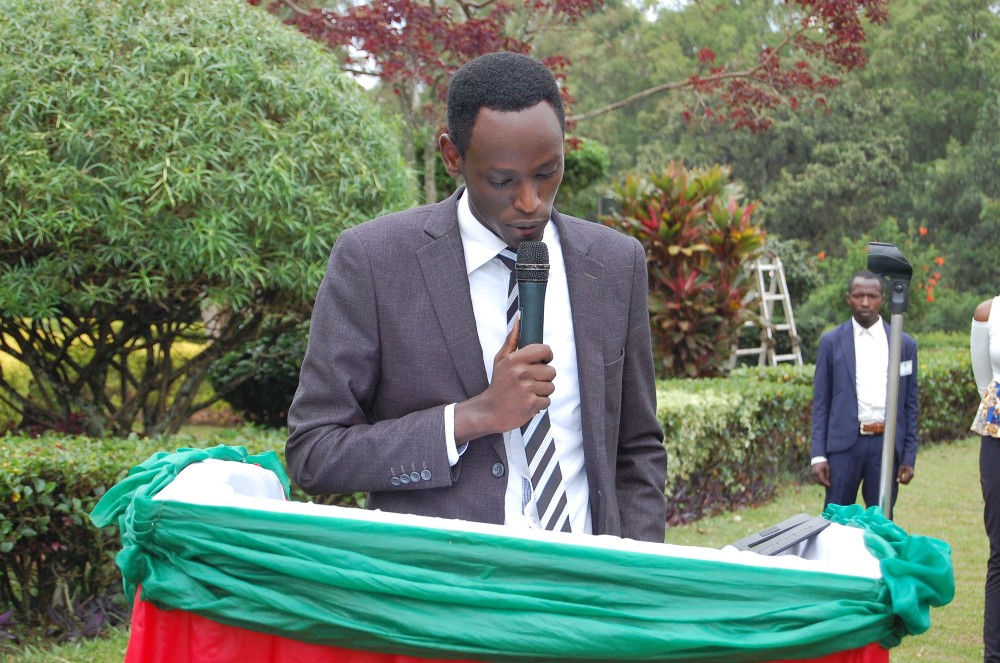
The coordinator of AERG-Huye Campus, Josué Niyomutabazi explained that the project will have been polished after the 100 days of 25th commemoration of the 1994 Genocide Against Tutsi.
“We want to make the project smart that execution can start with immediate effect. We will focus on AERG history and its resilience process,” he said.
“As the youth that survived genocide, we have a role to play providing explanations via social and mainstream media platforms,” added Niyomutabazi.
The museum will be based at the University of Rwanda Huye Campus where AERG was born on 20th October 1996.
It will feature three rooms where the first will be dedicated for advisory services, helping those experiencing trauma, the second will be reserved for written pieces, books, pictures and documentary films on history and activities of AERG. The third section of the museum will be equipped with computers connected to internet where AERG members will get training on technology and providing the truth about Rwanda’s history with the aim of addressing denial and trivialization of the 1994 Genocide Against the Tutsi.
Clarisse Mbuguje, one of the members, said that playing an active role in sharing information about the genocide through the media will be a milestone towards building the desired Rwanda.
Senator Gertrude Kazarwa who attended the event commended the project and reminded the youth on patriotism.
“The country was liberated by the youth and we are now in a secure country. Concentrate on your studies, remain patriotic and maintain the country’s security,” she said.
The suspect was arrested in Kinihira Sector of Rulindo District on his way from Miyove Sector in Gicumbi according to CIP Alex Rugigana, the Police Spokesperson for the Northern Region, who said he was arrested following information shared with Police by his neighbors.
“He owns a boutique where he sells different commodities. His neighbors reported to Police that he sells cannabis which his clients buy asking tobacco which others think it is the legal one,” CIP Rugigana said.
CIP Rugigaga added that in tracking him, Police were given information that he was on a motorcycle towards Kinihira in Rulindo where he was stopped by Police who searched and found him with 157 pellets which he had put inside his underwear.
The suspect was handed to Rwanda Investigation Bureau (RIB).
CIP Rugigana commended the residents for their cooperation in seizing drugs and urged the public to always report to officials whenever they know where drugs are sold.
As, for drug dealers, CIP Rugigana said, all the tricks they use are known and urged them to stop engaging in the illicit trade.
Article 263 of the penal code says that any person who, unlawfully produces, transforms, transports, stores, gives to another or sells narcotic drugs and psychotropic substances commits an offense.
Upon conviction, he or she is liable to a penalty from seven year to life imprisonment and a fine of more than Rwf20 million and not more than Rwf30 million in regard to severe narcotic drugs.
The Spokesperson of Rwanda Investigation Bureau (RIB), Modeste Mbabazi told IGIHE that China Road and Bridge Cooperation has been complaining over thefts of its tools by unknown people.
This prompted RIB agents to start an investigation that saw the said 10 people arrested.
“Now, 10 people have already been arrested including workers, traders and others who bought those materials. Investigations are underway,” Modeste Mbabazi explained.
Prior information got by RIB says that some employees of the company used to steal the items and sell them claiming them to be left over materials.
Items stolen include spare parts of machines used in construction, vessels among others. RIB has recovered some of the stolen items which were returned to the company.
RIB Spokesperson Mbabazi urged the public to avoid buying items of which origin they don’t know.
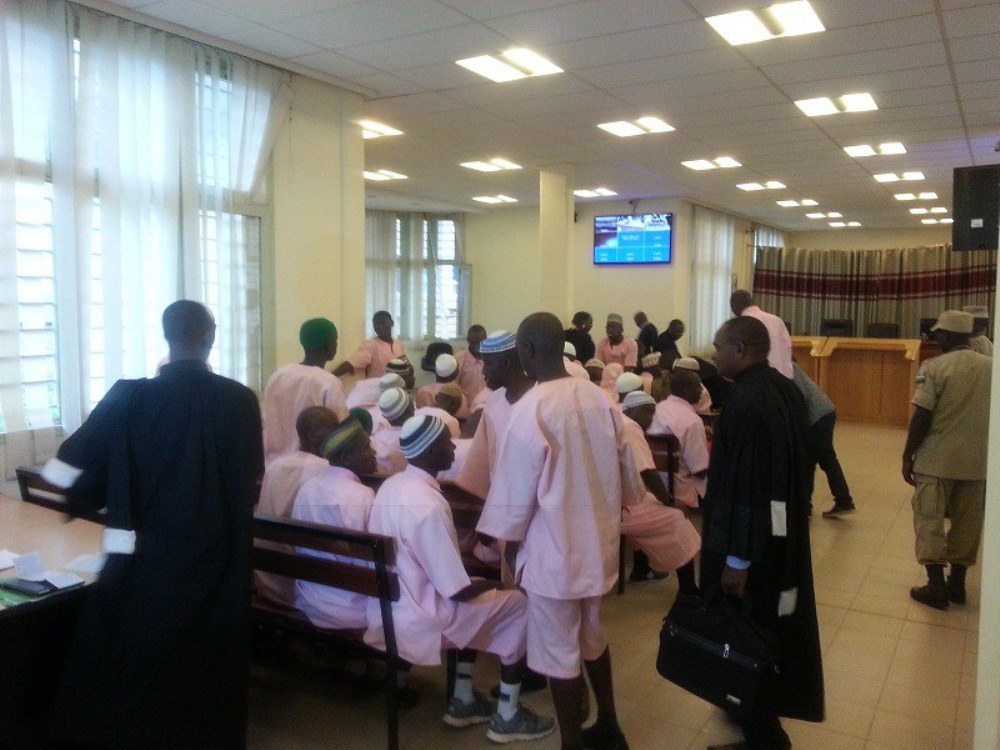
A majority of suspects were youth arrested in 2016 accused of terrorism, crimes, radicalism, treason and inciting the public to engage in terrorism acts and forming radical groups.
The 22 Muslims were acquitted yesterday, 2 sentenced for 10 years , 13 handed a sentence of five years while three others were handed three month’s sentence.
The ruling was scheduled on 28th February 2019 but was adjourned due to a bunch of files that had to be analyzed before the ruling which attracted a large number of suspects.
The remains will be accorded decent burial in different memorial sites of Bugesera district.
Construction activities of Nyamata hospital were on course during the 1994 Genocide Against Tutsi. It is said that there were three holes dug during that time as activities were underway.
The Director of Nyamata hospital, Dr William Rutagengwa has told IGIHE that Interahamwe had set a road block on the main road passing in front of the hospital to kill Tutsi in April 1994 and threw their bodies in those holes.
“We were aware of remains dumped in the premises but could not track the exact location. Construction for Nyamata hospital began in 1992. It was an incomplete building during the genocide. There were bushes in which neighboring residents hid themselves. In front of the hospital was a barricade where Interahamwe killed Tutsi. We had information that people hiding in that place and others killed around were thrown in those holes,” he said.
“The holes were not used since the hospital buildings were completed. The area was enclosed with a fence. There were three holes that we were not sure in which one the remains were. The remains of between 80 and 90 victims have been found and will be buried decently in standard memorial sites in the area,” added Rutagengwa.
The decision to exhume remains of victims from these holes for decent burial was taken during the 24th commemoration of the 1994 Genocide Against the Tutsi.