In a statement, the company with a presence in 10 countries spanning Africa, Europe and the Middle East said the move is aimed at fulfilling its long-time running of democratizing travel and optimizing customer experience for both domestic and international travellers in the East African markets.
Wakanow Group Chief Executive Officer (CEO), Bayo Adedeji affirmed that the new market entries would redefine how business executives, tourists and fun travellers access end-to-end travel services.
“[Wakanow.com->https://wakanow.com/] brings a fresh perspective and industry expertise to delivering travel services that suit the needs of local and international travellers.
“[Wakanow.com->https://wakanow.com/] continues to push the boundaries of travel technology, and our entry into East Africa represents a milestone in our commitment to enhancing travel experiences across the continent. Our online platform will empower East African travellers with a one-stop-shop for all their travel needs”, Adebayo stated.
He further disclosed that the company has invested in technology to optimise customer experience when they book flights, hotels and other services on the website.
“At Wakanow, our unwavering focus on the customer and our relentless drive to innovate on their behalf distinguishes us from the competition. Unlike any other player in the market, we harness technology to its fullest extent, enriching the customer experience with added value”, Adebayo added.
The CEO emphasized that Wakanow’s entry into the East African market also creates a gateway to a multitude of opportunities for both the business and tourism sectors.
He also announced the appointment of Josephine Fifi Rurangwa as the Business Development Manager for the new East Africa market.
Rurangwa, the CEO said, will spearhead initiatives aimed at offering exceptional end-to-end travel deals, including flight booking, visa assistance, hotel reservation, protocol services, airport transfers (Wakanow Ride), and travel insurance.
Rurangwa welcomed the appointment and vowed to leverage her experience to deliver exceptional service to the East African market.
“I am honoured to lead Wakanow’s business development efforts in East Africa. This region holds immense potential, and I am excited to leverage my experience and expertise to ensure that Wakanow becomes the preferred travel partner for individuals and organizations in Rwanda, Tanzania, Kenya, and Uganda,” she stated.
Rurangwa affirmed Wakanow’s commitment to prioritizing customer satisfaction and democratizing travel for Africans through the Pay Small Small (PSS) offering. This program allows customers to spread the cost of their flights overtime on [Wakanow.com->https://wakanow.com/], removing financial obstacles to booking.
“We are actively forging partnerships with local businesses, tour operators, and hospitality establishments, which will not only benefit our customers but also contribute to the local economy and tourism sector,” she added.
The company affirmed that Rurangwa, who has a decade-long career in the travel industry, brings a wealth of experience to her new role.
Prior to the appointment, Rurangwa served at Wakanow as Head of Africa Expansion.
Wakanow has been in existence for the last 16 years and is accredited by the International Air Transport Association (IATA).
As Wakanow ventures into East Africa, the company anticipates achieving new milestones under Rurangwa’s leadership, reinforcing its commitment to excellence, customer satisfaction, and innovation in the region.
Founded in 2008, Wakanow has rapidly grown to become a one-stop platform for travel enthusiasts, offering a comprehensive suite of services including flight bookings, hotel reservations, travel insurance, airport transfers, vacation packages, visa assistance, and more.
Besides Nigeria, Wakanow also operates in a number of other markets including, Ghana, Sierra Leone, Gambia, Liberia, Togo, Cote d’Ivoire, Cameroon, United Arab Emirates (UAE), and the UK.
A feasibility study report unveiled earlier this month identified four Sweet Spots for introducing CBDC in the country, including the need to increase resilience against possible network outages, power failures, and natural disasters; improve innovation and competition; contribute to achieving the cashless economy national initiative over time; and develop faster, cheaper, more transparent, and more inclusive cross-border remittances.
The feasibility study, which began in September 2022, also identified risks related to the adoption of the CBDC by the public, financial providers, and merchants with a high level of concern. To mitigate these risks, the study recommends additional investments in promoting CBDC and education in order to shift existing consumer habits to this new innovative product.
As the consultation process continues, many people are wondering what CBDCs are and how they differ from popular cryptocurrencies like Bitcoin.
In simple language, a CBDC is like digital cash issued by the central bank. It’s similar to regular money we use but in a digital form.
The main difference between CBDC and cryptocurrencies like Bitcoin and Ethereum is that CBDCs are issued and controlled by a country’s central bank, just like physical cash.
On the other hand, cryptocurrencies use a decentralized system for transactions and creating new units.
Because CBDCs are central bank-backed, they are considered a very secure way to hold and transfer money.
If the process to establish the digital currency sails through, Rwanda’s CBDC will be the official digital currency regulated by the National Bank of Rwanda.
“While crypto values change, Rwanda’s CBDC will always match the value of regular money,” BNR explains on its website.
Notably, the CBDC can be like a bank account (account-based) or like digital cash (token-based). Account-based CBDC links ownership to an identity and keeps records with a third party. Token-based CBDC doesn’t need a third party and is like using physical cash.
BNR affirms that CBDC will not replace existing digital payments like cards and electronic payments. However, it may offer new services and more payment options.
The ongoing consultation is aimed at getting public opinion on the Rwanda CBDC. The information will help the central bank understand the technology, regulations, and risks of the new digital money product before its rollout.
Three countries – the Bahamas, Jamaica, and Nigeria – have fully launched CBDCs, while several others are in the piloting stage.
In Nigeria, the eNaira is a central bank digital currency (CBDC) backed by law. It is the digital form of the Naira and is used just like cash.
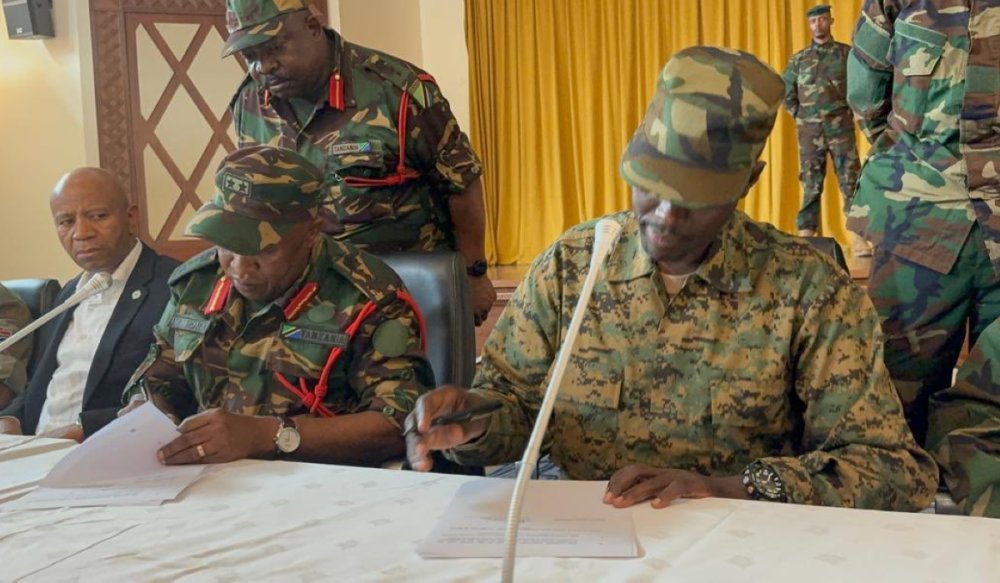
The delegation, led by Brigadier General Gabriel Elias Kwiligwa, arrived in Rwanda on Tuesday and is scheduled to attend the 10th meeting between the Rwanda Defence Forces and TPDF Brigades deployed along the Rwanda-Tanzania borderline.
“The delegation was welcomed by Col Justus Majyambere, Commander 5Div, upon their arrival at Rusumo One Stop Border Post. They proceeded to visit the Kibare Market in the Ndego sector of Kayonza district, an active hub where Tanzanians from Karagwe district frequently engage in trade,” RDF stated in a statement.
The quarterly security meeting will be held in Nyagatare, Eastern Province, and will be preceded by visits to some border areas in Kirehe and Kayonza districts, as well as Akagera National Park.
During the meeting, the forces are expected to deliberate on key issues, including sharing intelligence and information about the border, cross-border crimes, and security issues affecting communities living at the border points.
A similar meeting between Rwanda and Uganda authorities was held in the Eastern Province on Monday, during which the two governments pledged to renew their pledges to enhance cross-border cooperation.
The delegations were led by Clementine Mukeka, the Permanent Secretary of the Ministry of Foreign Affairs and International Cooperation in Rwanda, and Ambassador Julius Kivuna, Head of the Regional Peace and Security Department at the Ministry of Foreign Affairs of Uganda.
“Excited to host the 2nd Rwanda-Uganda Cross Border Security Meeting in Nyagatare! Our shared commitment to peace and prosperity is evident in the high-level attendance from both nations. Let’s work together to build a secure environment and promote sustainable development across our borders,” PS Mukeka said.
Ambassador Kivuna said the meeting provided the delegations with an opportunity to reflect on the progress made by the two countries since the last security meeting held in Butale, Uganda, where they discussed key aspects such as immigration, trade and customs, health, security, and mapping and demarcation of the borders.
“I am proud to report that Uganda has made significant strides in implementing the agreements and frameworks that we discussed in our previous meeting,” Kivuna stated.
“Our commitment to collaboration and cooperation with our Rwandan counterparts has only strengthened, and I am confident that our partnership will flourish in the years to come,” he added.
The officials first met in Kabale, Uganda, in December last year for high-level security deliberations following the reopening of the Gatuna-Katuna border post in January 2022.
Born in Uganda in 1977, the 47-year-old Rwandan grew up in Uganda when the National Resistance Army (NRA) prepared to topple Milton Obote’s administration.
Speaking during a recent interview on Sanny Ntayombya’s podcast ‘Long Form’, Habineza disclosed that he spent most of his childhood hiding alongside his family due to the political instability in the country at the time.
“I was born when there was war in Uganda. There were NRM rebels fighting Obote government and my region was called the Royal Triangle where the war taking place there. We used to see soldiers coming and taking our cows and we used to run,” he said, adding, “It was a sad moment but finally the war ended.”
Besides the political instability, Habineza also revealed that he and other Rwandan children had to endure constant bullying from local kids in the foreign land.
“It was a very difficult time to be in Uganda. We used to be beaten by other Ugandan kids who used to call us Banyarwanda as if Banyarwanda was a crime. I had this name of Habineza which couldn’t be hidden. Sometimes I felt like I was going to hide my name because every time they would call me Kanyarwanda,” he revealed.
“We used to fetch water from some piped water which would come from some springs in the mountains. So they find you there putting a jerrican there they hit you in the head. I could cry I say what is Munyarwanda. I go back crying. I knew that Munyarwanda was a crime. At first, I thought it was an abuse then I let it was a crime and then I said why don’t I change my name? They could tune my name and turn it into abusive words.”
He changed his name four times. First, he called himself Mugisha but faced opposition from his father. He later called himself Frasco, then Francis, and finally settled on Frank.
“I think Frank was more modern because we had some Congolese musicians like Franco,” he remarked.
When normalcy resumed in Uganda after the coup that saw President Yoweri Museveni of the National Resistance Movement (NRM) assume power, he was able to resume school, but sadly, he was forced to deal with the pain of losing his mother at an early age.
“It was a difficult process, and my mother died in between when I was in Primary 4. So that was a very difficult episode. We were three kids, so my father had a responsibility of taking care of us: three kids, one boy, and two girls. It was very difficult,” he said.
The challenging times forced him to get involved in activities of the Rwandan Patriotic Front (RPF) which was then preparing to liberate Rwanda in 1990. He was still in primary school.
“We used to attend youth meetings. The meetings were not public; we used to have them in the bushes. They also used to teach us Kinyarwanda dance. It was good,” he revealed.
In 1994 after the RPF took control of Rwanda following the 100 days of the Genocide against the Tutsi he was among Rwandans who returned home. They settled in Kayonza District in the Eastern Province.
“I was here in early October of 1994. We came in a big truck. The trucks that carry coffee,” he said.
However, he could not stay for long as schools were yet to reopen and he had to go back to Uganda to resume his high school studies.
“In March 1995, I had to go back to Uganda. I had left when I was in Form Three, and by the time I was leaving, schools were yet to reopen in Rwanda. I realized I could not find a job because as a Senior Three graduate, you don’t have a diploma or any certificate. There was also pressure to enrol us in either the army or local defence force. I realized going to the army when you don’t have even an O-level certificate would be a waste of much time here because you wouldn’t be much useful,” Habineza noted.
Back in Uganda, he benefitted from the foster care of renowned Ugandan writer John Nagenda’s family, where he developed a passion for politics and media. He was also a member of the Scouts Club, Wild Life Club and Chairman of the Red Cross Club.
“I had a lot of exposure there seeing newspapers every time watching TV and reading newspapers.”
It was while at high school that he thought of forming a political party to oppose Museveni’s government. He was about 17 years old.
But as fate would have it, he opted to join the National University of Rwanda in Butare, now the University of Rwanda, for his undergraduate studies after high school in 1999.
“When I went to Butare, knowing the history of the genocide in Rwanda, I thought, ‘What can I contribute in Rwanda?’ I said I would put much effort into environmental protection. I also had a passion for media, inspired by my uncle who used to have a column in the New Vision.
“When I came, I got accepted in the New Times. But I wrote like three, four articles, and none of my articles was published. When I went to Butare, they made me a correspondent for the News Line. I wrote for Rwanda News Line, Umuseso, and later the Rwanda Herald, and stopped in 2003.”
It’s while at Butare that he revived his idea of forming a political party in 2002.
“My love for the environment and the media pushed me into having another image of Rwanda. Seeing of what I wished new Rwanda to be. Later on that is when I decided to start a political party,” he added.
The path to starting a new party was, however, not smooth, as he was forced to shelve the idea after advice from government officials who thought he was not ready to run a party in just the second year of university.
“The officials heard me and said, ‘But you are still a young man and you have not finished university. I think I was in the second year then. You don’t even have money. Political parties are not a small thing. It requires money, it requires commitment.’ They also told me, ‘Maybe you are not seeing what is happening in the country. You see, there are these parties like MDR; they are having divisions, they are breaking up. But maybe when you start a new party, some people may misunderstand you and confuse you, or maybe you can become a new home for those people and they may bring trouble to you.’
“So they said, ‘Maybe it’s not a good time to start a new party as a young person.’ I thought the advice they gave me was genuine. I went and told my colleagues that this is the advice I got from the people in Kigali. They think that this is a wrong time for us. It’s too risky,” he revealed.
In 2005 he graduated from the university and was immediately appointed as a personal assistant to the minister of environment, forestry, water and mines.
When the minister was dropped from the Cabinet in 2006, he joined the National Coordinator for the Nile Basin Discourse Forum in Rwanda (NBDF), a civil society platform that had over 50 NGOs involved in the conservation of river Nile.
In 2007, he officially quit RPF and opted to form the Democratic Green Movement of Rwanda Party to oppose the government of the day. After six unsuccessful attempts, his party was finally registered in 2010.
He cited the decision to break ranks with President Paul Kagame’s RPF due to ideological differences, although he remained tight-lipped on details about his presidential manifesto and what he would do differently if elected president. He noted that it would be revealed at a later date, once sanctioned by the party delegates.
With two seats in parliament and one in the Senate, the MP insists that he is determined to run a non-violent opposition in the country.
He dismissed other opposition leaders, including former coalition member Victoire Ingabire Umuhoza, for lacking the best interest of the country and promoting violent opposition ideologies.
“These people, when you say you want nonviolence, they don’t believe in nonviolence, most of them. They would want you to fight. There is a connotation from East Africa where people see opposition fighting here and there, causing trouble, breaking windows, destabilizing everything. So when we say no, we don’t want to do that. Although I was born in Uganda, I don’t want to copy and paste what I see happening in Uganda to here. We have seen a lot of violence in Rwanda, we have the Genocide against the Tutsi. I was not even born here because of those problems from before,” he stated.
“We want something different to do opposition politics, but not like the ones in Uganda or Kenya. But another one where the people of Rwanda will feel safe with you. I have been in a situation where people felt unsafe with me. They said, ‘When you join Franc’s party, you will have trouble and will be put in prison.’ This is what I feel is a better thing than now. People are comfortable being in the Democratic Green Party of Rwanda. People can see a future in the party, people can contribute to the state of the party. We have different ideas and we show them, and we are not killed because we have opposed the government.”
The Head of State argued that nation-building is a collaborative effort and challenged the young people to use their skills to improve their lives and communities.
“There is no one person who can work alone in their own way to develop our people or our country. There is no single person who can do everything alone to benefit other people if they don’t work together,” President Kagame stated.
“This country is not for individuals or a specific group. It is for all of us. When we put our efforts together, when we work together, we are striving for the development of our nation and our collective development as a people.”
He was speaking at BK Arena in Kigali, where more than 7,500 youth volunteers gathered to celebrate their contributions to Rwanda’s development.
Acknowledging the youth volunteers’ sacrifices, Kagame noted that the young people played a key role in the government’s efforts to fight the COVID-19 pandemic.
“The fact that you accepted to sacrifice yourself, it’s just a reminder of our existing tradition of self-sacrifice. You demonstrated that during Covid-19, as youth volunteers, and it helped a lot in our fight against that pandemic. We would not have succeeded in our fight against COVID-19 without the important role you played,” he added.
He challenged the youths to keep up the volunteering spirit and work to better their skills every day.
“Where you have to put a lot of effort, where it all begins, the foundation of it all, is in building yourselves as individuals, each one of you. Build yourselves, and keep on that volunteerism spirit. Your willingness alone is not enough, you have to build your capabilities and equip yourself with skills so that you can put into practice everything you are willing to do,” the president told the volunteers.
Abdallah Utumatwishima, the Minister of Youth and Arts, also lauded the youths for their selfless efforts that helped the country navigate the challenging COVID-19 times.
“In the journey of 10 years, the world was shocked by the Covid-19 pandemic followed by disasters brought about by climate change that claimed the lives of many people. We are grateful for youth volunteers’ contributions through physical and mental work shown as we navigated the challenges,” Utumatwishima lauded the volunteers.
The volunteers, who attended the event, are among thousands of young people motivated to serve their communities in various parts of the country.
Most of the youth are involved in various development activities, including building houses, taking care of vulnerable members of society, and raising awareness about emerging public health issues.
Media reports indicate that the 82-year-old passed away in his living room while watching a movie with his grandchildren on Tuesday, April 16, 2024, as heavy rains pounded the United Arab Emirates, leading to flash floods in the desert region.
A close associate intimated to the media that on the day the chairman of Pan African Tobacco met his death, he had woken up as usual to go about his work, but he seemed concerned about the harsh weather.
He is quoted to have told his friends that he had not seen such heavy winds and storms in the UAE in the last decade.
“Nevertheless, the chairman worked throughout the day,” a close associate of the billionaire intimated.
While the octogenarian appeared to be physically okay, the associate noted, he was emotionally weak, as he was yet to fully recover from the death of his wife.
Despite the harsh weather, Ayabatwa is said to have insisted on going swimming as part of his routine cardiovascular exercise.
“The weather is really bad,” a family member told Ayabatwa, “Let’s wait for the weather to clear.”
The family managed to convince him to stay indoors at least until the weather improved. To pass time, he suggested watching TV.
A few moments later, he asked one of his grandchildren to get him a remote control. That was the last time they heard his voice as shortly after he became unresponsive.
The distraught kids rushed to inform their parents about what had happened. The parents called for emergency health services, and the old man was confirmed dead.
A postmortem conducted at one of the hospitals in Dubai confirmed that the billionaire had died of a heart attack.
Rujugiro was born in Rwanda around 1941 and started his vast tobacco business in 1978 in Burundi, where he was a refugee.
He had business interests in several other countries including Angola, DR Congo, Nigeria, South Sudan, Tanzania, and Uganda.
Rujugiro was last in Rwanda in 2010, after which it was revealed that he fled to South Africa, a country where he had been running business.
This move came following discoveries that he was allegedly involved in tax evasion and had connections with subversive groups aiming to destabilize Rwanda’s security, whom he also supported financially.
In a press statement released Monday night, KQ said the detained staffers had been unconditionally freed after more than two weeks in the custody of the Military Intelligence Unit.
“Kenya Airways confirms that military authorities in Kinshasa have unconditionally released our two employees who had been detained since 19 April 2024,” Group Managing Director and CEO Allan Kilavuka said.
“We wish to thank all those who worked tirelessly for the release of our innocent colleagues. Special thanks to KQ colleagues who have been on the ground in Kinshasa and those in Nairobi working to secure their release,” he added.
The CEO confirmed that KQ’s flights to Kinshasa, which were suspended on April 30 in protest of the arrest and detention of the two employees, will resume on Wednesday, May 8, 2024.
“With the necessary ground support in place, we are pleased to announce that Kenya Airways will resume flights to Kinshasa on 8 May 2024. We look forward to serving our valued customers once again,” the CEO confirmed.
KQ had earlier announced that the affected members of staff were arrested at the airline’s airport office in Kinshasa over missing customs documentation on valuable cargo that was to be transported on a KQ flight.
Kilavuka lamented that attempts to secure the release of the staffers had proved futile due to the continued disregard of court orders by the local authorities.
The CEO denied any wrongdoing on the part of the airline and staffers, insisting that the cargo under question had not been cleared to be airlifted.
Kilavuka said on Monday that the release of the two employees was made possible by efforts from the Kenyan government led by Prime Cabinet Secretary Musalia Mudavadi, who also doubles up as Foreign Affairs Cabinet Secretary, and the Kenyan embassy in Kinshasa.
“We want to reiterate that our employees are innocent and were only carrying out their duties in strict adherence to the laid-out procedures. We stand by their innocence and will continue to support them,” Kilavuka stated.
Speaking during the second Rwanda-Uganda cross-border meeting held in Nyagatare district, Eastern Province, on Monday, delegations from both countries affirmed their unwavering commitment to address border security bottlenecks and enhance trade between the two neighboring nations.
The delegations were led by Clementine Mukeka, the Permanent Secretary of the Ministry of Foreign Affairs and International Cooperation in Rwanda, and Ambassador Julius Kivuna, Head of the Regional Peace and Security Department at the Ministry of Foreign Affairs of Uganda.
“Excited to host the 2nd Rwanda-Uganda Cross Border Security Meeting in Nyagatare! Our shared commitment to peace and prosperity is evident in the high-level attendance from both nations. Let’s work together to build a secure environment and promote sustainable development across our borders,” PS Mukeka said.
Ambassador Kivuna said the meeting provided the delegations with an opportunity to reflect on the progress made by the two countries since the last security meeting held in Butale, Uganda, where they discussed key aspects such as immigration, trade and customs, health, security, and mapping and demarcation of the borders.
“I am proud to report that Uganda has made significant strides in implementing the agreements and frameworks that we discussed in our previous meeting,” Kivuna stated.
“Our commitment to collaboration and cooperation with our Rwandan counterparts has only strengthened, and I am confident that our partnership will flourish in the years to come,” he added.
The ambassador also noted that the second cross-border meeting provides the two countries with an opportunity to address any emerging challenges and chart a course for even greater cooperation in the future.
“On behalf of the Ugandan government, the Ugandan delegation, and on my own behalf, I pledge our unwavering commitment to enhancing cross-border cooperation with Rwanda. Together, I believe, we can create a safer and more prosperous future for our citizens on both sides of the border,” the ambassador affirmed.
The officials first met in Kabale in December last year for high-level security deliberations following the reopening of the Gatuna-Katuna border post in January 2022.
In a press statement on Monday, May 6, 2024, Jasiri Growth Accelerator (JGA) said the program targets early-stage innovative startups in Rwanda and Kenya.
The program is aimed at derisking promising startups and preparing them for funding by focusing on business concept refinement, commercialization, and growth.
To qualify for onboarding on the program, the startups must show potential for high growth and evidence of traction in serving – a large, unserved, or under-served market.
“In the third cohort of the Jasiri Growth Accelerator, we are excited to invite early-stage startups with potential for scale to apply. We are seeking ventures led by ambitious, dedicated, and impact-driven co-founding teams. Our commitment through the JGA is to work alongside the founding teams to support the achievement of their growth objectives while preparing them for further investment,” Aline Kabanda, East Africa Regional Director, Allan & Gill Gray Philanthropies Rwanda, said during the launch of the program.
Selected startups will receive $75,000 in funding to support their growth. This includes a tailored split between direct funding towards working capital and funded strategic advisory to address key development areas and growth priorities.
The program will run predominantly virtually for ten months, providing flexibility, with occasional in-person attendance required for specific sessions.
The application period is scheduled to close on May 31, 2024.
Interested startups can apply to join the program using the link:[ jasiri.org/jasiri-growth-accelerator->https://jasiri.org/jasiri-growth-accelerator/]
The Rwanda Defence Forces (RDF) revealed on Sunday, May 5, 2024, that the joint security team had managed to smoke out and kill a majority of the Al-Shabaab terrorists hiding in Odinepa, Nasua, Mitaka, and Manika forests during a one-week operation that started on April 26.
During the operation, only a few insurgents are reported to have escaped the military onslaught.
“From 26 April to 3rd May 2024, a joint operation of Mozambique army and Rwanda security forces was conducted against Al-Shabaab terrorist insurgents in their hideouts in the dense forests of Odinepa, Nasua, Mitaka & Manika, Eráti district, Nampula Province, Mozambique,” RDF stated, adding, “Only a few insurgents managed to escape via the Lúrio river.”
The Al-Shabaab insurgency began in October 2017 in Cabo Delgado province, northern Mozambique.
The group, known locally as Ansar al-Sunna wa Jamma (ASWJ), is distinct from the Somali group of the same name, but both believe in global jihad.
The insurgency began with the group expressing discontent over lack of economic benefits from natural gas in the region, allegations of government corruption and marginalization of local communities.
However, over the years that followed the rebellion escalated with the militia employing violent tactics, including attacks on civilians and security forces and destruction of property.
The Mozambique government struggled to contain the militia forcing it to seek military help from Rwanda and the Southern African Development Community (SADC).
Rwanda deployed its forces in 2021. In February 2022, RDF announced that the security forces had captured new terrorist hideouts in Nhica do Ruvuma and Pundanhar general areas west of Palma District.
At the time, the terrorists fled the new positions towards Muidube District inside the SADC Mission in Mozambique (SAMIM) designated sectors of responsibility.
RDF confirmed that the terrorists were seriously weakened by the joint forces’ actions but cautioned the residents to remain vigilant at all times.