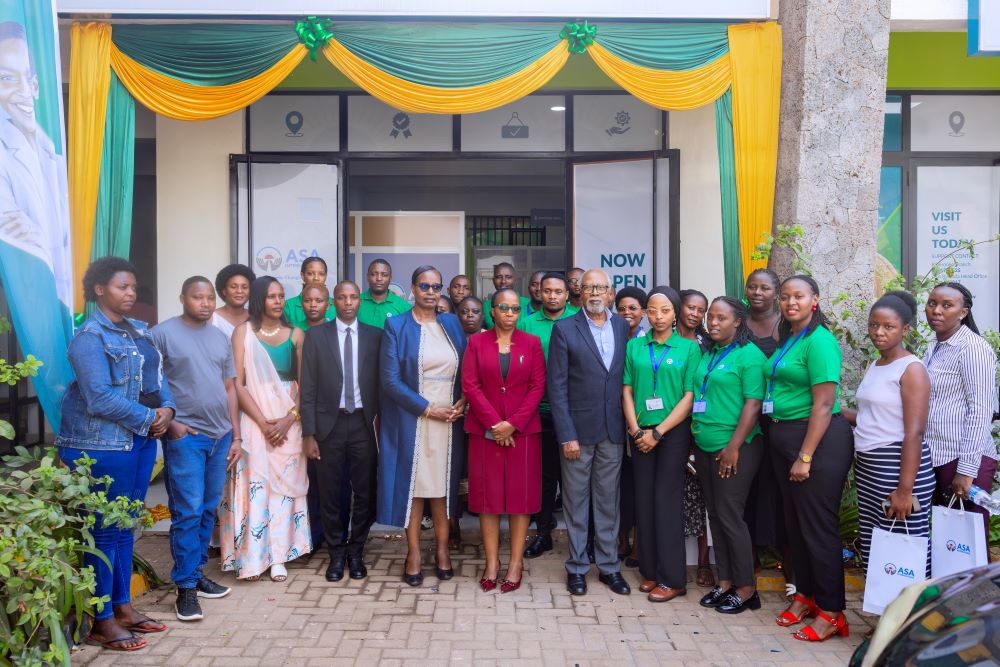
The visit, which took place at the Gisozi memorial site, provided the employees with an in-depth understanding of the history of the Genocide against the Tutsi from its planning and execution to its cessation and the nation’s journey of recovery and rebuilding.
Andy, the General Manager of Hunan Road & Bridge, expressed his admiration for the resilience and strength of the Rwandan people, noting that the experience at the memorial was deeply moving.
“As we work in Rwanda, we are part of this memory. Understanding the country’s history is essential. What we witnessed here demonstrates the strength and love Rwandans have for their nation. They were the ones who stood by each other during the most difficult times,” he stated.
Wang Jing, the Human Resources Manager at Hunan Road & Bridge, emphasised the importance of advocating for peace and ensuring that such tragic events are never repeated. He called on those who deny or downplay the genocide to visit the memorial and witness the reality of what happened.
“Denying what you haven’t seen is not the right approach. Those who question or deny the events of the past should come and see the truth, as we have. People, including children and women, lost their lives. Let them see the reality of what occurred,” Wang Jing remarked.
Hunan Road & Bridge is currently involved in the construction of the Prince House Masaka Road, a key infrastructure project that began in February 2026. The 10.3-kilometre road will consist of four lanes, expanding from the previous two-lane design to accommodate increased traffic and improve flow.
To ease congestion, an overhead section will be constructed, covering a distance of 1.3 kilometres. This section will connect the Prince House area in Remera to the Mutzig intersection in the Gasabo District. It will provide direct access to roads leading to Kigali International Airport and the Masaka region.
The new road design will include four lanes, two on the ground and two overhead, each with two directional lanes.
Additionally, the project includes a nine-kilometre stretch of road with four lanes, two in each direction, extending from Mutzig to Masaka Hospital.
The overall cost of expanding this road is projected to exceed 86 billion Rwandan francs upon completion.
Employees of Hunan Road & Bridges place wreaths on the graves of over 250,000 Tutsi victims killed in different parts of Kigali during the 1994 genocide.Employees of Hunan Road & Bridges pay their respects to Tutsi victims at the Kigali Genocide Memorial.Employees of Hunan Road & Bridges were educated on the history of the Genocide against the Tutsi, from its preparation and execution to the post-genocide journey of rebuilding.Employees of Hunan Road & Bridges at the Kigali Genocide Memorial.The Human Resources manager at Hunan Road & Bridges, Wang Jing, stated that genocide deniers should visit the Kigali Genocide Memorial to witness the history firsthand.
Facing rising fuel prices driven by international disruptions in oil supply, President Samia directed that government institutions immediately cut down on fuel use and unnecessary travel. At a ceremony for newly appointed officials in Dodoma, she said the government must act responsibly and lead by example.
Under her directive, the size of the presidential motorcade will be dramatically reduced. Instead of dozens of vehicles that previously traveled together, she will now be accompanied by a maximum of four cars: her official vehicle, security escort, police detail, and a backup car while the rest of the delegation will travel together on a single bus to further save fuel.
“From today, whenever I travel, the officers accompanying me will use consolidated transport in small buses to reduce fuel consumption and operational costs during this period,” President Samia said on Wednesday, stressing that the government must adapt its operations to the current economic pressures.
The decision also aims to reduce operational costs and demonstrate effective use of public resources at a time when many citizens are already experiencing higher prices for basic goods and services. Tanzania’s Energy and Water Utilities Regulatory Authority (EWURA) recently confirmed that petrol and diesel prices have risen significantly, influenced by global market volatility.
President Samia warned traders against taking advantage of the fuel situation by inflating prices on existing stocks. She said that while some price increases are unavoidable due to increased costs for imported goods, fairness is essential so that everyday citizens are not unfairly burdened.
The fuel cost increases come at a time of geopolitical uncertainty, including disruptions near the Strait of Hormuz, a key shipping route for global oil supplies. Tanzania is not alone in facing these challenges, as several other African countries including Madagascar, South Africa, Ethiopia, and Senegal have also taken measures to manage fuel scarcity and rising prices.
Tanzanian leader orders smaller convoys and shared buses to cut fuel use as prices rise.
Recently, a team of researchers from Cornell University discovered that a compound called JQ1 could stop sperm production in male mice by targeting the sperm‑making process, known as meiosis.
This process is crucial for the development of sperm, and by interfering with it, the compound essentially stops the production of sperm. The most remarkable aspect of this discovery is that it’s reversible. Once the treatment was stopped, the mice were able to resume normal sperm production and even successfully father offspring.
This method represents a major step forward because it focuses on stopping sperm development without harming the stem cells responsible for future sperm production. This is critical because it means that the treatment doesn’t lead to permanent infertility, and sperm production can return to normal once the compound is no longer used.
“We’re practically the only the group that’s pushing the idea that contraception targets in the testis are a feasible way to stop sperm production,” said Paula Cohen, professor of genetics and director of the Cornell Reproductive Sciences Center.
“Our study shows that mostly we recover normal meiosis and complete sperm function, and more importantly, that the offspring are completely normal,” Cohen said.
The findings were published on April 7 in the Proceedings of the National Academy of Sciences.
If successful in human trials, this research could lead to the development of a male contraceptive that’s easy to use and non-hormonal. Unlike hormonal birth control methods, which can cause side effects like mood changes, weight gain, or decreased libido, this non-hormonal approach could offer a safer and more comfortable alternative for men who wish to take control of their reproductive health.
The potential for a reversible male contraceptive is immense. It could provide an option for men who want to delay or avoid fatherhood without relying on traditional methods like condoms or vasectomy. Moreover, this method could be delivered through simple, non-invasive treatments, such as an injection or a patch that needs to be reapplied every few months. This would make it incredibly convenient and accessible.
While this research is still in its early stages and has only been tested in mice, the success of this study represents a significant milestone in the quest for male birth control. As scientists continue to refine this approach and move toward human trials, the future of reproductive health may become more balanced, allowing both men and women to share responsibility for family planning.
The development of a reversible male contraceptive offers a glimpse into a more equitable and flexible approach to reproductive choices, which could revolutionise how we think about contraception in the years to come.
A team of researchers from Cornell University has discover reversible male birth control that stops sperm production.
Both individuals shared a common disdain for the Tutsi, which they publicly demonstrated in speeches, writings, and actions.
On October 17, 1990, Mitterrand chaired a Cabinet meeting in his government, discussing issues related to France, such as trips made by certain leaders to Saudi Arabia, Japan, the plan to extract Uranium from Niger, France’s interests in Madagascar, and other matters.
The subject that took up the majority of the discussion was Rwanda. At that time, the Minister of Security was Pierre Joxe. Mitterrand expressed that the Tutsi were of no concern to him and that, even if they achieved their objectives, the Hutu would once again oppress them.
The minutes of the meeting state: “The President of the Republic emphasised that the purpose of our military mission in Rwanda is solely to protect our citizens [the French].”
“France does not wish to involve itself in the ethnic conflicts occurring within the country. However, there is no interest in seeing a small group of Tutsi overpower the majority Hutu population.”
During the meeting, Mitterrand further stated that even though the Tutsi had endured prolonged oppression, it would ultimately lead to nothing. The Hutu, he predicted, would unite and defeat them.
He remarked, “Even if the rebels prevail, the Hutu of Rwanda and neighbouring countries will soon unite and overthrow the government. We will continue to maintain good relations with the Rwandan government, which has grown closer to France after developing disagreements with Belgium, its former coloniser.”
These statements were made shortly after France deployed troops to Rwanda as part of Operation Noroît, an operation intended to protect French interests.
A report by the Duclert Commission revealed that these French soldiers went beyond their mission by providing training and equipment to the government forces of Habyarimana. The report indicates that, in the years that followed, France was well aware of the killings being perpetrated against the Tutsi but failed to take any action.
The relationship between former French President François Mitterrand and Rwanda’s then-President Juvénal Habyarimana has often been described as akin to that of a father and son, with their close political alliance widely viewed as one of the factors that shaped Rwanda’s path toward the 1994 Genocide against the Tutsi.
Having joined APR FC in January 2025 after moving from JS Kabylie in Algeria, Ouattara had spent nine months in Rwanda before he decided to pay his respects at the memorial in October.
The visit was not just a routine tour but a profound, personal journey to understand the painful history that Rwanda went through in 1994, a history that saw the loss of over a million Tutsi lives during the genocide.
Speaking to IGIHE in an exclusive interview, Ouattara said that the visit was a moment of reflection and a way to honor the victims of this devastating period in Rwanda’s history.
“I visited the Kigali Genocide Memorial to better understand the history of Rwanda, to pay tribute to the victims, and to take a moment of reflection,” Ouattara shared.
The memorial, with its heart-wrenching exhibits and solemn atmosphere, gave him the opportunity to grasp the depth of Rwanda’s suffering during the genocide and to appreciate the resilience of its people.
Ouattara was visibly moved by what he encountered at the memorial. At Gisozi, he saw exhibits, testimonies, and photos of victims, as well as the graves where thousands of Tutsi victims are buried.
He described the experience, saying, “At Gisozi, I discovered a place full of history, pain, and dignity. I saw exhibits on the 1994 Genocide against the Tutsi, testimonies, photos of victims, and the graves where thousands of people rest. It is a very striking and deeply moving place.”
The powerful imagery and personal stories he witnessed at the memorial left a lasting impression on him.
After his visit, Ouattara shared the experience with friends and family, emphasizing the importance of remembering the past and learning from it.
“Yes, I talked about it with some of my friends because I think this kind of visit is important to share. It’s a way to raise awareness, transmit the memory, and encourage everyone to reflect on the consequences of hatred and division,” he explained.
For Ouattara, it is crucial that people understand the tragic history of Rwanda to prevent similar atrocities from happening again.
The striker was also inspired by Rwanda’s remarkable recovery and unity. He admired how the country, despite its painful history, has rebuilt itself, creating a sense of national unity and hope for the future.
“I felt deeply moved by the pain of this place, but also inspired by the strength of Rwanda. Despite a very painful history, the country was able to rise again, rebuild its unity, and move forward with hope,” Ouattara reflected, noting that the strength of the Rwandan people is something that continues to inspire him.
For Ouattara, the most important takeaway from his visit was a message of memory, unity, and collective responsibility.
He emphasized the importance of peace, cohesion, and the need to protect these values every day.
“The main message I take away is the importance of memory, unity, and collective responsibility. This visit reminded me that peace, cohesion, and living together are precious values that must be protected every day,” he said.
Ouattara also had a message for the sports community, urging athletes to contribute to building a united society.
“My message to the sports community is one of unity, respect, and peace. Sport must be a space for brotherhood, discipline, and reconciliation. During this time of commemoration, I invite all actors in the sports world to remember, honor the victims, and contribute to building a united society,” he said.
He believes that sport has a vital role in promoting the values of peace and solidarity, and every athlete should be part of this mission.
As one of the top players in the Rwandan Premier League this season, Ouattara has scored 11 goals in 18 games, placing third on the top scorers’ list.
His impressive performance comes after playing a crucial role in helping APR FC win the league title, the Peace Cup, and the Heroes Cup in the previous season.
His commitment on and off the field reflects his dedication not only to football but also to spreading positive values and contributing to the well-being of society.
Djibril Ouattara of APR FC visited the Kigali Genocide Memorial at Gisozi in October 2025.Ouattara said that what he saw at the Kigali Genocide Memorial deeply moved him.This striker from Burkina Faso has been playing for APR FC since January 2025. In the 13 months he has spent at APR FC, Ouattara has won four trophies.
Umurerwa’s path to Zoe Wellness Studio began when she found herself at a crossroads in life. Living in Nigeria, she was battling a deep sense of loss and disconnection. “I was going through a serious depression. I felt lost. I didn’t know what I was doing with my life,” she recalls. Gym sessions felt overwhelming, and yoga didn’t resonate with her. After exhausting other avenues, a chance encounter at a sip-and-paint event would change everything. When a stranger introduced her to Pilates, Celine was intrigued. She attended a class, and the experience proved to be transformative. “For a whole hour, I didn’t think of myself. I was just trying to breathe and move my body. And from there, I knew this was something I could do.”
Pilates became more than just physical exercise for Umurerwa; it was a mental anchor. The focus on controlled movements, deep breathing, and posture restoration helped her rebuild not only her body but also her mind. Determined to share this healing practice, Celine returned to Rwanda with a clear vision: to offer women a safe space where they could connect with their bodies and find mental clarity, free from the intimidation often felt in traditional gyms. This led to the opening of Zoe Wellness Studio in Kigali.
Pilates transformed Celine’s life, and now she’s bringing its power to women in Kigali.
“When I started Zoe Wellness Studio, I wanted to create a safe space for women who want to move their bodies but don’t always feel comfortable in a gym setting,” Umurerwa shares. “Pilates isn’t just a movement; it helps with core strength and mental health. We do a lot of breathing in Pilates, which is essential for mental well-being.” Inside the studio, clients are greeted by a calming, light-filled space where they can slip off their shoes, leave their bags behind, and step onto the reformer beds. The sessions are gentle yet powerful, emphasizing slow, intentional movements that strengthen the body and quiet the mind.
Umurerwa personally guides beginners with patience and encouragement, emphasizing that “everything here is going to be a slow movement.”
Umurerwa is quick to dispel the misconception that Pilates is only for women, stating, “Pilates is for everyone, men, women, the elderly, and young people. If you want to move your body, it doesn’t matter who you are.”
Since its inception, Zoe Wellness Studio has grown exponentially, drawing full classes every day. The community that has developed around the studio is one of warmth and support. “We want to create a space where women can come in and feel safe to talk about what they’re going through. A lot of women don’t open up about their struggles, but in this space, they can,” says Umurerwa. In addition to reformer Pilates, the studio also offers aerial yoga, where clients can stretch and relax in hammocks, further promoting deep relaxation and well-being.
Zoe Wellness Studio is a safe haven for women to reconnect with their bodies, breathe deeply, and find strength.
Umurerwa’s commitment to cleanliness and safety is reflected in the studio’s meticulous care after each session, ensuring a safe and nurturing environment for every client. “It really, really changed my life in so many ways,” Celine shares, speaking about the impact Pilates had on her. “I knew that if it helped me, it could help other women who are going through the same things I went through.”
As Zoe Wellness Studio celebrates its first anniversary, Celine’s vision continues to expand. Plans for online classes will allow women, whether at home or on lunch breaks at work, to access the transformative benefits of mindful movement. From a woman who once felt lost to the founder of a growing community of strength and sisterhood, Celine Umurerwa’s story is a powerful reminder: sometimes, the gentlest movements, a deep breath, a slow stretch, a reformer glide can guide us back to ourselves.
For those in Kigali ready to reconnect with their body and mind, Zoe Wellness Studio is waiting.
Celine’s dream of building a supportive community where women can thrive physically and mentally is becoming a reality.From personal healing to empowering others, Celine Umurerwa’s journey led to the creation of Zoe Wellness Studio in Kigali.
This initiative was carried out in collaboration with France, which contributed £429,000 (about Rwf 680 million) for the purchase of various machines used for processing and recycling waste at the newly established landfill in Ruhango town.
Additionally, Rwf 300 million was allocated for the construction of the landfill site located in Rwoga Cell, Ruhango Sector.
Ruhango District Mayor, Habarurema Valens, mentioned that this project is the first of its kind outside Kigali and will help manage waste in the district through the program called ‘Ruhango Icyeye’ (Clean Ruhango).
All waste in Ruhango town will be collected and transported to the Rwoga landfill, where it will be sorted based on its type and processed into useful materials, including organic fertilizer.
This approach is expected to reduce the amount of waste accumulating at the landfill, as most of the materials previously stored there will now be processed into valuable products in factories.
“We plan to process nearly all of the waste, leaving only about 10% at the landfill. The rest will be turned into various products, including fertilizer,” he added.
He further explained that, after collecting waste from Ruhango town, the project will expand to other centers such as Kinazi, Gitwe, and Buhanda, where waste will also be collected and transported to the main landfill.
Paulin Buregeya, CEO of COPED Ltd, the company managing the landfill on behalf of Ruhango District, stated that the project has begun by collecting tons of waste daily in Ruhango town. Waste is being collected from households, street bins, markets and shops.
This waste will be collected at designated sites using electric-powered bicycles to help reduce costs, and then transported to the landfill.
At the landfill, the waste will be sorted into biodegradable and non-biodegradable categories, such as metal and plastic bottles, tires, glass, and other waste, which will be placed in separate areas.
Buregeya continued by explaining that they have set up a system to recycle some of the waste. Cardboard, paper, and plastic will be sent to factories to be turned into other products. Glass bottle fragments will be crushed and mixed with sand and cement to produce paving tiles, while plant-based waste will be processed into organic fertilizer.
“Our cities are facing challenges with waste, and we are figuring out how to process it without harming the environment. In the past, all the waste was dumped without sorting, but now, thanks to this project, only 10% will be discarded, and the rest will be recycled,” he said.
He also emphasized that projects like this create jobs, noting that in Ruhango, they started with more than 30 employees, and the number is expected to grow to 200 as the project progresses.
Workers involved in the project are also pleased to be earning income while contributing to the cleanup of the planet, Rwanda, and Ruhango District in particular.
It is expected that, after three months of the project’s implementation, an assessment will be conducted to determine whether similar initiatives can be extended to other districts, in order to continue promoting environmental sanitation throughout the country.
Residents are urged to collect waste regularly, and those responsible should promptly collect and transport it.Some of the paving stones were made using crushed glass bottle fragments, mixed with sand and cement.This is a facility where the recycled plastic from the waste is stored.Only 10% of waste will be discarded.Some of the papers and cardboard have been sorted from the waste and are awaiting to be sent to the factories.
With its lush landscapes, cool fresh air, and welcoming communities, it attracts a diverse mix of visitors eager to explore nature, experience local culture, and enjoy a different side of Rwanda; including its unique cow-based tourism, where visitors engage with traditional livestock practices deeply rooted in Rwandan heritage.
It is in this spirit of exploration and connection that, recently, a group of 92 travelers set off on an unforgettable adventure to this picturesque destination in Nyabihu District.
This journey, organized by RUA Safaris, brought together a diverse group of adventurers, including influencers, artists, and families. The tour offered a perfect blend of outdoor exploration, cultural immersion, and a true taste of Rwandan hospitality.
The adventure began with a breathtaking scenic drive through the hills of Bigogwe. As the group made their way through this rural paradise, the lush green landscapes, rolling hills, and clear skies left everyone in awe. Bigogwe is renowned for its natural beauty, and the opportunity to explore it on foot was something all the travelers eagerly anticipated.
The highlight of the trip was the hiking experience. The group trekked through the hills of Bigogwe, guided by locals who shared their knowledge of the area’s flora, fauna, and history.
The invigorating atmosphere of the hike brought a sense of peace and connection to nature. Whether they were experienced hikers or first-timers, the adventure proved to be equally rewarding, and everyone left feeling accomplished, with a deep appreciation for the landscape.
The vibrant spirit of Rwanda with Inyambo cows, where tradition meets unity in every step.
The experience deepened with traditional games and food. The travelers engaged in traditional Rwandan games, which brought joy and camaraderie to the group.
The games ranged from teamwork challenges to friendly competitions, offering a fun and interactive way to bond with fellow travelers while learning about local customs. The meal that followed was a true reflection of Rwandan cuisine.
Participants were treated to a feast of beans, cassava, Irish potatoes, and milk dishes prepared with fresh local ingredients. Sharing a meal together, surrounded by the beauty of Bigogwe, made the experience even more special.
Beyond the hiking, games, and food, the tour also allowed the travelers to connect with the local community. Many of the villagers shared their stories, providing insights into their daily lives.
It was a humbling experience to witness the warmth, hospitality, and resilience of the people of Bigogwe. RUA Safaris ensured that every moment of the tour was an opportunity to engage with Rwanda’s culture and the unique lifestyle of its rural communities.
Among the 92 travelers were notable influencers, including Linda and her husband, AG Promoter and his wife, the artist RunUp, Papa Cyangwe, and many others.
RunUp soaking in the beauty and adventure of Bigogwe.
Speaking to IGIHE, Amen Babu Rugemana, founder of RUA Safaris, expressed appreciation to the sponsors, partners, and participants who contributed to the success of the initiative.
“The trip went smoothly, and we are grateful to everyone who took part,” he said.
He noted that beyond hiking and food, the experience was about bringing people together to connect with the essence of Rwanda.
Rugemana also acknowledged key partners, including The CHOICE Live, IGIHE, Dopik Electronics, and L & L Attire, for their support in making the trip possible. He emphasized that such collaborations are essential in delivering unique and memorable experiences.
As RUA Safaris prepares for a trip to Zanzibar this summer, he reflected on the impact of the Bigogwe tour, describing it as unforgettable and highlighting the joy people find in such adventures.
“It was an unforgettable experience. It showed me how people are truly happy when they get the chance to experience such adventures. We can’t wait to continue offering more exciting opportunities to connect with nature and culture.”
Papa Cyangwe embracing the rich culture of Rwanda in traditional attire.
The trip to Bigogwe, organized by RUA Safaris, was more than just an adventure; it was a celebration of Rwanda’s rich culture, nature, and community spirit. From the challenging hikes and traditional food to the laughter-filled games and heartfelt connections with locals, every aspect of the trip was crafted to create lasting memories. For those seeking a deeper connection to Rwanda’s culture and natural beauty, a tour to Bigogwe with Ruwa Safaris is highly recommended. It was an experience that allowed everyone to disconnect from the daily grind and reconnect with the heart of Rwanda. The memories of this beautiful journey will continue to inspire future travels and a lasting love for Rwanda’s hidden gems.
Babu extends heartfelt gratitude to everyone who joined the Bigogwe adventure.
In a new study, scientists identified a single protein, called FTL1, that appears to play a central role in the aging brain. In experiments with mice, higher levels of this protein were linked to weaker connections between neurons, the cells responsible for memory, learning, and thinking.
Older mice with elevated FTL1 performed worse on memory tests and had fewer network connections in a key brain region called the hippocampus, which is vital for forming and storing memories.
To explore how FTL1 influences aging, the researchers increased its levels in the brains of young mice. The results were dramatic: the mice began to show brain changes and behaviors similar to much older animals. Their nerve cells developed simpler structures and fewer of the branching connections that healthy brains rely on.
But the most remarkable finding came when the team reduced FTL1 levels in older mice. After this adjustment, the animals showed clear signs of cognitive recovery.
Neurons started to build more connections again, and the mice performed significantly better on memory tests. According to Dr. Saul Villeda, the study’s senior author, this wasn’t just slowing aging it was a real reversal of age‑related decline.
Further investigation revealed that FTL1 also affects how brain cells use energy. In older mice with high levels of the protein, metabolism in the hippocampus slowed down.
However, when researchers treated these cells with a compound that boosted metabolism, they prevented many of the negative effects tied to FTL1.
This discovery could have major implications for future treatments targeting age‑related memory loss and cognitive decline in humans.
By focusing on FTL1 and how it impacts brain cell connections and metabolism, scientists may one day develop therapies that help preserve or even restore mental function in older adults.
While more research is needed before human treatments are possible, the findings offer exciting promise. Understanding the biology of brain aging is a major step toward tackling memory disorders and improving quality of life for older generations.
Scientists found a protein that drives brain aging and how to stop it.
Recognizing this problem, researchers at Tufts University have developed a new approach that could transform how AI systems are designed and used, making them both much more energy efficient and significantly smarter.
Traditional AI systems, like the large language models many people are familiar with, learn by processing vast amounts of data through trial and error. This method works, but it requires huge amounts of computing power, which translates into high energy demands and large carbon footprints.
To address this, the Tufts research team focused on combining the strengths of two different types of AI reasoning: neural networks (which learn patterns from data) and symbolic reasoning (which uses explicit logic and rules).
The result is called neuro‑symbolic AI, a hybrid system that mimics how humans think by breaking problems down into meaningful rules while still learning from experience. In practical tests, including classic problem‑solving tasks like the Tower of Hanoi puzzle, the neuro‑symbolic AI outperformed more traditional systems.
It solved complex problems more accurately and did so with far less energy. In one example, the new AI used only 1 % of the energy required by a conventional system while still achieving a 95 % success rate in solving difficult tasks.
This breakthrough has wide‑ranging implications. For robotics and visual‑language‑action systems which combine perception and physical movement the energy savings could make real‑world applications far more practical and affordable. The researchers say that by making AI thinking more structured and logical, systems don’t need to rely as heavily on brute‑force data processing, which is a major source of inefficiency in today’s models.
The development of more efficient AI is not only important for reducing environmental impact, but also for promoting broader access to advanced technology.
As AI continues to influence medicine, transportation, education, and industry, making these systems less energy‑intensive could help ensure they are both sustainable and widely available. This new research points toward a future where AI innovations are not just powerful, but also environmentally and economically responsible.
AI breakthrough cuts energy use by 100x while boosting accuracy.