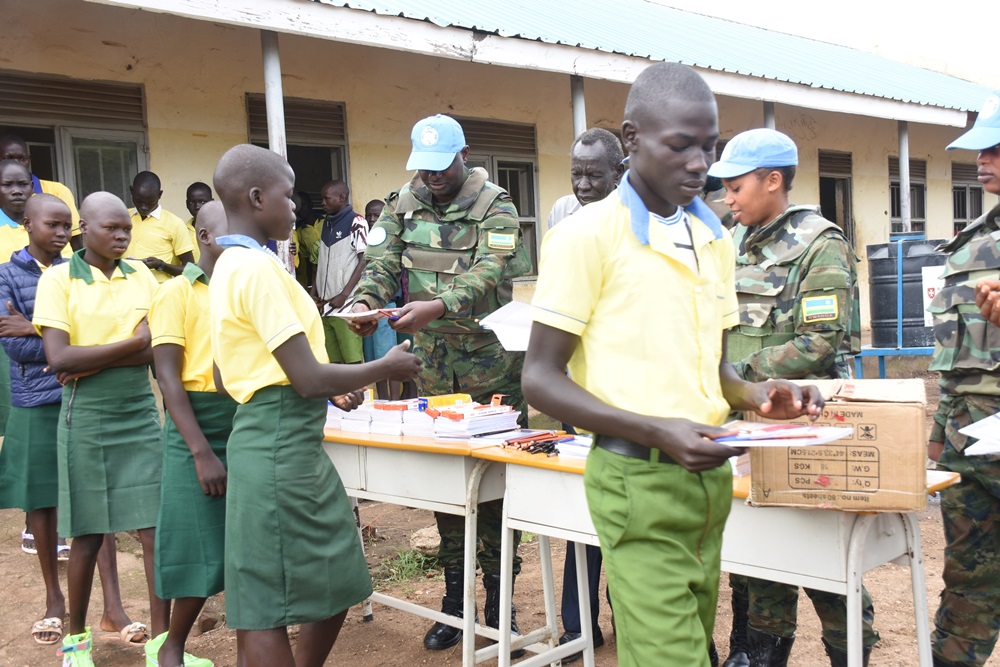
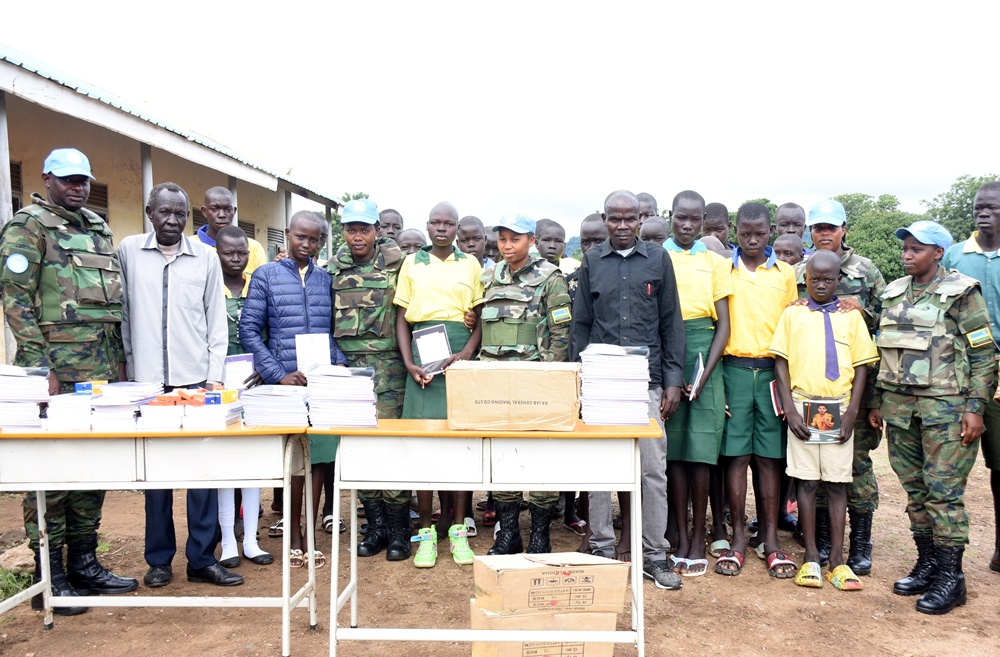
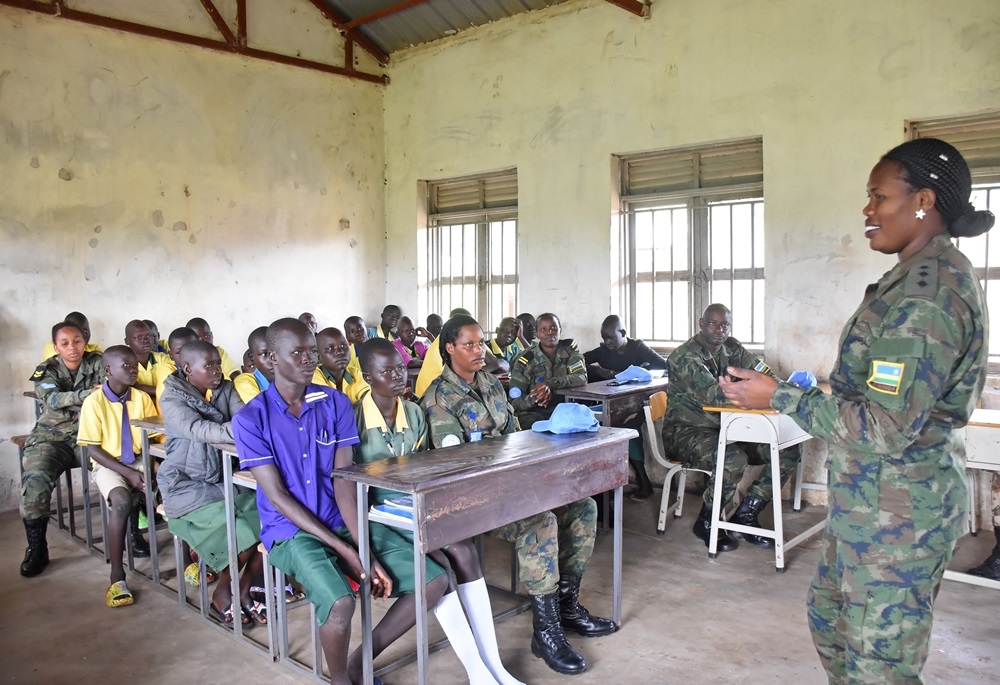
They donated scholastic materials to pupils of Lilia Payam Primary school and trained them on how to improve their hygiene and sanitation to prevent the spread of a variety of diseases.
Major Eugene Munyankera, encouraged the trainees to promote hygiene and sanitation as a foundation of good health, and encouraged them to call upon their colleagues who dropped out of school to rejoin.
Guido Okwana, the Deputy Head Teacher of Lilia Primary School thanked Rwandan peacekeepers for the training and provided support.
Those arrested include one Donathile Bayagambe, 40, a suspected major supplier of cannabis in Nyabihu and surrounding districts, who is also the alleged rightful owner of the 3,000 seized pellets as well as her two employees; Patrick Nizeyimana, 34, and Didier Bizimana, 31, who were delivering the narcotics to retailers.
Chief Inspector of Police (CIP) Mucyo Rukundo, the Western Region Political and Civic Education Officer (RPCEO), said that ANU first arrested Bayagambe’s two employees on Monday, September 5, at about 3:30pm, in Rwandarugari Village, Gasura Cell, Jomba Sector with a sack containing the 3,000 pellets of cannabis.
“Following the arrest of Nizeyimana and Bizimana, who were reported by the residents; they disclosed that they work for Bayagambe, who had given them the narcotics to supply her retailing clients.
Bayagambe was also located and arrested on Tuesday, September 6, in Kivuruga Village, Mwiyanike Cell, Mulinga Sector,” CIP Rukundo said.
The suspects are currently under RIB at Jomba station for further investigations.
“Nyabihu district is one of the transit routes for drug dealers, but the role of the public in identifying these routes and dealers through information sharing continues to yield positive results in breaking chains of supply,” CIP Rukundo said.
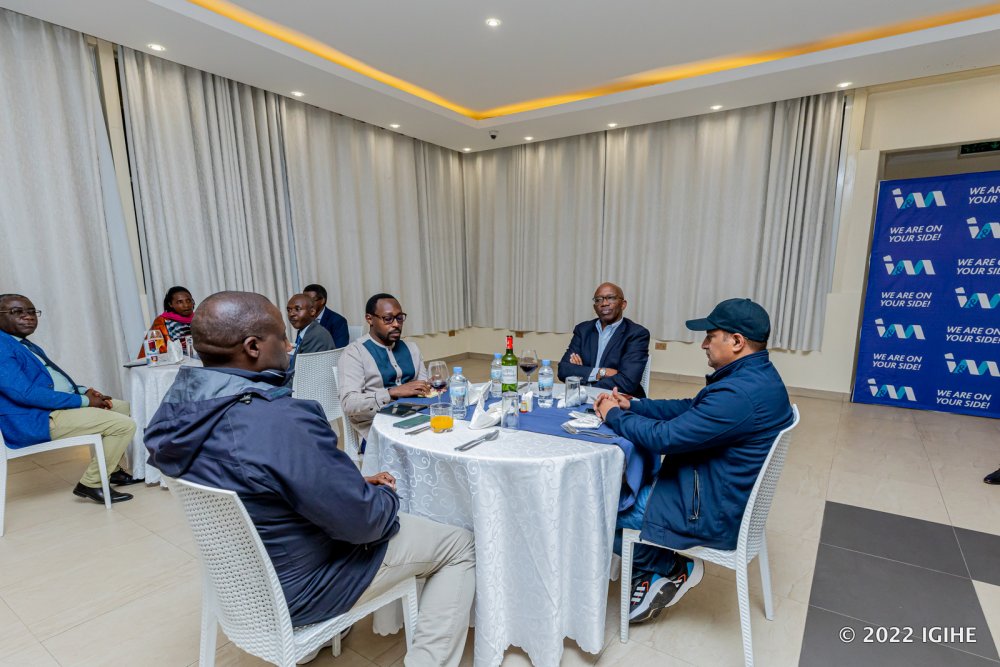
The pledge was made during a recent two-day visit of the bank’s Board Chairman, Bonaventure Niyibizi to interact with clients on 30th and 31st August 2022.
He said that the bank stands ready to work with them to respond to their needs in different aspects of development given that trade, agriculture, tourism and construction are among dominant activities in the districts.
“We want to tell you that I&M Bank is open to work with everyone to grow the economy, advance families’ progress an d the nation at large because we offer different top notch and fast services,” he said.
Clients commended the bank’s services particularly loan disbursement and urged the lender to increase branches and agents operating close to their doorsteps.
Salomon Mbarushimana, the Managing Director of Seed Potatos Fund, a company that multiplies potato seeds revealed that I&M Bank is a great development partner that has been closely working with clients to fix challenges for their businesses to thrive.
Landouard Gahonzire also commended the support he received when he applied for car loan.
“After submitting the application for car loan, the bank processed my request fast and informed me that the funds were transferred to my account. I was surprised because I thought they were calling me for clarification. I liked their customer care and quick services,” he noted.
Musanze District Vice Mayor for Economic Development, Andrew Mpuhwe Rucyahana said that the district has ample opportunities in trade and development which cannot be tapped into without strategic investment.
He extolled I&M Bank Rwanda for its contribution to the district’s development and urged residents to continue working with banks to achieve envisioned progress.
Incorporated in 1963, I&M Bank (Rwanda) Plc is the oldest Bank in Rwanda. It is today one of the leading players in the industry with a strong footprint across the country.
I&M Bank Rwanda offers the full range of personal, business, institutional and corporate banking products throughout its locations. The Bank has been listed on the Rwanda Stock Exchange since March 2017.
The Bank is also a subsidiary of I&M Group Plc, a leading regional financial services group in Eastern Africa with a presence in Kenya, Tanzania, and Uganda as well as a joint venture in Mauritius.
“Congratulations @trussliz on your election as Prime Minister of the UK. We look forward to further strengthening the existing close ties between the UK and Rwanda and wish you success,” Kagame tweeted.
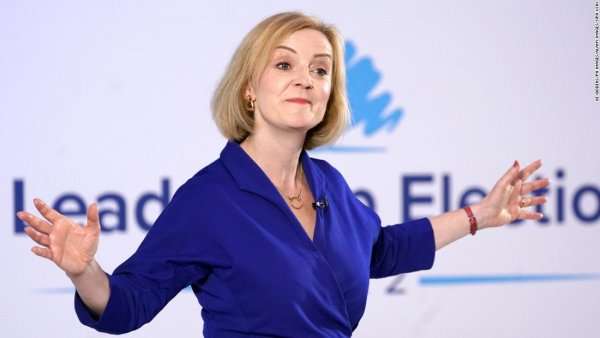
On Tuesday 6th September 2022, Liz Truss was appointed Britain’s next prime minister by Queen Elizabeth II at the Balmoral estate in Scotland, shortly after Boris Johnson met the monarch to formally offer his resignation.
“The Queen received in Audience The Right Honourable Elizabeth Truss MP today and requested her to form a new Administration,” reads part of a statement released by Buckingham Palace.
“Ms Truss accepted Her Majesty’s offer and kissed hands upon her appointment as Prime Minister and First Lord of the Treasury,” adds the statement.
Liz Truss, 47, becomes the 15th UK Prime Minister since Queen Elizabeth II was installed on the throne.
Liz Truss officially takes office one day after Britain’s conservative party’s members elected her as their leader in a tough race against Indian-origin former chancellor Rishi Sunak.
She replaces Boris Johnson who resigned in July this year.
Truss assumes office at time when the UK and Rwanda are working together to implement the Migration and Economic Development Partnership that will see migrants and asylum seekers staying in the country illegally deported to Rwanda.
At AAAC 2022, representatives from over 50 African countries will gather to discuss challenges, best practices and solutions in anesthesia and critical care.
During the event, Gradian will launch K-O2, its newest product alongside manufacturing partners Canon Virginia Inc. (CVI) and product development partner 10XBeta.
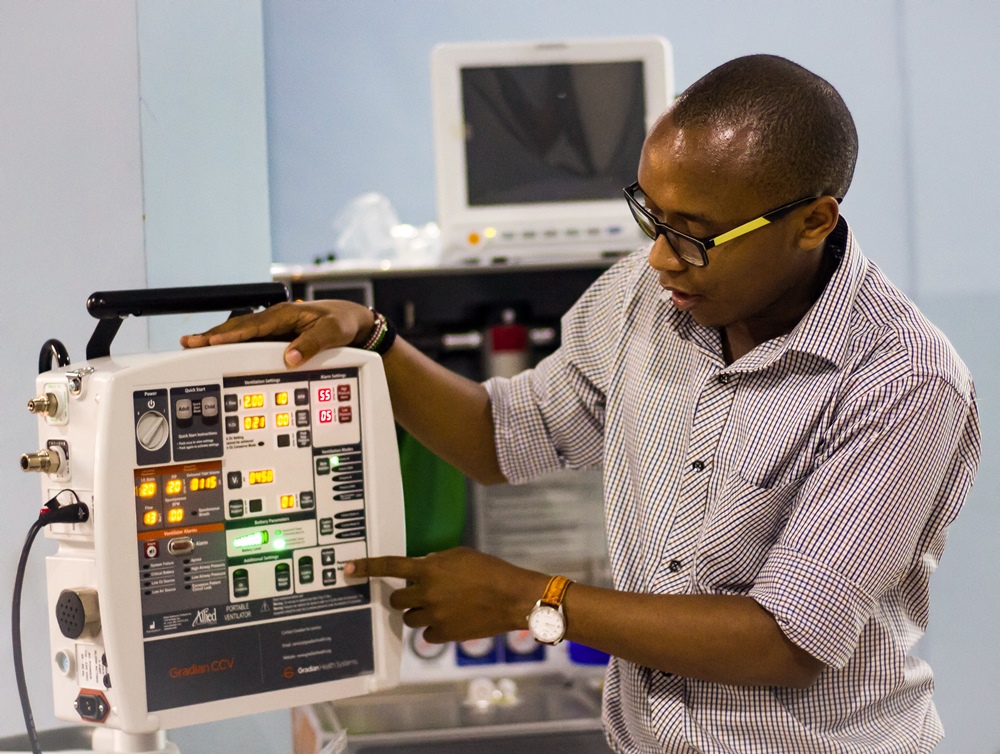
The K-O2 is a point of care oxygen generator and delivery system designed to improve oxygen access across a variety of healthcare facilities, an urgent need exasperated by the ongoing COVID-19 pandemic.
Gradian will also launch a redesigned version of its flagship product, the UAM, an anesthesia machine designed to work in the absence of electricity and medical oxygen.
Commenting on the company’s commitment to improved healthcare; the CEO of Gradian, Lina Sayed said: “We have seen exceptional leadership on the African continent, especially during the last 2+ years of an ongoing global pandemic. We know that our greatest strength is the healthcare providers who have worked endlessly to provide high- quality care to patients, which is why we’re especially excited to launch new anesthesia and oxygen therapy innovations developed based on the feedback of doctors across the continent.”
Gradian will also showcase new anesthesia and ventilation solutions for enhanced delivery of exceptional products to customers, made available through partnerships with world-class companies like Penlon, Amoul, and MTTS.
Throughout the event scheduled between 7th and 10th September 2022 at Kigali Conference and Exhibition Village (KCEV), members of Gradian’s executive, engineering, and clinical training teams will be available for interviews on site.
{{About Gradian Health Systems}}
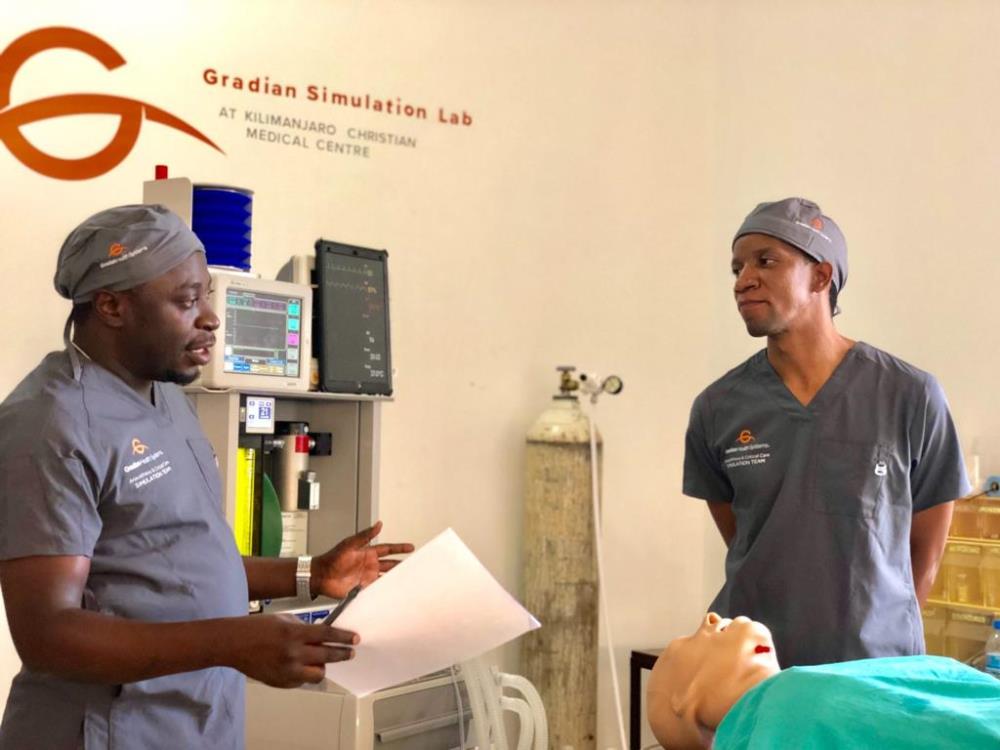
Gradian Health Systems is a nonprofit medical technology company that works in partnership with healthcare providers to design and introduce user-centric solutions that address gaps in technology solutions, training, and customer service.
With innovations in anesthesia, critical care, and oxygen therapy, Gradian has enabled healthcare teams to provide high-quality, safe care to more than 2.2 million patients across Africa, Asia, and Latin America.
Working in partnership with health facilities, national governments, global NGOs, and medical technology partners, Gradian is also revolutionizing the way that life-changing innovations are introduced by ensuring that healthcare providers are fully equipped to use their products with a hands-on training and reliable customer support model.
This collaboration builds on Gradian’s decade plus work developing and supporting medical technology in resource-limited settings and CVI’s 37 years of established manufacturing excellence and medical device expertise.
CVI will assume manufacturing operations for Gradian’s flagship product, the UAM, an anesthesia machine designed to work in the absence of electricity and medical oxygen and establish manufacturing operations for Gradian’s newest product – the K-O2. CVI plans to be in full scale production of both products by the end of 2022.
The UAM and K-O2 are specifically designed to better enable access to anesthesia and oxygen therapy, respectively, by addressing resource constraints that often prevent medical providers from being able to deliver continuous care for patients.
Commenting on the development; Lina Sayed, Chief Executive Officer, Gradian Health Systems said: “We are very excited to partner with Canon.”
“At Gradian, we know how important it is to work with partners whose missions align with ours. Canon’s proven expertise is unmatched – both in manufacturing and as a partner to work side-by-side with us to build a better future in healthcare. We are looking forward to what we hope will be a longstanding relationship with Canon,” she added.
Years of industry and manufacturing experience make both Gradian and CVI uniquely qualified to embark on a collaboration designed to deliver top of the line solutions that enable providers to offer premier care for their patients. By combining their excellence in manufacturing and product quality, the two organizations aim to create world-class products that address some of the biggest healthcare challenges to date.
“CVI and Gradian share many of the same values – a commitment to our customers, quality, and efficient manufacturing services to name a few,” said Ronald Kurz, Sr. Director and General Manager, Business Operations Group / Medical, Canon Virginia, Inc.
“Our corporate philosophy, is driven by the Japanese principle, ‘Kyosei,’ the concept that all people, regardless of race, religion, or culture, are harmoniously living and working together into the future,’ and we are proud to be working with a partner who is equally committed to this mission. We pride ourselves on providing exceptional service and resources to our partners and are very excited to see what the future holds for healthcare world-wide.”
Today’s announcement marks the beginning of a relationship that aims to build on both companies’ commitment to addressing inequities in healthcare and helping to ensure that everyone has access to the best health services possible.
{{About Gradian Health Systems}}
Gradian Health Systems is a nonprofit medical technology company that works in partnership with healthcare providers to design and introduce user-centric solutions that address gaps in technology solutions, training, and customer service.
With innovations in anesthesia, critical care, and oxygen therapy, Gradian has enabled healthcare teams to provide high-quality, safe care to more than 2.2 million patients across Africa, Asia, and Latin America.
Working in partnership with health facilities, national governments, global NGOs, and medical technology partners, Gradian is also revolutionizing the way that life-changing innovations are introduced by ensuring that healthcare providers are fully equipped to use their products with a hands-on training and reliable customer support model.
Learn more at: [gradianhealth.org->https://www.gradianhealth.org/]
{{About Canon Virginia, Inc.}}
Located in Newport News, Va., Canon Virginia, Inc. serves as the Canon manufacturing, engineering, recycling, and technical support center for the Americas.
Canon Virginia produces new products using advanced manufacturing methodologies while also serving as a factory service center providing expert customer service in the repair and refurbishment of Canon products.
Canon Virginia’s manufacturing services extend to injection mold making, contract manufacturing, medical contract manufacturing and aftermarket services.
For more information, call 1-866-99-CANON or visit https://www.cvi.canon.com/manufacturing- services/.
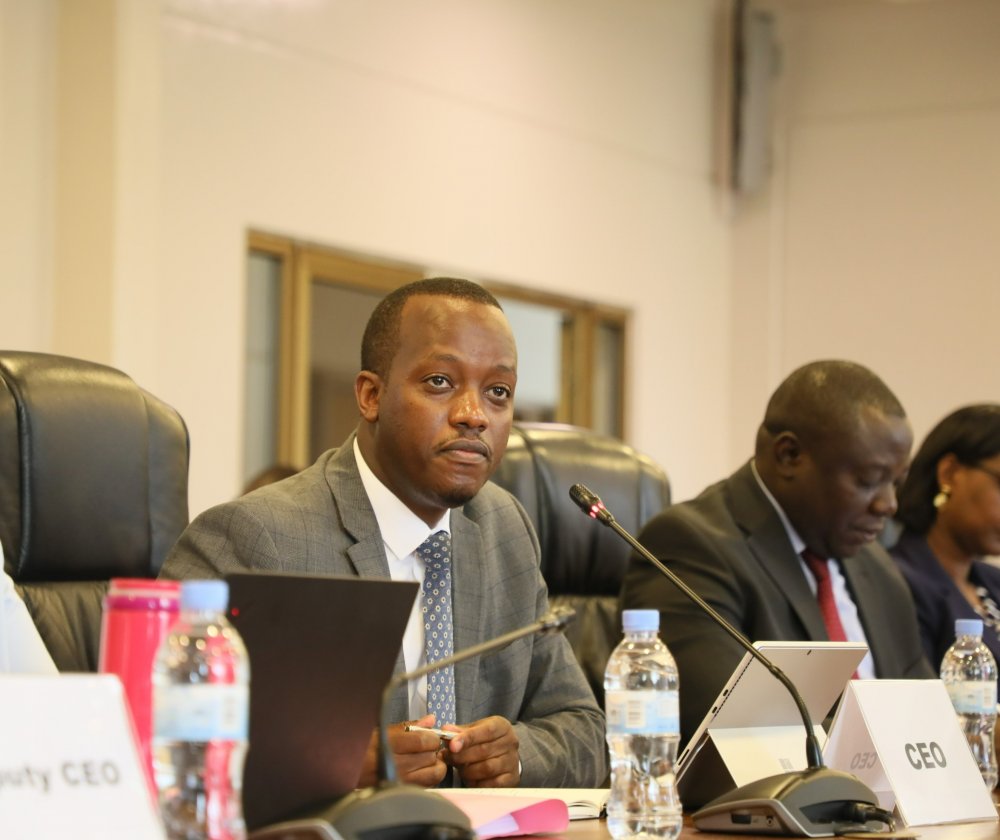
The institution’s management appeared before the committee as the hearing from government institutions to provide explanations on mistakes pointed out by the Auditor General (AG)’s report in the fiscal year 2020/2021 began on Monday 5th September 2022.
The pieces of land in question were bought at Rwf137 billion. The AG report indicates that the land has been idle for ten years where RSSB spent more Rwf394 million on it.
The expenses include taxes and the cost associated with its management.
The Director General of RSSB, Regis Rugemanshuro has revealed that the institution bought the pieces of land for future use because the value of land increases overtime.
“The pieces of land were bought for future projects. If the land is not bought early for future use, planning to build houses in the next 15 years would not be lucrative enough. However, buying the land earlier helps to mitigate risks of high cost it in the future,” he said.
The Chairperson of PAC, Valens Muhakwa questioned RSSB’s decision to buy plots of land without a clear plan for development.
“The institution should be far-sighted. You have the land but don’t know how it will be exploited. This is the problem being discussed. This is done by citizens trying to secure the future. Should RSSB be in a land banking race with citizens?”
Reacting to the concern, Rugemanshuro said: “What you say is true. There was no plan for all bought plots of land to determine whether they will be developed for business or something else. However, considering designed master plans, RSSB bought them in strategic locations ideal for different activities. In some instances, we handed over some plots of land unsuitable for our study plan.”
Parliamentarian (MP), Jean René Niyorurema also wondered how the institution can buy the land to be kept for 10 years yet the government informs the general public that those whose land remains undeveloped will be confiscated as per legal provisions.
“Keeping the land is not the sole plan. We also work with available investors willing to develop the land. Besides, we buy new land for clear reasons,” replied Rugemanshuro.
MP Jean Claude Ntezimana maintained that buying land before prices go high is not a bad idea but insisted that RSSB has what it takes to obtain information regarding the master plan for a particular area.
“For instance, you push forward public interest reasons while expropriating residents in Kiyovu cy’Abakene. It becomes meaningless for a citizen who passes by the area and realizes that the land is still idle. You have to buy pieces of land knowing better that you won’t face losses,” he said.
MP Christine Bakundufite said that RSSB was wrong to consider the Rwf137 billion worth land project because ‘it would have generated profits from other businesses’.
“This report shows that you have spent Rwf394 million. The longer it takes to develop the land, the more you increase losses,” she said.
PAC also indicated that the land owned by RSSB across the country is exploited at 3%.
RSSB explained that efforts are underway to set out a clear plan with which specific projects suitable for these pieces of land and their implementation timeframe will be determined not later than 2023 to develop the land in line with national development blueprint.
The institution also revealed that its land located in areas where the projects cannot materialize will be sold.
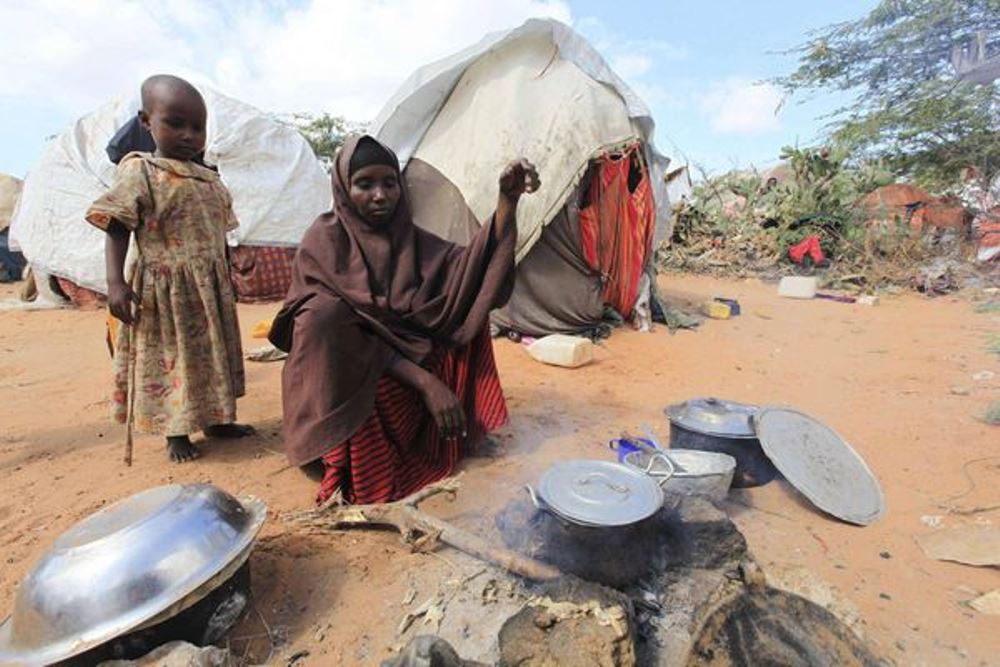
Martin Griffiths, under-secretary-general for Humanitarian Affairs and Emergency Relief Coordinator, told a news conference in Mogadishu, the capital of Somalia, that the severe drought ravaging the country is likely to push parts of the country into famine by the end of 2022.
“Famine is at the door, and today we are receiving a final warning. I have been shocked to my core these past few days by the level of pain and suffering we see so many Somalis enduring,” Griffiths said at the end of his five-day visit to Somalia.
The Somalia Food Security and Nutrition Analysis report released Monday shows concrete indications that famine will occur in two areas in the Bay region (Baidoa and Burhakaba districts) in south-central Somalia between October and December.
According to the report, with five consecutive seasons of poor rainfall, exhausted coping capacities of affected communities, depletion of livelihood assets, and other exacerbating factors, humanitarian assistance will be required to address high levels of needs beyond December 2022.
“I repeat: This is a final warning to all of us. The situation and trends resemble those seen in the 2010-2011, in that crisis. Except now they are worse,” Griffiths said.
He said the unprecedented failure of four consecutive rainy seasons, decades of conflict, mass displacement, and severe economic issues are pushing many people to the brink of famine.
“And these conditions are likely to last through to at least March 2023,” he said, pointing out that Baidoa is the epicenter of the humanitarian crisis in Somalia.
“It is not the only place with needs, but it is one of them. In camps for the displaced people, we saw extreme hunger. In the hospital in Baidoa, we had the unenviable privilege of seeing children so malnourished that they could barely speak,” the UN relief chief said.
The UN said the Bay region was also the epicenter of the humanitarian crisis in 2017 when severe drought led to agropastoral and displaced populations facing a risk of famine, which was only averted due to timely, robust, and sustained humanitarian assistance.
Griffiths said 1.5 million children across Somalia will face acute malnutrition by October if the current course remains. “The drought, the worst in four decades, is forecast to continue. This is, in those often-used words, and no more true than here, a humanitarian catastrophe. We know that the needs will grow,” he said.
In the runoff, Truss, 47, beat former Chancellor of the Exchequer Rishi Sunak by winning approximately 57.4 percent of the Conservative Party members’ vote, Graham Brady, chair of the party’s backbench 1922 Committee, announced Monday.
The voting took place a month after Johnson was forced to step down following an avalanche of ministerial resignations over his scandal-plagued leadership.
The formal handover is scheduled for Tuesday after Truss and Johnson meet Queen Elizabeth II, who is staying at her Balmoral estate in Scotland.
Truss will be Britain’s third female prime minister after Margaret Thatcher and Theresa May. She faces the immediate tasks of tackling the worsening cost-of-living crisis and handling a Brexit arrangement about Northern Ireland to avoid antagonizing the EU.
“I will deliver a bold plan to cut taxes and grow our economy. I will deliver on the energy crisis, dealing with people’s energy bills, but also dealing with the long-term issues we have on energy supply,” she said in her victory speech after the result was announced.
Though congratulating on Truss’s win, leader of the main opposition Labour Party Keir Starmer said in his tweets,” After 12 years of the Tories all we have to show for it is low wages, high prices, and a Tory cost of living crisis. Only Labour can deliver the fresh start our country needs.”
{{Cost of living crisis}}
Since the winter of 2021, Britain’s inflation has kept rising and successively hit new highs. Official data showed the Consumer Prices Index rose by 10.1 percent in July, far above the 2-percent target set by the Bank of England.
The central bank projected last month that higher energy prices would push Britain’s inflation to 13 percent in the fourth quarter of the year and inflation is likely to remain at very elevated levels throughout much of 2023.
The country’s energy regulator said in late August that the energy price cap will rise by 80 percent to 3,549 pounds (about 4,077 U.S. dollars) per year for an average household from October.
As millions of people in Britain face the prospect of escalating bills, Keith Baker, a research fellow in fuel poverty and energy policy at Glasgow Caledonian University, told Xinhua that the country could face its worst peacetime crisis since the General Strike of 1926. There has been a summer of disruption amid strikes by railway and airlines workers, and unions across sectors are threatening “waves of industrial action” in the coming weeks.
“We are now into really quite scary, unknown territory. We don’t know how much mortgage rates will go up, we don’t know how much food prices will go up, but we are seeing a trend that is certainly heading in that direction, and there’s no sign of it changing. In fact, there’s every sign it’s going to get worse,” said Baker.
Stuart Wilks-Heeg, a political expert at the University of Liverpool, told Xinhua that Truss as prime minister will probably face “the biggest set of policy challenges any prime minister has faced since at least the 1970s.”
Truss has campaigned to cut taxes, deregulation and prioritize economic growth, but experts doubt that these will be effective enough, given the severity of the situation. The Bank of England forecast last month that Britain will enter a five-quarter recession beginning in the final three months of 2022.
“She’s coming into a context which is almost unprecedented in modern British politics. It’s an extremely challenging situation. She hasn’t shown to me that she’s got the answers to the problems that we face,” Wilks-Heeg said.
Wilks-Heeg added that the leadership race took up too much time that could have been used to alleviate the situation.
“We’ve wasted a lot of time, so nothing has really happened over the summer to mitigate rising energy costs. The crisis will be looming even more urgently because we’re getting closer and closer to the winter. People’s fuel bills will already be going up, (while) inflation continues to rise,” he noted.
{{Northern Ireland Protocol }}
A dispute over the Northern Ireland Protocol — the rules governing post-Brexit trading arrangements for Northern Ireland — has strained Britain’s relations with the EU, stoking worries of a trade war if Truss presses ahead with her controversial bill to rewrite the protocol.
The Northern Ireland Protocol is a trade solution agreed by London and Brussels to prevent a hard border between Northern Ireland and the neighboring Republic of Ireland following Brexit.
Under the protocol, Northern Ireland is part of British customs territory but is subject to the EU’s customs code, value-added tax (VAT) rules and single market rules for goods. However, a de facto Irish Sea border was thus created between the British mainland and Northern Ireland, meaning goods transported to and from Northern Ireland are subject to border controls.
Northern Ireland’s pro-Brexit Democratic Unionist Party has demanded the removal or replacement of the protocol as a precondition for it to sit in the assembly and form a devolved government.
The EU warned Truss last week that they will not participate in talks with Britain over reforms to the Northern Ireland Protocol unless she takes the bill off the table. However, she is reportedly planning to override the protocol even before the bill passes through British parliament by activating Article 16, the agreement’s emergency mechanism, when she becomes prime minister.
{{Premiership prospect}}
These daunting challenges, if not properly tackled, could torpedo Truss’s premiership, some experts cautioned.
“More broadly, the country is in a very difficult situation. It’s not just the energy crisis. Almost every public service is struggling. There are strikes in all kinds of industries. The potential for this to overwhelm Liz Truss is very clear,” Wilks-Heeg said.
Wilks-Heeg added that Johnson might attempt to make a comeback should Truss’s leadership go wrong.
“He (Johnson) could well be successful in that, given the lack of obvious other contenders and given his obvious continuing popularity within the party,” he said.
However, Professor Iain Begg from the London School of Economics and Political Science believed the likelihood of Truss being ousted before the next general election in 2024 is low.
“I’ve seen suggestions that she might face a very rapid leadership challenge. I rather doubt it. I don’t think the Conservative Party wants to go through another convulsion, knowing how close they are to a general election. So she’s probably safe until the general election,” Begg said.
The main opposition Labour Party widened its lead in opinion polls over the Conservative Party as a summer of infighting caused damage to the Tories.
Begg added that Truss might be tempted to call an earlier general election if she gets a poll bounce after taking over.
“But it’s a perilous thing to do, as Theresa May found to her cost in 2017. She started off with a huge polling majority, and then she squandered it by ill-advised policies, but also by a lackluster campaign,” he said.
Speaking at a press briefing after a videoconference with German Chancellor Olaf Scholz, Macron said France is ready to deliver more gas to Germany while the latter will offer more electricity to France, if the current energy crisis persists in winter.
“We are going to finalize the gas connections in order to be able to deliver gas to Germany…It (Germany) will be ready to produce more electricity to bring to us in extreme situations,” Macron said.
The French president said that he was in favor of solidarity measures at the European level to deal with the current energy crisis.
“We are in favor of common gas purchasing practices that will make it possible to buy cheaper,” he explained.
However, he said there was “no need” for a gas pipeline linking France and Spain.
Concerning the high energy prices in Europe, Macron proposed to set up control mechanisms for speculative operations at the European level.
Days ahead of a European Union (EU) energy ministers’ meeting, Macron said that he supports a price cap on gas purchased from Russia at the EU level.
Macron assured his countrymen that France is not in a situation for energy rationing, but called on people to limit heating to 19 degrees Celsius to save energy.
“If we collectively know how to behave more soberly and save energy everywhere, then there will be no rationing or cuts,” he stressed.
On Friday, Macron chaired a Defense Council meeting on the energy crisis. French Minister for Energy Transition Agnes Pannier-Runacher said after the meeting that France’s gas reserves were 92 percent full in preparation for possible shortages this winter.
According to the minister, 32 of the country’s fleet of 56 nuclear reactors are currently offline for routine maintenance, but French multinational electric utility company EDF has committed to restarting all of them for this winter.